The Upside Down Life #4 – Blessed Are Those Who Mourn

I. Intro

Matthew 5:4; Hebrews 12:14-17

Today we will continue in our series The Upside Down Life, looking at the first 16 verses of Matt 5.  Today we will do some review work and unpack a few concepts in Matt 5 and then we will move into Heb 12.

(Review) Both Gene and Chris did an excellent job defining the words “blessed” (and what it means to be “poor.”)  Those notes are available here on the blog…

Review “poor in spirit”

  • Two weeks ago Chris said being “poor in spirit” is seeing our desperate need for God.
  • And then last week Gene said some pretty heavy things…
    • He said that as a church we are to be thankful that SBF has been privileged to go through all the struggles we have. God must be thrilled that there is somebody here who is broken and hungry for more… (Heavy words…a perfect message to begin our week-long fast as a church).
    • Gene went on to say SBF has lost pastors, people, programs, reputation, visible success, and a downward trend in the bank account…  [God comforts the afflicted – and afflicts the comfortable]
    • Your church is flat broke, you do not have it all together, you do not have it all figured out, and you cannot muscle, or buy, your way out of this one.
    • Blessed are those bankrupt in spirit, because they are entering the eternal reserves of the reservoirs of the God of true riches.
    • As a church we’ve been taken out to the woodshed…we’ve been spanked. Are you glad yet?  [I have a tremendous amount of respect for those of you who have stayed.]

Where do we go from “bankrupt in spirit”?  We mourn…

Today, we will look at 5:4 “Blessed are those who mourn for they will be comforted”

Once we see and acknowledge our deep spiritual poverty, it gives way to a deep and utter repentance.  (There’s a difference between repentance and “relentance.”)

There is a transforming grief, or repentance, that surfaces – not only for our own lives, but also for the injustice, greed, and suffering that grips our world.  (“Meanwhile we groan.”)

I’ve titled the message this morning, The Unlikely Route To Joy (borrowed from a chapter heading in Dan Allender’s’ book Wounded Heart).

  • In order to become rich, we need to acknowledge and own our poverty.
  • And in order to know “joy inexpressible and full of glory” (1 Pet 1:8) we must mourn.  This is the essence of living the upside down life (or counterintuitive).

I would like us to refer to mourning as a lifestyle of repentance.

For those of us who have read Pete Scazzero’s book, The Emotionally Healthy Church, we remember that the 3rd principle of the EHC is to live in brokenness and vulnerability.

This means living and leading out of our failure and pain, questions and struggles…[1]

This is how Paul led.  In 2 Cor 12 – Paul speaks of being caught-up to the third heaven – and then he shares about his thorn in the flesh“a messenger of Satan to torment me—to keep me from exalting myself! 8 Concerning this I implored the Lord three times that it might leave me. 9 And He has said to me, “My grace is sufficient for you, for power is perfected in weakness.”

Dr. Dan Allender – “An about face movement from denial and rebellion to truth and surrender… Repentance involves the response of humble hunger, bold movement, and wild celebration when faced with the reality of our fallen state and the grace of God…It is a shift in perspective as to where life is found…It is melting into the warm arms of God, received when it would be so understandable to be spurned.” (Wounded Heart)

**Mourning, or lifestyle repentance, is living WITH our failures, but not UNDER them.

II. BODY

With that said please turn to Hebrews 12…

If we had to boil down the book of Hebrews to a one-word description, the word would be perseverance. It is written specifically for a group of Christians who were about to quit.

Vs. 14-17 are full of some very specific admonitions to help us with engaging in a lifestyle of repentance…

14Pursue peace with all [people], and the sanctification without which no one will see [to perceive, to know, to become acquainted with by experience] the Lord.

15See to it [Looking diligently – episkapao] that no one comes short of the grace of God; that no root of bitterness springing up causes trouble, and by it many be defiled [stained];

16that there be no immoral or godless person like Esau, who sold his own birthright for a single meal.

17For you know that even afterwards, when he desired to inherit the blessing, he was rejected, for he found no place for repentance [NIV – he could bring about no change of mind], though he sought for it with tears.

This is a heavy passage: Esau found no place for repentance – even though he sought for it with tears.  (What are we supposed to do with this text?)

This passage offers us some insight into the reasons for Esau’s inability to come to a place of true repentance – and I believe it will help us to consider some possible issues that may be keeping us from fully knowing the privilege of repentance.

Listed in this passage are (at least) 6 admonitions that will move us toward embracing a lifestyle of true repentance…

1.  Pursue peace with all people.

Pursue: to run swiftly [NIV –  Make every effort]

Peace: from a primary verb eirēnē (harmonized relationships)

“If therefore you are presenting your offering at the altar, and there remember that your brother has something against you, leave your offering there before the altar, and go your way; first be reconciled to your brother, and then come and present your offering.”  Matthew 5:23,24 (NAS)

Roms 12:18 – “If possible, so far as it depends on you, be at peace with all men.”

(In a few weeks we’ll be talking about Mat 5:9 – Peacemaker vs. peacekeeper.)

I once flew from Reno, NV to Tulsa, OK and then rented a car and drove 3 hours just to ask someone’s forgiveness after reading this passage and taking it to heart.

2.  Pursue sanctification.

Sanctification: hallowed [NIV – Make every effort… to be holy] The Lord’s Prayer (Mat 6) hagiasmos (Heb 12 – noun), hagiazō (Mat 6 – verb)

We have positional sanctification and progressive sanctification

The Gospel Is for Believers.  We Christians need to hear the gospel all of our lives because it is the gospel that continues to remind us that our day-to-day acceptance with the Father is not based on what we do for God but on remembering what Christ did for us.  (That is what communion is all about…)

**Esau was rejected by God because he steadfastly refused to serve the purpose of God and instead served his lust for the immediate and the tangible.

3.  Pursue grace.

“See to it that no one comes short of the grace of God.” (v.15)

Grace: All that God is lavishly poured into you. If God has acted lavishly toward you, could you not be lavish to others?  Or yourself??

Jerry Bridges, in his masterpiece says, “The idea portrayed here is analogous to the ocean waves crashing upon the beach. One wave has hardly disappeared before another arrives.[2]

Pursue the truth in love (Eph 4:15).

“See to it that…no root of bitterness springing up causes trouble, and by it many be defiled.”  (v.15)

Notice the word, “many.”

Like a small root that grows into a great tree, bitterness springs up in our hearts and overshadows even our deepest relationships.

A “bitter root” comes when we allow disappointment or expectations to grow into resentment, or when we nurse grudges over past hurts.

Eph 4:15: But speaking the truth in love we are to grow up…” In my view this passage speaks to the epitome of what it means to be spiritually and emotionally healthy

5.  Pursue purity.

“See to it that…there be no immoral…person like Esau.” (v.16)

pornos – male prostitute.  Again, Esau steadfastly refused to humble himself to serve the purpose of God.  Instead he served his lust for the immediate and the tangible.

6.  Pursue God.

Instead of being godless (or, “unhallowed, profane” – Vine’s]

Esau found no place for repentance (metanoia), though he sought for it with tears.

We usually associate tears with repentance.  And it’s true that tears very often accompany true repentance.  But here we have the instance of Esau crying for repentance but not finding it.  Why?  Esau was in “relentance,” not true repentance.

III.CONCLUSION

“Repent therefore and return, that your sins may be wiped away, in order that times of refreshing may come from the presence of the Lord.”   Acts 3:19 (NAS)

Nothing will cause a renewed soul to hate sin so much as a realization of God’s grace; nothing will move him to mourn so genuinely over his sins as a sense of Christ’s dying love. It is that which breaks his heart: the realization that there is so much in him that is opposed to Christ. But a life of holiness is a life of faith (the heart turning daily to Christ), and the fruits of faith are genuine repentance, true humility, praising God for His infinite patience and mercy, pantings after conformity to Christ.  —The Doctrine of Sanctification by A.W. Pink.

[1] EHC: 110.

[2] Jerry Bridges, Transforming Grace.

Fasting As A Form of Worship

The leaders at Southside Bible Fellowship are calling for a church-wide fast from (Monday) March 26th through our Concert of Prayer (4-6pm) on Sunday April 1st.  Directly after our Concert of Prayer we will collectively break our fast with a meal of soup and bread.  Please keep reading to consider your options…

“I humbled my soul with fasting”  (Psalm 35:13b)

In Psalm 35 King David is crying out in agonized intercession to be rescued from his enemies. Part of David’s prayer is that he has bowed-down his soul with fasting.  It is widely accepted that our soul consists of our intellect, will, and emotions.  According to Matthew 6, Isaiah 58, and Psalm 35 the overall objective of fasting is to humble our soul (or to cause our intellect, will, and emotions to bow down) so that the desires and the purposes of God can become more prominent!  When we deny our appetites and soulish longings and turn to the Lord through worship, Christian meditation, supplication, and intercession there is a supernatural grace released upon us to see God’s heart and will.  The idea is to set aside regular times during a fast in order to seek the Lord and cry out for His kingdom to increase and for His will to be done – IN us and THROUGH us.

Matthew 6 describes and instructs us in three primary spiritual disciplines.  The chapter opens by encouraging us not to practice our “acts of righteousness” publicly; and if we do, we shall have no reward from our Father in heaven.  The three spiritual disciplines are giving, prayer (we are to pray secretly, sincerely, and specifically), and fasting.

Isaiah 58 is probably the best and most concise instruction on the spiritual discipline of fasting in the Bible.  Verse six lists the four reasons for fasting:  “To loosen the bonds of wickedness,”  “To undo the bands of the yoke,”  “To let the oppressed go free,” and to “break every yoke.”  Verses 8-14 contain some amazing promises concerning the fruits, or benefits, of fasting.

A simple definition for fasting would be voluntary abstinence of our appetites and our soulish longings for spiritual reasons.  The Bible speaks of it not as an option but as an expected and regularly practiced spiritual discipline.  The following are some of the purposes for fasting; these also convey some of the benefits of fasting:

1.   Fasting will sharpen our focus in prayer.  (After we get beyond the initial discomfort caused by our various addictions such as coffee, sugar, etc.)

2.   Fasting will cause us to be more sensitive to God’s guidance in our lives.

3.   Fasting is a sign of humble repentance and expressing to God our desire to be responsively obedient to His will and direction for our lives – both individually and as a church.

4.   It was common in biblical times to fast when the need for protection and/or deliverance was great.  An excellent example is when Queen Esther called for her people to fast with her when she appealed to the king to spare the Jews (see Esther 4:16).

5.   As David articulated in Psalm 35, fasting can be an expression of simple humility before God.

6.   Fasting, or the servant-leaders calling for a fast, can be the result of God’s people seeing a need and expressing their concern.  When Nehemiah heard about the great distress, reproach, and the broken down walls in Jerusalem the Bible tells us that he sat down and wept and mourned for days, and then fasted and prayed until the Lord revealed His plans (see Nehemiah 1:3-4).

7.   When Jesus fasted for forty days in the wilderness after His baptism He was strengthened spiritually against the strong temptations of Satan.  In fact, in Luke 4:14 it says that, “Jesus returned to Galilee in the power of the Spirit(emphasis added).

8.   Fasting can be simply an act of worship and adoration with no other purpose than to ascribe glory and honor to God.

There are many different ways to fast.  We can fast food and just drink water or juice, we can eat vegetables and/or fruit only (this has been called a “Daniel Fast,” see Daniel 1:8-17), we can choose not to eat any sugar or carbohydrates, we can fast one or two meals a day, we can fast from sun-up to sun-down.  Paul encourages married couples to occasionally fast sexual intercourse, “that you may devote yourselves to prayer…” (1 Corinthians 7:5).  We can fast television or the internet and pray instead!  Before we fast it is important to seek the Lord regarding what would be appropriate.

We are in a season of transition at Southside Bible Fellowship. There are several excellent reasons for us to embark on a corporate fast:  Over the last 2-3 years there has been relational tearing and woundedness. We want to fast and ask God to show us how to specifically engage in the ministry of reconciliation with those who have been hurt. We want to identify and “own” our past dysfunctions as a church — and repent and forsake them. We want to fast and ask God to once again visit us with salvations.  We want to fast for a fresh understanding of what it means to delight in God – as well as what it means for God to delight in us.  In addition, prayerfully consider any supplemental personal and family needs so that you will fast with a strong sense of God’s heart – asking for His “kingdom to come and His will to be done” IN you and THROUGH you.  May the Lord strengthen you and encourage you through a mighty demonstration of His power and might!!

The Upside Down Life (#1) – An Indepth Look At Matthew 5:1-16

The Way In Is the Way On.  An Overview of the Beatitudes…

I. INTRO

I have been serving here at SBF for 11 months now – and I can tell you that everything we have been studying up to this point has been preparing us for the study we are about to embark on…

We will take our time and work through the first 16 verses of Mathew 5.  These are also the first 16 verses of the most famous sermon of all time – The Sermon on the Mount (SOTM), which consist of chapters 5-7.  They are all red-letter verses, in other words these are the words of Jesus.

Here’s what John Stott the late pastor, author, and missiologist has said about the SOTM:

“The Sermon on the Mount is probably the best-known part of the teaching of Jesus, though arguably it is the least understood, and certainly it is the least obeyed. It is the nearest thing to a manifesto that he ever uttered, for it is his own description of what he wanted his followers to be and to do.”[1]

Now, reading the SOTM only takes about 10 minutes so it’s widely thought that Matthew is giving us the “Cliff Notes” version (i.e., highlights).

We need to make some theological distinctions as we lean into the Beatitudes and the SOTM…

Some of the theological roots of SBF include what’s known as a dispensational[2] view of the Bible.

Dispensationalists and most of the rest of Evangelicalism would differ on the interpretation and application of the Beatitudes (and the SOTM).

Classical dispensationalism would argue that the Beatitudes (and the SOTM) are not gospel but pertain to life in the millennial kingdom after to the second coming of Christ.[3] (If you have a Scofield Study Bible – that would emphasize the classical view of dispensationalism.)

It should be noted that there are more moderate views of dispensationalism.  If you have a Ryrie Study Bible – he’s a more moderate dispensationalist.  Yet he would still believe that primary fulfillment of the Beatitudes (and the SOTM) are in the millennial kingdom.[4] (Popular contemporary dispensationalists include John MacArthur and Charles Swindoll.  I have also heard that John MacArthur has become more moderate in his dispensationalism, but I don’t have first hand knowledge of that.  Charles Swindoll would also be considered a more moderate dispensationalist.)

The basic evangelical approach is to recognize that the kingdom of God has come in the person and work of Jesus. (Mk 1:15: “kingdom of God is at hand; repent and believe in the gospel). This “kingdom now” theological perspective teaches that Jesus established the kingdom of God (KOG) at His first coming and will consummate the KOG at His second coming – and we live in the age (or dispensation) between the two.  One theologian, George Ladd, has said we live in the presence of the future – between the already and the not yet.[5]

So, how will this affect our study of the Beatitudes?  I believe the Beatitudes (and the SOTM) ARE for today – and that they are the means to allowing the gospel to be worked into our lives – and then through our lives to others.

Here’s how I would say it: “The Gospel is not advice, it is news.”  (Jared Wilson, Gospel Wakefulness, Crossway 2011: 188.)  It is the ultimate Good News.  I would suggest to you that Sunday Services are not primarily the place to give advice… Gospel-centered (or Christ centered) change (i.e., sanctification) is rooted first and foremost in remembrance. We are to remind one another primarily of what Christ Jesus has done, not what we must do.

We cannot commend what we do not cherish.  -John Piper

And the essence of Christian maturity is when the Gospel – or, what Christ has done — gets worked IN – and then THROUGH our lives – which is what I’d like to spend our remaining time considering – and this will be the main intent of our series.

Today we will take a look at the Beatitudes.  Allow me to offer a few introductory thoughts.

II. BODY

Contained in the Beatitudes are eight qualities that characterize the life of Jesus Christ, and therefore, through conversion, they begin to characterize our life in Jesus Christ.  Jesus calls us to follow him, surrender to Him, and to depend upon His strength and power.

The word beatitude comes from the Latin word meaning “blessed.”

More specifically the word means exalted joy, or true happiness. (Joy is not always exuberant, but can also be described as calm delight in even the most adverse circumstances.  Joy fueled Paul’s contentmentPhil 4:11.)

With the beatitudes, Jesus dives into our innermost being probing the heart and raising the question of motive.  (This is why, at face value, it’s harder to be a Christian than Jewish…)

What made Jesus a threat to everyone and the reason He was eventually killed was that in His encounters with people (particularly the religious leaders), He exposes what they were on the inside.  Some people find it liberating – others hate it.  (Mat 23:27: hypocrites and whitewashed tombs.)

The Beatitudes, I have come to see, is our surrendered response to the Gospel.  I see the Beatitudes as a step-by-step spiritual formation process that moves us toward spiritual depth and maturity.  This becomes cyclical as we grow deeper and deeper in our faith.  The Beatitudes become the outworking of the Gospel IN and THROUGH our lives.

1. Blessed are the poor in spirit…

“You’re blessed when you’re at the end of your rope.  With less of you there is more of God and his rule.” (Petersen – MSG)

Another translation renders this verse, “Happy are those who know their need for God.” (JBP)

What does it mean to be “poor in spirit”?  A desperateness of soul that is weary of living in it’s own strength and longs for God’s mercy and grace to come and refresh the soul.  In a word, it is DESPERATION.

Prodigal Sons (Lk 15:11-32) The younger prodigal came to the end of himself (v.17) and though he had no idea of the Father’s love, made his way home.

In the recovery movement this would be similar to steps 1 & 2:

  • Step 1 – We admitted we were powerless over our addiction – that our lives had become unmanageable.
  • Step 2 – Came to believe that a Power greater than ourselves could restore us to sanity.

2. Blessed are those who mourn…

I have a river of sin in my life – with 3 primary tributaries…

  1. Original sin (Adam & Eve traded the presence of God for the knowledge of God – and that’s been our core tendency ever since…).
  2. Family of origin issues. (We all have negative traits and generational sin patterns that we bring into our Christian experience.  Are you in touch with yours?)
  3. My own dumb choices.

As we are honest about the sin that has infected us there will be a transforming grief and accompanying repentance, that surfaces – not only for our own lives, but also for the injustice, greed, lust, and suffering that grips our world.

I want to own my sin everyday.[6]

This is where the upside down life comes into play.  The Beatitudes are counterintuitive (paradox: seeming contradiction).  We go down to go up; death precedes resurrection; we get to joy by traveling through grief.  Our soul wants to find a way around grief, but God says, “No, you must travel through grief – and the good news is, He says, “I’ll go with you and we will do it in My strength and power.”

The way of the Gospel is a death and resurrection cycle…

**The gospel has the greatest potential to captivate us when we understand that we are more depraved than we ever realized and simultaneously more loved that we ever dared to imagine.

3. Blessed are the meek…

Rick Warren would say, “Meekness is not weakness, but the power of your potential under Christ’s control.”  The concept of meekness describes a horse that has been broken.  We can either surrender to Christ and invite His breaking, or remain the undisciplined and wild stallion.

Grieving over sin and suffering grows meekness in us and delivers us into a humble learning posture (disciple means learner).

4. Blessed are those who hunger and thirst for righteousness…Spiritual hunger and thirst is the growing desire to be empty of those things that don’t reflect God, and initiates a deep longing for wholeness in our lives.

5. Blessed are the merciful…

Mercy is entering into another persons feelings – attempting to see things from another person’s perspective – all with understanding AND acceptance…just like Jesus has done for us.

As we receive God’s mercy we begin to give mercy – to ourselves and to others.

6. Blessed are the pure in heart… Mercy cleanses our heart and restores purity to our lives.

Did you know that your virginity CAN be restored?

2 Cor 11:2For I am jealous for you with a godly jealousy; for I betrothed you to one husband, so that to Christ I might present you as a pure virgin.

7. Blessed are the peacemakers…

Purity gives way to a personal serenity and peacefulness.  Peace is not the absence of conflict, but the absence of anxiety in the midst of inevitable conflict – and when others encounter it, they want it too.

Our Western concept of peace needs to be considered in the light of the ancient Hebrew concept of peace, which is SHALOM — and means more than our limited understanding of peace (i.e., the lack of conflict).

Biblical SHALOM means a universal flourishing, wholeness and delight; a rich state of affairs in which natural needs are satisfied, natural gifts are fruitfully employed — all under the arc of God’s love. Shalom is the way things ought to be.

Neal Plantinga – “the webbing together of God, humans, and all creation in equity, fulfillment, and delight.”

I will also say there is a difference between a peacemaker and a peacekeeper.

To be a peacemaker does not mean peace at any cost.  Peacekeeping creates a false peace.  Many of us live out our lives with this false peace and say nothing or do nothing to change it—in churches, homes, work places, marriages.

Examples:

  • Someone makes inappropriate sexual comments to you at work.  You know its not accidental because its repetitive and degrading.  But you keep your mouth shut because you know they’ll threaten your job or make you miserable if you say anything.
  • A family member makes a scene at a family gathering.  It embarrasses you, the rest of the family, but you say nothing.  You keep the peace because to go there would unearth a lot of stuff that you just aren’t willing to deal with.
  • Your spouse makes insulting remarks to you or humiliates you publicly through critical tone of voice.  It grates on you.  But you keep silent because you want to keep the peace.

8. Blessed are the persecuted… Living life from a kingdom of God perspective will place us in conflict with those that oppose it (usually it’s “religious,” moralistic people!).

III. CONCLUSION

Without the knowledge of our extreme sin, the payment of the Cross seems trivial and does not electrify or transform.  But without the knowledge of Christ’s completely satisfying life and death, the knowledge of sin would crush us – or move us to deny and repress it.

By walking the way of the Beatitudes we hold our depravity and the Cross in a healthy and dynamic tension that will lead to transformation and renewal.


[1] The Message of the Sermon on the Mount, InterVarsity Press, 1978:15.

[2] Dispensationalism is a theological system that teaches biblical history is best understood in light of a number of successive administrations (dispensations) of God’s dealings with humankind. It maintains fundamental distinctions between God’s plans for national Israel and for the New Testament Church, and emphasizes prophecy of the end-times and a pre-tribulation rapture of the church prior to Christ’s Second Coming.

[3] As one dispensationalist put it, “this Sermon cannot be taken in its plain import and be applied to Christians universally…It has been tried in spots, but…it has always been like planting a beautiful flower in stony ground or in a dry and withering atmosphere” (I. M. Haldeman, The Kingdom of God, p. 149).

[4] The moderate dispensationalist [still] views the primary fulfillment of the Sermon and the full following of its laws as applicable to the Messianic kingdom” (Dispensationalism Today, 107-08).

[5] A good primer on this alternative to dispensationalism view would be the “The Gospel of the Kingdom” by George Ladd.

[6] “None is righteous, no, not one.” Romans 3:10 (ESV)
And you were dead in the trespasses and sins in which you once walked, following the course of this world, following the prince of the power of the air, the spirit that is now at work in the sons of disobedience.” Eph 2:1-2 (ESV)

The Church Gathered and the Church Scattered

2 Corinthians 5:18-21

18 Now all these things are from God, who reconciled[1] [to settle accounts – as in a bank statement] us to Himself through Christ [who paid our debt – the cross is where God’s justice and God’s mercy kiss] and gave us the ministry of reconciliation, 19 namely, that God was in Christ reconciling the world to Himself, not counting their trespasses against them, and He has committed to us the word [logos, or doctrine] of reconciliation.

20 Therefore, we are ambassadors [diplomats, emissaries, representatives] for Christ, as though God were making an appeal through us [sometimes the best way to “preach” to someone is to listen to them]; we beg you on behalf of Christ, be reconciled to God. 21 He made Him who knew no sin to be sin on our behalf, so that we might become the righteousness of God in Him [THAT is the gospel – Jesus lived the life we should have lived and died the death we should have died. We don’t live in our own strength – we live IN Him – or His strength].

Did you know that there are currently 38,000 Pro-test-ant[2] denominations?  Catholics have multiple orders (Dominicans, Franciscans, Jesuits, etc.), but have managed to stay under the umbrella of Rome.

I. INTRO

I’d like to speak with you today about the Church GATHERED and the Church SCATTERED.  First, the nerdy Stuff…

  • Ecclesia (Latin) Greek – κκλησί, meaning “congregation” or “church.” The literal translation is “called out ones.”
  • Ecclesiology – Refers to the theological study of the Christian Church.

1. Who is the Church? (Not What…?) It is the body of all believing, or confessing, Christians.  SBF is a unique expression of the larger Body of Christ.

2. What is the authority of the Church?

  • Jesus is the head of the body, the Church (Col 1:18)
  • Jesus is the Senior Pastor. 1 Peter 5:4 identifies Jesus as the “Chief Shepherd.” [A church in transition shouldn’t get a pastor until they don’t really need one.]
  • The Bible is our highest and final authority. Sola Scriptura, not solo Scriptura.

3. What is the relationship between a believer and the Church? As believers we are to submit ourselves to Jesus – the Head and Chief Shepherd of the Church.  There are three overlapping commitments that make up a healthy and vibrant church experience:

  • Celebration (Worship)
  • Congregation (Identity needs met) Acts 2:42-47

42 “They were continually devoting themselves to the apostles’ teaching and to fellowship, to the breaking of bread and to prayer. 43 Everyone kept feeling a sense of awe; and many wonders and signs were taking place through the apostles. 44 And all those who had believed were together and had all things in common; 45 and they began selling their property and possessions and were sharing them with all, as anyone might have need. 46 Day by day continuing with one mind in the temple, and breaking bread from house to house, they were taking their meals together with gladness and sincerity of heart, 47 praising God and having favor with all the people. And the Lord was adding to their number day by day those who were being saved.”

  • Cell (Intimacy and accountability needs met)

James 5:16: Confess your sins to one another, and pray for one another so that you may be healed.”

4. How should the Church be governed?

8 Therefore it says, “WHEN HE ASCENDED ON HIGH,
HE LED CAPTIVE A HOST OF CAPTIVES,
AND HE GAVE GIFTS TO MEN.”  9 (Now this expression, “He ascended,” what does it mean except that He also had descended into the lower parts of the earth? 10 He who descended is Himself also He who ascended far above all the heavens, so that He might fill all things.) 11 And He gave some as apostles, and some as prophets, and some as evangelists, and some as pastors and teachers [also add elders and deacons], 12 for the equipping of the saints for the work of service, to the building up of the body of Christ; 13 until we all attain to the unity of the faith, and of the knowledge of the Son of God, to a mature man, to the measure of the stature which belongs to the fullness of Christ. 14 As a result, we are no longer to be children, tossed here and there by waves and carried about by every wind of doctrine, by the trickery of men, by craftiness in deceitful scheming; 15 but speaking the truth in love, we are to grow up in all aspects into Him who is the head, even Christ,

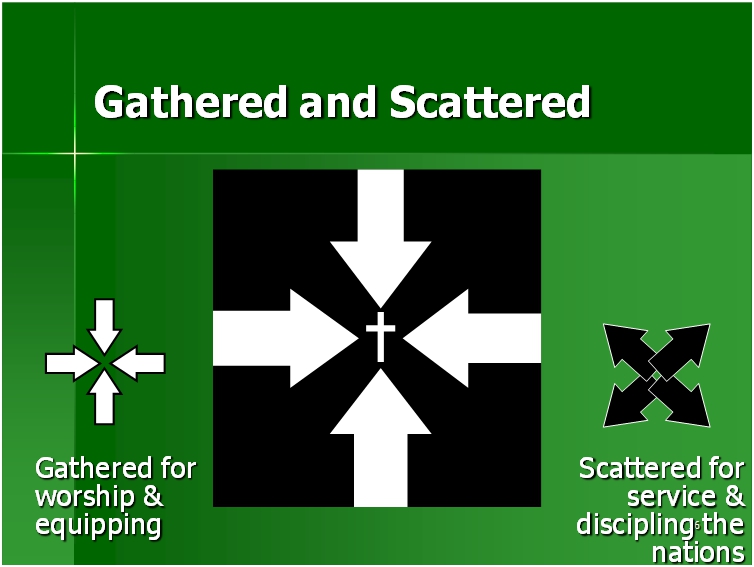
5. What does the Church do?  The church exists in two modes:

  • We gather for worship.
  • We scatter for mission.

II. BODY

We will now take a deeper look at what it means to gather for worship and scatter for mission

  • Gather for worship
  • Requires purposeful participation — moving from passive observation to active participation.

(Our identity) Eph 1: Blessed be the God and Father of our Lord Jesus Christ, who has blessed us with every spiritual blessing in the heavenly places in Christ, 4 just as He chose us in Him before the foundation of the world, that we would be holy and blameless before Him. In love 5 He predestined us to adoption as sons through Jesus Christ to Himself…”

Even before He made the world God chose you and adopted you, it gave Him great pleasure, God loved, chose, and adopted you.  You are His unique and special possession.

This is what we need to see: Coming is not an event; it is the fulfillment of God’s prehistoric (pre-history) desire.  God created Adam and Eve – it was good.  God wanted to be with people… (Some of you don’t even want to be with people J)

OT – they built a Tabernacle because God wanted to meet with His people.

It’s not our desire – it’s God’s desire – made possible by the blood of Jesus.  Church is not primarily about us – it’s primarily about God.

**We gather to, for, and around Jesus.

Our being here is all about Him – and sometimes competes with our expectations, needs, and desires.

Jesus is the head, the goal, chief shepherd – He’s the Sr. Pastor. He owns and loves the Church. He’s the object our worship, our preaching, and our mission.

The church is all about Him.  It’s not about music or the preaching – although, hopefully they are both focused on worshiping Jesus.

The music and the sermon are BOTH acts of worship (difference between a lecture and a sermon… “if people are taking notes at the end of a sermon it might not BE a sermon…”

If your Christianity is just about going to church then you don’t have Christianity, you have “Churchianity.”

Exalting only Jesus – giving all of our attention to Jesus

Sometimes it’s a sacrifice of praise (Hebs)

Our destination is always Jesus – give ourselves and assume a posture of personal humility, worship, and prayer.

Christ is present and available.

Ps 116:  1 I love the LORD because he hears my voice
and my prayer for mercy.
2 Because he bends down to listen,
I will pray as long as I have breath!
3 Death wrapped its ropes around me;
the terrors of the grave overtook me.
I saw only trouble and sorrow.
4 Then I called on the name of the LORD:
“Please, LORD, save me!”
5 How kind the LORD is! How good he is!
So merciful, this God of ours!
6 The LORD protects those of childlike faith;
I was facing death, and he saved me.
7 Let my soul be at rest again,
for the LORD has been good to me.
8 He has saved me from death,
my eyes from tears,
my feet from stumbling.
9 And so I walk in the LORD’s presence
as I live here on earth!
10 I believed in you, so I said,
“I am deeply troubled, LORD.”
11 In my anxiety I cried out to you,
“These people are all liars!”
12 What can I offer the LORD
for all he has done for me?
13 I will lift up the cup of salvation
and praise the LORD’s name for saving me.
14 I will keep my promises to the LORD
in the presence of all his people.

15 The LORD cares deeply
when his loved ones die.
16 O LORD, I am your servant;
yes, I am your servant, born into your household;
you have freed me from my chains.
17 I will offer you a sacrifice of thanksgiving
and call on the name of the LORD.
18 I will fulfill my vows to the LORD
in the presence of all his people—
19 in the house of the LORD
in the heart of Jerusalem.

Praise the LORD!

Scatter for mission

The term “missional church” may be a new term for you.  Here is the main idea:  We serve a missionary God, who crossed the ultimate cultural contexts to become one of us.  Jn 1:14 (MSG) The Word became flesh and blood, and moved into the neighborhood.

The Father sent the Son, the Son sent the Holy Spirit – and the Holy Spirit sends us.

Attractional model vs. a missional model.  In the end we want both.

What we are seeking to accomplish here at SBF can be defined as a “missional reorientation.”

At a very deep level we are redefining success:  It’s not about the 3 B’s (building, budget, and butts); it’s about how many people are we training and sending to be missionaries in their unique spheres of relationships.

Mat 28:18-20: 18 And Jesus came up and spoke to them, saying, “All authority has been given to Me in heaven and on earth. 19 Go therefore and make disciples of all the nations, baptizing them in the name of the Father and the Son and the Holy Spirit, 20 teaching them to observe all that I commanded you; and lo, I am with you always, even to the end of the age.”

Three things:

  1. All authority has been given to Jesus – and He is with us/you always. Our responsibility is basically twofold: a) stack kindling and b) splash (preach).  (D.L. Moody – At any moment we ought to be willing to preach, pray, or die.)
  2. “Go therefore” (Go ye) is the mission of the church.  Are we a “come ye” church, or a “go ye” church?
  3. Make disciples.  I’d like you to view every single person in your various spheres of relationship as a disciple…

[1] To “change or exchange” – it is God moving from hostility to friendship. Reconciliation is what God accomplishes, exercising His grace towards sinful humankind because of the sacrificial death of Christ in propitiatory [or appeasing] sacrifice under the judgment due to sin.

[2] The quotation “The lady doth protest too much, methinks.” comes from Shakespeare’s Hamlet, Act III, scene II. The phrase has come to mean that one can “insist so passionately about something not being true that people suspect the opposite of what one is saying.”