The Upside Down Life #4 – Blessed Are Those Who Mourn

I. Intro

Matthew 5:4; Hebrews 12:14-17

Today we will continue in our series The Upside Down Life, looking at the first 16 verses of Matt 5.  Today we will do some review work and unpack a few concepts in Matt 5 and then we will move into Heb 12.

(Review) Both Gene and Chris did an excellent job defining the words “blessed” (and what it means to be “poor.”)  Those notes are available here on the blog…

Review “poor in spirit”

  • Two weeks ago Chris said being “poor in spirit” is seeing our desperate need for God.
  • And then last week Gene said some pretty heavy things…
    • He said that as a church we are to be thankful that SBF has been privileged to go through all the struggles we have. God must be thrilled that there is somebody here who is broken and hungry for more… (Heavy words…a perfect message to begin our week-long fast as a church).
    • Gene went on to say SBF has lost pastors, people, programs, reputation, visible success, and a downward trend in the bank account…  [God comforts the afflicted – and afflicts the comfortable]
    • Your church is flat broke, you do not have it all together, you do not have it all figured out, and you cannot muscle, or buy, your way out of this one.
    • Blessed are those bankrupt in spirit, because they are entering the eternal reserves of the reservoirs of the God of true riches.
    • As a church we’ve been taken out to the woodshed…we’ve been spanked. Are you glad yet?  [I have a tremendous amount of respect for those of you who have stayed.]

Where do we go from “bankrupt in spirit”?  We mourn…

Today, we will look at 5:4 “Blessed are those who mourn for they will be comforted”

Once we see and acknowledge our deep spiritual poverty, it gives way to a deep and utter repentance.  (There’s a difference between repentance and “relentance.”)

There is a transforming grief, or repentance, that surfaces – not only for our own lives, but also for the injustice, greed, and suffering that grips our world.  (“Meanwhile we groan.”)

I’ve titled the message this morning, The Unlikely Route To Joy (borrowed from a chapter heading in Dan Allender’s’ book Wounded Heart).

  • In order to become rich, we need to acknowledge and own our poverty.
  • And in order to know “joy inexpressible and full of glory” (1 Pet 1:8) we must mourn.  This is the essence of living the upside down life (or counterintuitive).

I would like us to refer to mourning as a lifestyle of repentance.

For those of us who have read Pete Scazzero’s book, The Emotionally Healthy Church, we remember that the 3rd principle of the EHC is to live in brokenness and vulnerability.

This means living and leading out of our failure and pain, questions and struggles…[1]

This is how Paul led.  In 2 Cor 12 – Paul speaks of being caught-up to the third heaven – and then he shares about his thorn in the flesh“a messenger of Satan to torment me—to keep me from exalting myself! 8 Concerning this I implored the Lord three times that it might leave me. 9 And He has said to me, “My grace is sufficient for you, for power is perfected in weakness.”

Dr. Dan Allender – “An about face movement from denial and rebellion to truth and surrender… Repentance involves the response of humble hunger, bold movement, and wild celebration when faced with the reality of our fallen state and the grace of God…It is a shift in perspective as to where life is found…It is melting into the warm arms of God, received when it would be so understandable to be spurned.” (Wounded Heart)

**Mourning, or lifestyle repentance, is living WITH our failures, but not UNDER them.

II. BODY

With that said please turn to Hebrews 12…

If we had to boil down the book of Hebrews to a one-word description, the word would be perseverance. It is written specifically for a group of Christians who were about to quit.

Vs. 14-17 are full of some very specific admonitions to help us with engaging in a lifestyle of repentance…

14Pursue peace with all [people], and the sanctification without which no one will see [to perceive, to know, to become acquainted with by experience] the Lord.

15See to it [Looking diligently – episkapao] that no one comes short of the grace of God; that no root of bitterness springing up causes trouble, and by it many be defiled [stained];

16that there be no immoral or godless person like Esau, who sold his own birthright for a single meal.

17For you know that even afterwards, when he desired to inherit the blessing, he was rejected, for he found no place for repentance [NIV – he could bring about no change of mind], though he sought for it with tears.

This is a heavy passage: Esau found no place for repentance – even though he sought for it with tears.  (What are we supposed to do with this text?)

This passage offers us some insight into the reasons for Esau’s inability to come to a place of true repentance – and I believe it will help us to consider some possible issues that may be keeping us from fully knowing the privilege of repentance.

Listed in this passage are (at least) 6 admonitions that will move us toward embracing a lifestyle of true repentance…

1.  Pursue peace with all people.

Pursue: to run swiftly [NIV –  Make every effort]

Peace: from a primary verb eirēnē (harmonized relationships)

“If therefore you are presenting your offering at the altar, and there remember that your brother has something against you, leave your offering there before the altar, and go your way; first be reconciled to your brother, and then come and present your offering.”  Matthew 5:23,24 (NAS)

Roms 12:18 – “If possible, so far as it depends on you, be at peace with all men.”

(In a few weeks we’ll be talking about Mat 5:9 – Peacemaker vs. peacekeeper.)

I once flew from Reno, NV to Tulsa, OK and then rented a car and drove 3 hours just to ask someone’s forgiveness after reading this passage and taking it to heart.

2.  Pursue sanctification.

Sanctification: hallowed [NIV – Make every effort… to be holy] The Lord’s Prayer (Mat 6) hagiasmos (Heb 12 – noun), hagiazō (Mat 6 – verb)

We have positional sanctification and progressive sanctification

The Gospel Is for Believers.  We Christians need to hear the gospel all of our lives because it is the gospel that continues to remind us that our day-to-day acceptance with the Father is not based on what we do for God but on remembering what Christ did for us.  (That is what communion is all about…)

**Esau was rejected by God because he steadfastly refused to serve the purpose of God and instead served his lust for the immediate and the tangible.

3.  Pursue grace.

“See to it that no one comes short of the grace of God.” (v.15)

Grace: All that God is lavishly poured into you. If God has acted lavishly toward you, could you not be lavish to others?  Or yourself??

Jerry Bridges, in his masterpiece says, “The idea portrayed here is analogous to the ocean waves crashing upon the beach. One wave has hardly disappeared before another arrives.[2]

Pursue the truth in love (Eph 4:15).

“See to it that…no root of bitterness springing up causes trouble, and by it many be defiled.”  (v.15)

Notice the word, “many.”

Like a small root that grows into a great tree, bitterness springs up in our hearts and overshadows even our deepest relationships.

A “bitter root” comes when we allow disappointment or expectations to grow into resentment, or when we nurse grudges over past hurts.

Eph 4:15: But speaking the truth in love we are to grow up…” In my view this passage speaks to the epitome of what it means to be spiritually and emotionally healthy

5.  Pursue purity.

“See to it that…there be no immoral…person like Esau.” (v.16)

pornos – male prostitute.  Again, Esau steadfastly refused to humble himself to serve the purpose of God.  Instead he served his lust for the immediate and the tangible.

6.  Pursue God.

Instead of being godless (or, “unhallowed, profane” – Vine’s]

Esau found no place for repentance (metanoia), though he sought for it with tears.

We usually associate tears with repentance.  And it’s true that tears very often accompany true repentance.  But here we have the instance of Esau crying for repentance but not finding it.  Why?  Esau was in “relentance,” not true repentance.

III.CONCLUSION

“Repent therefore and return, that your sins may be wiped away, in order that times of refreshing may come from the presence of the Lord.”   Acts 3:19 (NAS)

Nothing will cause a renewed soul to hate sin so much as a realization of God’s grace; nothing will move him to mourn so genuinely over his sins as a sense of Christ’s dying love. It is that which breaks his heart: the realization that there is so much in him that is opposed to Christ. But a life of holiness is a life of faith (the heart turning daily to Christ), and the fruits of faith are genuine repentance, true humility, praising God for His infinite patience and mercy, pantings after conformity to Christ.  —The Doctrine of Sanctification by A.W. Pink.


[1] EHC: 110.

[2] Jerry Bridges, Transforming Grace.

A Generous Life #3 (of 6) 2 Cor 8:8-12

by Gene Heacock (Interim Teaching Pastor)

First The Gospel Then Giving

Focus on the new nature that we receive through conversion. I will preach the gospel in a different format and then return to the Macedonians.

The big idea: All giving is grace based (8:1), inspired by the sacrifice of Christ (8:9), and prompted by the Holy Spirit (8:10).

How do you and I learn something deeply, at our core? Albert Switzer said there are  3 ways: by example, by example, and by example.

And so it is with us by Christ’s sacrifice, by Christ’s sacrifice, and by Christ’s sacrifice.

The Gospel is not only about the forgiveness of sin but the heart of the gospel is that we are given a new heart.

What is the first two-letter word a child will say??  “NO!”  And the first four-letter word is usually, “MINE!!”

When we come to Christ our nature changes so not only do we have a new position with the Father but now we possess the nature of the Father.

  • The heart of the gospel is not just the forgiveness of sins
  • The heart of the gospel is that we might share His nature
  • The heart of the gospel is that we can have a new heart

Illustration – Forgiveness like sanitizing the kitchen. Our nature change is like having an impartation of a great chef’s DNA who now creates banquets for the benefit of others.

The Gospel in metaphor…

  • The Eternal flame and gasoline
  • International Terrorist and an Adoption Agency
  • Capitan Francesco Schettino and Jesus The Captain of our Souls
  • A High School Student Who Got it Right
  • Macedonians and The Manchesterians — you and I

Expound the metaphor as they unfold the nature of God, the work of Christ, and the impartation of our new nature.

Examine scripture that states we have a problem with actions-sins but much, much deeper is our nature (Eph:2:3).

The Lord Jesus Christ identified with our fallen nature and was consumed by God’s justice so that we did not have to endure the judgment of God and not only did He give us forgiveness but a brand new nature, His DNA – His heart of generosity

A High School Student who got it right – the story of John Cecil Rhodes…

Paul uses a Spirit-led strategy to build the case for giving through Christ’s sacrifice, the Macedonians example, and the Spirits leading.

2 Cor 8:8-12:

  • v8 not commanding but calling out your new nature to respond like others-beauty of example
  • v9 Christ gave His utmost and now we are related to Him follow the family line
  • v 10 Listen to the Spirit’s prompting
  • v 11 Allow generosity to flow out of your heart and trust that there is a provision of resurrection.
  • As the Spirit prompts so the Spirit provides
  • v 12 Consistency reflects the sacrifice of Christ staying on the Cross to accomplish the work, without faltering and with follow through

Summary: Their new Nature led the Macedonians.

  • They loved people they did not know
  • They loved people they could not see
  • They loved people that were not like them
  • They loved people that exceeded human limitations

Their act of giving transcended their circumstances. It was a Holy revolt against their horrible circumstances.

They gave to the one above their circumstances so as not to be controlled by their present pain.

Illustration Ann Marie Kurko – laughing at grace and her story of generosity hilarious 2 Cor 9:7

Taking it Home SBF questions from Pastor Gregg:

  1. How does the sacrifice of Christ effect your time, talents, and treasure?
  2. In what ways has God been generous to you? What does Paul mean that through 
Christ’s poverty we have become “rich”?
  3. How does generosity preach the gospel to those in need?
  4. What do your finances say about your theology?
  5. What sparks “desire”?
  6. Are you generous in proportion to your ability?
  7. Why or why not?
  8. How does our generosity reveal our heart and our idols[1]?


[1] Within the depravity of the human heart there is a need, a hunger to idolize. Tim Keller, in his book, Counterfeit Gods, explains that Scripture teaches the human heart is an “idol factory” (p. xiv). Idolatry quietly and subtly slips into our lives when we allow good things to become ultimate things. Another way to understand this is to think of idols as functional saviors (Jerry Bridges, The Bookends of the Christian Life, p 72).


A Generous Life #2 (of 6) 2 Cor 8:1-7

I. INTRO

The title of our series – A Generous Life – is what’s referred to in literature as a double entendre, which means it can be understood in two ways. (Often one meaning of a double entendre is innocent and the other is risqué.  In the case of our series title both meanings are scandalously grace-filled – but neither is risqué .)

  1. The first way to understand it is what we spoke about last week – The life of Jesus was the most generous life ever lived. In his unpublished essay on the Trinity, Jonathon Edwards writes, “God is infinitely happy in the enjoyment of Himself, in perfectly beholding and infinitely loving, and rejoicing in, His own essence and perfection.”[1] Our great God and Savior, Jesus Christ, left this “cocoon” of infinite perfection and with humility and generosity condescended into human history. And Philippians 2 tells us that, although He existed in the form of God, did not regard equality with God a thing to be grasped, 7 but emptied Himself, taking the form of a bond-servant, and being made in the likeness of men. 8 Being found in appearance as a man, He humbled Himself by becoming obedient to the point of death, even death on a cross.” (vs. 6-8).
  2. The second way to understand our series title is that you and I have access to a holy capacity to live a generous life.  We see this in 2 Cor 8:1,“the grace of God which has been given in the churches of Macedonia.” It was not born out of their own strength or power – it was God blessing and enabling them (and us) to become outrageously generous.

Today we will begin to work through 10 Principles of Generosity that are found in these two chapters.  (Found in last weeks notes here on the Southside blog – and in the study guides, which are also available for download here on at the blogsite, or there are hardcopies in the lobby.)  We will work through two principles per Sunday for the next five weeks.  (Gene will be here next week.)

Before we get to todays principles, I’d like to provide a little bit of background:

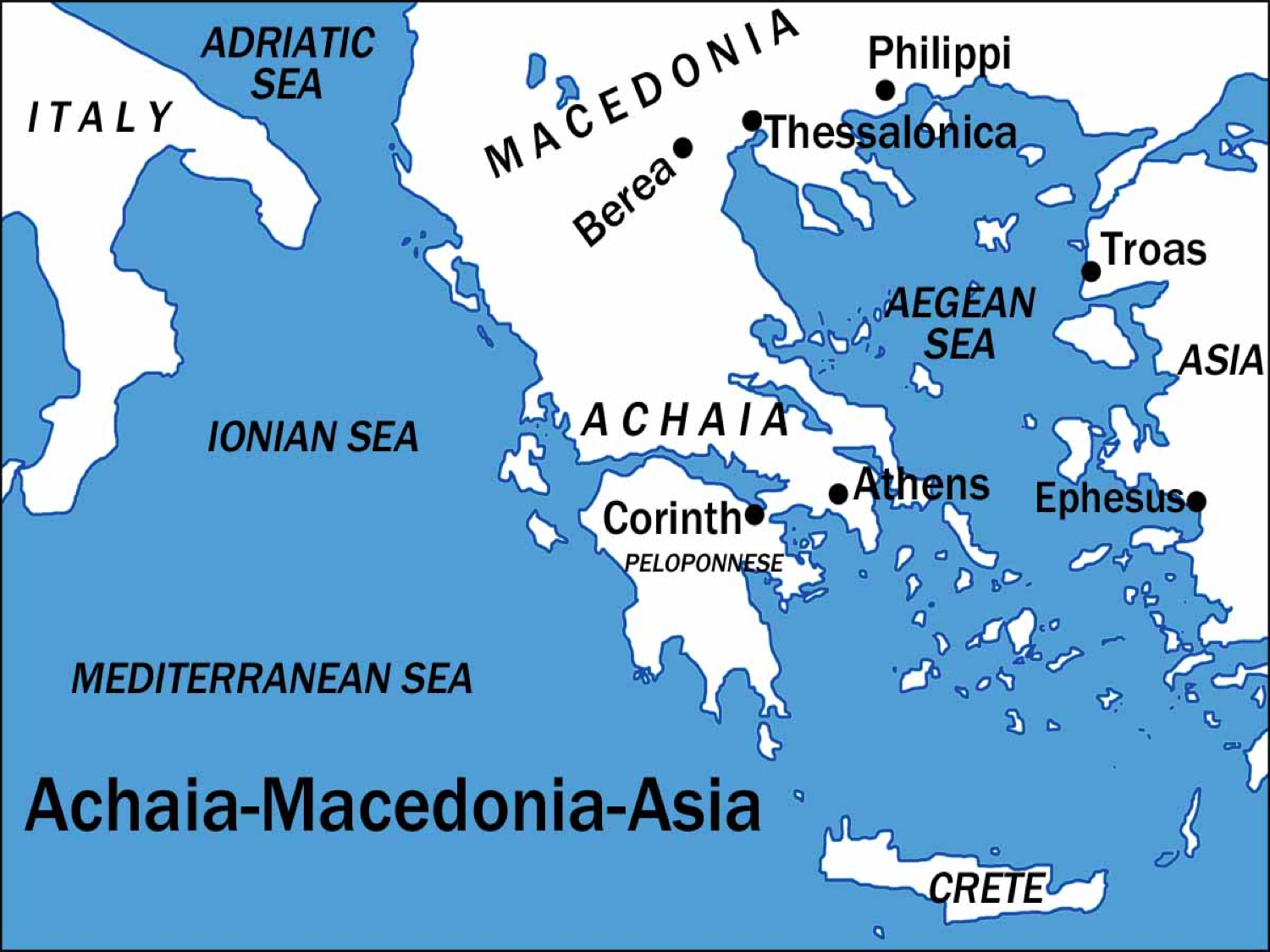
First of all, notice the geography…

Macedonia is to the north of Corinth.

A commentator describes Macedonia as, “a splendid tract of land, centered on the plains of the gulf of Thessalonica…Running up the great river valleys into the Balkan Mountains, it was famous for its timber and precious metals. The churches of Macedonia had been planted by Paul on his second missionary journey.[2]

I think it’s important to notice that Paul is seeking to motivate the Corinthians through a  bit of competition. In the south, Macedonia was referred to as the “barbaric North” and the Greeks and Macedonians had a lengthy history of political rivalry.

And Paul was probably writing 2 Corinthians from Macedonia.

Corinth was a prosperous double-ported Roman outpost and colony of approximately 200,000 people that sat on a narrow strip of land (isthmus) between the Aegean Sea with the Ionian Sea (within the larger Mediterranean Sea).

Corinth was cosmopolitan in nature, and not unexpectedly, Corinth became notorious for luxurious and debauched living.  Some commentators liken it to San Francisco during the California gold-rush days.

We know from Paul’s letters to the Corinthians that they were a pretty carnal church.  They took the grace of God for granted, tolerating immorality in their midst and some were also getting drunk at their gatherings.  One commentator states the Corinthians were, “undisciplined extremists…setting a poor example for their pagan neighbors. They also did not take kindly to [Paul’s] authority.”[3]

What we have in Corinth is a young church that was not yet disciplined – financially or otherwise, and Paul is seeking to teach them by showing them the example of the Macedonian churches. Churches that were so exemplary in their financial stewardship and generosity, that they are mentioned four times in the New Testament as exemplary churches.  They represented the kind of church that we here at SBF aspire to be.

Both the Macedonian churches and the church at Corinth were struggling under an economic recession that’s not totally unlike the one we are experiencing.  But the Macedonians were suffering far more painfully than those who lived in Corinth. The economic downturn hit them, apparently, much harder.

II. BODY

So in chapters 8-9 Paul has 10 principles for them. We’ll look at the first two today. 

Money is one of the ways that we show that we belong to Jesus and understand His life and message.  Throughout the course of the Gospels Jesus talks about money approximately 25% of the time.  In Mathew 6:21 and Luke 12:34, He says that where our treasure is, our heart is.  In other words, our hearts are reflected in our finances.  And Paul is saying that generosity reveals the grace of God.

So, the principles that we will look at today are:

  1. Generosity is a work of Gods grace. (2 Cor 8:1-6)
  2. Generosity is both a work of God’s grace and a choice. (2 Cor 8:7)

Let’s look at them one at a time…

1.  “Generosity is a work of Gods grace.” (2 Cor 8:1-6)

1 Now, brethren, we wish to make known to you the grace of God which has been given in the churches of Macedonia, 2 that in a great ordeal of affliction their abundance of joy and their deep poverty overflowed in the wealth of their liberality. 3 For I testify that according to their ability, and beyond their ability, they gave of their own accord, 4 begging us with much urging for the favor of participation in the support of the saints, 5 and this, not as we had expected, but they first gave themselves to the Lord and to us by the will of God. 6 So we urged Titus that as he had previously made a beginning, so he would also complete in you this gracious work as well.

I observed an equation in verse two.  It’s counter intuitive…

A great ordeal of affliction + abundance of joy + deep poverty = liberality.

This leads me to a hypothesis (or proposition):  Any circumstance that includes great affliction and deep poverty, wherein we place our joy and comfort in the gift of God’s grace through Jesus Christ, will result in liberality.

If we place our joy and comfort in the god of money, and that god was crucified through an economic downturn, and showed few signs of resurrection, we have no reason for joy and generous liberality.  

If, however, our God is Jesus, then, our source of joy and generous liberality is still alive and well. Where there’s root, there’s fruit…

John Piper sums up the spiritual dynamics of this text by saying: Grace comes down, Joy rises up, and Generosity flows out.

This brings us to our second principle of generosity…

2.  Generosity is both a work of God’s grace and a choice. (2 Cor 1:7)

7 But just as you abound in everything, in faith and utterance and knowledge and in all earnestness and in the love we inspired in you, see that you abound in this gracious work also.

First of all, this verse is a summary (or synopsis) of 1 Corinthians – with a loving admonishment to share the grace God has given, or imparted, to them (“see that you abound”).

“When poverty-stricken Macedonians beg Paul for the privilege of giving money to other poor saints…it is an extension of their joy in God…They are denying themselvesbut the joy of extending God’s grace to others is a far better reward than anything money could buy.[4]

Three important points:

  1. Grace initiates all giving that glorifies God, otherwise we would take pride and praise for our support of others.
  2. This grace alone is the root of genuine joy. Otherwise joy is misplaced and dissipates when circumstances turn bad.
  3. Grace-given joy is always other-oriented.  When our giving germinates in the soil of grace, it blooms in generous bounty to those in need. Such is the nature of true love.

What we find in our study of stewardship and generosity is that the seed-bed, the foundation of it all is grace.

The grace of God, first and foremost, is the power of God’s Holy Spirit that converts the soul. It is the activity, the moving, of God whereby God saves and justifies us through faith (see esp. Rom. 3:24; 5:15,17).

Therefore, grace is not something in which we merely believe; it is something we experience as well.

Grace, then, is a dynamic and experiential reality that empowers the human heart to look beyond its limitations and accomplish things that defy rational explanation.

Grace is the power that enables impoverished and suffering saints to give when, by all accounts, they should be the ones to get. Such was the operation of grace in the giving of these Macedonian believers.

If we attempt to live generous lives out of our own soul or self will, we cut off the very grace that was given through Jesus.  “Soul grace” (we’ll call it) actually denies the deity of Jesus.

III. CONCLUSION

There is a prosperity gospel that is preached in many churches throughout North America.  (It’s particularly said because this Americanized version of the gospel is being exported around the world.)  Those who claim that God wants His people to be materially rich have missed the whole point of the gospel.  Having said that, I believe there’s one area that they don’t go far enough in…

Their mantra is that, “we give to get – and we can never out-give God.”  Is there truth in that?  [Yes.]

What the gospel tells us, however, is that giving to get does not go far enough.  We are to give to get, to give again – and again, and again…

GRACE GIVING (Version 2)

(This is our initial attempt to generate a formal statement regarding SBF’s stance on the stewardship of finances.  Please read it and make any comments or ask any questions that would help you to better understand what the Bible teaches us about money.)

So what’s the deal with “tithing”? The word tithe simply means “one-tenth.” Under the Law of Moses in the Old Testament, the Israelites were required to give in such a way that it amounted to a little over 23% of their income. The first was 10% of all of their possessions (Lev. 27:30–33; Num. 18:20–21), which was given to the Levites for Temple Ministry. A second was taken from whatever produce was left after the first tithe was given. Jewish interpreters consider this to be a second giving requirement for feasts and sacrifices (Deut. 12:17–18; Lev. 27:30; Num. 18:21). Finally, another tithe was given once every three years to support the poor (Deut. 14:28–29). On top of these giving mandates were the voluntary freewill offerings given out of their own will and desire above and beyond their normal giving (Ex. 35:29; Lev. 22:23; Ezra 3:5).

When it comes to the New Testament teaching on giving, we begin with the understanding that the Mosaic Law no longer binds us (Rom. 6:14). This leads us to the question, “Should we still give according to the Old Testament system, or are we able to give less – or even more?”

Concerning this, Paul wrote, “He who sows sparingly will also reap sparingly, and he who sows bountifully will also reap bountifully. So let each one give as he purposes in his heart, not grudgingly or of necessity; for God loves a cheerful giver. And God is able to make all grace abound toward you, that you, always having all sufficiency in all things, may have an abundance for every good work” (2 Cor. 9:6–8).

As Christians who are no longer under the Law, we give because of the grace that God has given us. In 2 Corinthians 8, Paul commends the believers in Macedonia for what is often referred to as “grace giving.” Paul describes the qualities of this benevolence as being generous (2 Cor. 8:2), willful (2 Cor. 8:3), directed by God (2 Cor. 8:5), shared (2 Cor. 8:6), active (2 Cor. 8:7), and motivated by love (2 Cor. 8:8). This kind of giving should not be done out of a “legalistic” mentality, but as the Lord leads you to give (2 Cor. 8:8).

It may be concluded that the Old Testament tithing system set a standard for giving, and that while we are no longer required under the Law to give, we are under grace—and our giving is to reflect this. We are not under compulsion to give; rather, we are to give cheerfully and prayerfully as God leads us. New Testament teaching places our giving in the category of an aspect of worship unto the Lord, which is why churches (usually) receive these tithes and offerings as a part of our corporate worship gatherings on Sundays. Additionally, many churches also make the option available to give privately via online debit cards, as that is now how many people handle their “crops.”


[1] An Unpublished Essay on the Trinity.

[2] Edwin A. Judge:1982.

[4] Desiring God: 104.

A Generous Life #1 (of 6) 2 Cor 8:9

I. INTRO

Summit #1 is next Sat (01/14).  We are holding our first of three summits.  I want to invite everyone 13 years of age and older to come and participate in this process.

If you’re new to the church it’s a great time to jump in to help shape what SBF will become in the next season of fruitful ministry.  (My role is as a facilitator and coach – your role is to shape the future through prayerful dialogue with God and one another.)

Today we begin a 6-week series on A Generous Life.  (There are study guides available in the lobby and also available for download here at our blogsite.)  Why a series on A Generous Life?

The answer is both simple and profoundJesus Christ lived the most generous life ever lived.

The whole Bible – both the OT and NT, was written to point to Jesus.

We call this a Christ-centered, or gospel-centered view of the Bible.

Again, the whole Bible was written with God’s redemption through Jesus Christ in view.  The OT points to the coming of Jesus and the NT extols the coming of Jesus.  We want to see Jesus and worship Jesus in every text of Scripture.

Because of the generosity of Jesus Christ one of the gospel graces is generosity – and there is a connection between generosity and stewardship.  So this series will be about becoming generous stewards of God’s grace.  But the last thing we want to say is that Jesus lived a generous life and now you should too.

No, we want to explore the generosity of Jesus.  What we really want – and need – is to enter into His generosity.  It is the generosity of Jesus, by grace through faith, that changes us and empowers us to be generous.

Our passage for today, which was read, is 2 Cor 8:9.  This will be our foundational passage for the series.  Our aim is to engage in a gospel transformation of the soul in and through the sacrifice and provision of Jesus Christ.

Here’s the way pastor and author John Piper says it: “Seeing and savoring the supremacy of Christ frees us from the slavery of sin for the sacrifices of love.”

Living in and for the gospel is counterintuitive[1]…here is how pastor and author Tim Keller has said it: “Christ wins our salvation through losing, achieves power through weakness and service, comes to wealth via giving it all away.  And those who receive His salvation are not the strong and accomplished but those who admit they are weak and lost.”[2]

Each of us has three primary areas of stewardship in Christ: We’ll refer to them as our time, our talents, and our treasure.  There are other areas of stewardship that we are responsible for as well:  We are responsible for our primary relationships, our bodies, our sexuality, and to care for creation.

Again, it’s not about what we should do – the renegade Catholic priest, who initiated the Protestant Reformation, Martin Luther speaks about a great exchange… “Learn Christ and Him crucified. Learn to sing to Him and, despairing of yourself, say, ‘Lord Jesus, You are my righteousness, just as I am Your sin. You have taken upon Yourself what is mine and have given me what is Yours.’”[3]

“For our sake [the Father] made [Jesus] to be sin who knew no sin, so that in Him we might become the righteousness of God.” (2 Corinthians 5:21 ESV)

An overview of 2 Cor…

In 2 Cor 8-9 Paul is seeking to mobilize the Corinthian congregation to participate in an offering for the church members in Jerusalem…

You will notice that Paul never uses the word money, in 2 Cor 8-9, instead he calls it “grace,”  “generosity,” “blessing,” or “partnership.” He speaks of the “grace of giving” as one of the highest Christian virtues.

With this series we are not aiming at your wallet, we are aiming at your heart.

This series is NOT intended to ask you to give more – it’s intended to show you how.

Paul had quite a rocky relationship with the church at Corinth.  There were actually (at least) four letters that were written.  What has been canonized as Scripture are letters #2 and #4.  (#3 was, apparently, a letter of severe rebuke.)

Chapters 8 and 9 of this epistle concern the offering for the poor saints at Jerusalem.  It took between 8-10 years to accomplish; involved thousands of miles of travel; at least 10 collectors involved. An earthquake, crop failures, and persecution contributed to their needs at Jerusalem church.

II. BODY

With that in mind let’s dive into our passage for today – just one verse – 2 Cor 8:9, which is the foundational passage for our series on Generosity… For you know the grace of our Lord Jesus Christ, that though He was rich, yet for your sake He became poor, so that you through His poverty might become rich.

Today we want to ask and consider four questions:

  1. Do you know the grace of our Lord Jesus Christ?
  2. How was Jesus rich?
  3. How did He become poor?
  4. How do we become rich?

Let’s look at them one at a time…

1.  Do you know the grace of our Lord Jesus Christ?

What does it mean to know?

Ginōskōa knowledge grounded on personal experience.[4]

Paul is confident that the Corinthian church understood (i.e., was well-taught) in the area of the gospel of grace.  This is where the North American Church struggles today…

What is grace?  There are 10 ten occurrences of the word “grace” (charis) in chapters 8-9.

While there many facets of grace.  This morning I’d like to look at three types of grace:

A.  Common Grace refers to the grace of God that is common to all humankind. It is “common” because its benefits are experienced by the whole human race without distinction between one person and another. It is “grace” because it is undeserved and sovereignly bestowed by God. Mat 5:45b – [God] causes His sun to rise on the evil and the good, and sends rain on the righteous and the unrighteous.”  The fact that you’re breathing this morning is an effect of common grace.

B.  Saving Grace, or justifying grace, redemptive grace – or regenerating grace is a momentary action of God to bring about salvation into a previously unregenerated person – it’s an act of quickening the spiritually dead.  In John 3 Jesus had a conversation with a Pharisee named Nicodemus and told him – “…unless one is born again he cannot see the kingdom of God.” 1 Peter 1:3“Blessed be the God and Father of our Lord Jesus Christ, who according to His great mercy has caused us to be born again to a living hope through the resurrection of Jesus Christ from the dead.”

C.  Sanctifying Grace – Think of saving grace as birth (or regeneration) and sanctifying grace as growth.

Sanctification says the Westminster Shorter Catechism (Q.35), is “the work of God’s free grace, whereby we are renewed in the whole [person] after the image of God, and are enabled more and more to die unto sin, and live unto righteousness.”

The concept is not of sin being totally eradicated, but of a divinely wrought [or, shaped] character change freeing us from sinful habits and forming in us Christlike affections, dispositions, and virtues (J.I. Packer).[5]

With saving grace, God implants desires that were not there before: desire for God, for holiness, for worship; desire to pray, love, serve, honor, and please God; desire to show love and bring benefit to others. With sanctifying grace the Holy Spirit, “is at work in you, both to will and to work for His good pleasure” (Phil 2:13).

Here now is my favorite definition of grace – “All that God is, lavishly poured into you.”

U2 song Grace –

Grace
She takes the blame
She covers the shame
Removes the stain
It could be her name

Grace
It’s a name for a girl
It’s also a thought that changed the world
And when she walks on the street
You can hear the strings
Grace finds goodness in everything

2.  How was Jesus rich?

Jesus preexisted in the context of a Holy Trinity — Father, Son, and Holy Spirit.

This Godhead – Father, Son, and Holy Spirit have dwelled together in infinite relational harmony for all eternity. Their mutual love is pure, infinite, and perfect.  Their love is never stained by conflict, or competition, or polluted by self-centeredness.

Authors and theologians, dating back to the 7th century (including C.S. Lewis and Tim Keller), have suggested that the Trinitarian relationship is like a dance, with each member deferring to and delighting in the other.[6]

3.  How did He become poor?

Jesus condescended to become a human.  One theologian said, “This humiliation had the effect of restoring the true human nature without degrading the divine nature…Majesty stepped into the mess.” [7]

Eugene Peterson in his paraphrase (called The Message) writes, “The Word became flesh and blood, and moved into the neighborhood. We saw the glory with our own eyes, the one-of-a-kind glory, like Father, like Son, Generous inside and out, true from start to finish” (John 1:14).

Jesus gave up the comforts and joys of Triune eternal companionship to enter into the messiness of living with sinful, broken humanity—the hypocrisy, violence, corruption, sickness, and greed. Jesus came to share a new vision, with new power for living with humility, compassion, mercy, and generosity.

Philippians 2:6-9 says “Jesus, 6 who, although He existed in the form of God, did not regard equality with God a thing to be grasped, 7 but emptied Himself, taking the form of a bond-servant, and being made in the likeness of men. 8 Being found in appearance as a man, He humbled Himself by becoming obedient to the point of death, even death on a cross.”

4.  How do we become rich?

We become rich by being invited into the dance…

(Farewell Discourse) John 17:19-21 – 19 “For their sakes I sanctify Myself, that they themselves also may be sanctified in truth. 20 “I do not ask on behalf of these alone, but for those also who believe in Me through their word; 21 that they may all be one; even as You, Father, are in Me and I in You, that they also may be in Us, so that the world may believe that You sent Me.”

Here’s how one theologian sums up 2 Cor 8:9: “If this love of Christ, so magnanimous [generous] in its motive and so self-sacrificing in its execution, is an active force in the believer’s heart, how unnecessary, the apostle implies, any command to practice giving ought to be. What, without that love, might seem a cold moral duty has been transformed by it into a joyous privilege.”[8]

III. CONCLUSION

So 2 Cor 8:9, is the foundational passage for our series on Generosity/Stewardship… For you know the grace of our Lord Jesus Christ, that though He was rich, yet for your sake He became poor, so that you through His poverty might become rich.

We will build our series on this verse…

Over the next 5 weeks we will consider 10 Principles of Generosity (two per Sunday):

  1. Generosity is a work of Gods grace (2 Cor 8:1-6)
  2. Generosity is both a work of God’s grace and a choice (2 Cor 8:7)
  3. Generosity points us to the sacrifice of Christ (2 Cor 8:8-9)
  4. Generosity is measured proportionally (2 Cor 8:10-12)
  5. Generosity enables a holy equality (2 Cor 8:13-15)
  6. Generosity necessitates godly stewardship (2 Cor 8:16-24)
  7. Generosity begets generosity (2 Cor 9:1-5)
  8. Generosity is about sowing and reaping (2 Cor 9:6-12)
  9. Generosity is an evidence that someone is an active, intentional follower of Christ 
(2 Cor 9:13-14)
  10. Generosity promotes the worship of Jesus as God (2 Cor 9:15)

Finally, I want to share with you my verse for the year…Proverbs 1:23:

“Turn to my reproof, Behold, I will pour out my spirit on you; I will make my words known to you.”

I am willing to ask for the Lord’s reproof in my life, so that He will pour out His Spirit on me and make His words known to me.  My prayer is that, as a church, Southside will do the same…


[1] I.e., contrary to what we expect.

[2] Gospel Christianity, Redeemer Pres NYC 2003.

[3] Treatise on Christian Liberty (The Freedom of a Christian), AE, Vo. 31.

[4] It’s also a Jewish idiom (not slang, but a stylistic expression) for sexual intercourse between a man and a woman.

[5] J.I. Packer. Concise Theology.

[6] See Tim Keller, The Reason for God, pgs 214-222. See also C.S. Lewis Mere Christianity pg. pg. 152. The idea of the relationship of the Trinity as dance may also be traced back to a 7th century theologian named John of Damascus who described the Trinity as Perichoresis (the same word we get our English word “choreography” from).

[7] Douglas McCready. He Came Down From Heaven: The Preexistence of Christ and Christian Faith, IVP Academic 2005: 81.

[8] R.V.G. Tasker. 2 Corinthians, Tyndale NT Commentary, Eerdmans 1958: 116.