Relational Reconciliation

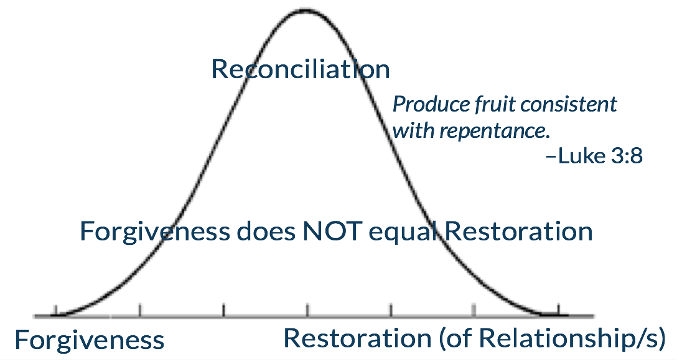
Consider the chart below. Forgiveness, reconciliation, and the restoration of relationships is always the goal. Reconciliation is at the heart of the gospel and is not an option. As believers we have been assigned the ministry of reconciliation:  

“All this is from God, who through Christ reconciled us to himself and gave us the ministry of reconciliation.” –2 Cor 5:18

While seeking to be reconciled, move towards forgiving those who have wounded and hurt you. (This is not an option either.) Now, it’s important to understand that forgiveness and restoration are not the same. You may choose to forgive, but the end result of reconciliation that leads to restoration may take more time. Notice the pathway on the chart below…

Reconciliation can be a long journey, but it is one that believers are admonished to take. In Mark 11:25, Jesus tells us, “When you stand praying, if you hold anything against anyone, forgive him, so that your Father in heaven may forgive you your sins.” Paul tells us to “Bear with each other and forgive whatever grievances you may have against one another. Forgive as the Lord forgave you” (Col 3:13). To forgive as God forgives us, we must:

a. See others as image bearers of God who are also given to sinful frailty

b. Be willing to bear their debt.

The word “forbearance” is a word that is used mostly in the KJV and can be defined as, “to abstain or hold back; forbearance is akin to patience and self-control.”

    Desire the other person’s good (sometimes at personal cost to you). People are not the hurt that they do to us. We are all broken yet God uses broken people to serve His purpose in a broken world.

    God Is Closer Than You Think #2 – What Is God Like?

    What Is God Like?  (A Taste For His Majesty*)

    I. INTRO

    Most of us know who Chuck Colson was – a Special Counsel to President Richard Nixon from 1969 to 1973…

    On June 1, 1973, Chuck Colson[1] visited his friend Tom Phillips,[2] while Watergate unfolded in the press. He was baffled and shocked at Phillips’ explanation that he had “accepted Jesus Christ.”

    But he saw that Tom was at peace and he wasn’t. When Colson left the house, he couldn’t get his keys in the ignition he was crying so hard. He wrote in his book, Loving God:

    That night I was confronted with my own sin—not just Watergate’s dirty tricks, but the sin deep within me, the hidden evil that lives in every human heart. It was painful and I could not escape. I cried out to God and found myself drawn irresistibly into His waiting arms. That was the night I gave my life to Jesus Christ and began the greatest adventure of my life.[3]

    Charles Colson’s New Understanding of God

    That story has been told thousands of times over the last four decades. We love to hear about this kind of conversion.

    But far too many of us settle for that story in our own lives and the life of our church.

    But not Charles Colson. Not only was the White House hatchet man willing to cry in 1973; he was also willing to repent several years later of a woefully inadequate view of God.

    It was during a period of unusual spiritual dryness. (If you are in one, take heart! More saints than you realize have had life-changing encounters with God right in the midst of the desert.)

    A friend suggested to Colson that he watch a videocassette lecture series by R.C. Sproul on the holiness of God. Here’s what Colson wrote:

    All I knew about Sproul was that he was a theologian, so I wasn’t enthusiastic. After all, I reasoned, theology was for people who had time to study, locked in ivory towers far from the battlefield of human need. However, at my friend’s urging I finally agreed to watch Sproul’s series.

    By the end of the sixth lecture I was on my knees, deep in prayer, in awe of God’s absolute holiness. It was a life-changing experience as I gained a completely new understanding of the holy God I believe in and worship.

    My spiritual drought ended, but this taste for the majesty of God only made me thirst for more of him.[4]

    In 1973 Colson had seen enough of himself to know his desperate need of God, and had been driven “irresistibly” (as he says) into God’s arms. But then several years later something else wonderful happened. A theologian spoke on the holiness of God and Chuck Colson says that he fell to his knees and “gained a completely new understanding of the holy God.” From that point on he had what he calls a “taste for the majesty of God.” Have you seen enough of God’s holiness to have an insatiable taste for His majesty?

    This same thing happened to Job in the Bible – through all his tribulations he came to see God anew.

    Job 1:1There was a man in the land of Uz whose name was Job; and that man was blameless and upright, one who feared God and turned away from evil.”

    Job was a believer, a deeply devout and prayerful man. Surely he knew God as he ought. Surely he had a “taste for the majesty of God.” But then came the pain and misery of his spiritual and physical desert. And in the midst of Job’s dryness God spoke in His majesty to Job:

    Job 40:8–14; 41:10–11: “Will you even put Me in the wrong? Will you condemn Me that you may be justified? Have you an arm like God, and can you thunder with a voice like His? Deck yourself with majesty and dignity; clothe yourself with glory and splendor?…Look on everyone that is proud, and bring him low? And tread down the wicked where they stand? …Who then is he that can stand before Me? Who has given to Me that I should repay him? Whatever is under the whole heaven is Mine.”

    In the end Job responds, like Colson, to a “completely new understanding of the Holy God.” Job says in 42:3–6:

    Therefore I have declared that which I did not understand,
    Things too wonderful for me, which I did not know.”
    ‘Hear, now, and I will speak;
    I will ask You, and You instruct me.’
    “I have heard of You by the hearing of the ear;
    But now my eye sees You;
    Therefore I retract,
    And I repent in dust and ashes.”

    These two stories of men encountering God in life-changing ways is the same thing that is happening to Isaiah in Chap 6…

    Isaiah 6:1-8 — In the year of King Uzziah’s death I saw the Lord sitting on a throne, lofty and exalted, with the train of His robe filling the temple. Seraphim stood above Him, each having six wings: with two he covered his face, and with two he covered his feet, and with two he flew. And one called out to another and said,

    “Holy, Holy, Holy, is the Lord of hosts,
    The whole earth is full of His glory.”

    And the foundations of the thresholds trembled at the voice of him who called out, while the temple was filling with smoke. Then I said,

    “Woe is me, for I am ruined!
    Because I am a man of unclean lips,
    And I live among a people of unclean lips;
    For my eyes have seen the King, the Lord of hosts.”

    Then one of the seraphim flew to me with a burning coal in his hand, which he had taken from the altar with tongs. He touched my mouth with it and said, “Behold, this has touched your lips; and your iniquity is taken away and your sin is forgiven.”

    Then I heard the voice of the Lord, saying, “Whom shall I send, and who will go for Us?” Then I said, “Here am I. Send me!”

    II. BODY

    Revival happens, individually and corporately, when we see God majestic in His holiness – and we come to grips with our own need and desperation.

    Brokenness, repentance, the unspeakable joy of forgiveness, a “taste for the majesty of God,” a hunger for His holiness—to see it more and to live it more: that’s revival. And it all begins by seeing God.

    We have a companion book for this series and we have a companion passage that I am asking all of us to pray for ourselves, our loved ones, for SBF. That passage is:

    Eph 1:17-19 — That the God of our Lord Jesus Christ, the Father of glory, may give to you a spirit of wisdom and of revelation in the knowledge of Him. 18 I pray that the eyes of your heart may be enlightened, so that you will know what is the hope of His calling, what are the riches of the glory of His inheritance in the saints, 19 and what is the surpassing greatness of His power toward us who believe.

    In our companion book “Christian Beliefs” by Wayne Grudem we are in Chap 2 – What Is God Like?  It is the longest chapter of the book (16 pages listing 24 separate attributes of God), and we won’t be able to cover them all this morning, so I would like to offer you 4 glimpses of God from the first 4 verses of Isaiah 6 that coincide with our companion book.

    1. God Exists – 6:1:KingUzziah is dead, and Isaiah encountered the Lord sitting on the throne.

    We see this also with the first four words of the Bible: Gen 1:1 – In the beginning God…” God was the living God when this universe banged into existence. And He will be the living God in 10 trillion years.

    God never had a beginning and therefore depends on nothing for His existence. He always has been and always will be alive.

    Our companion book describes God as “independent.”  I would take issue with Grudem’s choice of words here.  I agree with Grudem’s words that God “doesn’t actually need us or anything else in creation for anything.”[5]

    I would prefer to use the term self-differentiated rather than independent.  What does it mean to be self-differentiated?

    “Self-differentiation” is a term used to describe one who is emotional healthy – and is no longer ultimately dependent on anything other than themselves. They are able to live interdependently with others because their sense of worth is not dependent on external relationships, circumstances, or occurrences.

    There are three categories of connection that are worthy of our understanding:  

    • Independence (-)
    • Dependence (-), and
    • Interdependence (+).

    Within the Trinity each member is fully self-differentiated – and each is supremely interdependent.

    2. God Is Omnipotent – The word omnipotent means all-powerful (omni = all; potent = power). Notice the throne of God’s authority is not one throne among many thrones. It is high and lifted up above ALL thrones. Again in 6:1: “I saw the Lord sitting upon a throne high and lifted up.”

    That God’s throne is higher than every other throne signifies God’s superior power to exercise His authority. No opposing authority can nullify the decrees of God.

    What God purposes, God accomplishes. In Isaiah 46:10, God emphatically states: “My counsel shall stand, and I will accomplish all My purpose.”

    Daniel 4:35: “He does according to His will in the host of heaven and among the inhabitants of the earth; and none can stay his hand.”

    To be gripped by the sovereign omnipotence of God is either marvelous because He is for us — or it is terrifying because He is against us.

    Indifference to God’s omnipotence simply means we haven’t seen it for what it is. The sovereign authoritative power of the living God is a refuge full of joy and delight for those who have been gripped by the gospel, which is His new covenant promise of love, mercy, and forgiveness.

    3. God Is Holy – 6:2-4: “Seraphim stood above Him, each having six wings: with two he covered his face, and with two he covered his feet, and with two he flew. And one called out to another and said, “Holy, Holy, Holy, is the Lord of hosts, The whole earth is full of His glory.” And the foundations of the thresholds trembled at the voice of him who called out, while the temple was filling with smoke 6:3: “And one called to another, ‘Holy, holy, holy is the Lord of hosts!’”

    The seraphim are never mentioned again in the Bible again. The word seraph literally means “to burn.”  John Wesley describes them as, “An order of holy angels…[that] represent either their nature, which is bright and glorious…and pure; or their property, of fervent zeal for God’s service and glory.”[6]

    According to verse 4, when one of them speaks, the foundations of the thresholds in the temple shake.

    This scene is repeated in Rev 4:8, where John has a vision of the throne in heaven – “And the four living creatures, each one of them having six wings, are full of eyes around and within; and day and night they do not cease to say, “Holy, holy, holy is the Lord God, the Almighty, who was and who is and who is to come.”

    The difference between the creatures in Isaiah and Revelation have a lot to do with the eyes of these angelic beings.  In Isaiah the Seraphim covered their faces – and in Rev – the beings “are full of eyes around and within.”

    In Isaiah’s vision the Seraphim cannot even look upon the Lord. Great and good as they are, untainted by human sin, they revere their Maker in great humility. How much more will we shudder and quake in His presence!

    Let’s consider the word holy…

    • The possibilities of language to carry the meaning of God eventually run dry.
    • The root meaning of holy is to cut or separate. A holy thing is cut off from and separated from that which is common, or we might use the word, secular.
    • Earthly things (and people) are holy in so far as they are distinct from the world — and devoted to God.
    • The Bible speaks of holy ground (Exodus 3:5), holy assemblies (Exodus 12:16), holy sabbath (Exodus 16:23), a holy nation (Exodus 19:6); holy garments (Exodus 28:2), a holy city (Nehemiah 11:1), holy promises (Psalm 105:42), holy men (2 Peter 1:21) and women (1 Peter 3:5), holy scriptures (2 Timothy 3:15), holy hands (1 Timothy 2:8), a holy kiss (Romans 16:16), and a holy faith (Jude 20).  While it’s not used in the Bible, we speak of holy matrimony.
    • Almost anything can become holy if it is separated from the common and devoted to God.
    • God is not holy because He keeps the rules. He wrote the rules! God is not holy because He keeps the law. The law is holy because it reveals God.

    Habakkuk 2:20 –“The Lord is in his holy temple; let all the earth keep silence before him.”

    The final glimpse is not in our companion book – or, perhaps we could say it is interwoven throughout our companion book…

    3. God Is Glorious – 6:3: “Holy, holy, holy is the Lord of hosts, the whole earth is full of his glory.”

    We cannot separate God’s holiness from God’s glory.

    The glory of God is the manifestation of His holiness. God’s holiness is the incomparable perfection of His divine nature; His glory is the display of that holiness.

    When we say, or when the Bible says, “God is glorious” it means: God’s holiness has gone public. His glory is the open revelation of the secret of His holiness.

    Leviticus 10:3 — “I will show myself holy among those who are near me, and before all the people I will be glorified.”

    When God shows himself to be holy, what we see is glory. The holiness of God is His concealed glory. The glory of God is his revealed holiness.

    When the Seraphim say, “The whole earth is full of His glory,” it is because from the heights of heaven they can see the end of the world. From down here the view of the glory of God is limited. And truth be told, it’s limited largely by our foolish preferences for lessor things.

    Some day God will remove every competing glory and make His holiness known in awesome splendor to every humble creature.

    CONCLUSION

    Having said that, there is no need to wait. Like Chuck Colson, Job, and Isaiah, my prayer is that as individuals and as a church we will humble ourselves to go hard after the Holy God – that we would develop a taste for His majesty.

    I want to hold out this promise from God, who has existed forever, who is omnipotent, who is holy, and who is glorious.

    As we prepare our hearts for communion I’d like to read my favorite about revival. But I must warn you it’s not for the faint of heart…Burns asks the question:  Do we want a revival?  Do we really?  And then he answers…

    To the church, a revival means humiliation, a bitter knowledge of unworthiness and an open humiliating confession of sin on the part of her [pastors] and people.  It is not the easy and glorious thing many think it to be, who imagine it filled the pews and reinstated the church in power and authority.  It comes to scorch before it heals; it comes to [convict] people for their unfaithful witness, for their selfish living, for their neglect of the cross, and to call them to daily renunciation and to a deep and daily consecration.  That is why a revival has ever been unpopular with large numbers within the church.  Because it says nothing to them of power, or of ease, or of success; it accuses them of sin; it tells them they are dead; it calls them to awake, to renounce the world [system] and to follow Christ.[7]

    Sit quietly and reflect and repent as necessary – and when you’re ready come and remember what Christ has done.  His broken body and shed blood.  He lived the life we should have lived – and He died the death we should have died.  While we were yet dead in our sins, Christ died for us – He became poor that we might become rich in mercy and grace…

    * I am grateful to the teaching and preaching ministry of John Piper for some of the illustrations of this sermon – as well as the treatment of holiness — and the relationship between God’s holiness and God’s glory.


    [1]  Colson was Special Counsel to President Richard Nixon from 1969 to 1973. He gained notoriety at the height of the Watergate affair for being named as one of the Watergate Seven, and pleaded guilty to obstruction of justice. He became a Christian in 1973 after his arrest.

    [2] Chairman of the defense contractor Raytheon.

    [3] Loving God, p. 247.

    [4] Loving God (pp. 14–15).

    [5] Christian Beliefs: 22.

    [6] Wesley’s Notes On The Bible. Christian Classics Ethereal Library; 1.1 edition 2010.

    [7] James Burns. Revival, Their Laws & Leaders, Hodder and Stoughton 1909:50.

    The Upside Down Life #4 – Blessed Are Those Who Mourn

    I. Intro

    Matthew 5:4; Hebrews 12:14-17

    Today we will continue in our series The Upside Down Life, looking at the first 16 verses of Matt 5.  Today we will do some review work and unpack a few concepts in Matt 5 and then we will move into Heb 12.

    (Review) Both Gene and Chris did an excellent job defining the words “blessed” (and what it means to be “poor.”)  Those notes are available here on the blog…

    Review “poor in spirit”

    • Two weeks ago Chris said being “poor in spirit” is seeing our desperate need for God.
    • And then last week Gene said some pretty heavy things…
      • He said that as a church we are to be thankful that SBF has been privileged to go through all the struggles we have. God must be thrilled that there is somebody here who is broken and hungry for more… (Heavy words…a perfect message to begin our week-long fast as a church).
      • Gene went on to say SBF has lost pastors, people, programs, reputation, visible success, and a downward trend in the bank account…  [God comforts the afflicted – and afflicts the comfortable]
      • Your church is flat broke, you do not have it all together, you do not have it all figured out, and you cannot muscle, or buy, your way out of this one.
      • Blessed are those bankrupt in spirit, because they are entering the eternal reserves of the reservoirs of the God of true riches.
      • As a church we’ve been taken out to the woodshed…we’ve been spanked. Are you glad yet?  [I have a tremendous amount of respect for those of you who have stayed.]

    Where do we go from “bankrupt in spirit”?  We mourn…

    Today, we will look at 5:4 “Blessed are those who mourn for they will be comforted”

    Once we see and acknowledge our deep spiritual poverty, it gives way to a deep and utter repentance.  (There’s a difference between repentance and “relentance.”)

    There is a transforming grief, or repentance, that surfaces – not only for our own lives, but also for the injustice, greed, and suffering that grips our world.  (“Meanwhile we groan.”)

    I’ve titled the message this morning, The Unlikely Route To Joy (borrowed from a chapter heading in Dan Allender’s’ book Wounded Heart).

    • In order to become rich, we need to acknowledge and own our poverty.
    • And in order to know “joy inexpressible and full of glory” (1 Pet 1:8) we must mourn.  This is the essence of living the upside down life (or counterintuitive).

    I would like us to refer to mourning as a lifestyle of repentance.

    For those of us who have read Pete Scazzero’s book, The Emotionally Healthy Church, we remember that the 3rd principle of the EHC is to live in brokenness and vulnerability.

    This means living and leading out of our failure and pain, questions and struggles…[1]

    This is how Paul led.  In 2 Cor 12 – Paul speaks of being caught-up to the third heaven – and then he shares about his thorn in the flesh“a messenger of Satan to torment me—to keep me from exalting myself! 8 Concerning this I implored the Lord three times that it might leave me. 9 And He has said to me, “My grace is sufficient for you, for power is perfected in weakness.”

    Dr. Dan Allender – “An about face movement from denial and rebellion to truth and surrender… Repentance involves the response of humble hunger, bold movement, and wild celebration when faced with the reality of our fallen state and the grace of God…It is a shift in perspective as to where life is found…It is melting into the warm arms of God, received when it would be so understandable to be spurned.” (Wounded Heart)

    **Mourning, or lifestyle repentance, is living WITH our failures, but not UNDER them.

    II. BODY

    With that said please turn to Hebrews 12…

    If we had to boil down the book of Hebrews to a one-word description, the word would be perseverance. It is written specifically for a group of Christians who were about to quit.

    Vs. 14-17 are full of some very specific admonitions to help us with engaging in a lifestyle of repentance…

    14Pursue peace with all [people], and the sanctification without which no one will see [to perceive, to know, to become acquainted with by experience] the Lord.

    15See to it [Looking diligently – episkapao] that no one comes short of the grace of God; that no root of bitterness springing up causes trouble, and by it many be defiled [stained];

    16that there be no immoral or godless person like Esau, who sold his own birthright for a single meal.

    17For you know that even afterwards, when he desired to inherit the blessing, he was rejected, for he found no place for repentance [NIV – he could bring about no change of mind], though he sought for it with tears.

    This is a heavy passage: Esau found no place for repentance – even though he sought for it with tears.  (What are we supposed to do with this text?)

    This passage offers us some insight into the reasons for Esau’s inability to come to a place of true repentance – and I believe it will help us to consider some possible issues that may be keeping us from fully knowing the privilege of repentance.

    Listed in this passage are (at least) 6 admonitions that will move us toward embracing a lifestyle of true repentance…

    1.  Pursue peace with all people.

    Pursue: to run swiftly [NIV –  Make every effort]

    Peace: from a primary verb eirēnē (harmonized relationships)

    “If therefore you are presenting your offering at the altar, and there remember that your brother has something against you, leave your offering there before the altar, and go your way; first be reconciled to your brother, and then come and present your offering.”  Matthew 5:23,24 (NAS)

    Roms 12:18 – “If possible, so far as it depends on you, be at peace with all men.”

    (In a few weeks we’ll be talking about Mat 5:9 – Peacemaker vs. peacekeeper.)

    I once flew from Reno, NV to Tulsa, OK and then rented a car and drove 3 hours just to ask someone’s forgiveness after reading this passage and taking it to heart.

    2.  Pursue sanctification.

    Sanctification: hallowed [NIV – Make every effort… to be holy] The Lord’s Prayer (Mat 6) hagiasmos (Heb 12 – noun), hagiazō (Mat 6 – verb)

    We have positional sanctification and progressive sanctification

    The Gospel Is for Believers.  We Christians need to hear the gospel all of our lives because it is the gospel that continues to remind us that our day-to-day acceptance with the Father is not based on what we do for God but on remembering what Christ did for us.  (That is what communion is all about…)

    **Esau was rejected by God because he steadfastly refused to serve the purpose of God and instead served his lust for the immediate and the tangible.

    3.  Pursue grace.

    “See to it that no one comes short of the grace of God.” (v.15)

    Grace: All that God is lavishly poured into you. If God has acted lavishly toward you, could you not be lavish to others?  Or yourself??

    Jerry Bridges, in his masterpiece says, “The idea portrayed here is analogous to the ocean waves crashing upon the beach. One wave has hardly disappeared before another arrives.[2]

    Pursue the truth in love (Eph 4:15).

    “See to it that…no root of bitterness springing up causes trouble, and by it many be defiled.”  (v.15)

    Notice the word, “many.”

    Like a small root that grows into a great tree, bitterness springs up in our hearts and overshadows even our deepest relationships.

    A “bitter root” comes when we allow disappointment or expectations to grow into resentment, or when we nurse grudges over past hurts.

    Eph 4:15: But speaking the truth in love we are to grow up…” In my view this passage speaks to the epitome of what it means to be spiritually and emotionally healthy

    5.  Pursue purity.

    “See to it that…there be no immoral…person like Esau.” (v.16)

    pornos – male prostitute.  Again, Esau steadfastly refused to humble himself to serve the purpose of God.  Instead he served his lust for the immediate and the tangible.

    6.  Pursue God.

    Instead of being godless (or, “unhallowed, profane” – Vine’s]

    Esau found no place for repentance (metanoia), though he sought for it with tears.

    We usually associate tears with repentance.  And it’s true that tears very often accompany true repentance.  But here we have the instance of Esau crying for repentance but not finding it.  Why?  Esau was in “relentance,” not true repentance.

    III.CONCLUSION

    “Repent therefore and return, that your sins may be wiped away, in order that times of refreshing may come from the presence of the Lord.”   Acts 3:19 (NAS)

    Nothing will cause a renewed soul to hate sin so much as a realization of God’s grace; nothing will move him to mourn so genuinely over his sins as a sense of Christ’s dying love. It is that which breaks his heart: the realization that there is so much in him that is opposed to Christ. But a life of holiness is a life of faith (the heart turning daily to Christ), and the fruits of faith are genuine repentance, true humility, praising God for His infinite patience and mercy, pantings after conformity to Christ.  —The Doctrine of Sanctification by A.W. Pink.


    [1] EHC: 110.

    [2] Jerry Bridges, Transforming Grace.

    The Great Commandment Pt 2 – Matthew 22:39

    Love Your Neighbor as Yourself

    I.   INTRO/REVIEW

    A.   We have been looking at what the Bible refers to as the Great Commandment, which is for us, important preliminary vision passage because it synthesizes so much of the Scripture into two VERY straightforward commands.

    B.    (It is quite important for us to understand that when the NT authors declare God’s commands for us to be holy and to love our neighbor, etc. These commands are not there to show our ability, but to reveal our inability – and to remind us of our continual dependence on the grace of God to do in us and through us what we cannot do on our own.)

    C.    Matthew 22:33-40 (NAS): “Teacher, which is the great commandment in the Law?” And He said to him, “ ‘YOU SHALL LOVE THE LORD YOUR GOD WITH ALL YOUR HEART, AND WITH ALL YOUR SOUL, AND WITH ALL YOUR MIND.’ This is the great and foremost commandment. The second is like it, ‘YOU SHALL LOVE YOUR NEIGHBOR AS YOURSELF.’ On these two commandments depend the whole Law and the Prophets.” (Notice the order – and notice that Jesus was asked to answer with one commandment, but He gave them two…)

    D.   We have multiplied this passage into two messages…

    1. Last week: “You shall love the Lord your God with all your heart, and with all your soul, and with all your mind – this is the great and foremost commandment.” (Click here to read that post.)
    2. Review of last week: How do we love God?
    • Come alive to God.
    • Find your true joy and delight in the message of the Gospel – and the Person of Jesus Christ.
    •  Come to grips with the idolatry that grips ALL of our lives.

    (i)    Idolatry is not just a failure to obey God; it is setting our heart and affections on something, or someone other than God.

    (ii)  This cannot be remedied by repenting that you have an idol – or by engaging willpower to try and live differently.

    (iii) If we uproot our idols (through repentance) but fail to plant the love of God (or, delight in God) in its place, the idol will grow back – like mowing a weed.  Repentance and rejoicing must go together.

    E.  This week: (v. 39)“You shall love your neighbor as yourself.”  And here’s the questions we’re asking as we unpack these verses…

    • What is God’s heart/vision for Southside Bible Fellowship?
    • And for you?

    II.  BODY

    A.   The life-changing context of this commandment:

     ‘YOU SHALL LOVE YOUR NEIGHBOR AS YOURSELF.’ 40 On these two commandments depend the whole Law and the Prophets.”

    1. The overwhelming commandment to “neighbor love.”  Who is my neighbor?  This passage retold in Luke 10 – and is followed by Jesus unpacking the Good Samaritan and Mary and Martha.
    2. John Piper: This is a staggering commandment. If this is what it means, then something unbelievably powerful and reconstructing will have to happen in our souls.  It seems to demand that I tear the skin off my body and wrap it around another person so that I feel that I am that other person; and all the longings that I have for my own safety, health, success, and happiness I now feel for that other person as though s/he were me.

    B.    Loving God is invisible. It is an internal passion of the soul. But it comes to expression when we love others.  (Similar to James 2:18: “I will show you my faith by my works.”)

    1. Idolatry and pride are at the root of our sinfulness.  Pride is the desire for our own happiness apart from God and apart from the happiness of others in God.
    2. Pride is the pursuit of happiness anywhere but in the glory of God and the good of other people.

    C.   So, Jesus says, “Love your neighbor as yourself.”  How do we get there from here? Four points (adapted from John Piper):

    1.     Understand that our self-love is a creation of God.

    • Jesus says in effect: I start with your inborn, deep, defining human trait—your love for yourself.  It’s a given.  Jesus is saying, I don’t command it — I assume it.
    • We all have a powerful instinct of self-preservation and self-fulfillment. We all want to be happy, to live and love with satisfaction, we want enough food, we want enough clothes, we want a place to live, we want protection from violence, we want meaningful or important work, we want sincere and meaningful friendships, and we want our lives to count!  All this is self-love.
    • Self-love is the deep longing to diminish pain and to increase joy. That’s what Jesus starts with when he says, “as yourself.”
    • This is common to all people. We don’t have to learn it, it comes with our humanity. Our Father created it. These longings are natural…

    2.     Make your self-seeking the measure of your self-giving.

    • When Jesus says, “Love your neighbor as yourself,” the word “as” is very radical: That’s a BIG word: It means: If you are energetic in pursing your own happiness, be AS energetic in pursuing the happiness of your neighbor. If you are creative in pursuing your own happiness, be AS creative in pursuing the happiness of your neighbor. If you are persevering in pursuing your own happiness, be AS persevering in pursuing the happiness of your neighbor.
    • In other words, Jesus is not just saying: seek for your neighbor the same things you seek for yourself, but also seek them in the same way—with the same zeal, energy, creativity, and perseverance. The same life and death commitment when you are in danger.  Make your own self-seeking the measure of your self-giving.
    • Here’s where this gets difficult: We feel that if we take Jesus seriously, we will not just have to love others “as we love ourselves,” but we will have to love others “instead of loving ourselves.”
    • See the handout: “Developing Practical Skills to Love Well”… (This handout should be in the foyer at SBF.)

    3.     It’s the first commandment that makes the second doable.

    • This is why the first commandment is the first commandment.
    • If we try to accomplish the 2nd Commandment without FULLY engaging the 1st it will become the suicide of our own happiness.
    • The 1st commandment is the basis of the 2nd commandment. The 2nd  commandment is a visible expression of the 1st commandment.

    4.     Make God the focus of your self-seeking.

    • Take all your self-love—all your longing for joy, hope, love, security, fulfillment, and significance—take all that, and take it to God, until He satisfies your heart, soul, and mind.
    • What you will find is that this is not a canceling out of self-love. This is a fulfillment and transformation of self-love. Self-love is the desire for life and satisfaction rather than frustration and death.
    • God says, “Come to me, and I will give you fullness of joy. I will satisfy your heart, soul, and mind with My glory. This is the first and great commandment…
    • And with that great discovery—that God is the never-ending fountain of our joy—the way we love others will be forever changed.
    • Our quest for joy and happiness becomes a life-long quest for God. And He can be be found [only] in the Person Jesus Christ.  (I wish “all paths” led to God, but they do not…)

    III. CONCLUSION

    A.   As we bring this to a close, we can say that our ultimate GOAL is to love God with all of our heart, soul, and strength – and the FRUIT is that we will splash His love onto people.

    B.    God’s word for us this morning is that we embrace these commandments with tremendous focus and authenticity during this season of learning to express the redemptive love of God in and through SBF.

    C.    Let these verses deeply touch and challenge your soul – and remake your priorities.

    D.   Get alone with God and deal with Him about these things. Let’s not assume that we fully know what love is – or that love has the proper centrality in our lives.

    E.    God is saying:  All of Scripture, all God’s plans for history, hang on these two great purposes: that 1) he be loved with all our heart, and 2) that we love each other as we love ourselves.

    F.    A closing verse:  Gal 6:10 – “So then, while we have opportunity, let us do good to all people, and especially to those who are of the household of the faith.”