The Church Gathered and the Church Scattered

2 Corinthians 5:18-21

18 Now all these things are from God, who reconciled[1] [to settle accounts – as in a bank statement] us to Himself through Christ [who paid our debt – the cross is where God’s justice and God’s mercy kiss] and gave us the ministry of reconciliation, 19 namely, that God was in Christ reconciling the world to Himself, not counting their trespasses against them, and He has committed to us the word [logos, or doctrine] of reconciliation.

20 Therefore, we are ambassadors [diplomats, emissaries, representatives] for Christ, as though God were making an appeal through us [sometimes the best way to “preach” to someone is to listen to them]; we beg you on behalf of Christ, be reconciled to God. 21 He made Him who knew no sin to be sin on our behalf, so that we might become the righteousness of God in Him [THAT is the gospel – Jesus lived the life we should have lived and died the death we should have died. We don’t live in our own strength – we live IN Him – or His strength].

Did you know that there are currently 38,000 Pro-test-ant[2] denominations?  Catholics have multiple orders (Dominicans, Franciscans, Jesuits, etc.), but have managed to stay under the umbrella of Rome.

I. INTRO

I’d like to speak with you today about the Church GATHERED and the Church SCATTERED.  First, the nerdy Stuff…

  • Ecclesia (Latin) Greek – κκλησί, meaning “congregation” or “church.” The literal translation is “called out ones.”
  • Ecclesiology – Refers to the theological study of the Christian Church.

1. Who is the Church? (Not What…?) It is the body of all believing, or confessing, Christians.  SBF is a unique expression of the larger Body of Christ.

2. What is the authority of the Church?

  • Jesus is the head of the body, the Church (Col 1:18)
  • Jesus is the Senior Pastor. 1 Peter 5:4 identifies Jesus as the “Chief Shepherd.” [A church in transition shouldn’t get a pastor until they don’t really need one.]
  • The Bible is our highest and final authority. Sola Scriptura, not solo Scriptura.

3. What is the relationship between a believer and the Church? As believers we are to submit ourselves to Jesus – the Head and Chief Shepherd of the Church.  There are three overlapping commitments that make up a healthy and vibrant church experience:

  • Celebration (Worship)
  • Congregation (Identity needs met) Acts 2:42-47

42 “They were continually devoting themselves to the apostles’ teaching and to fellowship, to the breaking of bread and to prayer. 43 Everyone kept feeling a sense of awe; and many wonders and signs were taking place through the apostles. 44 And all those who had believed were together and had all things in common; 45 and they began selling their property and possessions and were sharing them with all, as anyone might have need. 46 Day by day continuing with one mind in the temple, and breaking bread from house to house, they were taking their meals together with gladness and sincerity of heart, 47 praising God and having favor with all the people. And the Lord was adding to their number day by day those who were being saved.”

  • Cell (Intimacy and accountability needs met)

James 5:16: Confess your sins to one another, and pray for one another so that you may be healed.”

4. How should the Church be governed?

8 Therefore it says, “WHEN HE ASCENDED ON HIGH,
HE LED CAPTIVE A HOST OF CAPTIVES,
AND HE GAVE GIFTS TO MEN.”  9 (Now this expression, “He ascended,” what does it mean except that He also had descended into the lower parts of the earth? 10 He who descended is Himself also He who ascended far above all the heavens, so that He might fill all things.) 11 And He gave some as apostles, and some as prophets, and some as evangelists, and some as pastors and teachers [also add elders and deacons], 12 for the equipping of the saints for the work of service, to the building up of the body of Christ; 13 until we all attain to the unity of the faith, and of the knowledge of the Son of God, to a mature man, to the measure of the stature which belongs to the fullness of Christ. 14 As a result, we are no longer to be children, tossed here and there by waves and carried about by every wind of doctrine, by the trickery of men, by craftiness in deceitful scheming; 15 but speaking the truth in love, we are to grow up in all aspects into Him who is the head, even Christ,

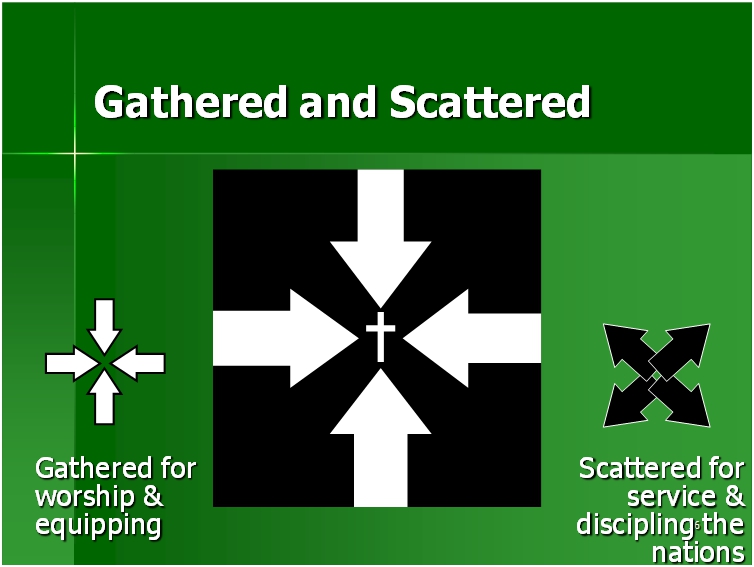
5. What does the Church do?  The church exists in two modes:

  • We gather for worship.
  • We scatter for mission.

II. BODY

We will now take a deeper look at what it means to gather for worship and scatter for mission

  • Gather for worship
  • Requires purposeful participation — moving from passive observation to active participation.

(Our identity) Eph 1: Blessed be the God and Father of our Lord Jesus Christ, who has blessed us with every spiritual blessing in the heavenly places in Christ, 4 just as He chose us in Him before the foundation of the world, that we would be holy and blameless before Him. In love 5 He predestined us to adoption as sons through Jesus Christ to Himself…”

Even before He made the world God chose you and adopted you, it gave Him great pleasure, God loved, chose, and adopted you.  You are His unique and special possession.

This is what we need to see: Coming is not an event; it is the fulfillment of God’s prehistoric (pre-history) desire.  God created Adam and Eve – it was good.  God wanted to be with people… (Some of you don’t even want to be with people J)

OT – they built a Tabernacle because God wanted to meet with His people.

It’s not our desire – it’s God’s desire – made possible by the blood of Jesus.  Church is not primarily about us – it’s primarily about God.

**We gather to, for, and around Jesus.

Our being here is all about Him – and sometimes competes with our expectations, needs, and desires.

Jesus is the head, the goal, chief shepherd – He’s the Sr. Pastor. He owns and loves the Church. He’s the object our worship, our preaching, and our mission.

The church is all about Him.  It’s not about music or the preaching – although, hopefully they are both focused on worshiping Jesus.

The music and the sermon are BOTH acts of worship (difference between a lecture and a sermon… “if people are taking notes at the end of a sermon it might not BE a sermon…”

If your Christianity is just about going to church then you don’t have Christianity, you have “Churchianity.”

Exalting only Jesus – giving all of our attention to Jesus

Sometimes it’s a sacrifice of praise (Hebs)

Our destination is always Jesus – give ourselves and assume a posture of personal humility, worship, and prayer.

Christ is present and available.

Ps 116:  1 I love the LORD because he hears my voice
and my prayer for mercy.
2 Because he bends down to listen,
I will pray as long as I have breath!
3 Death wrapped its ropes around me;
the terrors of the grave overtook me.
I saw only trouble and sorrow.
4 Then I called on the name of the LORD:
“Please, LORD, save me!”
5 How kind the LORD is! How good he is!
So merciful, this God of ours!
6 The LORD protects those of childlike faith;
I was facing death, and he saved me.
7 Let my soul be at rest again,
for the LORD has been good to me.
8 He has saved me from death,
my eyes from tears,
my feet from stumbling.
9 And so I walk in the LORD’s presence
as I live here on earth!
10 I believed in you, so I said,
“I am deeply troubled, LORD.”
11 In my anxiety I cried out to you,
“These people are all liars!”
12 What can I offer the LORD
for all he has done for me?
13 I will lift up the cup of salvation
and praise the LORD’s name for saving me.
14 I will keep my promises to the LORD
in the presence of all his people.

15 The LORD cares deeply
when his loved ones die.
16 O LORD, I am your servant;
yes, I am your servant, born into your household;
you have freed me from my chains.
17 I will offer you a sacrifice of thanksgiving
and call on the name of the LORD.
18 I will fulfill my vows to the LORD
in the presence of all his people—
19 in the house of the LORD
in the heart of Jerusalem.

Praise the LORD!

Scatter for mission

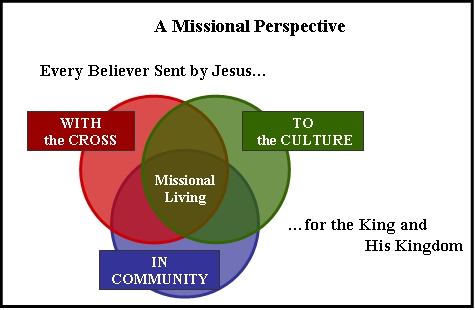
The term “missional church” may be a new term for you.  Here is the main idea:  We serve a missionary God, who crossed the ultimate cultural contexts to become one of us.  Jn 1:14 (MSG) The Word became flesh and blood, and moved into the neighborhood.

The Father sent the Son, the Son sent the Holy Spirit – and the Holy Spirit sends us.

Attractional model vs. a missional model.  In the end we want both.

What we are seeking to accomplish here at SBF can be defined as a “missional reorientation.”

At a very deep level we are redefining success:  It’s not about the 3 B’s (building, budget, and butts); it’s about how many people are we training and sending to be missionaries in their unique spheres of relationships.

Mat 28:18-20: 18 And Jesus came up and spoke to them, saying, “All authority has been given to Me in heaven and on earth. 19 Go therefore and make disciples of all the nations, baptizing them in the name of the Father and the Son and the Holy Spirit, 20 teaching them to observe all that I commanded you; and lo, I am with you always, even to the end of the age.”

Three things:

  1. All authority has been given to Jesus – and He is with us/you always. Our responsibility is basically twofold: a) stack kindling and b) splash (preach).  (D.L. Moody – At any moment we ought to be willing to preach, pray, or die.)
  2. “Go therefore” (Go ye) is the mission of the church.  Are we a “come ye” church, or a “go ye” church?
  3. Make disciples.  I’d like you to view every single person in your various spheres of relationship as a disciple…

[1] To “change or exchange” – it is God moving from hostility to friendship. Reconciliation is what God accomplishes, exercising His grace towards sinful humankind because of the sacrificial death of Christ in propitiatory [or appeasing] sacrifice under the judgment due to sin.

[2] The quotation “The lady doth protest too much, methinks.” comes from Shakespeare’s Hamlet, Act III, scene II. The phrase has come to mean that one can “insist so passionately about something not being true that people suspect the opposite of what one is saying.”
Start A Community Group!!

Community Groups:

One of the goals of this transition season at Southside is to see multiple groups of individuals and families sharing life together and living life on mission – serving the city and each other. We are seeking to be theological, relational, and missional. This can occur in multiple ways.

Community Groups will be a venue in which believers and unbelievers alike can gather together to dialogue about what is being taught in our Sunday gatherings. There are at least four integral components of a community group: 1) Worship – to meet with God and to know Him is our highest priority. 2) Conversational Prayer and Mutual Ministry – having a conversation together with God is an essential way to build unity; first by praising God and then by praying in response to the needs expressed. 3) Application of the Bible – we will seek not just to talk about the Bible, or about each other. Rather, we want our groups to seek to be transformed by the truth of the Gospel. So we will do our best to apply the truths learned to our everyday lives. 4) Sharing a Life – there’s nothing like an honest testimony to illustrate what is being taught.  When a person shares with the group, s/he feels more a part of the group. The objective of the leader is not to be the authority or even the teacher, but the guide.

Also, Community Groups are missional communities that will act as missionary teams, seeking the good of their unchurched family, friends, co-workers, and neighbors. They will be concerned with praying for and serving their sphere of relationships in such a way as to let them know that we are Christ’s disciples because we love one another.

Finally, and most simply stated, our community groups are networks of Christ-centered relationships. They are friends seeking to learn how to “speak the truth in love” to one another. They spend time together, meet one another’s needs, watch one another’s kids, bear one another’s burdens, encourage one another, challenge one another, hold one another accountable, rejoice with one another, weep with one another, correct one other, be corrected by one another.

This is gospel community. It is not natural. It is not easy. It is messy. It can be frustrating. But it is good, and it will change you.

Gathering for Worship:

This is perhaps what most people think of as “Going to Church.” Church, however, is not an event, or a ceremony – it is people. Those who have been saved by God’s grace have been saved into God’s family, into a community. So it is only natural for local pockets of this family to come together and celebrate what God has done in Jesus. We come together to celebrate the truth of the gospel and to rehearse the gospel by singing it, praying it, hearing it preached, and seeing it in communion and (God-willing) baptism. We come together to encourage and be equipped for lives on mission. Expect mostly expositional preaching (verse by verse through books of the bible), seeking to exalt Christ and unpack the gospel in every text. Expect communion often, if not every week, (we like remembering the gospel as many times in as many ways as possible.) Expect to be told the truth – no pulled punches. We won’t “Go to church.” The Church will gather.

Discipleship (Life-Long Learning)

We believe that gospel-centered (or Christ-centered) living will make us desperate for theology and that our worship gathering will whet your appetite for theology. However we see a huge need for an ever-increasing understanding of our faith. We live in an age of skepticism and relativity. In many places Christ and the church have been pushed to the margins of society instead of existing at the center. We believe that Christianity is a relational worldview that is complex, beautiful, and meaningful. We believe that if we are going to be effective missionaries we must understand our Bibles, love what it teaches, and proclaim its contents. We all have a lot to learn, and we envision venues within Southside that will take time to work through learning the central truths of our faith.

The Person and Ministry of the Holy Spirit

I. INTRO

Today we are studying the Person and ministry of the Holy Spirit.  We want to establish an ongoing theological[1] dialogue (vs. discussion).

Picture a continuum:

  • On one end of the continuum is what John MacArthur has called, “Charismatic Chaos.”
  • On the other end of the continuum is 2 Tim 3:5 – holding to a form of godliness, although they have denied its power.”

We don’t want to base our theology and practice solely on what we’re against, but what we are for – what we can embrace theologically.

My personal core values (unapologetically): As an active intentional follower of Christ, as a husband, as a father, as a grandfather, as a pastor, as a friend/mentor/coach:

  1. Theological – The study (and subsequent worship) of God is our highest calling.
  2. Relational – We are to love God, one another, and “seek the welfare of our city.”
  3. Missional – We serve a missionary God and we are called to be on mission with Him.

What will be our guidelines for theological engagement at SBF?

We want to work with what the Bible clearly and plainly teaches (today we will, eventually, consider the biblical phrase: baptism of the Holy Spirit).

First, I would like to define some terms:

Three primary (and overlapping) theological camps in U.S. Protestantism:[2] Fundamentalism (“orthodoxy in confrontation with modernity” -James Davison Hunter), Evangelicalism ( Biblicism, Christocentrism, Crucicentrism, Conversionism, Activism),[3] and Liberalism (individualism, ecumenism, empericalism, skepticism, anthropological optimism, rationalism, ethicalism, social idealism, immanencism). Within Evangelicalism there is also three main camps (think of them as state boarders vs. national boarders…):

1.  Dispensationalism  –

Sees God as structuring His relationship with humankind through several stages of revelation. Each dispensation amounts to a “test” of humankind to be faithful to the particular revelation given at the time.

Dispe1nsationalism holds to a literal meaning behind all the figurative passages.

As a result of this literal interpretation of Scripture, dispensationalism holds to a distinction between Israel (even believing Israel) and the church. On this view, the promises made to Israel in the OT were not intended as prophecies about what God would do spiritually for the church, but will literally be fulfilled by Israel itself (largely in the millennium). For example, the promise of the land…

2.  Covenant Theology

Covenant theology believes that God has structured His relationship with humanity by covenants rather than dispensations. Old Covenants (OT) and the New Covenant (NT). These covenants are not new tests, but are rather differing administrations of the single, overarching covenant of grace.

Adam sinned and broke the initial, or old, covenant, and thereby subjected himself and all his descendants to the penalty for covenant-breaking — which is condemnation.

God in His mercy instituted the “covenant of grace,” through Jesus Christ, which is the promise of redemption and eternal life to those who would believe in the (coming) redeemer.

3.  New Covenant Theology

The essential difference between New Covenant Theology (NCT) and Covenant Theology (CT) concerns the Mosaic Law. CT holds that the Mosaic Law can be divided into three groups of laws: a) civil law, b) ceremonial law, and c) moral law. According to CT the ceremonial law and civil law are no longer in force because they were fulfilled in Jesus, but the moral law continues.

NCT argues that we cannot divide the law up in that way – so, the whole Mosaic Law is canceled by the coming of Christ (Christ Event) and is no longer binding on the believer.  The Mosaic Law has been replaced by the law of Christ.  Love God and love your neighbor as your self.  Proponents of NCT might say something like, “Love God with all your heart, mind, and soul – and do whatever you want…”  They may also quote 1 Cor 6:12: All things are lawful for me, but not all things are profitable.”

Do we have to choose one — Dispensational, Covenant, or New Covenant?? No, it’s just good to be aware of these distinctions as we build a theological framework.  Can we achieve doctrinal certainty?  Not completely on this side of eternity.  God and theology are much deeper and more mysterious that we could ever hope to grasp.

Having said that, the Five Solas are five Latin phrases (or slogans) that emerged from the Protestant Reformation that are intended to summarize the Reformers’ basic theological principles in contrast to certain teachings of the Roman Catholic Church of the day. “Sola” is Latin meaning “alone” or “only” and the corresponding phrases are:

  • Sola Fide, by faith alone.
  • Sola Scriptura, by Scripture alone.
  • Solus Christus, through Christ alone.
  • Sola Gratia, by grace alone.
  • Soli Deo Gloria, glory to God alone.

These solas will hold us in good stead as we refurbish our theological base during this transition season.  Can we move toward doctrinal clarity?  Yes!

4.  Eschatology — Greek éschato: last + -logy. 

We do not need to get caught-up in the rapture debate.

Mat 24:44 – “For this reason you also must be ready; for the Son of Man is coming at an hour when you do not think He will.”

As a church we will teach people to endure tribulation – and if Jesus come early, it won’t matter.

We will encourage our congregation to read Revelation devotionally.  Encounter the risen Christ in Rev 1…

5.  Holy Spirit Empowered Gifts

Cessationism – The spiritual gifts, primarily those listed in 1 Cor 12:4-11, have ceased.  The key verse is 1 Cor 13:10 —  but when the perfect comes, the partial will be done away.”

1 Cor 14:1: “Pursue love, yet desire earnestly spiritual gifts, but especially that you may prophesy.”

James 5:14-15: “Is anyone among you sick? Then he must call for the elders of the church and they are to pray over him, anointing him with oil in the name of the Lord; 15 and the prayer offered in faith will restore the one who is sick, and the Lord will raise him up, and if he has committed sins, they will be forgiven him.”

While fear of a loss of control or emotionalism my drive some cessationists, their overwhelming desire is to protect the unique authority of the Bible and to protect the closed canon and not to have anything compete with Scripture in authority in our lives.

Continuationism – All the gifts are for today.  Consider  the context: 1 Cor 11, 12, 13, & 14…

II.  BODY

The Person of the Holy Spirit

“The Trinity: God eternally exists as three persons, Father, Son, and Holy Spirit, and each person is fully God, and there is one God.  -Wayne Grudem

“In no other subject is error more dangerous, or inquiry more laborious, or the discovery of truth more profitable.”  –Augustine, On The Trinity[4]

C.S. Lewis described the Trinity as a “dance” saying, “God is not a static thing…but a dynamic, pulsating activity, a life, almost…a kind of dance.”[5]

Tim Keller elaborates on this concept in the Reason for God in Chapter 14 – The Dance of God.[6]

The early leaders of the Greek NT church had a word for this – perichoresis.  Notice the root of our word ‘choreography’ within it. It means literally to “dance or flow around.”

The Father…Son…and Holy Spirit glorify each other…At the center of the universe, self-giving love, joy, delight – perfect fellowship is the dynamic currency of the Trinitarian life of God. The persons (not personalities) within the God-Head exalt, commune with, and defer to one another…

When early Greek Christians spoke of perichoresis in God they meant that each divine person harbors the others at the center of His being. In constant movement of overture and acceptance each person envelops and encircles the others.

When Jesus died for you He was, and is, inviting you into the dance…when we discern Jesus moving toward us and encircling us with infinite, self-giving love, we are invited to put our lives on a whole new foundation…

Since the Holy Spirit is the third person of the Trinity and is true and eternal God, then we must invoke, worship, and serve the blessed Holy Spirit, even as we do God the Father and God the Son.

Jesus taught us to do this in Mat 28:19 (The Great Commission): Go therefore and make disciples of all the nations, baptizing them in the name of the Father and the Son and the Holy Spirit.”

Now let’s consider the phrase “baptized with the Holy Spirit.”

The Holy Spirit is to be more than a doctrine.  The Holy Spirit is to be experienced.

Gordon Fee wrote, God’s Empowering Presence: The Holy Spirit in the Letters of Paul.  It’s 992 pages; Fee highlights, analyzes, exegetes, and summarizes every mention of the Holy Spirit in Paul’s writings. Pneumatology (the study of the Holy Spirit).

His findings can be reduced to three words:  “God’s empowering presence.”

Fee concludes that, for Paul, the Holy Spirit was more real and evident than we can possibly imagine in our day and age, the vital and experienced presence of the Holy Spirit was an assumed reality.

How do we experience the Holy Spirit?  Gal 5 is about “walking in the Holy Spirit.”  Paul says in the first 12 verses that they have opted for legalism (or moralism).

Then in verses 13-14 Paul lays it out: “…but through love serve one another. 14 For the whole Law is fulfilled in one word, in the statement, “YOU SHALL LOVE YOUR NEIGHBOR AS YOURSELF.”  Paul takes them back to the Great Commandment: Love God with your whole heart, soul, and mind – and love your neighbor as yourself.”

And then here is the evidence of the Holy Spirit…Paul calls it “fruit.”  “But the fruit of the Spirit is love, joy, peace, patience, kindness, goodness, faithfulness, 23 gentleness, self-control” (Gal 5:22-23).

The baptism of the Holy Spirit means to be immersed in the Holy Spirit.  No power, no Spirit.  (Holy Spirit power is different than will-power.)

Four Reasons Why It Is Appropriate To Expect To Experience the Holy Spirit Baptism:[7]

1.  Terminology — The very term “baptized in the Holy Spirit” implies an immersion in the life of the Spirit. (Refer to hand out…)

2.  Power, Boldness, and Confidence

Jesus says in Acts 1:5 and 8 that baptism in the Holy Spirit means, “You shall receive power…and you shall be my witnesses.”

This is an experience of holy boldness, confidence, and victory over sin.

A Christian without power is a Christian who needs a baptism in the Holy Spirit.

Eph 5:18 – we are to be continually and regularly “filled with the Holy Spirit.”  The verb filled has an imperative mood meaning it is a command and addresses the volition and the will.  Why?  Because we leak…

There is no reason to think that for Paul the baptism in the Holy Spirit was limited to the initial moment of conversion. And for sure in the book of Acts the baptism in the Holy Spirit is more than a subconscious divine act of regeneration—it certainly seems to be a conscious experience of power (Acts 1:8).

3.  The Testimony of Acts — In Acts the Holy Spirit is not a silent influence but an experienced power. Believers experienced the baptism in the Holy Spirit. They didn’t just believe it happened because an apostle said so.

4.  It Is The Result of Faith

The fourth reason we should stress the experience of baptism in the Holy Spirit is that in Acts the apostles teach that it is a result of faith.

In Acts 11:15–17 Peter reports how the Holy Spirit fell on Cornelius just as on the disciples at Pentecost. “As I began to speak, the Holy Spirit fell on them just as on us at the beginning. I remembered the word of the Lord, how he said, ‘John baptized in water, but you shall be baptized in the Holy Spirit.’ If then God gave the same gift to them as he gave to us, when we believed in the Lord Jesus Christ, who was I that I should withstand God?” 

Notice that the gift of the Spirit, or baptism in the Holy Spirit, is preceded by faith. The NASB correctly says in v. 17 that God gave the Holy Spirit after they believed.

How to Receive the Gift of the Holy Spirit.[8]  Peter’s instructions for how to receive the gift of the Holy Spirit in Acts 2:38–41…

1.  The Word of God Must Be Heard.  Peter has preached that in God’s plan Jesus was crucified, raised, and exalted as Lord over all the universe and that forgiveness of sin and spiritual renewal can be had from Him. God’s Word has been heard.

2.  God Must Call People To Himself.

The sovereign God must call men and women to himself, or we will never come. Verse 39: “The promise is to you and to your children and to all that are far off, everyone to whom the Lord our God calls to him.”

No one comes to faith in Christ unless the Father draws him (John 6:44, 65). The proclaimed gospel is heard with conviction and power only when the effectual call of God lays hold on the hearers.

3.  We Must Receive the Word.

Third, we must “receive the word.” Verse 41: “So those who received his word were baptized.”

Receiving the Word means that it becomes part of us so that we trust the Christ it presents.

  • We trust His provision for your forgiveness.
  • We trust His path for your life.
  • We trust His power to help you obey.
  • And we trust His promises for your future.

Radical commitment to Christ always involves repentance—a turning away from your own self-wrought provisions, paths, powers, and promises. And when we really turn to Christ for new paths, power, we open yourself to the Holy Spirit, because it is by His Spirit that Christ guides and empowers.

4.  We Express Our Faith Through Water Baptism.

Finally, we give an open confession and expression of faith in the act of water baptism (full immersion – like with the Holy Spirit, do you want to be sprinkled or immersed?) in obedience to Jesus Christ.

Baptism was the universal experience of all Christians in the New Testament. There were no unbaptized Christians after Pentecost. Christ had commanded it (Matthew 28:18f.) and the church practiced it. So we do today.

III. CONCLUSION

Finally, let’s affirm and critique the Charismatic and Pentecostal Movements:

Affirmation:

The most positive thing about the moderate Charismatic/Pentecostal teaching is that it is theologically appropriate to stress the experiential reality of receiving the Holy Spirit.

When we read the NT honestly, we can’t help but notice a BIG difference from a lot of our contemporary Christian experience.

For them the Holy Spirit was a fact and reality of experience.  For many Christians today it is only a fact of doctrine.  The Charismatic renewal has something to teach us here.

Critique:

That the unity of their fellowship is too often based around their experience – not theology.

Whether Paul sought to bring encouragement or correction to the churches in the NT, he wrote theological essays… Paul generally spends the first half of his letters laying out theology and the second half he describes how to implement, or engage, the theology.

When Paul wanted to go to the church in Rome and develop them into a missional sending church (for his intention to travel to Spain), what did he write?  Theology.  Experience is the fruit of biblical theology, not the goal.  Our impatience tends to confuse fruit for goals (e.g., love, joy, peace, etc. cannot be pursued on their own accord, they are the “fruit” of the settled presence of Christ in our hearts/lives).

This brings me to my second critique:  The gifts of the Holy Spirit were given for the purpose of mission and not personal gratification.  One good description of the kingdom of God is:  speaking the words of Jesus and doing the works of Jesus.  Words and works help to make the invisible kingdom visible.

We serve a missionary God:

The Father sent the Son, the Son sent the Holy Spirit, and the Holy Spirit sends you.

The ministry of the Holy Spirit is, basically, 4-fold: He 1) Saves, 2) Seals, 3) Sanctifies, and 4) Sends.

My prayer for us as a community of believers: “That we would experience Jesus Christ, the sovereign, risen, living, Lord of the universe; and that He would continue to become THE source and content of our real hope and joy.”

This coming Sunday:  Beatitudes.  Read Matthew 5:1-12.  See you then!!


[1] Theology means the study of God.

[2] Protestant Reformation – Martin Luther is regarded as the primary catalyst when he nailed his Ninety-Five Theses to the church door at Wittenberg for the in 1517.  (While Pope Leo was corrupt, the upshot of Luther’s theses was that followers of Christ are saved by grace alone, through faith alone.)

[3] Triperspectivalism (cut-and-paste this word and search for it on this blog and you will find an article).

[4] Book 1.3.5.

[5] Mere Christianity: 136.

[6] Pgs 214-221.

[7] Adapted from John Piper.

[8] Also adapted from John Piper.

“Seeking the welfare” of the city of Manchester…

Below is an excellent quote from Howard Snyder that helps us to distinguish between church and kingdom.  We have started to learn the difference at Southside…

Basically kingdom ministry is the goal and and church becomes the fruit, or receptacle, of kingdom ministry.  What is kingdom ministry?  One of the most basic of definitions is: speaking the words and doing the works of Jesus.  Jesus spoke truth at all times, and His words emanated from a heart filled with of deep compassion, empathy, and unconditional love.  The works of Jesus include loving, serving, feeding, prayer for healing, washing feet, speaking the truth in love, a sensitivity to the heart of the Father, etc.  Someone has humorously stated that, “Jesus came to comfort the afflicted and afflict the comfortable.”

Here’s what Paul told the Corinthians:

“For what have I to do with judging outsiders? Do you not judge those who are within the church?”  1 Corinthians 5:12

Our goal and motivation with outsiders is to speak and act in such a way as to point them to a loving Creator God who is alive and available for an intimate relationship.  (Who wouldn’t want that!?!?)  Notice there is judgement for those of us inside the church.  The Greek word is krinō and it basically means “to call into question” (see also Acts 23:6, 24:21).  There is accountability for our actions as members of God’s Church.

Kingdom is a gospel word — along with grace and cross.  It’s when we hold these three gospel words in appropriate tension that we engage the appropriate biblical expression of the Gospel (e.g. kingdom and grace without the cross will lead us into pluralistic liberalism, kingdom and cross without grace will lead us into moralistic legalism).

With all this in mind consider Snyder’s words:

“The church gets in trouble whenever it thinks it is in the church business rather than the kingdom business. In the church business, people are concerned with church activities, religious behavior in spiritual things. In the kingdom business, people are concerned with kingdom activities, all human behavior and everything God has made, visible and invisible. Kingdom people see human affairs as saturated with scriptural meaning and kingdom significance. Kingdom people seek first the kingdom of God and its justice; church people often put church work above concerns of justice, mercy and truth. Church people think about how to get people into the church; Kingdom people think about how to get the church into the world. Church people worry that the world might change the church; Kingdom people work to see the church change the world… If the church has one great need, it is this: to be set free for the kingdom of God, to be liberated from itself as it has become in order to be itself as God intends.”[1]

Southside: Lets “go ye…” to Manchester.

If you haven’t already, grab one of those Missional Prayer Guides in the foyer and fill it out (it’s pretty self-explanatory), place it in your Bible, and pull it out a few times a week to pray acquaintances, friends, and family across the page (right to left).  And don’t forget to use a pencil…


[1] Howard A. Snyder. Liberating the Church, The Ecology of Church and Kingdom, Inter-Varsity Press 1983:11.