The Upside Down Life (#1) – An Indepth Look At Matthew 5:1-16

The Way In Is the Way On.  An Overview of the Beatitudes…

I. INTRO

I have been serving here at SBF for 11 months now – and I can tell you that everything we have been studying up to this point has been preparing us for the study we are about to embark on…

We will take our time and work through the first 16 verses of Mathew 5.  These are also the first 16 verses of the most famous sermon of all time – The Sermon on the Mount (SOTM), which consist of chapters 5-7.  They are all red-letter verses, in other words these are the words of Jesus.

Here’s what John Stott the late pastor, author, and missiologist has said about the SOTM:

“The Sermon on the Mount is probably the best-known part of the teaching of Jesus, though arguably it is the least understood, and certainly it is the least obeyed. It is the nearest thing to a manifesto that he ever uttered, for it is his own description of what he wanted his followers to be and to do.”[1]

Now, reading the SOTM only takes about 10 minutes so it’s widely thought that Matthew is giving us the “Cliff Notes” version (i.e., highlights).

We need to make some theological distinctions as we lean into the Beatitudes and the SOTM…

Some of the theological roots of SBF include what’s known as a dispensational[2] view of the Bible.

Dispensationalists and most of the rest of Evangelicalism would differ on the interpretation and application of the Beatitudes (and the SOTM).

Classical dispensationalism would argue that the Beatitudes (and the SOTM) are not gospel but pertain to life in the millennial kingdom after to the second coming of Christ.[3] (If you have a Scofield Study Bible – that would emphasize the classical view of dispensationalism.)

It should be noted that there are more moderate views of dispensationalism.  If you have a Ryrie Study Bible – he’s a more moderate dispensationalist.  Yet he would still believe that primary fulfillment of the Beatitudes (and the SOTM) are in the millennial kingdom.[4] (Popular contemporary dispensationalists include John MacArthur and Charles Swindoll.  I have also heard that John MacArthur has become more moderate in his dispensationalism, but I don’t have first hand knowledge of that.  Charles Swindoll would also be considered a more moderate dispensationalist.)

The basic evangelical approach is to recognize that the kingdom of God has come in the person and work of Jesus. (Mk 1:15: “kingdom of God is at hand; repent and believe in the gospel). This “kingdom now” theological perspective teaches that Jesus established the kingdom of God (KOG) at His first coming and will consummate the KOG at His second coming – and we live in the age (or dispensation) between the two.  One theologian, George Ladd, has said we live in the presence of the future – between the already and the not yet.[5]

So, how will this affect our study of the Beatitudes?  I believe the Beatitudes (and the SOTM) ARE for today – and that they are the means to allowing the gospel to be worked into our lives – and then through our lives to others.

Here’s how I would say it: “The Gospel is not advice, it is news.”  (Jared Wilson, Gospel Wakefulness, Crossway 2011: 188.)  It is the ultimate Good News.  I would suggest to you that Sunday Services are not primarily the place to give advice… Gospel-centered (or Christ centered) change (i.e., sanctification) is rooted first and foremost in remembrance. We are to remind one another primarily of what Christ Jesus has done, not what we must do.

We cannot commend what we do not cherish.  -John Piper

And the essence of Christian maturity is when the Gospel – or, what Christ has done — gets worked IN – and then THROUGH our lives – which is what I’d like to spend our remaining time considering – and this will be the main intent of our series.

Today we will take a look at the Beatitudes.  Allow me to offer a few introductory thoughts.

II. BODY

Contained in the Beatitudes are eight qualities that characterize the life of Jesus Christ, and therefore, through conversion, they begin to characterize our life in Jesus Christ.  Jesus calls us to follow him, surrender to Him, and to depend upon His strength and power.

The word beatitude comes from the Latin word meaning “blessed.”

More specifically the word means exalted joy, or true happiness. (Joy is not always exuberant, but can also be described as calm delight in even the most adverse circumstances.  Joy fueled Paul’s contentmentPhil 4:11.)

With the beatitudes, Jesus dives into our innermost being probing the heart and raising the question of motive.  (This is why, at face value, it’s harder to be a Christian than Jewish…)

What made Jesus a threat to everyone and the reason He was eventually killed was that in His encounters with people (particularly the religious leaders), He exposes what they were on the inside.  Some people find it liberating – others hate it.  (Mat 23:27: hypocrites and whitewashed tombs.)

The Beatitudes, I have come to see, is our surrendered response to the Gospel.  I see the Beatitudes as a step-by-step spiritual formation process that moves us toward spiritual depth and maturity.  This becomes cyclical as we grow deeper and deeper in our faith.  The Beatitudes become the outworking of the Gospel IN and THROUGH our lives.

1. Blessed are the poor in spirit…

“You’re blessed when you’re at the end of your rope.  With less of you there is more of God and his rule.” (Petersen – MSG)

Another translation renders this verse, “Happy are those who know their need for God.” (JBP)

What does it mean to be “poor in spirit”?  A desperateness of soul that is weary of living in it’s own strength and longs for God’s mercy and grace to come and refresh the soul.  In a word, it is DESPERATION.

Prodigal Sons (Lk 15:11-32) The younger prodigal came to the end of himself (v.17) and though he had no idea of the Father’s love, made his way home.

In the recovery movement this would be similar to steps 1 & 2:

  • Step 1 – We admitted we were powerless over our addiction – that our lives had become unmanageable.
  • Step 2 – Came to believe that a Power greater than ourselves could restore us to sanity.

2. Blessed are those who mourn…

I have a river of sin in my life – with 3 primary tributaries…

  1. Original sin (Adam & Eve traded the presence of God for the knowledge of God – and that’s been our core tendency ever since…).
  2. Family of origin issues. (We all have negative traits and generational sin patterns that we bring into our Christian experience.  Are you in touch with yours?)
  3. My own dumb choices.

As we are honest about the sin that has infected us there will be a transforming grief and accompanying repentance, that surfaces – not only for our own lives, but also for the injustice, greed, lust, and suffering that grips our world.

I want to own my sin everyday.[6]

This is where the upside down life comes into play.  The Beatitudes are counterintuitive (paradox: seeming contradiction).  We go down to go up; death precedes resurrection; we get to joy by traveling through grief.  Our soul wants to find a way around grief, but God says, “No, you must travel through grief – and the good news is, He says, “I’ll go with you and we will do it in My strength and power.”

The way of the Gospel is a death and resurrection cycle…

**The gospel has the greatest potential to captivate us when we understand that we are more depraved than we ever realized and simultaneously more loved that we ever dared to imagine.

3. Blessed are the meek…

Rick Warren would say, “Meekness is not weakness, but the power of your potential under Christ’s control.”  The concept of meekness describes a horse that has been broken.  We can either surrender to Christ and invite His breaking, or remain the undisciplined and wild stallion.

Grieving over sin and suffering grows meekness in us and delivers us into a humble learning posture (disciple means learner).

4. Blessed are those who hunger and thirst for righteousness…Spiritual hunger and thirst is the growing desire to be empty of those things that don’t reflect God, and initiates a deep longing for wholeness in our lives.

5. Blessed are the merciful…

Mercy is entering into another persons feelings – attempting to see things from another person’s perspective – all with understanding AND acceptance…just like Jesus has done for us.

As we receive God’s mercy we begin to give mercy – to ourselves and to others.

6. Blessed are the pure in heart… Mercy cleanses our heart and restores purity to our lives.

Did you know that your virginity CAN be restored?

2 Cor 11:2For I am jealous for you with a godly jealousy; for I betrothed you to one husband, so that to Christ I might present you as a pure virgin.

7. Blessed are the peacemakers…

Purity gives way to a personal serenity and peacefulness.  Peace is not the absence of conflict, but the absence of anxiety in the midst of inevitable conflict – and when others encounter it, they want it too.

Our Western concept of peace needs to be considered in the light of the ancient Hebrew concept of peace, which is SHALOM — and means more than our limited understanding of peace (i.e., the lack of conflict).

Biblical SHALOM means a universal flourishing, wholeness and delight; a rich state of affairs in which natural needs are satisfied, natural gifts are fruitfully employed — all under the arc of God’s love. Shalom is the way things ought to be.

Neal Plantinga – “the webbing together of God, humans, and all creation in equity, fulfillment, and delight.”

I will also say there is a difference between a peacemaker and a peacekeeper.

To be a peacemaker does not mean peace at any cost.  Peacekeeping creates a false peace.  Many of us live out our lives with this false peace and say nothing or do nothing to change it—in churches, homes, work places, marriages.

Examples:

  • Someone makes inappropriate sexual comments to you at work.  You know its not accidental because its repetitive and degrading.  But you keep your mouth shut because you know they’ll threaten your job or make you miserable if you say anything.
  • A family member makes a scene at a family gathering.  It embarrasses you, the rest of the family, but you say nothing.  You keep the peace because to go there would unearth a lot of stuff that you just aren’t willing to deal with.
  • Your spouse makes insulting remarks to you or humiliates you publicly through critical tone of voice.  It grates on you.  But you keep silent because you want to keep the peace.

8. Blessed are the persecuted… Living life from a kingdom of God perspective will place us in conflict with those that oppose it (usually it’s “religious,” moralistic people!).

III. CONCLUSION

Without the knowledge of our extreme sin, the payment of the Cross seems trivial and does not electrify or transform.  But without the knowledge of Christ’s completely satisfying life and death, the knowledge of sin would crush us – or move us to deny and repress it.

By walking the way of the Beatitudes we hold our depravity and the Cross in a healthy and dynamic tension that will lead to transformation and renewal.


[1] The Message of the Sermon on the Mount, InterVarsity Press, 1978:15.

[2] Dispensationalism is a theological system that teaches biblical history is best understood in light of a number of successive administrations (dispensations) of God’s dealings with humankind. It maintains fundamental distinctions between God’s plans for national Israel and for the New Testament Church, and emphasizes prophecy of the end-times and a pre-tribulation rapture of the church prior to Christ’s Second Coming.

[3] As one dispensationalist put it, “this Sermon cannot be taken in its plain import and be applied to Christians universally…It has been tried in spots, but…it has always been like planting a beautiful flower in stony ground or in a dry and withering atmosphere” (I. M. Haldeman, The Kingdom of God, p. 149).

[4] The moderate dispensationalist [still] views the primary fulfillment of the Sermon and the full following of its laws as applicable to the Messianic kingdom” (Dispensationalism Today, 107-08).

[5] A good primer on this alternative to dispensationalism view would be the “The Gospel of the Kingdom” by George Ladd.

[6] “None is righteous, no, not one.” Romans 3:10 (ESV)
And you were dead in the trespasses and sins in which you once walked, following the course of this world, following the prince of the power of the air, the spirit that is now at work in the sons of disobedience.” Eph 2:1-2 (ESV)

A Generous Life #5 (of 6) 2 Cor 9:1-7

Reciprocity Reconstructed – 2 Cor 9:1-7

 I. INTRO

Where are we headed today?  The BIG IDEA is reciprocity reconstructed.

I would like to begin, however, with a review of our foundational verse in this series – and in this section (chapters 7-8): 2 Cor 8:9.

Then we’ll define, deconstruct and then reconstruct this concept of reciprocity – and then use that concept to help us unpack the three key verses in our passage today (primarily vs. 6,7, & 8).

Part of the teaching today will be a critique of the so-called Prosperity Gospel, sometimes referred to as Health & Wealth or Name It And Claim It.  Sadly, this message has seeped into the Evangelical landscape of North American Christianity.  And what’s even sadder is that it is being exported to third-world countries through infected missionaries and ministries.  But more about that in a few minutes…

Let’s begin by going back to our foundational verse for this series: 2 Cor 8:9, which identifies Jesus Christ as the most generous life ever lived…

2 Cor 8:9: For you know the grace of our Lord Jesus Christ, that though He was rich, yet for your sake He became poor, so that you through His poverty might become rich.

This is a rich (no pun intended :)) theological statement, which anchors this section on practical Christian stewardship. It identifies the ultimate example of (self) giving – how and why Jesus so fully and completely gave Himself (Christology).

This verse invites us to ask and answer three questions:

1. How rich was He?  No one ever started so rich as the Lord Jesus Christ.

Ps 50:12b: “For the world is Mine, and all it contains.”

2. How poor did He become? No one ever became as poor as the Lord Jesus Christ.

2 Cor 5:21: “For our sake He made Him to be sin who knew no sin, so that in Him we might become the righteousness of God.”

3. How rich do we become? No one ever started out so poor and have become so rich as those who have placed their faith and trust in Jesus Christ for the forgiveness of sins.

Eph 1:3 – Blessed be the God and Father of our Lord Jesus Christ, who has blessed us with every spiritual blessing in the heavenly places in Christ.” [no need for a second blessing]

Our “riches” in Christ include: Justification, forgiveness, sanctification, the Holy Spirit, partakers of the divine nature, new heart, new will, new creation, imperishable inheritance — the inheritance is Him.  We’ve been invited into the Trinitarian dance…

OK, with Paul’s lesson of Christology, let’s consider Reciprocity Reconstructed.  What does reciprocity mean? (Definition, Deconstruction, Reconstruction)

Definition: rec·i·proc·i·ty [res-uh-pros-i-tee] noun

A reciprocal state or relation.

Reciprocation; or mutual exchange.

Deconstruction: The word reciprocity has been adulterated by the (so called) Prosperity Gospel movement (i.e., “word of faith,” “positive confession,” “health & wealth gospel,” etc.) claims the Bible teaches financial (& physical) blessing is the will of God for Christians. Their doctrine teaches that:

  • Faith,
  • Positive speech, and
  • Donations to Christian ministries

Will always increase material wealth and physical health.  At the root of this “false” doctrine is their belief that God’s promise of dominion to Israel applies to Christians today.

Paul clearly warns against the desire to be rich. And by implication, he warns against ministries who stir up – and teach the desire to be rich.

1 Timothy 6:9-10: “Those who desire to be rich fall into temptation, into a snare, into many senseless and harmful desires that plunge people into ruin and destruction. For the love of money is a root of all kinds of evils. It is through this craving that some have wandered away from the faith and pierced themselves with many pangs.”

Reconstruction: The reciprocity of the gospel exchanges my sin for Christ’s righteousness. Martin Luther calls it, “the great exchange”…

Luther says, “This is that mystery which is rich in divine grace to sinners: wherein by a wonderful exchange our sins are no longer ours but Christ’s, and the righteousness of Christ not Christ’s but ours. He has emptied Himself of His righteousness that He might clothe us with it and fill us with it; and He has taken our evils upon Himself that He might deliver us from them.”

So, the Health & Wealth folks have cheapened the concept of reciprocity – and made it about materialism.  Kind of an Americanized brand of Christianity…

II. BODY – now let’s take these concepts and move into our passage for today…I’ll give a cursory view of the first five verses and then we’ll unpack vs. 6,7, & 8.

The ministry of giving in Corinth – 9:1-5:

  • Paul’s reminding them of their initial commitment to give – vv. 1-2.  Paul’s comment that the Corinthians’ initial zeal to give stirred up “most” (v.2) of the Macedonians is a healthy dose of realism.
  • In other words, not all the believers in Macedonia gave generously with joy in the midst of their poverty and affliction (cf. 8:1-5).
  • In vs. 3-5 we see Paul’s purpose in sending Titus –
    • Paul’s initial excitement has been somewhat tempered. Titus has come from Corinth with the discouraging report that the collection has, basically, been put “on the back burner.”
    • Paul expresses some disappointment here these verses.  Paul views stewardship and living out the generosity of Jesus as an important component of discipleship.  Paul had hoped they were farther along.
  • He is also attempting to prolong the friendly competition between the Macedonians and the Corinthians.

Verses 6-11 help us to understand and apply the principle of reciprocity in Christian giving…

In v.6 we encounter the illustration of “sowing” and “reaping”

Now I’m not a farmer (I could kill an artificial plant!), but in farming, what may initially appear to be a loss (“sowing”) – in due time, it will produce a gain (“reaping”). As one sows, so one reaps.

So, we need to ask what determines whether a gift is “sparing” or “bountiful”?  It is not determined by the quantity, but by:

  • The means of the giver (we learned from chapter 8 that giving is to be in proportion to our wealth (cf. 8:3,11,12; 1 Cor. 16:2); and
  • The heart (mind/mood) of the giver (it is possible to give a lot of money, but still be sowing “sparingly” (cf. 8:1-5; 9:5b).

In v.7 we encounter the pattern for generous stewardship. There are six parameters:

  1. Universal (“Let each one…”)
  2. Personal (“just as s/he has purposed in his heart”). Many commentators say that if Paul had believed that we should begin our giving with a tithe, he would have reiterated that here.
  3. Choice/Resolve (“as he has purposed;” this verb proaireomai, found only here in the NT, means: to choose deliberately or to make up your own mind about something.)  In the end only you and God will know if you are sowing sparingly or bountifully.
  4. “Not Grudgingly,” or, without regret. Lit., “not out of sorrow;” i.e., giving and then grieving over the fact that money is gone; thinking of all the things you could have purchased with the money.
  5.  “Not Under Compulsion. No force – psychological, guilt-driven, or otherwise.
  6. Cheerful. The Greek word translated “cheerful” is hilaron, from which we get out English word “hilarious.”  What does it mean to be a cheerful, or hilarious, giver?  It means that we find our joy, our delight, our pleasure in the generosity of Jesus Christ and we give out of a worshipful, joyful heart – as we remember what Jesus Christ has done.  Is it an act of faith?  Yes.  We sow and we wait…

III. CONCLUSION

What if the cheerfulness of responsive obedient giving is not there?

I’ll suggest three things[1]:

  1. Don’t say it doesn’t matter how you feel. Confess the sin of joylessness (yes, joylessness is a sin). Acknowledge the coldness of your heart.  (Money might be one of your root idols!)
  2. Pray earnestly that God would give to you, or restore, the joy of responsive obedience.
  3. Go ahead and do the outward dimension of your responsive obedience in the hope that the doing will rekindle the delight.

Paul envisions us joyfully and bountifully sowing in the light of God’s faithfulness — that we might give as a response to His joyful sacrifice and righteousness. (Heb 12:2: “For the joy set before Him He endured the cross.”)


[1] Adapted from John Piper, Desiring God: 248-249.

A Generous Life #2 (of 6) 2 Cor 8:1-7

I. INTRO

The title of our series – A Generous Life – is what’s referred to in literature as a double entendre, which means it can be understood in two ways. (Often one meaning of a double entendre is innocent and the other is risqué.  In the case of our series title both meanings are scandalously grace-filled – but neither is risqué .)

  1. The first way to understand it is what we spoke about last week – The life of Jesus was the most generous life ever lived. In his unpublished essay on the Trinity, Jonathon Edwards writes, “God is infinitely happy in the enjoyment of Himself, in perfectly beholding and infinitely loving, and rejoicing in, His own essence and perfection.”[1] Our great God and Savior, Jesus Christ, left this “cocoon” of infinite perfection and with humility and generosity condescended into human history. And Philippians 2 tells us that, although He existed in the form of God, did not regard equality with God a thing to be grasped, 7 but emptied Himself, taking the form of a bond-servant, and being made in the likeness of men. 8 Being found in appearance as a man, He humbled Himself by becoming obedient to the point of death, even death on a cross.” (vs. 6-8).
  2. The second way to understand our series title is that you and I have access to a holy capacity to live a generous life.  We see this in 2 Cor 8:1,“the grace of God which has been given in the churches of Macedonia.” It was not born out of their own strength or power – it was God blessing and enabling them (and us) to become outrageously generous.

Today we will begin to work through 10 Principles of Generosity that are found in these two chapters.  (Found in last weeks notes here on the Southside blog – and in the study guides, which are also available for download here on at the blogsite, or there are hardcopies in the lobby.)  We will work through two principles per Sunday for the next five weeks.  (Gene will be here next week.)

Before we get to todays principles, I’d like to provide a little bit of background:

First of all, notice the geography…

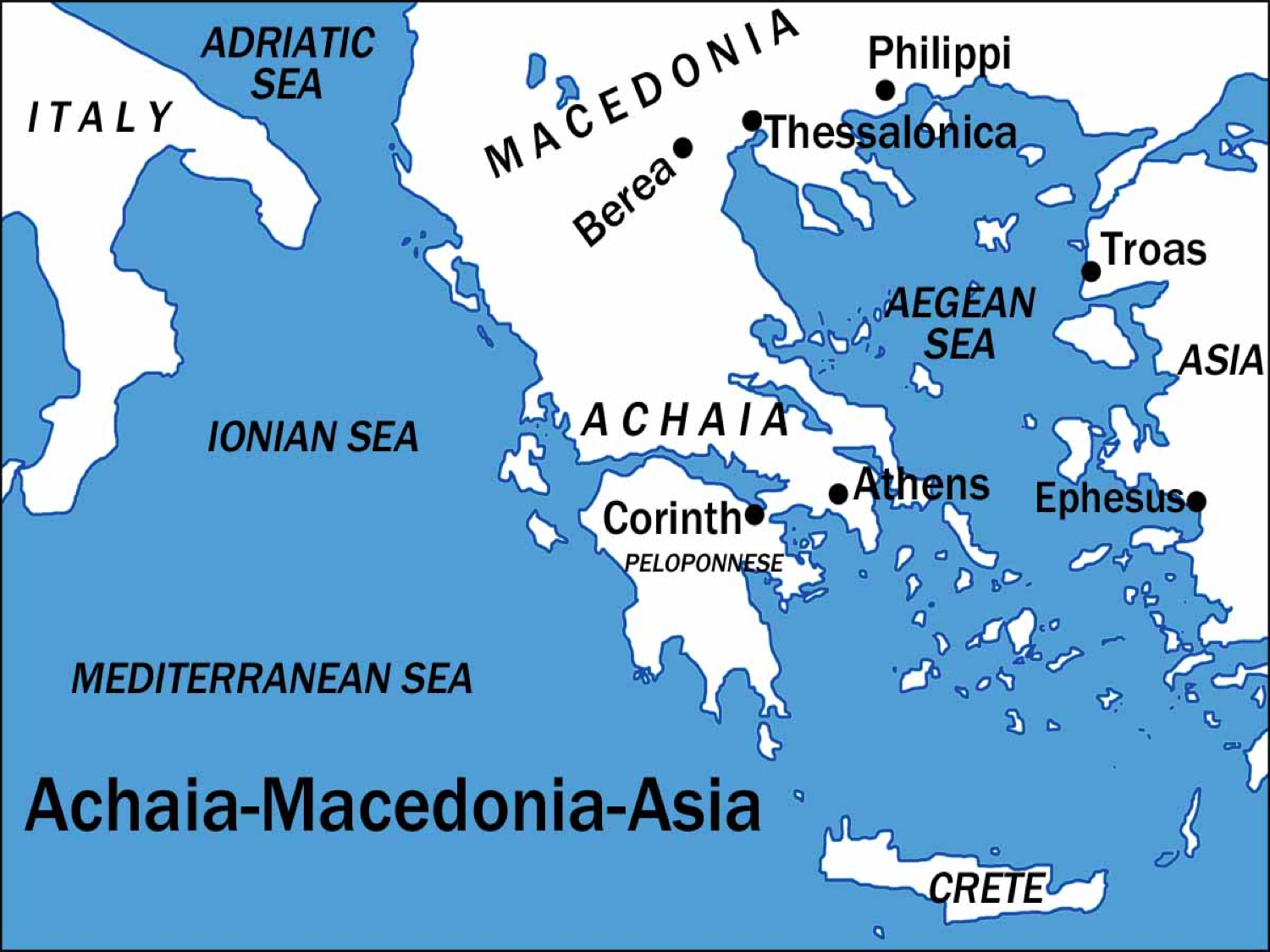
Macedonia is to the north of Corinth.

A commentator describes Macedonia as, “a splendid tract of land, centered on the plains of the gulf of Thessalonica…Running up the great river valleys into the Balkan Mountains, it was famous for its timber and precious metals. The churches of Macedonia had been planted by Paul on his second missionary journey.[2]

I think it’s important to notice that Paul is seeking to motivate the Corinthians through a  bit of competition. In the south, Macedonia was referred to as the “barbaric North” and the Greeks and Macedonians had a lengthy history of political rivalry.

And Paul was probably writing 2 Corinthians from Macedonia.

Corinth was a prosperous double-ported Roman outpost and colony of approximately 200,000 people that sat on a narrow strip of land (isthmus) between the Aegean Sea with the Ionian Sea (within the larger Mediterranean Sea).

Corinth was cosmopolitan in nature, and not unexpectedly, Corinth became notorious for luxurious and debauched living.  Some commentators liken it to San Francisco during the California gold-rush days.

We know from Paul’s letters to the Corinthians that they were a pretty carnal church.  They took the grace of God for granted, tolerating immorality in their midst and some were also getting drunk at their gatherings.  One commentator states the Corinthians were, “undisciplined extremists…setting a poor example for their pagan neighbors. They also did not take kindly to [Paul’s] authority.”[3]

What we have in Corinth is a young church that was not yet disciplined – financially or otherwise, and Paul is seeking to teach them by showing them the example of the Macedonian churches. Churches that were so exemplary in their financial stewardship and generosity, that they are mentioned four times in the New Testament as exemplary churches.  They represented the kind of church that we here at SBF aspire to be.

Both the Macedonian churches and the church at Corinth were struggling under an economic recession that’s not totally unlike the one we are experiencing.  But the Macedonians were suffering far more painfully than those who lived in Corinth. The economic downturn hit them, apparently, much harder.

II. BODY

So in chapters 8-9 Paul has 10 principles for them. We’ll look at the first two today. 

Money is one of the ways that we show that we belong to Jesus and understand His life and message.  Throughout the course of the Gospels Jesus talks about money approximately 25% of the time.  In Mathew 6:21 and Luke 12:34, He says that where our treasure is, our heart is.  In other words, our hearts are reflected in our finances.  And Paul is saying that generosity reveals the grace of God.

So, the principles that we will look at today are:

  1. Generosity is a work of Gods grace. (2 Cor 8:1-6)
  2. Generosity is both a work of God’s grace and a choice. (2 Cor 8:7)

Let’s look at them one at a time…

1.  “Generosity is a work of Gods grace.” (2 Cor 8:1-6)

1 Now, brethren, we wish to make known to you the grace of God which has been given in the churches of Macedonia, 2 that in a great ordeal of affliction their abundance of joy and their deep poverty overflowed in the wealth of their liberality. 3 For I testify that according to their ability, and beyond their ability, they gave of their own accord, 4 begging us with much urging for the favor of participation in the support of the saints, 5 and this, not as we had expected, but they first gave themselves to the Lord and to us by the will of God. 6 So we urged Titus that as he had previously made a beginning, so he would also complete in you this gracious work as well.

I observed an equation in verse two.  It’s counter intuitive…

A great ordeal of affliction + abundance of joy + deep poverty = liberality.

This leads me to a hypothesis (or proposition):  Any circumstance that includes great affliction and deep poverty, wherein we place our joy and comfort in the gift of God’s grace through Jesus Christ, will result in liberality.

If we place our joy and comfort in the god of money, and that god was crucified through an economic downturn, and showed few signs of resurrection, we have no reason for joy and generous liberality.  

If, however, our God is Jesus, then, our source of joy and generous liberality is still alive and well. Where there’s root, there’s fruit…

John Piper sums up the spiritual dynamics of this text by saying: Grace comes down, Joy rises up, and Generosity flows out.

This brings us to our second principle of generosity…

2.  Generosity is both a work of God’s grace and a choice. (2 Cor 1:7)

7 But just as you abound in everything, in faith and utterance and knowledge and in all earnestness and in the love we inspired in you, see that you abound in this gracious work also.

First of all, this verse is a summary (or synopsis) of 1 Corinthians – with a loving admonishment to share the grace God has given, or imparted, to them (“see that you abound”).

“When poverty-stricken Macedonians beg Paul for the privilege of giving money to other poor saints…it is an extension of their joy in God…They are denying themselvesbut the joy of extending God’s grace to others is a far better reward than anything money could buy.[4]

Three important points:

  1. Grace initiates all giving that glorifies God, otherwise we would take pride and praise for our support of others.
  2. This grace alone is the root of genuine joy. Otherwise joy is misplaced and dissipates when circumstances turn bad.
  3. Grace-given joy is always other-oriented.  When our giving germinates in the soil of grace, it blooms in generous bounty to those in need. Such is the nature of true love.

What we find in our study of stewardship and generosity is that the seed-bed, the foundation of it all is grace.

The grace of God, first and foremost, is the power of God’s Holy Spirit that converts the soul. It is the activity, the moving, of God whereby God saves and justifies us through faith (see esp. Rom. 3:24; 5:15,17).

Therefore, grace is not something in which we merely believe; it is something we experience as well.

Grace, then, is a dynamic and experiential reality that empowers the human heart to look beyond its limitations and accomplish things that defy rational explanation.

Grace is the power that enables impoverished and suffering saints to give when, by all accounts, they should be the ones to get. Such was the operation of grace in the giving of these Macedonian believers.

If we attempt to live generous lives out of our own soul or self will, we cut off the very grace that was given through Jesus.  “Soul grace” (we’ll call it) actually denies the deity of Jesus.

III. CONCLUSION

There is a prosperity gospel that is preached in many churches throughout North America.  (It’s particularly said because this Americanized version of the gospel is being exported around the world.)  Those who claim that God wants His people to be materially rich have missed the whole point of the gospel.  Having said that, I believe there’s one area that they don’t go far enough in…

Their mantra is that, “we give to get – and we can never out-give God.”  Is there truth in that?  [Yes.]

What the gospel tells us, however, is that giving to get does not go far enough.  We are to give to get, to give again – and again, and again…

GRACE GIVING (Version 2)

(This is our initial attempt to generate a formal statement regarding SBF’s stance on the stewardship of finances.  Please read it and make any comments or ask any questions that would help you to better understand what the Bible teaches us about money.)

So what’s the deal with “tithing”? The word tithe simply means “one-tenth.” Under the Law of Moses in the Old Testament, the Israelites were required to give in such a way that it amounted to a little over 23% of their income. The first was 10% of all of their possessions (Lev. 27:30–33; Num. 18:20–21), which was given to the Levites for Temple Ministry. A second was taken from whatever produce was left after the first tithe was given. Jewish interpreters consider this to be a second giving requirement for feasts and sacrifices (Deut. 12:17–18; Lev. 27:30; Num. 18:21). Finally, another tithe was given once every three years to support the poor (Deut. 14:28–29). On top of these giving mandates were the voluntary freewill offerings given out of their own will and desire above and beyond their normal giving (Ex. 35:29; Lev. 22:23; Ezra 3:5).

When it comes to the New Testament teaching on giving, we begin with the understanding that the Mosaic Law no longer binds us (Rom. 6:14). This leads us to the question, “Should we still give according to the Old Testament system, or are we able to give less – or even more?”

Concerning this, Paul wrote, “He who sows sparingly will also reap sparingly, and he who sows bountifully will also reap bountifully. So let each one give as he purposes in his heart, not grudgingly or of necessity; for God loves a cheerful giver. And God is able to make all grace abound toward you, that you, always having all sufficiency in all things, may have an abundance for every good work” (2 Cor. 9:6–8).

As Christians who are no longer under the Law, we give because of the grace that God has given us. In 2 Corinthians 8, Paul commends the believers in Macedonia for what is often referred to as “grace giving.” Paul describes the qualities of this benevolence as being generous (2 Cor. 8:2), willful (2 Cor. 8:3), directed by God (2 Cor. 8:5), shared (2 Cor. 8:6), active (2 Cor. 8:7), and motivated by love (2 Cor. 8:8). This kind of giving should not be done out of a “legalistic” mentality, but as the Lord leads you to give (2 Cor. 8:8).

It may be concluded that the Old Testament tithing system set a standard for giving, and that while we are no longer required under the Law to give, we are under grace—and our giving is to reflect this. We are not under compulsion to give; rather, we are to give cheerfully and prayerfully as God leads us. New Testament teaching places our giving in the category of an aspect of worship unto the Lord, which is why churches (usually) receive these tithes and offerings as a part of our corporate worship gatherings on Sundays. Additionally, many churches also make the option available to give privately via online debit cards, as that is now how many people handle their “crops.”


[1] An Unpublished Essay on the Trinity.

[2] Edwin A. Judge:1982.

[4] Desiring God: 104.

The Great Commandment Pt 2 – Matthew 22:39

Love Your Neighbor as Yourself

I.   INTRO/REVIEW

A.   We have been looking at what the Bible refers to as the Great Commandment, which is for us, important preliminary vision passage because it synthesizes so much of the Scripture into two VERY straightforward commands.

B.    (It is quite important for us to understand that when the NT authors declare God’s commands for us to be holy and to love our neighbor, etc. These commands are not there to show our ability, but to reveal our inability – and to remind us of our continual dependence on the grace of God to do in us and through us what we cannot do on our own.)

C.    Matthew 22:33-40 (NAS): “Teacher, which is the great commandment in the Law?” And He said to him, “ ‘YOU SHALL LOVE THE LORD YOUR GOD WITH ALL YOUR HEART, AND WITH ALL YOUR SOUL, AND WITH ALL YOUR MIND.’ This is the great and foremost commandment. The second is like it, ‘YOU SHALL LOVE YOUR NEIGHBOR AS YOURSELF.’ On these two commandments depend the whole Law and the Prophets.” (Notice the order – and notice that Jesus was asked to answer with one commandment, but He gave them two…)

D.   We have multiplied this passage into two messages…

  1. Last week: “You shall love the Lord your God with all your heart, and with all your soul, and with all your mind – this is the great and foremost commandment.” (Click here to read that post.)
  2. Review of last week: How do we love God?
  • Come alive to God.
  • Find your true joy and delight in the message of the Gospel – and the Person of Jesus Christ.
  •  Come to grips with the idolatry that grips ALL of our lives.

(i)    Idolatry is not just a failure to obey God; it is setting our heart and affections on something, or someone other than God.

(ii)  This cannot be remedied by repenting that you have an idol – or by engaging willpower to try and live differently.

(iii) If we uproot our idols (through repentance) but fail to plant the love of God (or, delight in God) in its place, the idol will grow back – like mowing a weed.  Repentance and rejoicing must go together.

E.  This week: (v. 39)“You shall love your neighbor as yourself.”  And here’s the questions we’re asking as we unpack these verses…

  • What is God’s heart/vision for Southside Bible Fellowship?
  • And for you?

II.  BODY

A.   The life-changing context of this commandment:

 ‘YOU SHALL LOVE YOUR NEIGHBOR AS YOURSELF.’ 40 On these two commandments depend the whole Law and the Prophets.”

  1. The overwhelming commandment to “neighbor love.”  Who is my neighbor?  This passage retold in Luke 10 – and is followed by Jesus unpacking the Good Samaritan and Mary and Martha.
  2. John Piper: This is a staggering commandment. If this is what it means, then something unbelievably powerful and reconstructing will have to happen in our souls.  It seems to demand that I tear the skin off my body and wrap it around another person so that I feel that I am that other person; and all the longings that I have for my own safety, health, success, and happiness I now feel for that other person as though s/he were me.

B.    Loving God is invisible. It is an internal passion of the soul. But it comes to expression when we love others.  (Similar to James 2:18: “I will show you my faith by my works.”)

  1. Idolatry and pride are at the root of our sinfulness.  Pride is the desire for our own happiness apart from God and apart from the happiness of others in God.
  2. Pride is the pursuit of happiness anywhere but in the glory of God and the good of other people.

C.   So, Jesus says, “Love your neighbor as yourself.”  How do we get there from here? Four points (adapted from John Piper):

1.     Understand that our self-love is a creation of God.

  • Jesus says in effect: I start with your inborn, deep, defining human trait—your love for yourself.  It’s a given.  Jesus is saying, I don’t command it — I assume it.
  • We all have a powerful instinct of self-preservation and self-fulfillment. We all want to be happy, to live and love with satisfaction, we want enough food, we want enough clothes, we want a place to live, we want protection from violence, we want meaningful or important work, we want sincere and meaningful friendships, and we want our lives to count!  All this is self-love.
  • Self-love is the deep longing to diminish pain and to increase joy. That’s what Jesus starts with when he says, “as yourself.”
  • This is common to all people. We don’t have to learn it, it comes with our humanity. Our Father created it. These longings are natural…

2.     Make your self-seeking the measure of your self-giving.

  • When Jesus says, “Love your neighbor as yourself,” the word “as” is very radical: That’s a BIG word: It means: If you are energetic in pursing your own happiness, be AS energetic in pursuing the happiness of your neighbor. If you are creative in pursuing your own happiness, be AS creative in pursuing the happiness of your neighbor. If you are persevering in pursuing your own happiness, be AS persevering in pursuing the happiness of your neighbor.
  • In other words, Jesus is not just saying: seek for your neighbor the same things you seek for yourself, but also seek them in the same way—with the same zeal, energy, creativity, and perseverance. The same life and death commitment when you are in danger.  Make your own self-seeking the measure of your self-giving.
  • Here’s where this gets difficult: We feel that if we take Jesus seriously, we will not just have to love others “as we love ourselves,” but we will have to love others “instead of loving ourselves.”
  • See the handout: “Developing Practical Skills to Love Well”… (This handout should be in the foyer at SBF.)

3.     It’s the first commandment that makes the second doable.

  • This is why the first commandment is the first commandment.
  • If we try to accomplish the 2nd Commandment without FULLY engaging the 1st it will become the suicide of our own happiness.
  • The 1st commandment is the basis of the 2nd commandment. The 2nd  commandment is a visible expression of the 1st commandment.

4.     Make God the focus of your self-seeking.

  • Take all your self-love—all your longing for joy, hope, love, security, fulfillment, and significance—take all that, and take it to God, until He satisfies your heart, soul, and mind.
  • What you will find is that this is not a canceling out of self-love. This is a fulfillment and transformation of self-love. Self-love is the desire for life and satisfaction rather than frustration and death.
  • God says, “Come to me, and I will give you fullness of joy. I will satisfy your heart, soul, and mind with My glory. This is the first and great commandment…
  • And with that great discovery—that God is the never-ending fountain of our joy—the way we love others will be forever changed.
  • Our quest for joy and happiness becomes a life-long quest for God. And He can be be found [only] in the Person Jesus Christ.  (I wish “all paths” led to God, but they do not…)

III. CONCLUSION

A.   As we bring this to a close, we can say that our ultimate GOAL is to love God with all of our heart, soul, and strength – and the FRUIT is that we will splash His love onto people.

B.    God’s word for us this morning is that we embrace these commandments with tremendous focus and authenticity during this season of learning to express the redemptive love of God in and through SBF.

C.    Let these verses deeply touch and challenge your soul – and remake your priorities.

D.   Get alone with God and deal with Him about these things. Let’s not assume that we fully know what love is – or that love has the proper centrality in our lives.

E.    God is saying:  All of Scripture, all God’s plans for history, hang on these two great purposes: that 1) he be loved with all our heart, and 2) that we love each other as we love ourselves.

F.    A closing verse:  Gal 6:10 – “So then, while we have opportunity, let us do good to all people, and especially to those who are of the household of the faith.”