

Gospel-Shaped Power

By David Herring (June 26, 2011 @ Southside)

Acts 4:1-12 And as they were speaking to the people, the priests and the captain of the temple and the Sadducees came upon them, 2 greatly annoyed because they were teaching the people and proclaiming in Jesus the resurrection from the dead. 3 And they arrested them and put them in custody until the next day, for it was already evening. 4 But many of those who had heard the word believed, and the number of the men came to about five thousand. 5 On the next day their rulers and elders and scribes gathered together in Jerusalem, 6 with Annas the high priest and Caiaphas and John and Alexander, and all who were of the high-priestly family. 7 And when they had set them in the midst, they inquired, “By what power or by what name did you do this?” 8 Then Peter, filled with the Holy Spirit, said to them, “Rulers of the people and elders, 9 if we are being examined today concerning a good deed done to a crippled man, by what means this man has been healed, 10 let it be known to all of you and to all the people of Israel that by the name of Jesus Christ of Nazareth, whom you crucified, whom God raised from the dead—by him this man is standing before you well. 11 This Jesus is the stone that was rejected by you, the builders, which has become the cornerstone. 12 And there is salvation in no one else, for there is no other name under heaven given among men by which we must be saved.”

Acts 4:13-37 Now when they saw the boldness of Peter and John, and perceived that they were uneducated, common men, they were astonished. And they recognized that they had been with Jesus. 14 But seeing the man who was healed standing beside them, they had nothing to say in opposition. 15 But when they had commanded them to leave the council, they conferred with one another, 16 saying, “What shall we do with these men? For that a notable sign has been performed through them is evident to all the inhabitants of Jerusalem, and we cannot deny it. 17 But in order that it may spread no further among the people, let us warn them to speak no more to anyone in this name.” 18 So they called them and charged them not to speak or teach at all in the name of Jesus. 19 But Peter and John answered them, “Whether it is right in the sight of God to listen to you rather than to God, you must judge, 20 for we cannot but speak of what we have seen and heard.” 21 And when they had further threatened them, they let them go, finding no way to punish them, because of the people, for all were praising God for what had happened. 22 For the man on whom this sign of healing was performed was more than forty years old. 23 When they were released, they went to their friends and reported what the chief priests and the elders had said to them. 24 And when they heard it, they lifted their voices together to God and said, “Sovereign Lord, who made the heaven and the earth and the sea and everything in them, 25 who through the mouth of our father David, your servant, said by the Holy Spirit, “‘Why did the Gentiles rage, and the peoples plot in vain? 26 The kings of the earth set themselves, and the rulers were gathered together, against the Lord and against his Anointed’ — 27 for truly in this city there were gathered together against your holy servant Jesus, whom you anointed, both Herod and Pontius Pilate, along with the Gentiles and the peoples of Israel, 28 to do whatever your hand and your plan had predestined to take place. 29 And now, Lord, look upon their threats and grant to your servants to continue to speak your word with all boldness, 30 while you stretch out your hand to heal, and signs and wonders are performed through the name of your holy servant Jesus.” 31 And when they had prayed, the place in which they were gathered together was shaken, and they were all filled with the Holy Spirit and continued to speak the word of God with boldness. 32 Now the full number of those who believed were of one heart and soul, and no one said that any of the things that belonged to him was his own, but they had everything in common. 33 And with great power the apostles were giving their testimony to the resurrection of the Lord Jesus, and great grace was upon them all. 34 There was not a needy person among them, for as many as were owners of lands or houses sold them and brought the proceeds of what was sold 35 and laid it at the apostles’ feet, and it was distributed to each as any had need. 36 Thus Joseph, who was also called by the apostles Barnabas (which means son of encouragement), a Levite, a native of Cyprus, 37 sold a field that belonged to him and brought the money and laid it at the apostles’ feet.

Acts – How does the Gospel get from Jerusalem to the rest of the world?

Our passage – the Gospel impacts Jerusalem on the day after Pentecost (5000 believe)

  1. Gospel silence is demanded
  2. Gospel boldness is requested
  3. Gospel power is displayed

Big Idea: The Gospel produces unnatural boldness and humility in believers.

1. Gospel silence is demanded – the Jewish authorities demand silence about the Gospel

4:13-22 Now when they saw the boldness of Peter and John, and perceived that they were uneducated, common men, they were astonished. And they recognized that they had been with Jesus. 14 But seeing the man who was healed standing beside them, they had nothing to say in opposition. 15 But when they had commanded them to leave the council, they conferred with one another, 16 saying, “What shall we do with these men? For that a notable sign has been performed through them is evident to all the inhabitants of Jerusalem, and we cannot deny it. 17 But in order that it may spread no further among the people, let us warn them to speak no more to anyone in this name.” 18 So they called them and charged them not to speak or teach at all in the name of Jesus. 19 But Peter and John answered them, “Whether it is right in the sight of God to listen to you rather than to God, you must judge, 20 for we cannot but speak of what we have seen and heard.” 21 And when they had further threatened them, they let them go, finding no way to punish them, because of the people, for all were praising God for what had happened. 22 For the man on whom this sign of healing was performed was more than forty years old.

– The boldness of the disciples astonishes the authorities

4:13 “Now when they saw the boldness of Peter and John, and perceived that they were uneducated, common men, they were astonished. And they recognized that they had been with Jesus.”

They had made the connection between their boldness and the relationship with Jesus.

– The product of the miracle silences the authorities

4:14 “But seeing the man who was healed standing beside them, they had nothing to say in opposition.”

– Their astonishment and their silence evaporates when they have a council

– What evaporates their bewilderment? They consider the influence these men and this miracle will have on the rest of the people – perhaps these men have more power and will use their power to displace us.

4:16-17 “What shall we do with these men? For that a notable sign has been performed through them is evident to all the inhabitants of Jerusalem, and we cannot deny it. 17 But in order that it may spread no further among the people, let us warn them to speak no more to anyone in this name.”

Their greed for power blinded them to the meaning the miracle and the Gospel behind it.

– Peter identifies the authority issue.

4:19-20 But Peter and John answered them, “Whether it is right in the sight of God to listen to you rather than to God, you must judge, 20 for we cannot but speak of what we have seen and heard.”

-Why would they fear the spread of such a message? If people came to believe in this Jesus, then they would probably overthrow those who crucified Him

– Therefore, they use all the authority they have to forbid the spreading of the Gospel

4:18 “So they called them and charged them not to speak or teach at all in the name of Jesus.”

2. Gospel boldness is requested The disciples pray for boldness to speak about the Gospel

4:23-31 When they were released, they went to their friends and reported what the chief priests and the elders had said to them. 24 And when they heard it, they lifted their voices together to God and said, “Sovereign Lord, who made the heaven and the earth and the sea and everything in them, 25 who through the mouth of our father David, your servant, said by the Holy Spirit, “‘Why did the Gentiles rage, and the peoples plot in vain? 26 The kings of the earth set themselves, and the rulers were gathered together, against the Lord and against his Anointed’ — 27 for truly in this city there were gathered together against your holy servant Jesus, whom you anointed, both Herod and Pontius Pilate, along with the Gentiles and the peoples of Israel, 28 to do whatever your hand and your plan had predestined to take place. 29 And now, Lord, look upon their threats and grant to your servants to continue to speak your word with all boldness, 30 while you stretch out your hand to heal, and signs and wonders are performed through the name of your holy servant Jesus.” 31 And when they had prayed, the place in which they were gathered together was shaken, and they were all filled with the Holy Spirit and continued to speak the word of God with boldness. 

– The disciples are released, so they go and report everything to their friends

-What is their response to this power move?  a bigger power move – prayer; although they have been threatened by the “temple” authorities, they appeal to the King who reigns in the true temple

– Notice the language of authority and power:

4:24-26 “Sovereign Lord, who made the heaven and the earth and the sea and everything in them, 25 who through the mouth of our father David, your servant, said by the Holy Spirit, “‘Why did the Gentiles rage, and the peoples plot in vain? 26 The kings of the earth set themselves, and the rulers were gathered together, against the Lord and against his Anointed’

– They interpret this “power struggle” through Gospel lenses with this quote of Scripture

4:27-28 for truly in this city there were gathered together against your holy servant Jesus, whom you anointed, both Herod and Pontius Pilate, along with the Gentiles and the peoples of Israel, 28 to do whatever your hand and your plan had predestined to take place.

– Notice their theology of predestination and God’s sovereignty doesn’t stifle their praying or evangelizing, it emboldens them to request what He promises

4:29-30 And now, Lord, look upon their threats and grant to your servants to continue to speak your word with all boldness, 30 while you stretch out your hand to heal, and signs and wonders are performed through the name of your holy servant Jesus.”

They don’t pray for vengeance against the temple authorities, they pray for boldness in Gospel witness because they expect God to continue to be merciful (“while you stretch out your hand to heal”).

– God grants their request:

4:31 And when they had prayed, the place in which they were gathered together was shaken, and they were all filled with the Holy Spirit and continued to speak the word of God with boldness.

3. Gospel power is displayed – The power of the Gospel is displayed in the radical generosity of believers.

4:32-37 Now the full number of those who believed were of one heart and soul, and no one said that any of the things that belonged to him was his own, but they had everything in common. 33 And with great power the apostles were giving their testimony to the resurrection of the Lord Jesus, and great grace was upon them all. 34 There was not a needy person among them, for as many as were owners of lands or houses sold them and brought the proceeds of what was sold 35 and laid it at the apostles’ feet, and it was distributed to each as any had need. 36 Thus Joseph, who was also called by the apostles Barnabas (which means son of encouragement), a Levite, a native of Cyprus, 37 sold a field that belonged to him and brought the money and laid it at the apostles’ feet.

– Luke is doing 2 things in these 6 verses: summarizing and preparing us for the next development

– Now what would you expect after a moment like verse 4:31?  it seems like you would expect this next section to be exploding with more miracles, healings, and exorcisms

– What do you find instead? the miracle of generosity in believers

-Remember what they prayed for:

4:29-30 And now, Lord, look upon their threats and grant to your servants to continue to speak your word with all boldness, 30 while you stretch out your hand to heal, and signs and wonders are performed through the name of your holy servant Jesus.

4:33 And with great power the apostles were giving their testimony to the resurrection of the Lord Jesus, and great grace was upon them all.

– Their theology transforms their practice – we have something in common with everyone (our need of the Gospel)

– They met the urgent needs of their friends:

4:34 There was not a needy person among them

Religious authorities:

– Cowards (weasels)

– Selfish (prideful)

Believers:

– Courageous (lions)

– Generous (humble)

May God grant us the same courage and generosity because the Gospel produces unnatural boldness and humility in believers.
Discernment: Thinking God’s Thoughts after Him

By Sinclair Ferguson

Someone I knew recently expressed an opinion that surprised and in some ways disappointed me. I said to myself, “I thought he would have more discernment than that.”

The experience caused me to reflect on the importance of discernment, and the lack of it in our world. People do not see issues clearly and are easily misled because they do not think biblically. But, sadly, one cannot help reflecting on how true that is of ourselves, in the church community too.

Most readers of this article would want to distance themselves from what might be regarded as the lunatic fringe of contemporary Christianity. But there is more to discernment. True discernment means not only distinguishing the right from the wrong; it means distinguishing the primary from the secondary, the essential from the indifferent, the permanent from the transient, the good and the better from the best.

Thus discernment is like the physical senses; to some it is given as a special grace gift (1Cor. 12:10), but a measure of it is essential for us all, and must be constantly nourished. The Christian must take care to nourish his “sixth sense” of spiritual discernment. This is why the psalmist prays, “Teach me knowledge and good judgment” (Ps. 119:66).

1.     But what is discernment? In Scripture (as Ps.119:66 indicates) it is the ability to make discriminating judgments, to distinguish between, and recognize the moral implications of, different situations and courses of action. It includes, apparently, the ability to “weigh up” and assess the moral and spiritual status of individuals, groups and even movements. Thus, while warning us against judgmentalism, Jesus urges us to be discerning and discriminating, lest we cast our pearls before pigs (Matt. 7:1, 6).

The most remarkable example of such discernment is described in John 2:24-25: “Jesus would not entrust himself to them . . . for he knew what was in a man.” This is discernment without judgmentalism. It involved our Lord’s knowledge of God’s Word (he, supremely had prayed, “Teach me . . . good judgment, for I believe in your commands” [Ps. 119:66]) and his observation of God’s ways with men. Doubtless his discernment grew as he himself experienced conflict with, and victory over, temptation and measured what is by what ought to be.

Christ’s discernment penetrates to the deepest reaches of the heart, but it is of the same type as the discernment the Christian is to develop, for the only discernment we possess is that which we receive in union with Christ, by the Spirit, through God’s Word.

2.     Discernment is learning to “think God’s thoughts after him,” practically and spiritually; it means having a sense of how things look in God’s eyes, and seeing them in some measure “uncovered and laid bare.” 

How should this discernment affect the way we live?

  • It acts as a means of protection, guarding us from being deceived spiritually.
  • We are not blown away by the winds of teaching that make central an element of the gospel that is peripheral, or treat a particular application of Scripture as though it were Scripture’s central message.

3.     Discernment also acts as an instrument of healing, when exercised in grace. I have known a small number of people whose ability to offer a diagnosis of the spiritual needs of others has been remarkable. They have diagnosed others’ spiritual condition better than the people themselves could ever do. When exercised in love, discernment can be the healing knife in spiritual surgery.

Again, discernment can function as the key to Christian freedom. The zealous but undiscerning Christian becomes enslaved—to others, to his own uneducated conscience, to an unbiblical pattern of life. From such bondage, growth in discernment sets us free, enabling us to distinguish practices that may be helpful in some circumstances from those that are mandated in all circumstances.

In a different way, true discernment enables the freed Christian to recognize that the exercise of freedom in any given respect is not essential to the enjoyment of it.

4.     Finally, discernment serves as a catalyst to spiritual development: “The mocker seeds wisdom and finds none, but knowledge comes easily to the discerning” (Prov. 14:6). Why? Because the discerning Christian goes to the heart of the matter. He knows something about everything, namely that all things have their common fountain in God. Increase in knowledge therefore does not lead to increased frustration, but to a deeper recognition of the harmony of all God’s words and words.

How is such discernment to be obtained? We receive it as did Christ himself—by the anointing of the Spirit: through our understanding of God’s Word, by our experience of God’s grace and by the progressive unfolding to us of the true condition of our own hearts. That is why we should pray; “I am your servant, give me discernment” (Ps. 119:25).

Sinclair B. Ferguson is an associate professor of systematic theology at Westminster Theological Seminary. His many books include John Owen on the Christian Life.

The Gospel and the Beatitudes (Matthew 5:3-10)

This is a sermon I spoke at three services at Shiloh Community Church in Orleans MI last weekend (Palm Sunday).  I focused primarily on poor in spirit, mourning, and peacemaking

It’s Palm Sunday and we are remembering and celebrating the triumphal entry of The Servant King Jesus – arriving into Jerusalem to the praise and adulation of the multitude — and less than a week later, he is to be brutally and shamefully murdered…

  1. Next week is the high point of the Christian calendar as we celebrate the resurrection of Jesus Christ from the dead.
  2. Jesus triumphed over death and hell and bridged the gap between our utter depravity and God’s standard of holiness. (To miss the mark by even a little is still to have missed the mark.)
  3. We call this sacrifice the Gospel – or Good News.

I believe it is Tim Keller who reminds us that the Gospel is not advice, it is news.  It is the ultimate Good News.  He suggests that weekend services are not primarily the place to give advice… Gospel-centered (or Christ-centered) change is rooted in remembrance. We are to remind one another of what Christ Jesus has done, not what we must do.

We cannot commend what we do not cherish.  -John Piper

The essence of Christian maturity is when the Gospel – or, what Christ has done — gets worked in – and then through our lives, which is what I’d like to spend our remaining time considering.

Turn to Matthew 5 where we will take a look at the Beatitudes.  While you’re turning, allow me to offer a few introductory thoughts.

What is Christian conversion? Christian conversion, or salvation, occurs when genuine repentance and sincere faith in Jesus intersect.

  1. These are not two separate actions – but one motion with two parts:
    • As we turn to Christ for salvation we turn away from the sin that we are asking Jesus Christ to forgive us from. (Rom 3:23 – All have sinned and fallen short of God’s standard.)
    • Neither repentance nor faith come first – they must come at the same time.
  2. They are two sides of the same coin.[1]

Contained in the Beatitudes are eight qualities that characterize the life of Jesus Christ, and therefore, through conversion, they begin to characterize our life in Jesus Christ.  Jesus calls us to follow him through life and to depend upon his strength and power.

The word beatitude comes from the Latin word meaning “blessed.”

  1. More specifically the word means exalted joy, or true happiness. (Joy is calm delight in even the most adverse circumstances.  Joy fueled Paul’s contentment.)
  2. With the beatitudes, Jesus dives into our innermost being probing the heart and raising the question of motive.
  3. What made Jesus a threat to everyone and the reason He was eventually killed was that in His encounters with people (particularly the religious leaders), He exposes what they were on the inside.  Some people find it liberating – others hate it.

The Beatitudes, I have come to see, are our surrendered response to the Gospel.  I view the Beatitudes as a step-by-step spiritual formation process that moves us toward spiritual depth and maturity.  This becomes cyclical as we grow deeper and deeper in our faith.  The Beatitudes become the outworking of the Gospel in and through our lives.

Matthew 5:3-10…

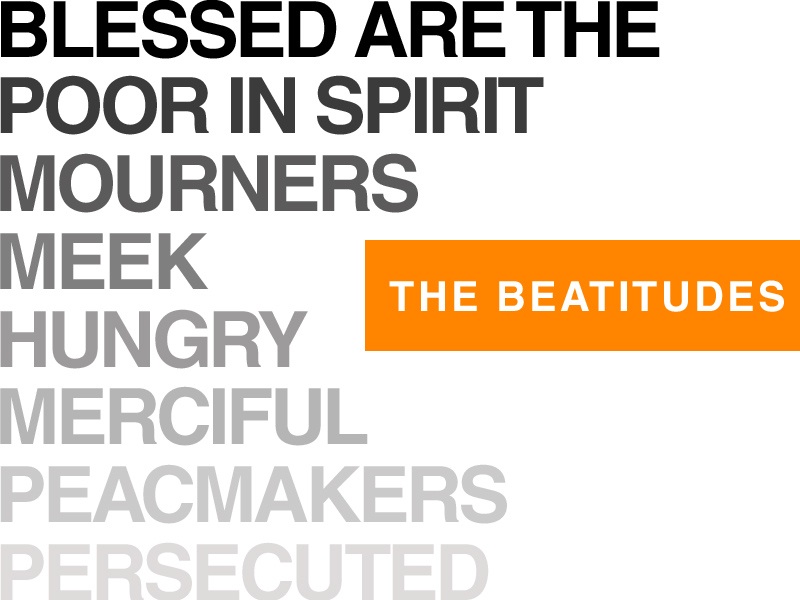
3“Blessed are the poor in spirit, for theirs is the kingdom of heaven.

 4“Blessed are those who mourn, for they shall be comforted.

 5“Blessed are the meek (gentle), for they shall inherit the earth.

 6“Blessed are those who hunger and thirst for righteousness, for they shall be satisfied.

 7“Blessed are the merciful, for they shall receive mercy.

 8“Blessed are the pure in heart, for they shall see God.

 9“Blessed are the peacemakers, for they shall be called sons of God.

 10“Blessed are those who have been persecuted for the sake of righteousness, for theirs is the kingdom of heaven.

Following is an overview and how one unfolds into the next…The first two are foundational to the Gospel blossoming in and through our lives…

1.  Blessed are the poor in spirit…

a.  “You’re blessed when you’re at the end of your rope.  With less of you there is more of God and his rule.” (MSG)
b.  Another translation renders this verse, “Happy are those who know their need for God.” (JBP)
c.  What does it mean to be “poor in spirit”?  A desperateness of soul that is weary of living in it’s own strength and longs for God’s mercy and grace to come and refresh the soul.  In a word, it is DESPERATION.
d.  Consider the Prodigal Sons (Lk 15)…

2.  Blessed are those who mourn…

a.  I have a river of sin in my life – with 3 primary tributaries…

#1 – Original sin (Adam & Eve traded the presence of God for the knowledge of God – and that’s been our core tendency ever since…

#2 – Family of origin issues

#3 – My own dumb choices.

b.  As we are honest about the sin that has infected us there will be a transforming grief and accompanying repentance, that surfaces – not only for our own lives, but also for the injustice, greed, lust, and suffering that grips our world.

c.  I want to own my sin everyday.[2]

d.  This is counter intuitive (paradox – seeming contradiction).  We go down to go up; death precedes resurrection; we get to joy by traveling through grief.  Our soul wants to find a way around grief, but God says, “No, you must travel through grief – and the good news is, He says, “I’ll go with you and we will do it in My strength and power.”

e.  The way of the Gospel is a death and resurrection cycle…

f.  The gospel has the greatest potential to captivate us when we understand that we are more depraved than we ever realized and simultaneously more loved that we ever dared to imagine.

g.  I don’t mind inviting you to question your own salvation today.  If our default mode is, “I’m basically a good person…” then we simply have not understood the gospel.

3.  Blessed are the meek…

a.  Rick Warren would say, “Meekness is not weakness, but the power of your potential under Christ’s control.”

b.  The concept of meekness describes a horse that has been broken.  We can either surrender to Christ and invite the breaking, or remain the undisciplined and wild stallion.

c.  Grieving over sin and suffering grows meekness in us and delivers us into a humble learning posture (disciple means learner).

4.  Blessed are those who hunger and thirst for righteousness…Spiritual hunger and thirst is the growing desire to be empty of those things that don’t reflect God, and initiates a deep longing for wholeness in our lives.

5.  Blessed are the merciful…

a.  Mercy is entering into another persons feelings – attempting to see things from another person’s perspective – all with understanding AND acceptance…just like Jesus has done for us.

b.  As we receive God’s mercy we begin to give mercy – to ourselves and to others.

6.  Blessed are the pure in heart…

a.  Mercy cleanses our heart and restores purity to our lives.

b.  Did you know that your (spiritual and emotional) virginity CAN be restored?

2 Cor 11:2For I am jealous for you with a godly jealousy; for I betrothed you to one husband, so that to Christ I might present you as a pure virgin.

7.  Blessed are the peacemakers…

a.  Purity gives way to a personal serenity and peacefulness.  Peace is not the absence of conflict, but the absence of anxiety in the midst of inevitable conflict – and when others encounter it, they want it too.

b.  Our Western concept of peace needs to be considered in the light of the ancient Hebrew concept of peace, which is SHALOM — and means more than our limited understanding of peace (i.e., the lack of conflict).

Biblical SHALOM speaks of a universal flourishing, wholeness and delight; a rich state of affairs in which natural needs are satisfied, natural gifts a fruitfully employed — all under the arc of God’s love. Shalom is the way things ought to be.

Neal Plantinga – “the webbing together of God, humans, and all creation in equity, fulfillment, and delight.”

c.  There is a difference between a peacemaker and a peacekeeper.

To be a peacemaker does not mean peace at any cost.

Peacekeeping creates a false peace.

Many of us live out our lives with this false peace and say nothing or do nothing to change it—in churches, homes, work places, and our marriages.

Examples:

(i)  A family member makes a scene at a family gathering.  It embarrasses you, the rest of the family, but you say nothing.  You keep the peace because to go there would unearth a lot of stuff that you just aren’t willing to deal with.

(ii) Your spouse makes insulting remarks to you or humiliates you publicly through critical tone of voice.  It grates on you.  But you keep silent because you want to keep the peace.

d.  We struggle with this false peace because the conventional wisdom of the day is that its better to keep the peace than to make the peace and there is a very real difference.

e.  Keeping this false peace insures that real issues, real concerns, and real problems are never dealt with.

f.  A façade, or veneer, of peace in that there is calm but the reality is the tension is still there.

g.  True peacemakers will challenge and disrupt the false peace.

h.  Jesus didn’t have a problem disrupting the false peace of his day.

i.  The whole history of redemption, climaxing in the death and resurrection of Jesus is God’s strategy to bring about a just and lasting peace between rebel man and himself and between man and man (Eph 2:14-22)

j.  Colossians 1:19-20 puts it like this,

“For God was pleased to have all his fullness dwell in him, and through him to reconcile to himself all things, whether things on earth or things in heaven, by making peace through his blood, shed on the cross.”

k.  True peacemakers will give people the benefit of the doubt while graciously bringing up concerns

l.  But true peacemakers will deal with what is real.  FIRST IN THEIR OWN LIVES…

m.  True peacemakers will steward the conflict they find themselves in because God will often use conflict to develop things in our lives that are developed in no other way.

8.  Blessed are the persecuted… Living life from a kingdom of God perspective will place us in conflict with those that oppose it (often times it’s “religious” people!).

Without the knowledge of our extreme sin, the payment of the Cross seems trivial and does not electrify or transform.

But without the knowledge of Christ’s completely satisfying life and death, the knowledge of sin would crush us – or move us to deny and repress it. By walking the way of the Beatitudes we hold our depravity and the Cross in a healthy and dynamic tension that will lead to transformation and renewal.


[1] Wayne Gudem, Systematic Theology, p. 713.

[2] “None is righteous, no, not one.” Romans 3:10 (ESV)
And you were dead in the trespasses and sins in which you once walked, following the course of this world, following the prince of the power of the air, the spirit that is now at work in the sons of disobedience.” Eph 2:1-2 (ESV)

Random Reflections on the Prop 8 Ruling…

I have mixed emotions about yesterdays Prop 8 ruling. As an intentional follower of Christ, I hold a historic, orthodox, New Testament view of marriage. I am also cognizant of how we (Protestants at least) have allowed any moral authority on this issue to dissipate by collectively allowing our divorce rate to match (and some would say, exceed) that of the larger culture. If we can’t do marriage well, how can we weigh in on others? I am reminded of Paul’s words to the Corinthians that we are not to “judge” those outside the church, but that we are to judge ourselves – those of us inside the church (1 Cor 5:12). As active, intentional followers of Christ we would probably be wise to focus on removing the log from our own collective eye (Mat 7:3).

In my view, legislating morality is always Plan B. Plan A, according to my understanding of the Bible, is cultivating and growing in our relationship with Jesus Christ (personally and collectively), growing in sound doctrine, modeling authentic community, and learning how to love. (The first three, BTW, are intended to feed the fourth.)

I appreciate author and pastor Tim Keller’s approach here…In Prodigal God he quotes from The Lord of the Rings – the hobbits asking the ancient Treebeard whose side he is on: “I am not altogether on anybody’s side, because nobody is altogether on my side…[But] there are some things, of course, whose side I’m altogether not on.” Keller notes that Jesus’ own answer, through a parable, is similar. Jesus doesn’t pick a side yet singles out religious moralism as a particularly deadly spiritual condition (pg 13). I find religious moralism on both sides of the Prop 8 issue. I would prefer honest respectful dialogue.

In commenting on the Parable of the Prodigal (Keller would say it should be plural), Keller correctly identifies two basic ways people seek happiness: 1) moral conformity and 2) self-discovery. Each is a way of finding personal significance and worth, of addressing the ills of society, and for determining right from wrong. The elder brother in the parable illustrates the way of moral conformity, while the younger illustrates the way of self-discovery. Underneath both brothers’ sharply different patterns of behavior is actually the same motivation and aim – using their father to get the things on which their hearts are really fixed. For both, it was the wealth of the father, not the love of the father, that they believed would make them happy and fulfilled (pgs 29-39).  (If you’ve found yourself asking, “Why does he title the book Prodigal God?  That’s a great question…get the book.)

As I contemplate my life, I have spent various stints as both the younger and elder brother. In both, during my darker moments, I have sought the hand of God and not the heart of God.

Just last night Linda and I were reading a biography of the early church father, Athanasius (don’t ask). He defined sin as an abuse of freedom. We humans, he said, were originally given the ability to know God by looking at the creation (and seeing its otherwise inexplicable order and harmony) and noticing the image of God within ourselves. But we have turned away from the signs of God in creation and ourselves, and turned instead to the things of this world to satisfy ourselves – whether, I would add, it be moral conformity or self-discovery.

Perhaps you’ve heard the story of Ghandi’s encounter with a respected Christian missionary… Gandhi admired Jesus and often quoted from the Sermon on the Mount. Once when E. Stanley Jones met with Ghandi he asked him, “Though you quote the words of Christ often, why is that you appear to so adamantly reject becoming his follower?” Ghandi replied, “Oh, I don’t reject your Christ. I love your Christ. It’s just that so many of you Christians are so unlike your Christ.”

Somethings just don’t seem to change. Ann Rice is another, more recent example of someone, who “in the name of Christ,” quit the church.

This is yet another wake-up call for the us (inside the church). Not to react with religious moralism, but to respond with appropriate self-reflection, honesty, repentance, love – and a willingness to dialogue. In the great political cartoon strip of its day, Pogo declared, “We have met the enemy and it is us!”