Relational Reconciliation

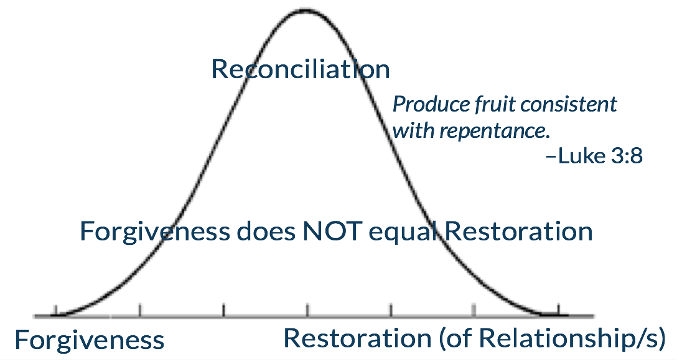
Consider the chart below. Forgiveness, reconciliation, and the restoration of relationships is always the goal. Reconciliation is at the heart of the gospel and is not an option. As believers we have been assigned the ministry of reconciliation:  

“All this is from God, who through Christ reconciled us to himself and gave us the ministry of reconciliation.” –2 Cor 5:18

While seeking to be reconciled, move towards forgiving those who have wounded and hurt you. (This is not an option either.) Now, it’s important to understand that forgiveness and restoration are not the same. You may choose to forgive, but the end result of reconciliation that leads to restoration may take more time. Notice the pathway on the chart below…

Reconciliation can be a long journey, but it is one that believers are admonished to take. In Mark 11:25, Jesus tells us, “When you stand praying, if you hold anything against anyone, forgive him, so that your Father in heaven may forgive you your sins.” Paul tells us to “Bear with each other and forgive whatever grievances you may have against one another. Forgive as the Lord forgave you” (Col 3:13). To forgive as God forgives us, we must:

a. See others as image bearers of God who are also given to sinful frailty

b. Be willing to bear their debt.

The word “forbearance” is a word that is used mostly in the KJV and can be defined as, “to abstain or hold back; forbearance is akin to patience and self-control.”

    Desire the other person’s good (sometimes at personal cost to you). People are not the hurt that they do to us. We are all broken yet God uses broken people to serve His purpose in a broken world.

    Soul Shift #2: Preparing Our Hearts For Prayer – A Survey of Mathew 6

    SoulShiftI.  INTRO

    Last week I made three points I would like to review…

    1. Prayer is not a method to get what we want from God, but the primary means of getting more of God Himself.  Through prayer, we want to find our delight, comfort, and joy primarily in God as He becomes the end goal of our lives.
    2. Often times when we endeavor to press into God, our circumstances will get harder before they get better.  This can be because God will begin to point-out and address areas in our lives that have become hindrances or barriers to our intimacy with God.
    3. Last Sunday I described those hindrances and barriers as (modern day) idols – or functional saviors.
      • They are all the earth-bound things we tend to turn to, to quiet the (legitimate) longings and/or pain that we have in our souls.
      • To unhook from some of those idols takes honesty, confession, repentance, surrender, and a heart that sincerely seeks to grow.

    This morning you’ll need your Bibles open to Mathew 6; we will be looking at the whole chapter.  We are asking two questions today:

    1. How do we prepare our hearts for prayer?
    2. What is the fruit of a heart prepared for prayer?

    II. BODY

    In asking the question: How do we prepare our hearts for prayer? We must first take a careful look at Mat 6:1 – and particularly the words “your righteousness.”

    • NAS — “Beware of practicing your righteousness before men...”
    • NIV — “Be careful not to practice your righteousness in front of others…”

    In our study of prayer it is essential that we get started on the right foot.  The phrase our righteousness is foundational because EVERYTHING else is built on top of it.  If it’s really ‘your,’ or ‘our’ own righteousness – that we somehow earn our way into God’s presence, we will find ourselves turning away from the gospel and turning TO religion (or moralism).

    If, however, it is God’s righteousness we will begin to generate a holy confidence and expectation to build a life of prayer.  See also 6:33 – “But seek first His kingdom and His righteousness and all these things shall be added unto you.”

    **We don’t need to make bigger commitments about prayer, what we really need is to think and to believe truer thoughts about God — thoughts that are shaped by the gospel.  We are called to work, love, and pray FROM His righteousness, not FOR His righteousness.

    With this in mind let’s look at four spiritual disciplines (or ‘means of grace’) we can participate with God in detaching from our various accumulated idolatrous affections and prepare our hearts to encounter God — and move from ‘ordinary prayer’ to ‘extraordinary prayer.’  They are:

    1. Giving
    2. Prayer
    3. Forgiveness
    4. Fasting

    We’ll look briefly at one at a time:

    1.  Giving (or Generosity) – (vs. 2-4, 19-21)

    These verses boils down to two overlapping ideas:

    • Motive matters
    • Generosity prepares our heart to pray

    2 Cor 8:9: For you know the grace of our Lord Jesus Christ, that though He was rich, yet for your sake He became poor, so that you through His poverty might become rich. (This is a concise and powerful theological statement that summarizes the gospel)

    2 Cor 8:9 is the cornerstone, the basis, for any theology of stewardship or generosity – identifying Jesus Christ as the most generous life ever lived

    As Christians we face countless enemies to the welfare of our souls, be it pride, lust, bitterness, or envy.  But few are as powerful and relentless as greed.  Greed has been deified in our American culture…

    What is the most effective counter-attack to this insidious force of greed?  Generosity.

    No one ever started so rich and became as poor as the Lord Jesus Christ.  And no one ever started out so poor and have become so rich as those who have placed their faith and trust in Jesus Christ for the forgiveness of sins.

    Martin Luther spoke of a “great exchange,” or a transaction; our sin is charged to Jesus and Jesus’s righteousness is credited to us.

    2.  Prayer – (vs. 6:5-8) We are to, first and foremost, pray privately and pray authentically.

    Have you ever shaken your fist at God over His seeming lack of response to your prayers?

    If so, you’ll be able to relate to the prophet Habakkuk, who lived about 650 years before Christ.

    His book begins with this complaint: “How long, O Lord, must I call for help, but You do not listen?” (Hab.1:2a).

    God was not offended by Habakkuk’s prayer.

    Passionate, honest, gritty, and even angry prayers have been recorded throughout the Bible.

    And Habakkuk certainly wasn’t the only one to complain. Moses, Gideon, and David, and Elijah all questioned God.

    Job even cursed the day God made him and said, “I loathe my very life; therefore I will give free rein to my complaint and speak out in the bitterness of my soul. I will say to God, ‘Do not condemn me, but tell me what charges you have against me. Does it please you to oppress me, to spurn the work of your hands…?'” (Job 10:1-3).

    When we get into the Lord’s Prayer we’ll see that it’s best to approach God with humility, deep respect, and honor.  Having said that, God can certainly take our intense emotions and questions.

    2 Cor 4:17-18: For momentary, light affliction is producing for us an eternal weight of glory far beyond all comparison, 18 while we look not at the things which are seen, but at the things which are not seen; for the things which are seen are temporal, but the things which are not seen are eternal.”

    3.  Forgiveness – I find it interesting that the Lord’s Prayer speaks to the issue of forgiveness, but Matthew comes back to it in 6:14-15.

    Mark Twain said that, “Forgiveness is the fragrance that the flower leaves on the heel of the one who crushed it.”

    When we truly experience the forgiveness of our sins there is an inward transformation that awakens in us a desire to glorify, trust, and obey God.

    When we carry with us a deep appreciation for this grace-fueled transformation, we’ll have a heart that is more ready to forgive.  This doesn’t mean the process will be comfortable or easy, but it will mean that we can approach someone in need of forgiveness remembering that we are just as much in need of what you’re about to give to him or her.

    4.  Fasting“I humbled my soul with fasting”  (Psalm 35:13b)

    Isaiah 58:6-14

    “Is this not the fast which I choose, To loosen the bonds of wickedness, To undo the bands of the yoke, And to let the oppressed go free And break every yoke? “Is it not to divide your bread with the hungry And bring the homeless poor into the house; When you see the naked, to cover him; And not to hide yourself from your own flesh? “Then your light will break out like the dawn, And your recovery will speedily spring forth; And your righteousness will go before you; The glory of the Lord will be your rear guard. “Then you will call, and the Lord will answer; You will cry, and He will say, ‘Here I am.’ If you remove the yoke from your midst, The pointing of the finger and speaking wickedness, 10 And if you give yourself to the hungry And satisfy the desire of the afflicted, Then your light will rise in darkness And your gloom will become like midday. 11 “And the Lord will continually guide you, And satisfy your desire in scorched places, And give strength to your bones; And you will be like a watered garden, And like a spring of water whose waters do not fail. 12 “Those from among you will rebuild the ancient ruins; You will raise up the age-old foundations; And you will be called the repairer of the breach, The restorer of the streets in which to dwell. 13 “If because of the sabbath, you turn your foot From doing your own pleasure on My holy day,
    And call the sabbath a delight, the holy day of the Lord honorable, And honor it, desisting from your own ways, From seeking your own pleasure And speaking your own word, 14 Then you will take delight in the Lord, And I will make you ride on the heights of the earth; And I will feed you with the heritage of Jacob your father, For the mouth of the Lord has spoken.”

    A simple definition for fasting would be voluntary abstinence of our appetites and our soulish longings for spiritual reasons.  The Bible speaks of it not as an option but as an expected and regularly practiced spiritual discipline. 

    There are many different ways to fast. 

    • We can fast food and just drink water or juice
    • We can eat vegetables and/or fruit only (this has been called a “Daniel Fast,” see Daniel 1:8-17)
    • We can choose not to eat any sugar or carbohydrates
    • We can fast one or two meals a day
    • We can fast from sun-up to sun-down.
    • Paul encourages married couples to occasionally fast sexual intercourse, “that you may devote yourselves to prayer…” (1 Corinthians 7:5).
    • We can fast television or the internet and pray instead!

    Before we fast it is important to seek the Lord regarding what would be appropriate.

    What is the fruit of a heart prepared for prayer?

    Preparing our hearts for prayer, learning how to pray, and leaning into prayer is the cure for anxiety.

    Vs. 25-34 are not to be seen as admonitions to simply STOP BEING ANXIOUS!  They are telling us that as we make God the object and desire of our prayers; as we seek to find our comfort and joy IN HIM through:

    • Generosity
    • Prayer
    • Forgiveness
    • Fasting

    These spiritual disciplines, or ‘means of grace’ lead us into the presence of God, which BECOMES the cure to our anxiety.  God is the goal of prayer, but the loss of anxiety – or peacefulness is the fruit.

    CONCLUSION

    Who are the two most important people who ever lived?

    Certainly, Jesus.  The first One is easy, but who’s the second one?  Adam.

    There are only two groups of people on the earth:

    • Those who are in Adam
    • Those who are in Christ.

    If you are an active, intentional follower of Jesus Christ your past may help to EXPLAIN you but your past does not DEFINE you.[1]

    To live our lives from a gospel-centered perspective is to live, and work, and love, and serve FROM our new identify ‘in Christ;’ not to live, and work, and serve FOR Christ’s – or anyone’s approval.

    You idols do not define you – they may help to explain you, but they don’t define you.

    Sometimes the most mature and appropriate thing to do is to take our focus off of our sins – even our besetting sins, and to focus on remembering what Christ has done.

    When we encounter Christ through humbling our soul, we will find ourselves doing what Isaiah 30:22 says – “You will scatter your idols as an impure thing and say to them, ‘Be gone!’”

    Take some time to reflect on what Christ has done… No one was ever so rich and became so poor as Jesus Christ – and if you are in Him, no one was ever so poor and became so rich as you.


    [1] Mark Driscoll, Who Do You Think You Are? 2012.

    God Is Closer Than You Think #5 – What Is Prayer?

    by JT Holderman

    DOCTRINE

    Illustration of Answered Prayer: Daniel and the Lion’s Den. Daniel is thrown into the pit with the lions and spends the night. But guess what, Daniel was found by King Darius the next morning, unharmed. Prayer is powerful. Both Daniel and King Darius prayed, and God delivered. He heard their prayers.

    Definition: A theologian of our day gives a definition for prayer. He says “prayer is personal communication with God” (Wayne Grudem ST-377). I think he captures the essence of prayer, being in relationship, communication, being in conversation with God. Remember you and I were created to be in relationship with God, and relationships are defined by being in communication with one another.

    Jesus Makes Prayer Possible: Do you know what gives us confidence in prayer? Jesus. His death on our behalf creates a way for us to know and be in relationship with God again. When you pray to Jesus, he hears you and whispers it into the Father’s ear. Jesus is our advocate.

    Kinds of Prayer:

    • Petition: Asking God for…
    • Supplication: Asking God for something on behalf of someone else…
    • Praise: Lifting up God’s greatness
    • Thanksgiving: Thanking God
    • Confession: Asking for forgiveness
    • Sorrow: Prayers of tears and lament

    Why do we pray? As Christians prayer is often a response to a need we have. We need help. And we pray because prayer has power. The prayer of Daniel and Darius had power to overcome the Lion’s hunger in the pit. But why does prayer have power? Prayer has power because we communicate with the living God.

    Illustration of Answered Prayer #2: There’s a woman in 1st Samuel in the Old Testament. Her name is Hannah. She’s barren, she can’t have a child. She pours out her soul to the Lord. And you know what, God heard her prayer, just like he hears your prayer. He heard it, and he answered it. He gave her a son. His name was Samuel.

    What about Unanswered Prayer: We have confidence when we know God has answered our prayer right? But is the same true when we don’t think God has answered our prayer? There is no such thing as unanswered prayer. There is simply prayer that isn’t answered in the manner you and I would like it to be answered. Our prayers are always subject to God’s will. And that’s where we find comfort in unanswered prayer, in the fact that God knows what is best for his children, even when we think he doesn’t.

    EXPOSITION OF MATTHEW 6:5-13:

    Context: Matthew has recorded three chapters worth of His sermon and teachings to the people, we often refer to this portion of Scripture as the “Sermon on the Mount” because Jesus ascended a mountain, sat down, and preached to all those who followed him.

    How Not to Pray vv. 5-8: So in v. 5 Jesus begins to instruct us how to pray. And what does he do first? He tells how NOT to pray. Don’t pray like this, and he gives two examples. Don’t pray like the hypocrites. Jesus explains that these people pray to be seen, they find fulfillment not in praying to God, but their motive is to be seen as pious, as holy people by others. Don’t pray like the hypocrites who pray to be seen, but instead Jesus says to pray in private, in secret where the motive is simply to be in conversation with God.

    Jesus also says we are not to pray like the Gentiles, non-Jews in Jesus’ day, unclean people. Read vv. 7 and 8 with me. What is the Gentiles problem in prayer? They heap up empty phrases. They simply say things hoping they will be heard. They want to sound sophisticated and use lots of words to try to impress God and earn His favor. Their motive is to impress, to appear holy to God. The hypocrite wants to appear holy to the masses and the Gentile wants to appear holy to God. So we can see here from these first four verses that what is crucial to Jesus in prayer is MOTIVE. Why we pray is important.

    How to Pray: So again knowing about prayer is of little value. Knowing HOW to pray is of infinite value. So in vv. 9-13 Jesus launches into “how” we are to pray, it’s commonly referred to as the Lord’s Prayer.

    “Our Father…”: Jesus begins with addressing who He is praying to, God the Father. It’s crucial for us to see that He begins by pointing his conversation, his spoken prayer at God. And the word Father here is important. He doesn’t say Lord, even though He is, He doesn’t say God, he says father. And father implies a close relationship, a nearness to God.

    “Hallowed be your name”: And after addressing God, Jesus hallows God’s name. Now what does that mean? A person who is hallowed is worthy of our praise. To hallow something or someone is to treat them as Holy, perfect, spotless. But to say that you hallow God’s name, that you revere Him, means also that your life will be such that it reflects that, that it continually brings glory to God as the Holy one.

    “Thy Kingdom Come”: Now when you hear the word Kingdom, think of God’s reign, as a King over all the earth. Jesus is often referred to in three offices, prophet, priest and King. The Kingdom of God is the reign of Jesus over all the earth and that began with His earthly ministry. He teaches us here with the authority of a Lord, a King. So when we pray this, we are simply praying that God would reign over this world. We’re just saying, God be God here and now.

    “Your will be done…”: This is a hard one to pray. Remember Jesus in the Garden of Gethsemane? He prayed this, “not my will but yours.” And what happened? He died. To pray that God’s will be done is an absolute sacrifice. It is the ultimate bending of our knee and acknowledging that God knows what is best. It’s hard to pray this because we are inviting God to answer our prayer not in the manner we want, but he wants. Just like Jesus in the garden.

    “Give us this day our daily bread”: It isn’t until half way through the prayer that Jesus ever asks for anything in His own life. Here Jesus asks for food, bread. Now this is an image for both physical nourishment that we need from God to live on, as well as spiritual nourishment for our walk with Him.

    “Forgive…”: Jesus moves on and asks for forgiveness. Now it’s odd that Jesus asks for forgiveness. Why? Because Scripture tells us that Jesus was perfect, he did not sin, he was the only person who didn’t need forgiveness!!! This is why his death atones for our sins and brings us into relationship with God. So why does he include this. Remember, the whole point of this prayer is an example to you and I of how we should pray. We should pray like Jesus. And so confession, asking for forgiveness is a key part of prayer. Primarily because it forces us to be conscious of our sins, conscious of the ways in which we have turned from God, the ways in which our faith has faltered.

    “And lead us not into temptation…”: Jesus ends his example of how we are to pray like Him by admitting that temptation and evil are a reality that we have to deal with, they are universal and inescapable for every human being. The devil is not off the leash. Temptation is essentially a test. When we are tempted our faith is tested. Praying this petition is about admitting that we need God’s help as we face temptation. We can’t do it alone.

    Praise and Petition: Now we walked through those pretty quickly. But did you notice as we went through the whole prayer that it was really broken into two separate types of prayer? The first portion of the prayer is what? A prayer of praise. Jesus begins by praising God, by hallowing his name, by exclaiming the goodness of His will and the power of His kingdom. A whole half of this prayer is simply praising God! When you look at your prayer life, if you were to average how much of your prayer time is spent in praising God, hallowing His name, what do you think it would be? And so it isn’t until after Jesus has praised the Father that he moves into asking for things.

    APPLICATION

    Our Prayer Life: Let’s wind down and bring this home. I would contend the main reason we don’t pray is because God is not a priority in our lives. If God is really our priority in life, if knowing Him is the supreme good above all that we seek after during the hours of the day, then prayer will be as natural as breathing. Prayer is breathing in and out for a Christian. Without prayer we suffocate! And so I argue that the reason we don’t pray as much as we feel called to, or as much as Scripture urges us to, is because God really is not the priority He should be.

    And when God becomes our priority, we pray. Not because we are supposed to and it’s what good Christians do, but because we want to! We want to be in relationship with Him who has lavished grace upon us. Prayer is simply communicating with God. What is the most essential thing for any relationship? Communication. If you’re married you know that communication can make a marriage wonderful, or it become a hindrance to loving one another. And so in the same way, our communication with God is of vital importance. Satan wants to thwart prayer more than anything else in our walk as Christians because the reality of our relationship with God is changed through prayer. Prayer is the most powerful action you can do as a Christian. Our call this morning is to take up the charge to be lovers of God, to be people who are characterized by having God as our priority in life.

    Closing Prayer: And so where are you? Is God the priority in your life? Or is he simply a priority? Do you pray? Do you wonder what God’s will is for your life? Pray. Do you need help with a struggle you’re currently facing? Pray. Do you feel stuck? Pray. Do you feel lost? Pray. No matter what you are going through this morning, God knows and he wants you to talk to him about it.

    The Upside Down Life #8 – Blessed Are Those Who Hunger and Thirst, Pt B

    Hunger & Thirst For God’s Righteousness (Not Yours)

    I. INTRO

    Today we have something very important to consider.  If you’ve been around for the last year – or most of the last year, hopefully you have noticed that I have been harping about the gospel.

    We’ve been saying that the Bible is NOT a disconnected set of stories each with a lesson on how to live our lives — but the Bible contains ONE single story – with three layers:

    • The first layer of every sub-story tells us what’s wrong with the human race and the world.
    • The second layer tells us what God has done to make it right.
    • And the third layer tells us how it will all end.

    Good Bible exegesis (or analysis, or interpretation) will always look for these three layers in every sub-story of the Bible – from Genesis to Revelation.  Some are more specific to a particular layer, but the Bible only has one story.  If we SEE that the Bible begins to really come alive…

    Over the course of the last year we have been considering what amounts to three aspects of God’s grace – we could describe them as past grace, present grace, and future grace.

    • Past grace is what the Bible calls JUSTIFICATION.
    • Present grace is what the Bible calls SANCTIFICATION.
    • Future grace is what the Bible calls GLORIFICATION.

    So, we could say the believing Christian has been justified by grace, is being sanctified by grace, and will be glorified by grace.  Our past, our present, and our future are all wrapped-up in God’s grace.

    We are justified, sanctified, and glorified by grace alone, through faith alone, in Christ alone.

    We have spent most of the last year preaching and teaching about present grace the grace for sanctification, believing that most of us “get” grace for salvation but not grace for sanctification.

    In my preparing for this message/sermon today I have come to believe that not only have we had a faulty belief (or understanding) of present grace (sanctification), but that we may also have a faulty belief about past grace – or justification.

    Let me throw a pop-quiz at you – and then I’ll pray and we’ll jump into the sermon for today: Does God want you to try and be good?

    At the risk of making some of you mad I will say – if your answer is “yes” there’s a good chance you’re still stuck in moralism. (Moralism is the anti-gospel, relegating change to will power and behavior modification techniques.)

    If your answer is a genuine, heartfelt “no” then you may be on your way to understanding sanctifying grace – and what we will be talking about today – God’s imputed righteousness.

    With that said I’d like to pray for our time together this morning and then we’ll begin…Eph 1:18-20:

    18 I pray that the eyes of your heart may be enlightened, so that you will know what is the hope of His calling, what are the riches of the glory of His inheritance in the saints, 19 and what is the surpassing greatness of His power toward us who believe. These are in accordance with the working of the strength of His might 20 which He brought about in Christ, when He raised Him from the dead and seated Him at His right hand in the heavenly places.”  Amen

    We’ll begin with a review and then move toward a greater understanding of God’s Righteousness.

    Our series is The Upside Down Life and we are taking our time moving through the introduction of what theologians believe is the greatest, most profound sermon ever given – The Sermon On the Mount, which is found in Matthew chapters 5-7.  (It’s really just an overview.)

    Jesus opens the sermon with 8 distinctive markings of the Christian and the Christian life – that we have come to describe as the Beatitudes.

    There is a stanza in the famous Robert Frost poem titled The Road Not Taken that helps us to understand what Jesus was saying.  While I don’t think this is what Frost had in mind, it DOES help us to reflect on our lives…

    “Two roads diverged in a wood, and I,
    I took the one less traveled by,
    And that has made all the difference.”

    Why would we take the road less traveled? Is the Christian life a hard road?  Yes, because in this inaugural sermon Jesus jumps below the surface and into the question of motive – why we do what we do.

    To walk this road is to encounter Truth (with a capital T).  It’s the Truth about God – for God IS Truth.  AND it’s the truth about us.

    Now the good news is – the gospel tells us that Jesus Christ has made a way, a road for us to walk along — with Him.  And the Beatitudes describe this less traveled way…

    The road begins with admitting our spiritual poverty.  To truly/honestly acknowledge and admit our spiritual poverty leads us into a place of mourning and repentance, which, in-turn, renders in us a meekness wherein we become humble learners (or true disciples).  And as humble learners a holy craving, or longing erupts in us to know and be known by God.

    Matthew 5:6 declares: Blessed are those who hunger and thirst for righteousness, for they shall be satisfied.” (The Beatitudes – and the SOTM ARE a road less traveled…

    Here’s how King David said it in Psalm 42:1-2: “As the deer pants for the water brooks, So my soul pants for You, O God. My soul thirsts for God, for the living God; When can I go and meet with God?” (NIV)

    The series is titled The Upside Down Life because the gospel-way is so counter-intuitive to the human condition – we are hard-wired in our fallen nature toward self-determination and legalism.

    Last week Gene began to break down for us what it means to hunger and thirst for God – he said, first and foremost, that righteousness is not a product but a Person.

    Gene likened the first three Beatitudes to a spiritual rototilling of the soul.

    Gene likened a hunger and thirst for righteousness to a consuming desire for Jesus – as we become aware of hunger pangs for heaven.

    Humility opens the door to holiness and happiness.

    Gene encouraged us to re/discover our great Evangelical tradition of deeper encounters…

    • John WesleyHoliness not as achieving sinless perfection but as having one’s heart fully fixed on God. (His “heart was strangely warmed.”)
    • Bernard of Clairvaux – “To Thee our inmost spirit cries…[for that] which only Thou canst fill…”
    • Blaise Pascal’s “Night of Fire” in 1654 – 2 hours of “Joy, joy, joy, tears of joy.”
    • D. L. Moody’s experience with God: “…I can only say that God revealed himself to me, and I had such an experience of His love that I had to ask Him to stay His hand.”

    And I would add Sarah Edwards (d. 1758), wife of Puritan pastor and theologian Jonathan Edwards, to Gene’s list.  She had such an encounter with God such that she felt her soul “being filled to all the fullness of God.” As her husband was to describe it, God had filled Sarah with “joy unspeakable and full of glory” (1 Peter 1:8).  Most of us have wrongly determined that that kind of joy is reserved for heaven.  It’s not.  There are both a momentary and a residential joy that are available to us – no matter what our circumstances are.

    Today, I’d like to zero in on the word righteousness in Matt 5:6: “Blessed are those who hunger and thirst for righteousness – for they shall be satisfied.”

    Here’s the BIG IDEA: The doctrine of righteousness is a part of the larger doctrine of justification (or, grace for the past).

    Think of justification as one coin with two sides…

    • One side is God’s MERCY and FORGIVENESS.
    • One the other side is IMPUTED (credit) RIGHTEOUSNESS and GRACE (for sanctification).

    If you’ve been going to church for a while now – you’ve probably heard a definition for justification that goes something like this:  Justification means “just as if I’d never sinned.”

    Now that’s a nice play on words but it’s woefully shallow and certainly an incomplete definition.  Because it only deals with one side of the coin.

    Let’s see if we can understand a little better this essential concept of imputed righteousness…

    II. BODY

    What is righteousness?  Righteousness is a validating performance record that opens doors (Tim Keller).

    • Job? Resume…
    • Grad school? Academic record Grades…

    We tend to believe it’s the same with God – that we are to, somehow, build a resume of a moral performance record to make it into heaven.

    Jesus comes along, and with the other NT writers, tells us about an absolutely unheard of spirituality, an unimaginable approach to God. Where God provides us with an unblemished record—absolutely free of charge. Not just a good record, or even a great record – but a divine righteousness – a perfect record that comes to us as a gift! 

    When we have this it’s the end of our personal struggle for validation, for worth, or worthiness, and acceptability.

    Apart from the Christian gospel there is no other religion or belief system that offers anything like this. 

    The gospel is God developing a perfect righteousness and He offers it to us – and by THAT righteousness alone we are accepted. 

    Roms 3:21: But now apart from the law the righteousness of God has been made known, to which the Law and the Prophets testify.”

    Free Justification – Forgiveness AND Imputed Righteousness are essential to understanding the gospel.  Tim Keller likens it to the table in a grand banquet room…  Free Justification IS the table.  No table, no dinner…

    Why is free justification so important?  Because it affects our assurance of salvation.

    We begin to understand Free Justification as we consider the difference between IMPARTED righteousness and IMPUTED righteousness.  I’ll give you a brief overview of both and what IMPUTED righteousness accomplishes and then we’ll pick it up again next week…

    Many churches – including the Catholic Church teach IMPARTED righteousness.

    This actually can be defined as THE single issue that brought about the Protestant Reformation.  Martin Luther saw this afresh in his study of the first five chapters of the book of Romans.

    So, what IS Imparted Righteousness?

    • The word, “impart” means to “to give.” We could also describe it as  “infused” righteousness.
    • Imparted righteousness thus declares that Christ’s righteousness is given to, or infused within – so that the believer actually becomes righteous.  (This is NOT what the bible teaches.)

    Paul is not writing that we are transformed into people who possess righteousness, but rather that we have been united to Christ

    And because of our union with Him (the emphasis of Romans 5), we have that which He possesses, that is, we have HIS righteousness.

    Imputed Righteousness – The word “impute” means “ascribe” or “credit.” Imputed righteousness carries the theological weight of being “counted” or “considered” or “reckoned” righteous.

    Within the first 12 verses of Romans 4 (this is where Martin Luther saw this) you will notice the number of times the word “credited” (in both the NIV and NASV Bibles) is used.  This word distinguishes the means of faith by which both Abraham and all other believers are justified before God.

    Paul is not writing that we are transformed into people who possess righteousness, but rather that we have been united to Christ (i.e., the 30 “in Him” passages of Paul’s letters), that “in Him” — because of our union with Him (the emphasis of Romans 5), we have that which He possesses, that is, righteousness.

    III. CONCLUSION — What imputed righteousness accomplishes:

    1. In God’s eyes Jesus’ perfect record is imputed to us.
    2. We are treated as if we had lived the perfect life that Jesus lived.
    3. We are given the love that Jesus deserved (through His obedience).
    4. We have the same access to the Father that Jesus did.
    5. The best news is that all of this comes not from us doing anything (i.e., works) at all, but simply by faith.