The Church Gathered and the Church Scattered

2 Corinthians 5:18-21

18 Now all these things are from God, who reconciled[1] [to settle accounts – as in a bank statement] us to Himself through Christ [who paid our debt – the cross is where God’s justice and God’s mercy kiss] and gave us the ministry of reconciliation, 19 namely, that God was in Christ reconciling the world to Himself, not counting their trespasses against them, and He has committed to us the word [logos, or doctrine] of reconciliation.

20 Therefore, we are ambassadors [diplomats, emissaries, representatives] for Christ, as though God were making an appeal through us [sometimes the best way to “preach” to someone is to listen to them]; we beg you on behalf of Christ, be reconciled to God. 21 He made Him who knew no sin to be sin on our behalf, so that we might become the righteousness of God in Him [THAT is the gospel – Jesus lived the life we should have lived and died the death we should have died. We don’t live in our own strength – we live IN Him – or His strength].

Did you know that there are currently 38,000 Pro-test-ant[2] denominations?  Catholics have multiple orders (Dominicans, Franciscans, Jesuits, etc.), but have managed to stay under the umbrella of Rome.

I. INTRO

I’d like to speak with you today about the Church GATHERED and the Church SCATTERED.  First, the nerdy Stuff…

  • Ecclesia (Latin) Greek – κκλησί, meaning “congregation” or “church.” The literal translation is “called out ones.”
  • Ecclesiology – Refers to the theological study of the Christian Church.

1. Who is the Church? (Not What…?) It is the body of all believing, or confessing, Christians.  SBF is a unique expression of the larger Body of Christ.

2. What is the authority of the Church?

  • Jesus is the head of the body, the Church (Col 1:18)
  • Jesus is the Senior Pastor. 1 Peter 5:4 identifies Jesus as the “Chief Shepherd.” [A church in transition shouldn’t get a pastor until they don’t really need one.]
  • The Bible is our highest and final authority. Sola Scriptura, not solo Scriptura.

3. What is the relationship between a believer and the Church? As believers we are to submit ourselves to Jesus – the Head and Chief Shepherd of the Church.  There are three overlapping commitments that make up a healthy and vibrant church experience:

  • Celebration (Worship)
  • Congregation (Identity needs met) Acts 2:42-47

42 “They were continually devoting themselves to the apostles’ teaching and to fellowship, to the breaking of bread and to prayer. 43 Everyone kept feeling a sense of awe; and many wonders and signs were taking place through the apostles. 44 And all those who had believed were together and had all things in common; 45 and they began selling their property and possessions and were sharing them with all, as anyone might have need. 46 Day by day continuing with one mind in the temple, and breaking bread from house to house, they were taking their meals together with gladness and sincerity of heart, 47 praising God and having favor with all the people. And the Lord was adding to their number day by day those who were being saved.”

  • Cell (Intimacy and accountability needs met)

James 5:16: Confess your sins to one another, and pray for one another so that you may be healed.”

4. How should the Church be governed?

8 Therefore it says, “WHEN HE ASCENDED ON HIGH,
HE LED CAPTIVE A HOST OF CAPTIVES,
AND HE GAVE GIFTS TO MEN.”  9 (Now this expression, “He ascended,” what does it mean except that He also had descended into the lower parts of the earth? 10 He who descended is Himself also He who ascended far above all the heavens, so that He might fill all things.) 11 And He gave some as apostles, and some as prophets, and some as evangelists, and some as pastors and teachers [also add elders and deacons], 12 for the equipping of the saints for the work of service, to the building up of the body of Christ; 13 until we all attain to the unity of the faith, and of the knowledge of the Son of God, to a mature man, to the measure of the stature which belongs to the fullness of Christ. 14 As a result, we are no longer to be children, tossed here and there by waves and carried about by every wind of doctrine, by the trickery of men, by craftiness in deceitful scheming; 15 but speaking the truth in love, we are to grow up in all aspects into Him who is the head, even Christ,

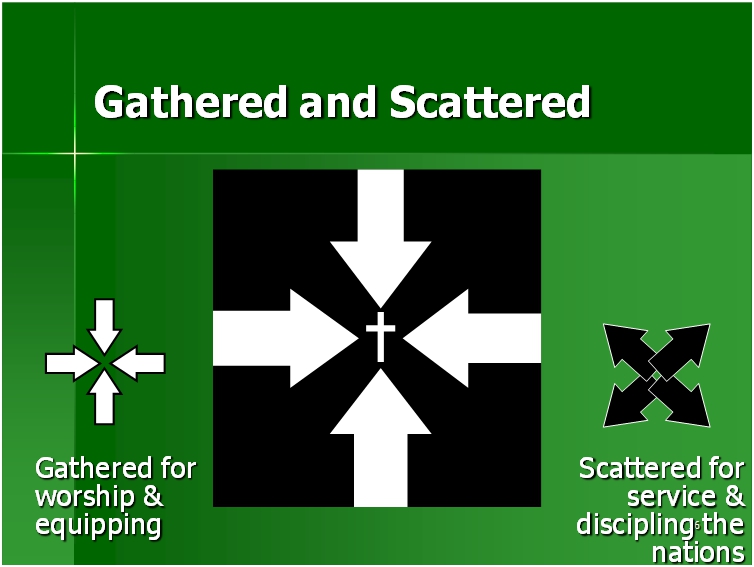
5. What does the Church do?  The church exists in two modes:

  • We gather for worship.
  • We scatter for mission.

II. BODY

We will now take a deeper look at what it means to gather for worship and scatter for mission

  • Gather for worship
  • Requires purposeful participation — moving from passive observation to active participation.

(Our identity) Eph 1: Blessed be the God and Father of our Lord Jesus Christ, who has blessed us with every spiritual blessing in the heavenly places in Christ, 4 just as He chose us in Him before the foundation of the world, that we would be holy and blameless before Him. In love 5 He predestined us to adoption as sons through Jesus Christ to Himself…”

Even before He made the world God chose you and adopted you, it gave Him great pleasure, God loved, chose, and adopted you.  You are His unique and special possession.

This is what we need to see: Coming is not an event; it is the fulfillment of God’s prehistoric (pre-history) desire.  God created Adam and Eve – it was good.  God wanted to be with people… (Some of you don’t even want to be with people J)

OT – they built a Tabernacle because God wanted to meet with His people.

It’s not our desire – it’s God’s desire – made possible by the blood of Jesus.  Church is not primarily about us – it’s primarily about God.

**We gather to, for, and around Jesus.

Our being here is all about Him – and sometimes competes with our expectations, needs, and desires.

Jesus is the head, the goal, chief shepherd – He’s the Sr. Pastor. He owns and loves the Church. He’s the object our worship, our preaching, and our mission.

The church is all about Him.  It’s not about music or the preaching – although, hopefully they are both focused on worshiping Jesus.

The music and the sermon are BOTH acts of worship (difference between a lecture and a sermon… “if people are taking notes at the end of a sermon it might not BE a sermon…”

If your Christianity is just about going to church then you don’t have Christianity, you have “Churchianity.”

Exalting only Jesus – giving all of our attention to Jesus

Sometimes it’s a sacrifice of praise (Hebs)

Our destination is always Jesus – give ourselves and assume a posture of personal humility, worship, and prayer.

Christ is present and available.

Ps 116:  1 I love the LORD because he hears my voice
and my prayer for mercy.
2 Because he bends down to listen,
I will pray as long as I have breath!
3 Death wrapped its ropes around me;
the terrors of the grave overtook me.
I saw only trouble and sorrow.
4 Then I called on the name of the LORD:
“Please, LORD, save me!”
5 How kind the LORD is! How good he is!
So merciful, this God of ours!
6 The LORD protects those of childlike faith;
I was facing death, and he saved me.
7 Let my soul be at rest again,
for the LORD has been good to me.
8 He has saved me from death,
my eyes from tears,
my feet from stumbling.
9 And so I walk in the LORD’s presence
as I live here on earth!
10 I believed in you, so I said,
“I am deeply troubled, LORD.”
11 In my anxiety I cried out to you,
“These people are all liars!”
12 What can I offer the LORD
for all he has done for me?
13 I will lift up the cup of salvation
and praise the LORD’s name for saving me.
14 I will keep my promises to the LORD
in the presence of all his people.

15 The LORD cares deeply
when his loved ones die.
16 O LORD, I am your servant;
yes, I am your servant, born into your household;
you have freed me from my chains.
17 I will offer you a sacrifice of thanksgiving
and call on the name of the LORD.
18 I will fulfill my vows to the LORD
in the presence of all his people—
19 in the house of the LORD
in the heart of Jerusalem.

Praise the LORD!

Scatter for mission

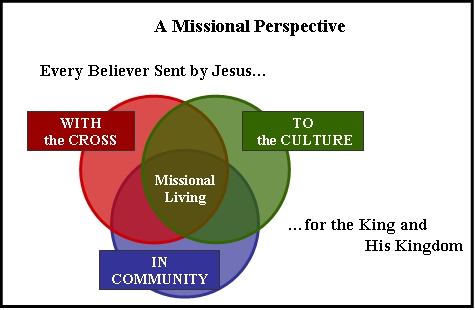
The term “missional church” may be a new term for you.  Here is the main idea:  We serve a missionary God, who crossed the ultimate cultural contexts to become one of us.  Jn 1:14 (MSG) The Word became flesh and blood, and moved into the neighborhood.

The Father sent the Son, the Son sent the Holy Spirit – and the Holy Spirit sends us.

Attractional model vs. a missional model.  In the end we want both.

What we are seeking to accomplish here at SBF can be defined as a “missional reorientation.”

At a very deep level we are redefining success:  It’s not about the 3 B’s (building, budget, and butts); it’s about how many people are we training and sending to be missionaries in their unique spheres of relationships.

Mat 28:18-20: 18 And Jesus came up and spoke to them, saying, “All authority has been given to Me in heaven and on earth. 19 Go therefore and make disciples of all the nations, baptizing them in the name of the Father and the Son and the Holy Spirit, 20 teaching them to observe all that I commanded you; and lo, I am with you always, even to the end of the age.”

Three things:

  1. All authority has been given to Jesus – and He is with us/you always. Our responsibility is basically twofold: a) stack kindling and b) splash (preach).  (D.L. Moody – At any moment we ought to be willing to preach, pray, or die.)
  2. “Go therefore” (Go ye) is the mission of the church.  Are we a “come ye” church, or a “go ye” church?
  3. Make disciples.  I’d like you to view every single person in your various spheres of relationship as a disciple…

[1] To “change or exchange” – it is God moving from hostility to friendship. Reconciliation is what God accomplishes, exercising His grace towards sinful humankind because of the sacrificial death of Christ in propitiatory [or appeasing] sacrifice under the judgment due to sin.

[2] The quotation “The lady doth protest too much, methinks.” comes from Shakespeare’s Hamlet, Act III, scene II. The phrase has come to mean that one can “insist so passionately about something not being true that people suspect the opposite of what one is saying.”

A Generous Life #1 (of 6) 2 Cor 8:9

I. INTRO

Summit #1 is next Sat (01/14).  We are holding our first of three summits.  I want to invite everyone 13 years of age and older to come and participate in this process.

If you’re new to the church it’s a great time to jump in to help shape what SBF will become in the next season of fruitful ministry.  (My role is as a facilitator and coach – your role is to shape the future through prayerful dialogue with God and one another.)

Today we begin a 6-week series on A Generous Life.  (There are study guides available in the lobby and also available for download here at our blogsite.)  Why a series on A Generous Life?

The answer is both simple and profoundJesus Christ lived the most generous life ever lived.

The whole Bible – both the OT and NT, was written to point to Jesus.

We call this a Christ-centered, or gospel-centered view of the Bible.

Again, the whole Bible was written with God’s redemption through Jesus Christ in view.  The OT points to the coming of Jesus and the NT extols the coming of Jesus.  We want to see Jesus and worship Jesus in every text of Scripture.

Because of the generosity of Jesus Christ one of the gospel graces is generosity – and there is a connection between generosity and stewardship.  So this series will be about becoming generous stewards of God’s grace.  But the last thing we want to say is that Jesus lived a generous life and now you should too.

No, we want to explore the generosity of Jesus.  What we really want – and need – is to enter into His generosity.  It is the generosity of Jesus, by grace through faith, that changes us and empowers us to be generous.

Our passage for today, which was read, is 2 Cor 8:9.  This will be our foundational passage for the series.  Our aim is to engage in a gospel transformation of the soul in and through the sacrifice and provision of Jesus Christ.

Here’s the way pastor and author John Piper says it: “Seeing and savoring the supremacy of Christ frees us from the slavery of sin for the sacrifices of love.”

Living in and for the gospel is counterintuitive[1]…here is how pastor and author Tim Keller has said it: “Christ wins our salvation through losing, achieves power through weakness and service, comes to wealth via giving it all away.  And those who receive His salvation are not the strong and accomplished but those who admit they are weak and lost.”[2]

Each of us has three primary areas of stewardship in Christ: We’ll refer to them as our time, our talents, and our treasure.  There are other areas of stewardship that we are responsible for as well:  We are responsible for our primary relationships, our bodies, our sexuality, and to care for creation.

Again, it’s not about what we should do – the renegade Catholic priest, who initiated the Protestant Reformation, Martin Luther speaks about a great exchange… “Learn Christ and Him crucified. Learn to sing to Him and, despairing of yourself, say, ‘Lord Jesus, You are my righteousness, just as I am Your sin. You have taken upon Yourself what is mine and have given me what is Yours.’”[3]

“For our sake [the Father] made [Jesus] to be sin who knew no sin, so that in Him we might become the righteousness of God.” (2 Corinthians 5:21 ESV)

An overview of 2 Cor…

In 2 Cor 8-9 Paul is seeking to mobilize the Corinthian congregation to participate in an offering for the church members in Jerusalem…

You will notice that Paul never uses the word money, in 2 Cor 8-9, instead he calls it “grace,”  “generosity,” “blessing,” or “partnership.” He speaks of the “grace of giving” as one of the highest Christian virtues.

With this series we are not aiming at your wallet, we are aiming at your heart.

This series is NOT intended to ask you to give more – it’s intended to show you how.

Paul had quite a rocky relationship with the church at Corinth.  There were actually (at least) four letters that were written.  What has been canonized as Scripture are letters #2 and #4.  (#3 was, apparently, a letter of severe rebuke.)

Chapters 8 and 9 of this epistle concern the offering for the poor saints at Jerusalem.  It took between 8-10 years to accomplish; involved thousands of miles of travel; at least 10 collectors involved. An earthquake, crop failures, and persecution contributed to their needs at Jerusalem church.

II. BODY

With that in mind let’s dive into our passage for today – just one verse – 2 Cor 8:9, which is the foundational passage for our series on Generosity… For you know the grace of our Lord Jesus Christ, that though He was rich, yet for your sake He became poor, so that you through His poverty might become rich.

Today we want to ask and consider four questions:

  1. Do you know the grace of our Lord Jesus Christ?
  2. How was Jesus rich?
  3. How did He become poor?
  4. How do we become rich?

Let’s look at them one at a time…

1.  Do you know the grace of our Lord Jesus Christ?

What does it mean to know?

Ginōskōa knowledge grounded on personal experience.[4]

Paul is confident that the Corinthian church understood (i.e., was well-taught) in the area of the gospel of grace.  This is where the North American Church struggles today…

What is grace?  There are 10 ten occurrences of the word “grace” (charis) in chapters 8-9.

While there many facets of grace.  This morning I’d like to look at three types of grace:

A.  Common Grace refers to the grace of God that is common to all humankind. It is “common” because its benefits are experienced by the whole human race without distinction between one person and another. It is “grace” because it is undeserved and sovereignly bestowed by God. Mat 5:45b – [God] causes His sun to rise on the evil and the good, and sends rain on the righteous and the unrighteous.”  The fact that you’re breathing this morning is an effect of common grace.

B.  Saving Grace, or justifying grace, redemptive grace – or regenerating grace is a momentary action of God to bring about salvation into a previously unregenerated person – it’s an act of quickening the spiritually dead.  In John 3 Jesus had a conversation with a Pharisee named Nicodemus and told him – “…unless one is born again he cannot see the kingdom of God.” 1 Peter 1:3“Blessed be the God and Father of our Lord Jesus Christ, who according to His great mercy has caused us to be born again to a living hope through the resurrection of Jesus Christ from the dead.”

C.  Sanctifying Grace – Think of saving grace as birth (or regeneration) and sanctifying grace as growth.

Sanctification says the Westminster Shorter Catechism (Q.35), is “the work of God’s free grace, whereby we are renewed in the whole [person] after the image of God, and are enabled more and more to die unto sin, and live unto righteousness.”

The concept is not of sin being totally eradicated, but of a divinely wrought [or, shaped] character change freeing us from sinful habits and forming in us Christlike affections, dispositions, and virtues (J.I. Packer).[5]

With saving grace, God implants desires that were not there before: desire for God, for holiness, for worship; desire to pray, love, serve, honor, and please God; desire to show love and bring benefit to others. With sanctifying grace the Holy Spirit, “is at work in you, both to will and to work for His good pleasure” (Phil 2:13).

Here now is my favorite definition of grace – “All that God is, lavishly poured into you.”

U2 song Grace –

Grace
She takes the blame
She covers the shame
Removes the stain
It could be her name

Grace
It’s a name for a girl
It’s also a thought that changed the world
And when she walks on the street
You can hear the strings
Grace finds goodness in everything

2.  How was Jesus rich?

Jesus preexisted in the context of a Holy Trinity — Father, Son, and Holy Spirit.

This Godhead – Father, Son, and Holy Spirit have dwelled together in infinite relational harmony for all eternity. Their mutual love is pure, infinite, and perfect.  Their love is never stained by conflict, or competition, or polluted by self-centeredness.

Authors and theologians, dating back to the 7th century (including C.S. Lewis and Tim Keller), have suggested that the Trinitarian relationship is like a dance, with each member deferring to and delighting in the other.[6]

3.  How did He become poor?

Jesus condescended to become a human.  One theologian said, “This humiliation had the effect of restoring the true human nature without degrading the divine nature…Majesty stepped into the mess.” [7]

Eugene Peterson in his paraphrase (called The Message) writes, “The Word became flesh and blood, and moved into the neighborhood. We saw the glory with our own eyes, the one-of-a-kind glory, like Father, like Son, Generous inside and out, true from start to finish” (John 1:14).

Jesus gave up the comforts and joys of Triune eternal companionship to enter into the messiness of living with sinful, broken humanity—the hypocrisy, violence, corruption, sickness, and greed. Jesus came to share a new vision, with new power for living with humility, compassion, mercy, and generosity.

Philippians 2:6-9 says “Jesus, 6 who, although He existed in the form of God, did not regard equality with God a thing to be grasped, 7 but emptied Himself, taking the form of a bond-servant, and being made in the likeness of men. 8 Being found in appearance as a man, He humbled Himself by becoming obedient to the point of death, even death on a cross.”

4.  How do we become rich?

We become rich by being invited into the dance…

(Farewell Discourse) John 17:19-21 – 19 “For their sakes I sanctify Myself, that they themselves also may be sanctified in truth. 20 “I do not ask on behalf of these alone, but for those also who believe in Me through their word; 21 that they may all be one; even as You, Father, are in Me and I in You, that they also may be in Us, so that the world may believe that You sent Me.”

Here’s how one theologian sums up 2 Cor 8:9: “If this love of Christ, so magnanimous [generous] in its motive and so self-sacrificing in its execution, is an active force in the believer’s heart, how unnecessary, the apostle implies, any command to practice giving ought to be. What, without that love, might seem a cold moral duty has been transformed by it into a joyous privilege.”[8]

III. CONCLUSION

So 2 Cor 8:9, is the foundational passage for our series on Generosity/Stewardship… For you know the grace of our Lord Jesus Christ, that though He was rich, yet for your sake He became poor, so that you through His poverty might become rich.

We will build our series on this verse…

Over the next 5 weeks we will consider 10 Principles of Generosity (two per Sunday):

  1. Generosity is a work of Gods grace (2 Cor 8:1-6)
  2. Generosity is both a work of God’s grace and a choice (2 Cor 8:7)
  3. Generosity points us to the sacrifice of Christ (2 Cor 8:8-9)
  4. Generosity is measured proportionally (2 Cor 8:10-12)
  5. Generosity enables a holy equality (2 Cor 8:13-15)
  6. Generosity necessitates godly stewardship (2 Cor 8:16-24)
  7. Generosity begets generosity (2 Cor 9:1-5)
  8. Generosity is about sowing and reaping (2 Cor 9:6-12)
  9. Generosity is an evidence that someone is an active, intentional follower of Christ 
(2 Cor 9:13-14)
  10. Generosity promotes the worship of Jesus as God (2 Cor 9:15)

Finally, I want to share with you my verse for the year…Proverbs 1:23:

“Turn to my reproof, Behold, I will pour out my spirit on you; I will make my words known to you.”

I am willing to ask for the Lord’s reproof in my life, so that He will pour out His Spirit on me and make His words known to me.  My prayer is that, as a church, Southside will do the same…


[1] I.e., contrary to what we expect.

[2] Gospel Christianity, Redeemer Pres NYC 2003.

[3] Treatise on Christian Liberty (The Freedom of a Christian), AE, Vo. 31.

[4] It’s also a Jewish idiom (not slang, but a stylistic expression) for sexual intercourse between a man and a woman.

[5] J.I. Packer. Concise Theology.

[6] See Tim Keller, The Reason for God, pgs 214-222. See also C.S. Lewis Mere Christianity pg. pg. 152. The idea of the relationship of the Trinity as dance may also be traced back to a 7th century theologian named John of Damascus who described the Trinity as Perichoresis (the same word we get our English word “choreography” from).

[7] Douglas McCready. He Came Down From Heaven: The Preexistence of Christ and Christian Faith, IVP Academic 2005: 81.

[8] R.V.G. Tasker. 2 Corinthians, Tyndale NT Commentary, Eerdmans 1958: 116.

1 John 4:1-6 (#9)

I.      INTRO

  1. An overview of 1 John (Remember, the Gospel of John was written that we might believe. The Letters of John were written to churches/believers and were written that we might know – as in assurance.)
    1. Knowing Authentic Fellowship – 1 John 1:1 – 2:17
    2. Knowing Gospel Truth -1 John 2:18 – 2:28
    3. Knowing Our Gift of Righteousness – 1 John 2:29 – 3:10
    4. Knowing Sacrificial Love – 1 John 3:11 – 4:21
    5. Knowing Gospel Assurance – 1 John 5:1 – 5:21
  2. Last week Gene spoke of 3 spiritual bullies from 1 John 3:11-24:
    1. Breaking The Spirit of CainBreak free of legalism and judgment…
    2. Passionless of loveless ChristianityChrist’s passion for us becomes our passion for Him and each other.
    3. Condemning Heart – God knows everything about your heart and He still died for you and forgave your sins then why are you condemning yourself?
  3. Our passage this week: 1 John 4:1-61 Beloved, do not believe every spirit, but test the spirits to see whether they are from God, because many false prophets have gone out into the world. 2 By this you know the Spirit of God: every spirit that confesses that Jesus Christ has come in the flesh is from God; 3 and every spirit that does not confess Jesus is not from God; this is the spirit of the antichrist, of which you have heard that it is coming, and now it is already in the world. 4 You are from God, little children, and have overcome them; because greater is He who is in you than he who is in the world. 5 They are from the world; therefore they speak as from the world, and the world listens to them. 6 We are from God; he who knows God listens to us; he who is not from God does not listen to us. By this we know the spirit of truth and the spirit of error.

II.    BODY

  1. Our passage today describes two distinct groupings of people…
    1. V. 5 – Those who are from the world-system (kosmos). We must distinguish between the people of the world and the world system. God loves the people (Jn 3:16) and hates the world system that perpetuates greed, abuse of every kind, racism, revenge, hostility, peacekeeping instead of peacemaking…
    2. V. 6 – Those who are from God.  Also in v. 6 John further identifies this distinction as the spirit of truth and the spirit of error.  Everyone one the planet falls into one of these two groups.  It’s yes or no, it’s in or out.
  2. Spirit of TRUTH vs. the spirit of ERROR (v. 6)
    1. TRUTH – (alētheia) Objective truth: That which is true no matter what we believe.  What if you said, “I don’t believe in gravity…”  This word speaks of reality as opposed to illusion.
    2. ERROR – (planē) This word means to wander, or to stray. The word contains the idea of being deluded (mistaken or deceived).
      1. Humanism (which dates back to 6th-century BC pre-Socratic Greek philosophers – and back to 1000 BC in India) is human-centered philosophy, or worldview that rejects the supernatural and focuses on human values and concerns.  Humanism rejects truth in favor of what is tangible.
      2. Humanism merged into the Enlightenment in 18th-century Europe, to mobilize the power of reason in order to reform society and advance knowledge.
      3. The Enlightenment merged into Modernism, which in part rejected the existence of a compassionate, all-powerful Creator God.
      4. Finally, we have Modernism merging into Postmodernism, which is inherently suspicious towards a global meta-narrative (a unifying truth that totalizes the world).
      5. Each of these philosophies, or world-views is, in some way, a reaction to the previous one.  And each, at its core is focused on humankind – and not God.  They are human-centered and not God-centered.
      6. THIS is what John is speaking about in our 1 John passage today.  It reflects what John refers to as from the world (v. 5), or the spirit of error (v. 6).
      7. Now, is the totality of Humanism, The Enlightenment, Modernism, and Postmodernism wrong or evil? No, in fact each worldview, or philosophy, has benefited humanity in many ways – and, it should be noted, each have generated valuable critiques of the Church along the way.
      8. What I am saying is that at their core they are human-centered and not God-centered.  And they each reflect what John is saying in today’s passage in that they have caused humankind to wander, or to stray. At their core they are mistaken and deceived.
  3. So, we must ask: What is the spirit of truth?  What is the essential, bottom-line foundation of all objective truth?
    1. We see it in 1 Jn 4:2 – “Jesus Christ has come in the flesh.”
      1. It is the perfect intersection of God’s mandate for perfect holiness and God’s sacrificial love (4:1 the word Beloved is agapētos and speaks of the fact that John’s readers are loved with God’s sacrificial love.)
      2. This is THE central, objective truth of all time.  Our western calendar reflects this truth when it divides history into B.C. and A.D (Anno Domini — Latin, which means, In the year of the Lord).
      3. This is the essence of the gospel – Jesus Christ, the Second person of the Trinity, became The Suffering Servant of all humanity – and condescended to come to earth and live the life we should have lived (i.e., perfect holiness) – and died the death we should have died.
      4. Here is how John said it in his opening words of his Gospel narrative (vs. 1-2): 1 In the beginning was the Word, and the Word was with God, and the Word was God. 2 He was in the beginning with God. 3 All things came into being through Him, and apart from Him nothing came into being that has come into being. 4 In Him was life, and the life was the Light of men. 5 The Light shines in the darkness, and the darkness did not comprehend it.
      5. 1 Jn 4:2 – “Jesus Christ has come in the flesh. Again, this is THE central objective Truth of all time.
    2. Now, let’s turn our attention to the word confesses in 4:2.  What does it mean to confess(v 2)?
      1. To confess is not simply to speak the words, to confess means that our affections (or feelings) have been stirred.  There are (at least) three accompanying affections that contribute to our confession: 1) Heartfelt Reverence, 2) Conviction, and 3) Submission
      2. The difference between decisions and affections.  Decisions do not require transformation.
      3. John is saying that a sincere and genuine confession of Christ is evidence of the Holy Spirit’s work.
      4. Mere doctrinal words, no matter how true, don’t prove anything about the spirit or person behind them, unless the words come with heartfelt reverence, and heartfelt conviction, and heartfelt submission to Christ.
    3. Here’s what pastor, theologian and author John Piper says: My conclusion is that what verse 2 means is this: “By this you know the Spirit of God: every spirit which sincerely confesses that Jesus Christ has come in the flesh and which has a corresponding disposition of loving reverence and submission to Jesus Christ, is of God.” So the sign of the Spirit’s reality is not merely the truth of the words, but also the disposition corresponding to that truth [which is heartfelt reverence, and heartfelt conviction, and heartfelt submission to Christ].
    4. We must ask the question:  Has the downside of humanism, the enlightenment, modernism, and postmodernism crept into the Church?
      1. YES it has.
      2. How?  We, in the Church, have a tendency to want to view God’s Word as about us – and not about God.
      3. If we read the Bible with the lens of humanism (spirit of error) we tend to see it as a rulebook – what must we do to please God?
      4. The goal of God is God.  God is about promoting His own glory, not ours.
      5. If we read the Bible with the lens of the spirit of truth – that the Book is about God, we will begin to see (in new ways) what God has done for us!
      6. The Westminster Confession got it right with the statement, The chief end of humankind is to glorify God and enjoy Him forever. (Or, as John Piper would say, to glorify God BY enjoying Him forever.)

III.   CONCLUSION

  1. I’d like to conclude today with some thoughts regarding spiritual discernment.
  2. What is spiritual discernment?
    1. First and foremost spiritual discernment is the result, or fruit, of viewing all things through the foundational objective Truth, which confesses that Jesus Christ has come in the flesh [and] is from God (1 Jn 4:2).
    2. Second, spiritual discernment is learning to see and evaluate all things from this perspective. (We must all repent of allowing a humanistic perspective to affect and infect our perspective.)
  3. As we wind down, let’s look at 1 John 4:4: [Grandpa Pastor John reminds the people in the church’s he’s writing to:] You are from God, little children, and have overcome them; because greater is He who is in you than he who is in the world.
  4. Consider the magnitude of these verses: 1 Cor 2:9-11 (emphasis added) :

9 but just as it is written, “THINGS WHICH EYE HAS NOT SEEN AND EAR HAS NOT HEARD, AND which HAVE NOT ENTERED THE HEART OF MAN, ALL THAT GOD HAS PREPARED FOR THOSE WHO LOVE HIM.” [from Is. 64, 65]

10 For to us God revealed them through the Spirit; for the Spirit searches all things, even the depths of God. 11 For who among men knows the thoughts of a man except the spirit of the man which is in him? Even so the thoughts of God no one knows except the Spirit of God.

5.  When conversion breaks in upon our souls the same Holy Spirit who searches the depths of God comes to live inside us. Wisdom and spiritual discernment are freshly and abundantly available to us through the abiding Holy Spirit. (Now THAT is good news!!) This is an amazing truth and opportunity for us to live joyful, abundant, wise, and discerning lives.

“Seeking the welfare” of the city of Manchester…

Below is an excellent quote from Howard Snyder that helps us to distinguish between church and kingdom.  We have started to learn the difference at Southside…

Basically kingdom ministry is the goal and and church becomes the fruit, or receptacle, of kingdom ministry.  What is kingdom ministry?  One of the most basic of definitions is: speaking the words and doing the works of Jesus.  Jesus spoke truth at all times, and His words emanated from a heart filled with of deep compassion, empathy, and unconditional love.  The works of Jesus include loving, serving, feeding, prayer for healing, washing feet, speaking the truth in love, a sensitivity to the heart of the Father, etc.  Someone has humorously stated that, “Jesus came to comfort the afflicted and afflict the comfortable.”

Here’s what Paul told the Corinthians:

“For what have I to do with judging outsiders? Do you not judge those who are within the church?”  1 Corinthians 5:12

Our goal and motivation with outsiders is to speak and act in such a way as to point them to a loving Creator God who is alive and available for an intimate relationship.  (Who wouldn’t want that!?!?)  Notice there is judgement for those of us inside the church.  The Greek word is krinō and it basically means “to call into question” (see also Acts 23:6, 24:21).  There is accountability for our actions as members of God’s Church.

Kingdom is a gospel word — along with grace and cross.  It’s when we hold these three gospel words in appropriate tension that we engage the appropriate biblical expression of the Gospel (e.g. kingdom and grace without the cross will lead us into pluralistic liberalism, kingdom and cross without grace will lead us into moralistic legalism).

With all this in mind consider Snyder’s words:

“The church gets in trouble whenever it thinks it is in the church business rather than the kingdom business. In the church business, people are concerned with church activities, religious behavior in spiritual things. In the kingdom business, people are concerned with kingdom activities, all human behavior and everything God has made, visible and invisible. Kingdom people see human affairs as saturated with scriptural meaning and kingdom significance. Kingdom people seek first the kingdom of God and its justice; church people often put church work above concerns of justice, mercy and truth. Church people think about how to get people into the church; Kingdom people think about how to get the church into the world. Church people worry that the world might change the church; Kingdom people work to see the church change the world… If the church has one great need, it is this: to be set free for the kingdom of God, to be liberated from itself as it has become in order to be itself as God intends.”[1]

Southside: Lets “go ye…” to Manchester.

If you haven’t already, grab one of those Missional Prayer Guides in the foyer and fill it out (it’s pretty self-explanatory), place it in your Bible, and pull it out a few times a week to pray acquaintances, friends, and family across the page (right to left).  And don’t forget to use a pencil…


[1] Howard A. Snyder. Liberating the Church, The Ecology of Church and Kingdom, Inter-Varsity Press 1983:11.