
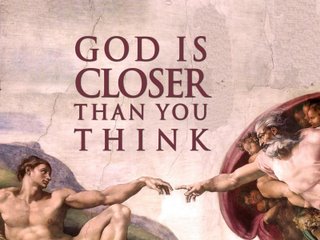
God Is Closer Than You Think #2 – What Is God Like?

What Is God Like?  (A Taste For His Majesty*)

I. INTRO

Most of us know who Chuck Colson was – a Special Counsel to President Richard Nixon from 1969 to 1973…

On June 1, 1973, Chuck Colson[1] visited his friend Tom Phillips,[2] while Watergate unfolded in the press. He was baffled and shocked at Phillips’ explanation that he had “accepted Jesus Christ.”

But he saw that Tom was at peace and he wasn’t. When Colson left the house, he couldn’t get his keys in the ignition he was crying so hard. He wrote in his book, Loving God:

That night I was confronted with my own sin—not just Watergate’s dirty tricks, but the sin deep within me, the hidden evil that lives in every human heart. It was painful and I could not escape. I cried out to God and found myself drawn irresistibly into His waiting arms. That was the night I gave my life to Jesus Christ and began the greatest adventure of my life.[3]

Charles Colson’s New Understanding of God

That story has been told thousands of times over the last four decades. We love to hear about this kind of conversion.

But far too many of us settle for that story in our own lives and the life of our church.

But not Charles Colson. Not only was the White House hatchet man willing to cry in 1973; he was also willing to repent several years later of a woefully inadequate view of God.

It was during a period of unusual spiritual dryness. (If you are in one, take heart! More saints than you realize have had life-changing encounters with God right in the midst of the desert.)

A friend suggested to Colson that he watch a videocassette lecture series by R.C. Sproul on the holiness of God. Here’s what Colson wrote:

All I knew about Sproul was that he was a theologian, so I wasn’t enthusiastic. After all, I reasoned, theology was for people who had time to study, locked in ivory towers far from the battlefield of human need. However, at my friend’s urging I finally agreed to watch Sproul’s series.

By the end of the sixth lecture I was on my knees, deep in prayer, in awe of God’s absolute holiness. It was a life-changing experience as I gained a completely new understanding of the holy God I believe in and worship.

My spiritual drought ended, but this taste for the majesty of God only made me thirst for more of him.[4]

In 1973 Colson had seen enough of himself to know his desperate need of God, and had been driven “irresistibly” (as he says) into God’s arms. But then several years later something else wonderful happened. A theologian spoke on the holiness of God and Chuck Colson says that he fell to his knees and “gained a completely new understanding of the holy God.” From that point on he had what he calls a “taste for the majesty of God.” Have you seen enough of God’s holiness to have an insatiable taste for His majesty?

This same thing happened to Job in the Bible – through all his tribulations he came to see God anew.

Job 1:1There was a man in the land of Uz whose name was Job; and that man was blameless and upright, one who feared God and turned away from evil.”

Job was a believer, a deeply devout and prayerful man. Surely he knew God as he ought. Surely he had a “taste for the majesty of God.” But then came the pain and misery of his spiritual and physical desert. And in the midst of Job’s dryness God spoke in His majesty to Job:

Job 40:8–14; 41:10–11: “Will you even put Me in the wrong? Will you condemn Me that you may be justified? Have you an arm like God, and can you thunder with a voice like His? Deck yourself with majesty and dignity; clothe yourself with glory and splendor?…Look on everyone that is proud, and bring him low? And tread down the wicked where they stand? …Who then is he that can stand before Me? Who has given to Me that I should repay him? Whatever is under the whole heaven is Mine.”

In the end Job responds, like Colson, to a “completely new understanding of the Holy God.” Job says in 42:3–6:

Therefore I have declared that which I did not understand,
Things too wonderful for me, which I did not know.”
‘Hear, now, and I will speak;
I will ask You, and You instruct me.’
“I have heard of You by the hearing of the ear;
But now my eye sees You;
Therefore I retract,
And I repent in dust and ashes.”

These two stories of men encountering God in life-changing ways is the same thing that is happening to Isaiah in Chap 6…

Isaiah 6:1-8 — In the year of King Uzziah’s death I saw the Lord sitting on a throne, lofty and exalted, with the train of His robe filling the temple. Seraphim stood above Him, each having six wings: with two he covered his face, and with two he covered his feet, and with two he flew. And one called out to another and said,

“Holy, Holy, Holy, is the Lord of hosts,
The whole earth is full of His glory.”

And the foundations of the thresholds trembled at the voice of him who called out, while the temple was filling with smoke. Then I said,

“Woe is me, for I am ruined!
Because I am a man of unclean lips,
And I live among a people of unclean lips;
For my eyes have seen the King, the Lord of hosts.”

Then one of the seraphim flew to me with a burning coal in his hand, which he had taken from the altar with tongs. He touched my mouth with it and said, “Behold, this has touched your lips; and your iniquity is taken away and your sin is forgiven.”

Then I heard the voice of the Lord, saying, “Whom shall I send, and who will go for Us?” Then I said, “Here am I. Send me!”

II. BODY

Revival happens, individually and corporately, when we see God majestic in His holiness – and we come to grips with our own need and desperation.

Brokenness, repentance, the unspeakable joy of forgiveness, a “taste for the majesty of God,” a hunger for His holiness—to see it more and to live it more: that’s revival. And it all begins by seeing God.

We have a companion book for this series and we have a companion passage that I am asking all of us to pray for ourselves, our loved ones, for SBF. That passage is:

Eph 1:17-19 — That the God of our Lord Jesus Christ, the Father of glory, may give to you a spirit of wisdom and of revelation in the knowledge of Him. 18 I pray that the eyes of your heart may be enlightened, so that you will know what is the hope of His calling, what are the riches of the glory of His inheritance in the saints, 19 and what is the surpassing greatness of His power toward us who believe.

In our companion book “Christian Beliefs” by Wayne Grudem we are in Chap 2 – What Is God Like?  It is the longest chapter of the book (16 pages listing 24 separate attributes of God), and we won’t be able to cover them all this morning, so I would like to offer you 4 glimpses of God from the first 4 verses of Isaiah 6 that coincide with our companion book.

1. God Exists – 6:1:KingUzziah is dead, and Isaiah encountered the Lord sitting on the throne.

We see this also with the first four words of the Bible: Gen 1:1 – In the beginning God…” God was the living God when this universe banged into existence. And He will be the living God in 10 trillion years.

God never had a beginning and therefore depends on nothing for His existence. He always has been and always will be alive.

Our companion book describes God as “independent.”  I would take issue with Grudem’s choice of words here.  I agree with Grudem’s words that God “doesn’t actually need us or anything else in creation for anything.”[5]

I would prefer to use the term self-differentiated rather than independent.  What does it mean to be self-differentiated?

“Self-differentiation” is a term used to describe one who is emotional healthy – and is no longer ultimately dependent on anything other than themselves. They are able to live interdependently with others because their sense of worth is not dependent on external relationships, circumstances, or occurrences.

There are three categories of connection that are worthy of our understanding:  

  • Independence (-)
  • Dependence (-), and
  • Interdependence (+).

Within the Trinity each member is fully self-differentiated – and each is supremely interdependent.

2. God Is Omnipotent – The word omnipotent means all-powerful (omni = all; potent = power). Notice the throne of God’s authority is not one throne among many thrones. It is high and lifted up above ALL thrones. Again in 6:1: “I saw the Lord sitting upon a throne high and lifted up.”

That God’s throne is higher than every other throne signifies God’s superior power to exercise His authority. No opposing authority can nullify the decrees of God.

What God purposes, God accomplishes. In Isaiah 46:10, God emphatically states: “My counsel shall stand, and I will accomplish all My purpose.”

Daniel 4:35: “He does according to His will in the host of heaven and among the inhabitants of the earth; and none can stay his hand.”

To be gripped by the sovereign omnipotence of God is either marvelous because He is for us — or it is terrifying because He is against us.

Indifference to God’s omnipotence simply means we haven’t seen it for what it is. The sovereign authoritative power of the living God is a refuge full of joy and delight for those who have been gripped by the gospel, which is His new covenant promise of love, mercy, and forgiveness.

3. God Is Holy – 6:2-4: “Seraphim stood above Him, each having six wings: with two he covered his face, and with two he covered his feet, and with two he flew. And one called out to another and said, “Holy, Holy, Holy, is the Lord of hosts, The whole earth is full of His glory.” And the foundations of the thresholds trembled at the voice of him who called out, while the temple was filling with smoke 6:3: “And one called to another, ‘Holy, holy, holy is the Lord of hosts!’”

The seraphim are never mentioned again in the Bible again. The word seraph literally means “to burn.”  John Wesley describes them as, “An order of holy angels…[that] represent either their nature, which is bright and glorious…and pure; or their property, of fervent zeal for God’s service and glory.”[6]

According to verse 4, when one of them speaks, the foundations of the thresholds in the temple shake.

This scene is repeated in Rev 4:8, where John has a vision of the throne in heaven – “And the four living creatures, each one of them having six wings, are full of eyes around and within; and day and night they do not cease to say, “Holy, holy, holy is the Lord God, the Almighty, who was and who is and who is to come.”

The difference between the creatures in Isaiah and Revelation have a lot to do with the eyes of these angelic beings.  In Isaiah the Seraphim covered their faces – and in Rev – the beings “are full of eyes around and within.”

In Isaiah’s vision the Seraphim cannot even look upon the Lord. Great and good as they are, untainted by human sin, they revere their Maker in great humility. How much more will we shudder and quake in His presence!

Let’s consider the word holy…

  • The possibilities of language to carry the meaning of God eventually run dry.
  • The root meaning of holy is to cut or separate. A holy thing is cut off from and separated from that which is common, or we might use the word, secular.
  • Earthly things (and people) are holy in so far as they are distinct from the world — and devoted to God.
  • The Bible speaks of holy ground (Exodus 3:5), holy assemblies (Exodus 12:16), holy sabbath (Exodus 16:23), a holy nation (Exodus 19:6); holy garments (Exodus 28:2), a holy city (Nehemiah 11:1), holy promises (Psalm 105:42), holy men (2 Peter 1:21) and women (1 Peter 3:5), holy scriptures (2 Timothy 3:15), holy hands (1 Timothy 2:8), a holy kiss (Romans 16:16), and a holy faith (Jude 20).  While it’s not used in the Bible, we speak of holy matrimony.
  • Almost anything can become holy if it is separated from the common and devoted to God.
  • God is not holy because He keeps the rules. He wrote the rules! God is not holy because He keeps the law. The law is holy because it reveals God.

Habakkuk 2:20 –“The Lord is in his holy temple; let all the earth keep silence before him.”

The final glimpse is not in our companion book – or, perhaps we could say it is interwoven throughout our companion book…

3. God Is Glorious – 6:3: “Holy, holy, holy is the Lord of hosts, the whole earth is full of his glory.”

We cannot separate God’s holiness from God’s glory.

The glory of God is the manifestation of His holiness. God’s holiness is the incomparable perfection of His divine nature; His glory is the display of that holiness.

When we say, or when the Bible says, “God is glorious” it means: God’s holiness has gone public. His glory is the open revelation of the secret of His holiness.

Leviticus 10:3 — “I will show myself holy among those who are near me, and before all the people I will be glorified.”

When God shows himself to be holy, what we see is glory. The holiness of God is His concealed glory. The glory of God is his revealed holiness.

When the Seraphim say, “The whole earth is full of His glory,” it is because from the heights of heaven they can see the end of the world. From down here the view of the glory of God is limited. And truth be told, it’s limited largely by our foolish preferences for lessor things.

Some day God will remove every competing glory and make His holiness known in awesome splendor to every humble creature.

CONCLUSION

Having said that, there is no need to wait. Like Chuck Colson, Job, and Isaiah, my prayer is that as individuals and as a church we will humble ourselves to go hard after the Holy God – that we would develop a taste for His majesty.

I want to hold out this promise from God, who has existed forever, who is omnipotent, who is holy, and who is glorious.

As we prepare our hearts for communion I’d like to read my favorite about revival. But I must warn you it’s not for the faint of heart…Burns asks the question:  Do we want a revival?  Do we really?  And then he answers…

To the church, a revival means humiliation, a bitter knowledge of unworthiness and an open humiliating confession of sin on the part of her [pastors] and people.  It is not the easy and glorious thing many think it to be, who imagine it filled the pews and reinstated the church in power and authority.  It comes to scorch before it heals; it comes to [convict] people for their unfaithful witness, for their selfish living, for their neglect of the cross, and to call them to daily renunciation and to a deep and daily consecration.  That is why a revival has ever been unpopular with large numbers within the church.  Because it says nothing to them of power, or of ease, or of success; it accuses them of sin; it tells them they are dead; it calls them to awake, to renounce the world [system] and to follow Christ.[7]

Sit quietly and reflect and repent as necessary – and when you’re ready come and remember what Christ has done.  His broken body and shed blood.  He lived the life we should have lived – and He died the death we should have died.  While we were yet dead in our sins, Christ died for us – He became poor that we might become rich in mercy and grace…

* I am grateful to the teaching and preaching ministry of John Piper for some of the illustrations of this sermon – as well as the treatment of holiness — and the relationship between God’s holiness and God’s glory.


[1]  Colson was Special Counsel to President Richard Nixon from 1969 to 1973. He gained notoriety at the height of the Watergate affair for being named as one of the Watergate Seven, and pleaded guilty to obstruction of justice. He became a Christian in 1973 after his arrest.

[2] Chairman of the defense contractor Raytheon.

[3] Loving God, p. 247.

[4] Loving God (pp. 14–15).

[5] Christian Beliefs: 22.

[6] Wesley’s Notes On The Bible. Christian Classics Ethereal Library; 1.1 edition 2010.

[7] James Burns. Revival, Their Laws & Leaders, Hodder and Stoughton 1909:50.

Tangible and Intangible Qualities of Church Leaders

I. INTRO

The Bible gives us a very thorough description of the tangible[1] qualities in in 1 Timothy 3:1-13 and Titus 1:5-3:11.  They are very straightforward, with only a couple opportunities for disagreement on interpretation:

1.  Vs. 1 – if any man aspires to the office of overseer, it is a fine work he desires to do” (NAS); “man” (KJV/NKJV); Whoever aspires to be…” (NIV).  The Greek word is tes and is an indefinite pronoun. [See also anthropos – and the use of male/masculine pronouns; gender inclusive language]

An issue that has come to the forefront over the last 20 years or so is the issue of women in leadership. There are three basic views related to gender roles. The first two are extremes (we land in the middle)…

  • Chauvinism is an extreme position, which says that men and women have been created in a hierarchy with the male as the higher and superior sex.
  • Egalitarian is an extreme position, which says there is no God-ordained structuring of how men and women ought to serve in the home or in the church.
  • Complementarian — Though equal, men and women have biblically defined complementary and distinct roles in marriage, family life, and church leadership.

It is extremely important to cultivate a compassionate and kind complementarianism that starts with celebrating Christ’s love for the Church. Men are strongly encouraged to love their wives and children as Christ loved the church (Eph 5:25), and for church leaders to lead and serve people sacrificially.

2.  Vs. 2 – the husband of one wife.”  Can a single, divorced, or widowed man be an elder?

Some Roman Catholic scholars suggest that “wife” refers to the Church to which the elder, or in their case “priest”, should reckon himself married. (This interpretation helps to enforce celibacy among the priesthood.)

Another view is that Paul’s purpose is to insist that only married men be eldersThree objections:

  • The word “one” is quite emphatic in the Greek text. Paul’s point is that the elder must have nothing to do with any woman other than his wife.
  • If single men cannot be elders then Paul himself (not to mention Jesus) would be excluded.
  • In view of Paul’s statements in 1 Cor. 7 about the benefits and advantages of the singlehood when it comes to ministry, it seems unlikely that he would exclude single men from eldership in his pastoral letter to Timothy.

To be the “husband of one wife” means that one is faithful, devoted, and loyal to his spouse — a “one-woman man.”

Sexual promiscuity was rampant in the ancient world (as it is in ours), and this qualification is designed to address that problem. An elder must be a man of unquestioned morality and fidelity.

II. BODY

1.  Tangibles Qualities — God’s blueprint for building His church includes using men in the office of pastor. The pastor is first an elder, and along with the other elders, the pastor is responsible to do the following:

  • Oversee the church (1 Timothy 3:1). The primary meaning of the word bishop is “overseer.” The general oversight of the ministry and operation of the church is the responsibility of the pastor along with the other elders.
  • Rule over the church (1 Timothy 5:17). The word translated “rule” literally means “to stand before.” The idea is to lead or to attend to, with an emphasis on being a diligent caretaker. This would include the responsibility to exercise church discipline and reprove those who err from the faith (Matthew 18:15-17; 1 Corinthians 5:11-13).
  • Feed the church (1 Peter 5:3). Literally, the word pastor means “shepherd.” The pastor has a duty to “feed the flock” with God’s Word and to lead them in the proper way.
  • Guard the doctrine of the church (Titus 1:9). The teaching of the apostles was to be committed to “faithful men” who would teach others also (2 Timothy 2:2). Preserving the integrity of the gospel is one of the pastor’s highest callings.

2.  Intangibles Qualities (more intuitive).  We can say that the TANGIBLES qualities are more the SCIENCE of leadership, while the INTANGIBLES are more the ART of leadership.

  • Calling, Character, Competence, and Chemistry

Calling

A person’s sense of God’s voice directing him or her to this particular role, to our particular church and mission, and to impact our community.

1 Timothy 3:1 — If any man aspires to the office of overseer, it is a fine work he desires to do” NIV – “noble task.”

Rom 1:3 – “Paul, a bond-servant of Christ Jesus, called as an apostle, set apart for the gospel of God.”

General calling: bond servant and set aside for the gospel.  Specific calling: apostle.

Character

These are all the tangible qualities listed in 1 Tim and Titus, which speak to the heart and integrity of a Christian leader.

Simply put, we need to have confidence in a person’s walk with Jesus Christ. We need to know that he or she is committed to spiritual disciplines.

We also make the mistake of placing gifting of character…

Competence

Competence includes the skill sets, gifts, education, experience, and leadership required to fulfill the responsibilities.

1 Timothy 3:10 – These men must also first be tested…”

2 Timothy 2:15 – “Be diligent to present yourself approved to God as a workman who does not need to be ashamed, accurately handling the word of truth.”

1 Peter 4:10-11 – “As each one has received a special gift, employ it in serving one another as good stewards of the manifold grace of God. 11  Whoever speaks, is to do so as one who is speaking the utterances of God; whoever serves is to do so as one who is serving by the strength which God supplies; so that in all things God may be glorified through Jesus Christ, to whom belongs the glory and dominion forever and ever.”

Chemistry

Chemistry is the degree of a relational fit within the leadership team and church culture. This includes the specific team in which the person would be serving.

Ephesians 4:3 – being diligent to preserve the unity of the Spirit in the bond of peace.”

Acts 4:24; 5:12 – They were together with “one accord.”

  • Spiritual and emotional health coupled with production.

Titus 2:12 – Training us to renounce ungodliness and worldly passions, and to live self-controlled, upright, and godly lives in the present age.”

Proverbs 12:24 – “The hand of the diligent will rule, but the slack hand will be put to forced labor.”

  • Growing discernment.

Philippians 1:9 – And this I pray, that your love may abound still more and more in real knowledge and all discernment.”

Hebrews 5:14 – “But solid food is for the mature, who because of practice have their senses trained to discern good and evil.”

  • A shepherd’s heart…

Having had their heart broken by the church, these people still love the church and seek to serve her.

Psalm 51:17 – “The sacrifices of God are a broken spirit;
a broken and contrite heart, O God, you will not despise.”


[1] Able to be touched; clear and to the point.

God’s Mission Becomes Our Mission

I. INTRO

Last week we turned an important corner in the life of this church with our Sacred Assembly.  Today, I’d like for us to consider the mission of God’s Church – and more specifically this church, Southside Bible Fellowship.

By way of introduction, God has a MISSION, a MEANS, and a METHOD.

1. What is the MISSION of God?

God’s mission is the manifestation of His own glory.

“For the earth will be filled

With the knowledge of the glory of the Lord,

As the waters cover the sea.” Habakkuk 2:14

What is God’s glory?  God’s glory is the shining forth of the perfection of all of God’s attributes.

God’s supreme desire is that He might be known and enjoyed above all things.

God seeks to be recognized as supremely worthy, supremely splendid, and supremely valuable. God’s glory is sensed when we feel the reality of His presence, goodness, and superiority.

2. The MEANS of God’s mission is Jesus Christ and the work He did on the cross.

We call this the gospel.  God creates, calls, rescues, redeems, saves, restores, restrains, and grants — all to the end that we may find our true comfort, joy, and delight in Him.

The gospel is the historical narrative of the triune God orchestrating the reconciliation and redemption of a broken creation and fallen creatures, from Satan, sin and its effects to the Father and each other through the birth, ministry, death, resurrection, ascension — and future return of the substitutionary Son by the power of the Spirit for God’s glory and the Church’s joy. (We see summary statements of this throughout Scripture – both Old and New Testaments.)

To be “gospel-centered” means to both see and live out this narrative as the central theme, or singular story line, of the Bible.  It is central. It is singular.

The gospel stands at the center of God’s redemptive plan, and in it we see Him most clearly for Who He is and what He has done.

3. The METHOD of God’s mission is you and me – the Church.  In a nutshell we (the Church) are all called to live as missionaries in our current life station and cultural context.

Family, friends, neighbors, co-workers – all our social networks.

If you were preparing to be a missionary in Malaysia what activities would best prepare you?

We are to begin the discipleship process BEFORE conversion.  (This is where most churches get it wrong…think about it – we start discipling our kids before they’re converted…)

II. BODY

Having identified God’s MISSION, MEANS, and METHOD I would like to spend the rest of our time considering the mission of the church – and specifically this church – SBF as we enter into a new season of ministry…

The mission of the Church universal is: To glorify God by making disciples through embodying the gospel of Jesus Christ.

God’s mission and the mission of His Church are inseparably linked. If God’s mission is to be glorified through the redemption and reconciliation of a people, the Church’s mission must orient around the glory of God and seek to glorify Him through redemption and reconciliation.

2 Corinthians 5:17-20 – “Therefore if anyone is in Christ, he is a new creature; the old things passed away; behold, new things have come. 18 Now all these things are from God, who reconciled us to Himself through Christ and gave us the ministry of reconciliation, 19 namely, that God was in Christ reconciling the world to Himself, not counting their trespasses against them, and He has committed to us the word of reconciliation.

20 Therefore, we are ambassadors for Christ, as though God were making an appeal through us; we beg you on behalf of Christ, be reconciled to God. 21 He made Him who knew no sin to be sin on our behalf, so that we might become the righteousness of God in Him.

The mission of the Church is highlighted in these verses. As those who have been reconciled to God through the gospel of Jesus Christ, we are now ambassadors of reconciliation to a lost and broken world. We plead, urge, implore, reason, pray, serve, preach, teach and gather to see God glorified through reconciliation.

We also see the mission of the church in the more familiar Matthew 28:19-20:

Go therefore and make disciples of all the nations, baptizing them in the name of the Father and the Son and the Holy Spirit, 20 teaching them to observe all that I commanded you; and lo, I am with you always, even to the end of the age.”

A suggested mission for SBF: To glorify God through making disciples.  We will accomplish this through:

  1. Gospel-centered worship
  2. Gospel-centered prayer
  3. Gospel-centered community
  4. Gospel-centered service
  5. Gospel-centered mission.

1. Gospel-Centered Worship

All of life is worship. Every thought, word, desire, and deed involves the ascribing of worth and value – glory. Each attitude, affection and activity is an expression of our allegiance, whether to our Creator or His creation. God is alone worthy of our worship.

Worship is related to every area of our lives. We are called to eat, drink, speak, think, and work to the glory of God (1 Corinthians 10:31 – whatever you do, do all to the glory of God”). Worship cannot be narrowed down to a particular time and place as if God does not claim authority over certain aspects of our lives. There are no neutral desires or deeds; everything is an expression of worship.

Gospel-centered worship is to be pursued in every facet of our lives as we consider how all encompassing the gospel is to us. Gospel-centered worship is nurtured through:

The gathering of God’s people in a weekend worship service. Within this venue, we worship God by remembering the gospel through preaching, teaching, singing, praying and celebrating the ordinances of baptism and communion. Each presents an opportunity for the church to receive, remember, respond and rejoice in the work of our great King.

Gospel-centered worship also means that we orient our lives (between Sundays) around learning how to worship God and bring Him glory through our thoughts, words, and deeds.  Again, 1 Corinthians 10:31 becomes our holy objective – whatever you do, do all to the glory of God”

1 Corinthians 10:31, Psalm 145:1-21, Isaiah 43:6-7, Colossians 3:1-17

2. Gospel-Centered Prayer

Turn with me to Exodus 33:15-18 –“Then [Moses] said to [God], “ If Your presence does not go with us, do not lead us up from here. 16 For how then can it be known that I have found favor in Your sight, I and Your people? Is it not by Your going with us, so that we, I and Your people, may be distinguished from all the other people who are upon the face of the earth? 17 The Lord said to Moses, “I will also do this thing of which you have spoken; for you have found favor in My sight and I have known you by name.” 18 Then Moses said, “I pray You, show me Your glory!

What we have here is the greatest request we could ever make of God.  It transcends any other request that we could ask of God.

It’s an unrelenting desire to engage the presence of God.

If you want to know the real you, listen for what you pray for involuntarily.  Listen to the spontaneous prayers that irrupt from your heart.

Moses’ prayer is a reflex of the heart.  It reveals what he REALLY wants.

What is it that you involuntarily pray for?  What is the unrehearsed outburst of your soul…

God loves it when we address Him in prayer as the END and not simply a MEANS.  If you’re like me it’s easy to fall into the trap of seeing God as the MEANS to our true desires instead of seeing God as the END of all our desires.  We seek God for jobs, for relationships, for good health, for material things – and all those are good yet the ultimate value is God Himself.

The prayer that most delights God is the prayer that makes Him our most passionate desire.

Jonathan Edwards concluded the most essential difference between a Christian and a moralist is that a Christian obeys God out of the sheer delight in who He is. The gospel means that we are not obeying God to get anything but to give him pleasure because we see his worth and beauty. Therefore, the Christian is able to draw power out of the contemplation of God (i.e., prayer). The moralist will usually only come and petition God for things…

Gospel-centered prayer, is making God the END and not the MEANS — rather than anxious petitioning.

3. Gospel-Centered Community

We worship a triune God, Who has eternally existed as Father, Son and Holy Spirit. In identifying the tri-unity of God, we recognize that God is communal. The Godhead has perpetually dwelt in perfect harmony, unity, joy, and love. Bearing the image of God, we are called to reflect this reality. We are called to be communal creatures imaging the community of our Creator.

Though each Christian has a personal relationship with God, that relationship is not individual or private. The Christian faith is not intended to be lived in isolation. We were made for community – relationship with God and with each other.

The local church is not merely a place that we attend but a people to whom we belong. The Bible calls us members of the body (1 Corinthians 12:12-31) with the expectation that we contribute to the body for the glory of God and the good of His people.

Gospel-centered community is a radical call amid a culture of mere attendance and casual involvement. It involves mutual love, care, consistency and authenticity as we seek to adorn the person and work of Christ with our lives. Where these elements are lacking, we have moved away from gospel-centered community and into the realm of social clubs.

Gospel-centered community is primarily expressed through Community Groups that meet during the week, or Sunday School classes that meet before the service on Sunday mornings. Groups are not perfect and those who participate in them will find them messy at times. However, our hope is that group members will be radically committed to reform from within. This takes time, prayer, effort, patience, love, trust and hope.

Acts 2:42-47, Hebrews 3:12-13, 1 Corinthians 12:12-31

4. Gospel-Centered Service

Gospel-centered service is motivated by the reconciling work of God and seeks to extend His grace and mercy to others for His glory and not our own. It is an expression of love and stewardship of grace marked by humility, generosity and hospitality and empowered by a passion for the glory of God.

Service can and should be pursued in various ways by all recipients of varied grace. Those who have been impacted by the gospel have countless opportunities – both formal and informal – to serve others by greeting at the doors of the church, following up guests who will be visiting our church, volunteering to work with our children and youth, teaching, singing, serving communion, giving financially to the needs of others, opening their homes to their neighbors, etc.

John 13:1-20, 1 Peter 3:8-11, 2 Corinthians 8:1-9:15

5. Gospel-Centered Mission

We are used to thinking of mission in terms of funding and sending missionaries to work in other countries to share the plan of salvation with unreached people groups.

If there is an unreached people group in the United States, it is New Englanders. A recent Gallup poll placed the six states of New England in the top ten least religious states in the nation.

Those in New England who attend evangelical churches hover between 1- 3% of the population. There is a higher percentage of evangelical Christian churchgoers in Mormon Utah than in New Hampshire!

Gospel-centered mission is the recognition that each one of us is sent by God as a missionary into our own sphere of relationships – family, friends, neighbors, co-workers – where we boldly promote the gospel through collaborative expressions of mercy and generosity.

We serve a missionary God: The Father sent the Son, the Son sent the Holy Spirit, and the Holy Spirit sends us.

Let me just say that I am more of a fan of mining the vein of our current relational sphere than I am into organizing what we’ve known as “street witnessing.”  And I am more of a fan of initially engaging our relational network through learning how to listen.  In our culture at this moment in history, we will earning the right to speak through first of all learning how to listen.

2 Corinthians 5:11-2, Matthew 28:18-20, Mt. 4:19; John 20:21; Acts 16:20; 17:6, and to make disciples of all nations Matt. 28:18-20; Acts 1:8

The Upside Down Life #4 – Blessed Are Those Who Mourn

I. Intro

Matthew 5:4; Hebrews 12:14-17

Today we will continue in our series The Upside Down Life, looking at the first 16 verses of Matt 5.  Today we will do some review work and unpack a few concepts in Matt 5 and then we will move into Heb 12.

(Review) Both Gene and Chris did an excellent job defining the words “blessed” (and what it means to be “poor.”)  Those notes are available here on the blog…

Review “poor in spirit”

  • Two weeks ago Chris said being “poor in spirit” is seeing our desperate need for God.
  • And then last week Gene said some pretty heavy things…
    • He said that as a church we are to be thankful that SBF has been privileged to go through all the struggles we have. God must be thrilled that there is somebody here who is broken and hungry for more… (Heavy words…a perfect message to begin our week-long fast as a church).
    • Gene went on to say SBF has lost pastors, people, programs, reputation, visible success, and a downward trend in the bank account…  [God comforts the afflicted – and afflicts the comfortable]
    • Your church is flat broke, you do not have it all together, you do not have it all figured out, and you cannot muscle, or buy, your way out of this one.
    • Blessed are those bankrupt in spirit, because they are entering the eternal reserves of the reservoirs of the God of true riches.
    • As a church we’ve been taken out to the woodshed…we’ve been spanked. Are you glad yet?  [I have a tremendous amount of respect for those of you who have stayed.]

Where do we go from “bankrupt in spirit”?  We mourn…

Today, we will look at 5:4 “Blessed are those who mourn for they will be comforted”

Once we see and acknowledge our deep spiritual poverty, it gives way to a deep and utter repentance.  (There’s a difference between repentance and “relentance.”)

There is a transforming grief, or repentance, that surfaces – not only for our own lives, but also for the injustice, greed, and suffering that grips our world.  (“Meanwhile we groan.”)

I’ve titled the message this morning, The Unlikely Route To Joy (borrowed from a chapter heading in Dan Allender’s’ book Wounded Heart).

  • In order to become rich, we need to acknowledge and own our poverty.
  • And in order to know “joy inexpressible and full of glory” (1 Pet 1:8) we must mourn.  This is the essence of living the upside down life (or counterintuitive).

I would like us to refer to mourning as a lifestyle of repentance.

For those of us who have read Pete Scazzero’s book, The Emotionally Healthy Church, we remember that the 3rd principle of the EHC is to live in brokenness and vulnerability.

This means living and leading out of our failure and pain, questions and struggles…[1]

This is how Paul led.  In 2 Cor 12 – Paul speaks of being caught-up to the third heaven – and then he shares about his thorn in the flesh“a messenger of Satan to torment me—to keep me from exalting myself! 8 Concerning this I implored the Lord three times that it might leave me. 9 And He has said to me, “My grace is sufficient for you, for power is perfected in weakness.”

Dr. Dan Allender – “An about face movement from denial and rebellion to truth and surrender… Repentance involves the response of humble hunger, bold movement, and wild celebration when faced with the reality of our fallen state and the grace of God…It is a shift in perspective as to where life is found…It is melting into the warm arms of God, received when it would be so understandable to be spurned.” (Wounded Heart)

**Mourning, or lifestyle repentance, is living WITH our failures, but not UNDER them.

II. BODY

With that said please turn to Hebrews 12…

If we had to boil down the book of Hebrews to a one-word description, the word would be perseverance. It is written specifically for a group of Christians who were about to quit.

Vs. 14-17 are full of some very specific admonitions to help us with engaging in a lifestyle of repentance…

14Pursue peace with all [people], and the sanctification without which no one will see [to perceive, to know, to become acquainted with by experience] the Lord.

15See to it [Looking diligently – episkapao] that no one comes short of the grace of God; that no root of bitterness springing up causes trouble, and by it many be defiled [stained];

16that there be no immoral or godless person like Esau, who sold his own birthright for a single meal.

17For you know that even afterwards, when he desired to inherit the blessing, he was rejected, for he found no place for repentance [NIV – he could bring about no change of mind], though he sought for it with tears.

This is a heavy passage: Esau found no place for repentance – even though he sought for it with tears.  (What are we supposed to do with this text?)

This passage offers us some insight into the reasons for Esau’s inability to come to a place of true repentance – and I believe it will help us to consider some possible issues that may be keeping us from fully knowing the privilege of repentance.

Listed in this passage are (at least) 6 admonitions that will move us toward embracing a lifestyle of true repentance…

1.  Pursue peace with all people.

Pursue: to run swiftly [NIV –  Make every effort]

Peace: from a primary verb eirēnē (harmonized relationships)

“If therefore you are presenting your offering at the altar, and there remember that your brother has something against you, leave your offering there before the altar, and go your way; first be reconciled to your brother, and then come and present your offering.”  Matthew 5:23,24 (NAS)

Roms 12:18 – “If possible, so far as it depends on you, be at peace with all men.”

(In a few weeks we’ll be talking about Mat 5:9 – Peacemaker vs. peacekeeper.)

I once flew from Reno, NV to Tulsa, OK and then rented a car and drove 3 hours just to ask someone’s forgiveness after reading this passage and taking it to heart.

2.  Pursue sanctification.

Sanctification: hallowed [NIV – Make every effort… to be holy] The Lord’s Prayer (Mat 6) hagiasmos (Heb 12 – noun), hagiazō (Mat 6 – verb)

We have positional sanctification and progressive sanctification

The Gospel Is for Believers.  We Christians need to hear the gospel all of our lives because it is the gospel that continues to remind us that our day-to-day acceptance with the Father is not based on what we do for God but on remembering what Christ did for us.  (That is what communion is all about…)

**Esau was rejected by God because he steadfastly refused to serve the purpose of God and instead served his lust for the immediate and the tangible.

3.  Pursue grace.

“See to it that no one comes short of the grace of God.” (v.15)

Grace: All that God is lavishly poured into you. If God has acted lavishly toward you, could you not be lavish to others?  Or yourself??

Jerry Bridges, in his masterpiece says, “The idea portrayed here is analogous to the ocean waves crashing upon the beach. One wave has hardly disappeared before another arrives.[2]

Pursue the truth in love (Eph 4:15).

“See to it that…no root of bitterness springing up causes trouble, and by it many be defiled.”  (v.15)

Notice the word, “many.”

Like a small root that grows into a great tree, bitterness springs up in our hearts and overshadows even our deepest relationships.

A “bitter root” comes when we allow disappointment or expectations to grow into resentment, or when we nurse grudges over past hurts.

Eph 4:15: But speaking the truth in love we are to grow up…” In my view this passage speaks to the epitome of what it means to be spiritually and emotionally healthy

5.  Pursue purity.

“See to it that…there be no immoral…person like Esau.” (v.16)

pornos – male prostitute.  Again, Esau steadfastly refused to humble himself to serve the purpose of God.  Instead he served his lust for the immediate and the tangible.

6.  Pursue God.

Instead of being godless (or, “unhallowed, profane” – Vine’s]

Esau found no place for repentance (metanoia), though he sought for it with tears.

We usually associate tears with repentance.  And it’s true that tears very often accompany true repentance.  But here we have the instance of Esau crying for repentance but not finding it.  Why?  Esau was in “relentance,” not true repentance.

III.CONCLUSION

“Repent therefore and return, that your sins may be wiped away, in order that times of refreshing may come from the presence of the Lord.”   Acts 3:19 (NAS)

Nothing will cause a renewed soul to hate sin so much as a realization of God’s grace; nothing will move him to mourn so genuinely over his sins as a sense of Christ’s dying love. It is that which breaks his heart: the realization that there is so much in him that is opposed to Christ. But a life of holiness is a life of faith (the heart turning daily to Christ), and the fruits of faith are genuine repentance, true humility, praising God for His infinite patience and mercy, pantings after conformity to Christ.  —The Doctrine of Sanctification by A.W. Pink.


[1] EHC: 110.

[2] Jerry Bridges, Transforming Grace.