
Gospel Shaped Prayer and Passion (Acts 1:12-14)

Series: Gospel Chronicles: How God Shapes and Builds the Church.  A Study in the Book of Acts Part 1

I.      INTRO

A.   Last week we spoke of some implicit core values that were seeded throughout the first two chapters that helped to shape the Jerusalem church as it launched (which we’ll look at next week).

  1. They valued the kingdom of God.
  2. They valued humility and prayer — and as a result they grabbed a hold of unity.
  3. They valued the work and ministry of the Holy Spirit.
  4. They valued contextualized[1] Gospel presentations.
  5. They valued honest, and straight-forward Gospel presentations
  6. They valued an outward missional focus.
  7. They valued discipleship in the context of authentic community.

B.    Today, in our study of the book of Acts, I’d like for us to consider how we can become people of passionate prayer.  Passion driven…fighting unholy passions or getting in touch with God’s holy passions.

C.    I am going to take a different approach than you have probably heard regarding this subject of prayer.

D.   CS Lewis[2] has this fascinating quote that speaks to the issue of passion:
“Indeed if we consider the unblushing promises of reward and the staggering nature of the rewards promised in the Gospels, it would seem that Our Lord finds our desires [i.e., passions] not too strong, but too weak. We are half-hearted creatures, fooling about with drink and sex and ambition when infinite joy is offered us, like an ignorant child who wants to go on making mud pies in a slum because he cannot imagine what is meant by the offer of a holiday at the sea. We are far too easily pleased” (Weight of Glory pgs 25-26).

E.    Most teaching on prayer focuses on petitionary prayer. Today I would like to focus more on preparing our hearts for petitionary prayer.

F.    We will be looking at 4 passages today:  Acts 1:12-14; Lk 11:2-4; Rom 14:17; & Jer 29:7.

G.   Acts 1:12-14 –  

12Then they returned to Jerusalem from the mount called Olivet, which is near Jerusalem, a Sabbath day’s journey away.

13When they had entered the city, they went up to the upper room where they were staying; that is, Peter and John and James and Andrew, Philip and Thomas, Bartholomew and Matthew, James the son of Alphaeus, and Simon the Zealot, and Judas the son of James.

14These all with one mind were continually devoting themselves to prayer, along with the women, and Mary the mother of Jesus, and with His brothers.

H.   I’d like to look closely at the phrase, from v. 14, continually devoting themselves to prayer.  (The NIV Bible says, They all joined together constantly in prayer.)  What  does this mean??  Our English Bibles do not do this phrase justice.

I.      There is one Greek word for the phrase, continually devoting themselves.  And that word is HOMOTHUMADON, which comes from two Greek words:

1.     HOMO – meaning same. homo – same; hetero – different

2.     THUMADON – Comes from the Gk word thumos and is often translated as rage or wrath.  There is, however, a noble thumos that burns for the good of others, for God’s will to be done on earth as in heaven, and thus it motivates people to act.  Wrath or rage anger is usually personal; born of envy, self-absorption, or vengence. Thumos is often translated as “spirited” or “passion.” It implies a focused indignation or fight.  (It is also the word we get our English trademarked word Thermos[3] from.)

HOMOTHMUDON is used 10 of its 12 NT occurrences in the Book of Acts.[4]

3.     So, our English translations certainly do not do justice to this volatile Greek word.  We can define HOMTHUMADON as: To be together, to become unified with a passionate fierceness and indignation – it’s a crying out for God’s purpose and order to be established.  (Remember, our battle is NOT against flesh and blood [Eph 6:12] – so the fieriness and indignation is not directed toward people – it speaks more of an attitude of desire.)

4.     Today we are going to ask the question – How does this happen?  How does this come about?

II.    BODY

A.   There are 2 holy passions I’d like for us to consider as we pursue passionate prayer for the upcoming season of fruitful ministry here at Southside…

A PASSION FOR GOD’S NAME TO BE GLORIFIED.

A PASSION TO SEEK THE WELFARE OF OUR CITY.

1.     A PASSION FOR GOD’S NAME TO BE GLORIFIED.

a.     Luke’s shorter version of the Lord’s Prayer

2And He said to them, “When you pray, say:
‘Father, hallowed be Your name.
Your kingdom come’” [Very important words concerning prayer!]

3‘Give us each day our daily bread.
4‘And forgive us our sins,
For we ourselves also forgive everyone who is indebted to us.
And lead us not into temptation.’

b.     The Lord’s Prayer is a template.  There is both form and spontaneity (like jazz).

c.     Notice how v. 2 is God-focused – or, upward focused and vs. 3-4 begin to teach us about petitionary prayer.  For our purpose today, I’d like to zero-in on vs. 2.

d.     V. 2a — Father, hallowed be Your name

  • We address God as Father (Mat – “Our Father” in a family context)
  • When we pray, we are to begin with God.  Passionate prayer begins with a concern for and a preoccupation with God.
  • When we pray, Hallowed Be Your Name we are both asking for and declaring that God’s reputation, God’s renown, and God’s fame would be set apart esteemed, and honored as holy, — That God’s Name would be worshiped, treasured, and loved.
  • We are speaking (declaring) this both to ourselves.
  • And to our city.  (This is what was going on in the upper room!)
  • May our thoughts and emotions that arise at the mention of Your Name be worthy of God.  We don’t want to treat God lightly, or flippantly.  We don’t want God’s name to be treated as common — or of little consequence.
  • But that God would be primary – and at the center of our hearts and minds.  We seek this for ourselves AND for the people in our city (and around the world).
  • **We don’t need to make bigger commitments regarding prayer, the real need is to believe truer and more lofty thoughts about God…

e.     2b — Your kingdom come…

  • Last week we defined the KOG as the “rule and reign of God.”
    • The Christ Event established the KOG on the earth and it will be consummated when Jesus returns.  (Jesus pulls eternity into the present at stakes it with the Cross.)
    • Meanwhile we have partial but growing access to eternity.  The presence and power of God has been unleashed across the earth. (2 Cor 5:2 [NIV] “Meanwhile we groan, longing to be clothed instead with our heavenly dwelling…”)
  • We position ourselves for passionate prayer by aligning ourselves with the God’s rule and reign in our lives.  This is also what was happening for those 10 days in the upper room (Acts 1:12-14)
  • When we pray: “Your Kingdom Come,” it’s a prayer that seeks to banish all the other modern day idols from our lives (primarily money, sex, and power).
  • Rom 14:17 – 17For the kingdom of God is not eating and drinking [temporal things], but righteousness and peace and joy in the Holy Spirit.
    • Gospel fruit – Where God reigns He brings these things into our lives.
    • Righteousness – (It’s like being pregnant – you either are or you aren’t.)  Roms 5 clearly tells us that righteousness is a gift – SO if we are lacking a sense of right standing (before God) there is either poor theology of what God offers us in Jesus OR there is resistance on our part.
    • Peace — Prince of Peace does not rule and reign in your heart?
    • Joy – Perhaps other masters have taken dominion?
    • Christ alone by grace alone, through faith alone (Mat 7:22-23).
  • The primary objective of God’s kingdom is not to get us into heaven, but to get heaven into us… (There are still people to be saved from the wrath of hell.)

f.      So what am I saying about positioning ourselves for passionate prayer?

  • Passionate prayer begins with being God-focused, God-centered.  We don’t begin with our petitions, we begin with God.
  • We ELEVATE, WORSHIP, and GLORIFY the NAME of GOD. (Mission exists because worship doesn’t. –John Piper)
  • SURRENDER (ABANDON) your life to the KING.  God will take your sin (infection) and exchange (Luther) for right standing, peace, and joy.
  • Worship is not about the music – it’s, first and foremost, about the heart.
  • Baptism is important (Anabaptists – 16th century)

2.     A PASSION TO SEEK THE WELFARE OF OUR CITY.

a.     Jeremiah 29:7 — Seek the welfare of the city where I have sent you into exile, and pray to the LORD on its behalf; for in its welfare you will have welfare.’

b.     This verse helps us to refocus toward a KOG orientation.  Church is great, but is not the goal.  Church is the fruit of kingdom activity/ministry.  Kingdom ministry begins with seeking the welfare of the city.

c.     What is our city? In the Bible it was the regional hub.  Paul was urban centric – because he knew if he reached the cities he would reach the culture – and the countryside.  Historians estimate that by 300 AD somewhere between 1/3 to 1/2 the population of the Roman Empire was Christian.

d.     If you want to affect your world for Christ, seek the welfare of Manchester; if you want to affect the nations for Christ, seek the welfare of Manchester (the world is coming to Manchester, is it not?).

e.     The is Missional reorientation taking place in churches around the world.  We will be talking/praying about the more in the coming days – here it is in a nutshell…

  • How churches measure success is being redefined.  From “How do we get people to come?” to “How do we equip and mobilize our people to go?”

f.      You might be saying, “I’m already to busy just trying to keep my head above water!”  The missional question is, “How will we – or how do we – best represent Jesus Christ where God already has us?  Family, friends, neighborhoods, work, clubs, sports.”  Are you good news, bad news, or no news?

III.  CONCLUSION

A.    How do we become people of passionate prayer?  Ask God – individually and corporately – to grow IN us and then THROUGH us:

  1. A PASSION FOR GOD’S NAME TO BE GLORIFIED.
  2. A PASSION TO SEEK THE WELFARE OF OUR CITY.

B.    Next week: Gospel Shaped Mission (Acts 2)


[1] The message never changes, but the methods do.

[2] One of the most prolific and profound Christian authors of the 20th century.

[3] Genericized Trademarks – like Jacuzzi, Cellophane, Google – Thermos is a trademark name for a vacuum flask.

The Missional Reorientation of the Church

I was recently a part of a diagnostic team that conducted an in-depth analysis of a church on the east coast. One of the important recommendations is for them to turn outward in some fresh new ways. The following article will be included in the final report as an appendix resource…

Missional means adopting the posture of a missionary, learning and adapting to the culture around you while remaining biblically sound. (from Planting Missional Churches by Ed Stetzer)

For the church, the concept of maintenance is the one-word summary of the Christendom church paradigm that has been in place for some 1,710 years since Constantine became Roman emperor[1]and made Christianity the “state religion.” In Western Christendom, the church existed in a friendly environment and occupied the seat of influence, if not power. Today the church has been marginalized, pushed to the edge of western society.[2] The good news for us as 21st century followers of Christ is that God inspired marginalized people to write the Bible to other marginalized people. This is key, and holds great promise and adventure for us in these days ahead.

Intentionally moving from maintenance mode to missional mode involves a theological reorientation that proactively shifts from an ecclesiocentric[3] understanding of mission to a theocentric[4] reconceptualization of Christian mission.[5] In other words, the church becomes the fruit of missional activity, not the goal. As this new paradigm forms, a radical shift begins as missional praxis (practice) takes on fresh perspective. In this sense missional praxis includes missions–and much more. It brings together evangelism and social action and invites every member of the church to contextualize the gospel of Jesus Christ into the subcultures where our lives are spent beyond the church property – neighborhoods, extended family, the workplace, clubs, and other social groupings. Every member becomes a missionary.

The mission of the church, according to the late missiologist Lesslie Newbigin, is not merely an interpretation of history; it is a history making force.[6] Newbigin also noted, that the real challenge for Christianity is the conversion of a culture. During the Enlightenment there was a shift in the location of reliable truth from the story told in the Bible to the “eternal truths of reason,”[7] of which the mathematical physics of Newton offered the supreme model. These “eternal truths of reason,” required no faith and doubted everything except what could be measured and proved.

This emerging missional perspective is further enhanced by author and professor Charles Van Engen’s definition of mission, “God’s mission works primarily through the people of God as they intentionally cross barriers from Church to non-church, faith to non-faith, to proclaim by word and deed the coming of God in Jesus Christ.”[8]

Each local church becomes a missional community described as the pilgrim people of God who are on a journey towards the fullness of the reign of God.[9] Missional communities of faith no longer see the church service as the primary connecting point with those outside the community (of faith). Connecting with those outside happens during the week with those whom God has sovereignly placed in our lives within the various sub-cultures of our own local community. As we personally and authentically engage Christ – and then listen to, serve, love, and share the gospel with those around us, we act as missionaries to our culture.

As churches see their present community as a mission field. Leadership of a mission outpost is practiced with faithfulness and on-going compassion, knowing that for many years to come it will remain a mission outpost. It does not have the goal of becoming a churched-culture local church. The spirit of a mission outpost is one of mission, whereas the spirit of a churched-culture local church is one of maintenance focused on membership vs. salvation, maintenance vs. societal outreach, and dollars vs. meeting specific human hurts and hopes.[10]

Most traditional mission sending agencies in North America and Europe have, in general, failed to recognize that the most urgent contemporary mission field can now be found in our own back yards, and that the most aggressive paganism with which we have to engage is the ideology that now controls the “developed” world.[11]

The entire Bible is to be viewed as a “manual in mission,” or as one missiologist has said, “There is only one scriptural symbol that corresponds to the question of the dynamic and functional relation of the Church to the world. That symbol is mission.”[12] Finally, Van Engen also suggests that leadership effectiveness, as we move toward a missional praxis mindset, need not be measured by accomplishments, but how God’s people are equipped, empowered, inspired, and organized to participate with God’s mission.[13]

Congregations should no longer expect the community to exclusively come to us.  The Great Commission (Mat. 28:18-20) calls us to go.  There is a difference between a go ye church and a come ye church. Local missional praxis ministry involves the people of God crossing barriers to serve the other.  For congregations with well cared for facilities, mix missional outreach with ministries that go off-campus as well as workshops and classes that showcase the campus.

In measuring its effectiveness, the maintenance congregation asks, “How many visitors have we attracted?” The missional praxis congregation asks, “How many members have we sent?”

Unchurched adults interested in finding a congregation aren’t nearly as likely to visit one in person as a churched person who is shopping for a new congregation. This means effective evangelism must begin outside the church building in relationships between Christians and unbelievers, according to research the attractional model of Church (come ye) generally attracts transfer growth, while a missional model of Church (go ye) generally attracts a higher conversion growth percentage. It’s not either-or, but both-and.


[1] Ogden, Greg. Unfinished Business: Returning the Ministry To the People of God. Zondervan, Rev. 2003.

[2] A primary reason for this is that the church has lost much of its moral authority due to imposing a “Christian” moralism without gospel-changed hearts, which often led to cruelty, hypocrisy, and the abuse of power and authority.

[3] Or, church-centered.

[4] To God-centered.

[5] Guder, Darrell L., and Lois Barrett. Missional Church: A Vision for the Sending of the Church in North America. Grand Rapids, MI: Eerdmans 1998:4.

[6] Newbigin, Lesslie. The Gospel in a Pluralist Society. Grand Rapids, MI: Eerdmans 1989: 131.

[7] Newbigin, Lesslie. Proper Confidence: Faith, Doubt, and Certainty in Christian Discipleship, Eerdmans 1995:73.

[8] Fuller Theological Seminary: MP502, Lecture 1.

[9] Guder: 204

[10] Freeman, Robert E., Fuller Theological Seminary: ML525 Leadership Selection and Training in the Info-Tech Age. Lesson 1 — PARADIGMS OF ADULT TRAINING IN MISSION.

[11] Newbigin, Lesslie. The Open Secret: An Introduction to the Theology of Mission (Revised). Grand Rapids, MI: Eerdmans, 1995:10.

[12] Bosch, David J. The Why and How of a True Biblical Foundation for Mission. Reprinted as Hermeneutical Principles in the Biblical Foundation for Mission, Evangelical Review of Theology 17(4): 437-451, Oct. 1993.

[13] Van Engen, Charles. God’s Missionary People: Rethinking the Purpose of the Local Church. Grand Rapids, MI: Baker, 1991: 176.

Trinitarian Dance

C.S. Lewis described the Trinity as a “dance” saying, “God is not a static thing…but a dynamic, pulsating activity, a life, almost…a kind of dance” (Mere Christianity, p 136).

Tim Keller elaborates on this concept in the Reason for God in Chapter 14 – The Dance of God (pgs 214-221):

I believe that Christianity makes the most sense out of our individual life stories and out of what we see in the world’s history. In the last six chapters I have been arguing that the Christian understanding of where we came from, what’s wrong with us, and how it can be fixed has greater power to explain what we see and experience than does any other competing account. It is time to draw together the various threads of the narrative we have been examining and view the story line of Christianity as a whole. The Bible has often been summed up as a drama in four acts – creation, fall, redemption and restoration.

The divine dance
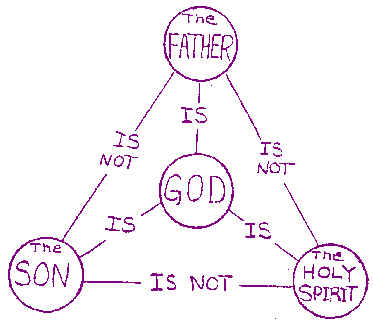
Christianity, alone among the world faiths, teaches that God is triune. The doctrine of the Trinity is that God is one being who exists eternally in three persons: Father, Son and Holy Spirit. The Trinity means that God is, in essence, relational.

The Gospel writer John describes the Son as living from all eternity in the ‘bosom of the Father’ (John 1:18), an ancient metaphor for love and intimacy. Later in John’s Gospel, Jesus, the Son, describes the Spirit as living to ‘glorify’ him (John 16:14). In turn, the Son glorifies the Father (17:4) and the Father, the Son (17:5). This has been going on for all eternity (17:5b).

What does the term ‘glorify’ mean? To glorify something or someone is to praise, enjoy and delight in them. When something is useful you are attracted to it for what it can bring you or do for you. But if it is beautiful, then you enjoy it simply for what it is. Just being in its presence is its own reward. To glorify someone is also to serve or defer to him or her. Instead of sacrificing their interests to make yourself happy, you sacrifice your interests to make them happy. Why? Your ultimate joy is to see them in joy.

What does it mean, then, that the Father, Son and Holy Spirit glorify one another? If we think of it graphically, we could say that self-centeredness is to be stationary, static. In self-centeredness we demand that others orbit around us. We will do things and give affection to others, as long as it helps us meet our personal goals and fulfils us.

The inner life of the triune God, however, is utterly different. The life of the Trinity is characterized not by self-centeredness but by mutually self-giving love. When we delight and serve someone else, we enter into a dynamic orbit around him or her, we centre on the interests and desires of the other. That creates a dance, particularly if there are three persons, each of whom moves around the other two. So it is, the Bible tells us. Each of the divine persons centers upon the others. None demands that the others revolve around him. Each voluntarily circles the other two, pouring love, delight and adoration into them. Each person of the Trinity loves, adores, defers to and rejoices in the others. That creates a dynamic, pulsating dance of joy and love. The early leaders of the Greek church had a word for this – perichoresis. Notice the root of our word ‘choreography’ within it. It means literally to ‘dance or flow around’.

The Father…Son…and Holy Spirit glorify each other…At the center of the universe, self-giving love is the dynamic currency of the Trinitarian life of God. The persons within God exalt, commune with, and defer to one another… When early Greek Christians spoke of perichoresis in God they meant that each divine person harbors the others at the center of his being. In constant movement of overture and acceptance each person envelops and encircles the others. (In The Reason For God, Keller quotes from Cornelius Plantinga – Engaging God”s World, from which the above paragraph is taken.)

In Christianity God is not an impersonal thing nor a static thing – not even just one person – but a dynamic pulsating activity, a life, a kind of drama, almost, if you will not think me irreverent, a kind of dance. . . . [The] pattern of this three-personal life is . . . the great fountain of energy and beauty spurting up at the very centre of reality.

The doctrine of the Trinity overloads our mental circuits. Despite its cognitive difficulty, however, this astonishing, dynamic conception of the triune God is bristling with profound, wonderful, life-shaping, world-changing implications.

The dance of love
If there is no God, then everything in and about us is the product of blind impersonal forces. The experience of love may feel significant, but evolutionary naturalists tell us that it is merely a biochemical state in the brain.

But what if there is a God? Does love fare any better? It depends on who you think God is. If God is unipersonal, then until God created other beings there was no love, since love is something that one person has for another. This means that a unipersonal God was power, sovereignty and greatness from all eternity, but not love. Love then is not of the essence of God, nor is it at the heart of the universe. Power is primary.

However, if God is triune, then loving relationships in community are the ‘great fountain…at the center of reality’.

When people say, ‘God is love,’ I think they mean that love is extremely important, or that God really wants us to love. But in the Christian conception, God really has love as his essence. If he was just one person he couldn’t have been loving for all eternity. If he was only the impersonal all-soul of Eastern thought, he couldn’t have been loving, for love is something persons do. Eastern religions believe the individual personality is an illusion, and therefore love is, too. Chesterton wrote, ‘For the Buddhist…personality is the fall of man, for the Christian it is the purpose of God, the whole point of his cosmic idea.’ It is the purpose of God because he is essentially, eternally, interpersonal love…

The dance of creation
Jonathan Edwards on reflecting on the interior life of the triune God, concluded that God is infinitely happy. Within God is a community of persons pouring glorifying, joyful love into one another…

Returning to the dance
…When Jesus died for you he was, as it were, inviting you into the dance…when we discern Jesus moving toward us and encircling us with infinite, self-giving love, we are invited to put our lives on a whole new foundation…

BTW, you can find an excellent unpublished essay on the Trinity by Edwards here.

Art, Truth, & Creativity

Did you know that about 30% of the Bible is poetry?

We need the artists to help us unpack the truths in the Bible. We have gotten very good at slicing and dicing the Bible through the transliteration of biblical languages. While this has been – and will continue to be – immensely helpful to biblical scholarship, we also need the nuance of the artists to help us see what only they can see.

The artists are often the first to see and feel a truth – active intentional followers of Christ, or not. They bring it out of their subconscious and into their art – even when they have no idea what they are really doing and cannot fathom the depths of truth their art is expressing. John Wimber used to say that while the Bible is all truth, not all truth is in the Bible.

Having said that, we certainly need a grid to run truth through… For me that includes Scripture and counsel from those whom I respect and admire in the Lord.

Back to art… C. S. Lewis said that art is often a backdoor to truth – and that his imagination was baptized when he was still an atheist because of excellent art.

The creativity that forms art is certainly biblical. The first sentence in the Bible speaks to its prominence:

“In the beginning, God created…” God initiates creativity.

Jesus modeled artful creativity as well. He was always changing his approach to expressing the gospel narrative.

He did not say anything to them without using a parable” (Matt. 13:34).

He spoke in many different venues and employed many different object lessons including drawing in the sand, turning over tables, picking up a coin, pointing to a sower, and setting a child on his lap.

Just some thoughts…