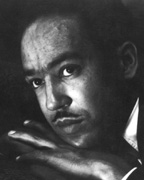
I, Too, Sing America

My brother sent along this Langston Hughes poem. “Tomorrow” took a while and for that I feel ashamed. I hope we’ll work hard to make sure everyone feels welcome at the table…


I, too, sing America.

I am the darker brother.
They send me to eat in the kitchen
When company comes,
But I laugh,
And eat well,
And grow strong.

Tomorrow,
I’ll be at the table
When company comes.
Nobody’ll dare
Say to me,
“Eat in the kitchen,”
Then.

Besides,
They’ll see how beautiful I am
And be ashamed–

I, too, am America.

Langston Hughes (1902-1967), is particularly known for his insightful, colorful portrayals of black life in America from the twenties through the sixties. Hughes left a large body of poetic work, as well as eleven plays and countless works of prose, including the well-known “Simple” books: Simple Speaks His Mind, Simple Stakes a Claim,Simple Takes a Wife, and Simple’s Uncle Sam. He edited the anthologies The Poetry of the Negro and The Book of Negro Folklore, wrote an acclaimed autobiography (The Big Sea) and co-wrote the play Mule Bone with Zora Neale Hurston.

Core Concepts of Leadership

I have found there is no such thing as hard and fast rules when it comes to leadership. Leadership is an art form as much as it is science. Every organization, circumstance, and leadership opportunity may call for a distinctive course of action. Some would describe this as situational leadership.

What are the core concepts of leadership? My current thinking is listed below. I have even attempted to place them in an order of importance.

1. Emotional Health. Emotional health is concerned with such things as: naming, recognizing, and managing our own feelings; identifying with and having active compassion for others; initiating and maintaining close and meaningful relationships; breaking free from self-destructive patterns; being aware of how our past impacts our present; developing the capacity to express our thoughts and feelings clearly, both verbally and nonverbally; respecting and loving others without having to change them; asking for what we need, want, or prefer clearly, directly, and respectfully; accurately self-assessing our strengths, limits, and weaknesses and freely sharing them with others; learning the capacity to resolve inevitable conflict maturely, and negotiate solutions that consider the perspectives of others; distinguishing and appropriately expressing our sexuality and sensuality; and grieving well. Effective leaders, first and foremost, model the capacities listed above and then they develop a learning system within their organization to assist members in measuring and growing in emotional health. (In a Christian organization, this would be an essential component of the discipleship process. In my opinion this critical piece of discipleship has been severely over-looked in the Church.)

2. Life-Long Learning. With the meteoric advance of technology there is an accompanying realization that formal learning, typically concentrated in the earlier stages of life, can no longer sustain an individual or organization throughout their lifecycle. Peter Senge, in his book The Fifth Discipline, describes this concept as developing a learning community. Senge defines a learning community as one that is continually expanding its capacity to create its future. Other definitions include:

  • An organization that achieves its goals by providing an environment conducive to the continuous learning and development of individuals, teams, and the organization.
  • An organization in which people at all levels individually and collectively are continually increasing their capacity to produce the results they really care about.
  • An organization that when a mistake is made notices the mistake, fixes it, figures out what caused the problem and corrects the root cause.

3. Developmental Empowerment. This concept is related, or we might say, the outcome of the previous two concepts. Developmental empowerment encourages and supports the importance of human responsibility in both the development and the interactive nature of growth. Developmental empowerment encourages growth in stages, looks for and quantifies evidences that accompany transformations from stage to stage, and understands the process as being lifelong, with milestones representing fundamental change. Committed to holism, developmental empowerment sees all aspects of life influencing and interacting with each other. This is a distinct shift for most organizations (including the church).

4. Calculated Delegation. Delegation is both a word and a skill that we have all heard of, yet few understand well. Effective delegation can be a dynamic tool for motivating and training team members to realize their full potential. Artful delegation underpins a style of management that allows staff members to use and develop their gifts, callings, and passion to full potential. Delegation is primarily about entrusting our authority to others, granting authority equal to responsibility.

5. Strategic Mapping. Members of an organization are more able to adapt to changes if there is a generated map of intent laid out (a map is generally more flexible than a plan). Mapping is crucial in effective leadership because it provides the organization with a direction and quantitative means to achieve its goals. Effective leaders initiate the mapping process and exert effort in communicating those plans as clearly (and redundantly) as possible.

These five principles: emotional health, life-long leadership, developmental empowerment, calculated delegation, and strategic mapping are all important in improving leadership skills. But these are not enough. The success of leadership will ultimately depend on the way we recognize our organization’s needs and how we can adapt our leadership style to those needs. In the same way that we would evaluate our team’s performance, also regularly evaluate and reflect on our own. Only you can tell what appropriate leadership is for your situation.

44 Lessons On Church Leadership From Lyle Schaller: A Compilation (4 of 4)

You might ask, “Who is Lyle Schaller?” Quite simply, he may be America’s best church strategist in the last 30 (or so) years. He has a demonstrated genius for practical solutions to a myriad of organizational issues and problems. Schaller, a Methodist, has over 140 titles listed on Amazon.com. My assumption is that he is mostly retired now. What follows are the final of 44 lessons for church leaders…

35. The least happy staff arrangements “tend to be those that include two or more first-born staff members or an only-born senior ministry and an only-born associate….The happiest staff combinations tend to be those that include a middle-born senior minister and a middle-born associate minister….The most relaxed and the least competitive staff teams include a last-born senior pastors and a last-born associate minister….The most effective ministerial teams tend to be composed of a middle-born senior minister and a first-born associate.” The Multiple Staff and the Larger Church, p. 102.

36. “The larger the congregation, the more important it is to build a staff that complements and reinforces the priorities of the senior minister.” The Multiple Staff and the Larger Church, p. 81.

37. “In the smaller congregations the role of the patriarch, or tribal chief, usually is filled by an older lay person. The minister is the visit medicine man. Tribal identity is in the laity, not in the pastor. By contrast, in congregations with a multiple staff, and especially the huge and mini-denomination size churches, the role of the tribal chief is filled by the senior ministry. Frequently the corporate identity of the very large church is in the personality of the senior ministry who has served that congregation for a decade or longer.” The Multiple Staff and the Larger Church, p. 41.

38. “The larger the congregation, the more vulnerable that church is to an inappropriate match of pastor and people.” The Multiple Staff and the Larger Church, p. 25.

39. “The larger the congregation, the greater the expectations that institution placed on the senior minister to be the initiating leader.” The Multiple Staff and the Larger Church, p. 19.

40. “The ability to understand, accept and enjoy the ambiguity may be one of the most important characteristics of the happy and effective pastor of the middle-sized congregation.” The Middle-Sized Church, p. 17.

41. “In the best of…churches…leaders have created, sometimes over a period of several generations, a rich tapestry of symbols, parables, folk sayings, favorite expressions, beliefs, legends, stories, rituals, customs, and festivals which reinforce the feeling that indeed this is a unique congregation. By contrast, the weak churches are swathed in layers of gray cloth—ready for their funeral. The congregational culture gives meaning to life for many of the members.” The Middle-Sized Church, p. 30

42. The greatest measurable difference that distinguishes congregations is whether they are accumulating capital or living off the accumulated capital. The Middle-Sized Church, p. 33.

43. “Don’t Be The First Associate! Be The Third!” Survival Tactics in the Church, Chapter 6, pp. 166ff.

44. “Very few chapters in an effective pastorate extend beyond three or four years.” Survival Tactics in the Church, p. 29.

World Reaction to Obama Win

International reaction to the historic election of Barack Obama as President-elect of the United States has begun.

I’m collecting some reactions to Obama’s victory from around the world. (The photo to the left is from Israel)

Reaction to Obama’s win ranged from jubilation to trepidation on the streets of the world’s capital cities as official congratulations from heads of state began to flow shortly after Republican candidate John McCain conceded the election.[McCain’s concession speech was very impressive, BTW]

Kenyan President Mwai Kibaki called Obama’s victory in the US presidential election a “momentous” day for Kenya, where Obama’s father was born.

Afghan President Hamid Karzai said Obama’s victory took the world into a “new era.” “The election of Senator Barack Obama to the presidency of the United States has taken the American people and the rest of the world with them into a new era – an era where race, colour and ethnicity, I hope, will also disappear… in politics in the rest of the world,” he said.

BBC: World Welcomes Obama Victory. The United States has seen the biggest transformation in its standing in the world since the election of Kennedy in November 1960. This is a country which has habitually, sometimes irritatingly, regarded itself as young and vibrant, the envy of the world. Often this is merely hype. But there are times when it is entirely true. With Barack Obama’s victory, one of these moments seems to have arrived.

LONDON: Within hours of Senator Barack Obama claiming the Democratic presidential nomination, the world’s attention switched from a primary campaign that had riveted outsiders to a presidential contest that raises deep concerns about where and how America will lead the world.

Even though Senator Hillary Rodham Clinton did not immediately concede defeat, Obama’s claim shifted the focus from the tantalizing question of the primaries — were the Democrats prepared to make history on matters of race and gender — to the looming battle between relative youth and relative age, between experience and renewal and, most of all, between the untested champion of the Democrats to the nominee of a Republican Party whose global image has been scarred by the war in Iraq and fear of neo-conservative adventures.

…Gerard Baker, the U.S. editor of The Times of London, wrote: “In 220 years a country that has steadily multiplied in diversity, where ethnic minorities and women have risen to the very highest positions in so many fields of human life, has chosen a succession of 42 white men as its leader. For good measure, the vice presidency, the only other nationally directly elected position in the US government, has been held by a succession of 46 white males.”

“But last night, in a tumultuous break with this long history, the ultimate realization of the American dream moved a little closer, and a black man became his party’s nominee for the presidency,” Baker wrote.

The Guardian: Obama is England’s Hope Too They did it. They really did it. So often crudely caricatured by others, the American people yesterday stood in the eye of history and made an emphatic choice for change for themselves and the world. Though bombarded by a blizzard of last-minute negative advertising that should shame the Republican party, American voters held their nerve and elected Barack Obama as their new president to succeed George Bush. Elected him, what is more, by a clearer majority than one of those bitter narrow margins that marked the last two elections…

…Mr Obama will take office in January amid massive unrealisable expectations and facing a daunting list of problems – the wars in Iraq and Afghanistan, the broken healthcare system, the spiralling federal budget and America’s profligate energy regime all prominent among them. Eclipsing them all, as Mr Obama has made clear in recent days, is the challenge of rebuilding the economy and the banking system. These, though, are issues for another day. Today is for celebration, for happiness and for reflected human glory. Savour those words: President Barack Obama, America’s hope and, in no small way, ours too.

Haaretz: Israel is worried about what the outcome of America’s presidential election may portend for Washington’s policy on Iran. On most Israel-related issues, Jerusalem foresees no dramatic changes in U.S. policy, regardless of who is elected. On Iran, however, it is worried that Democratic candidate Barack Obama will take a significantly softer line than the outgoing administration has. During his campaign, Obama repeatedly said that if elected, he would begin a dialogue with the Iranian regime.

The Australian: Obama Has World Mandate IT IS a sublime moment – Barack Obama to succeed George W. Bush, an affirmation of America, its foundation mission, its abiding dreams.

The American people have turned the page. This is more than a vote for change. It is a act of renewal, a turning point in American history and a quest for a better nation. The American people chose Obama yet most of the world also wanted Obama – that invests his Presidency with a potential authority unknown in history and an opportunity to touch not just Americans but people around the world.

Australian Prime Minister Kevin Rudd: Obama has turned Martin Luther King’s dream into a reality . “Twenty-five years ago Martin Luther King had a dream of an America where men and women would be judged not on the colour of their skin but on the content of their character,” Rudd told reporters. “Today what America has done is turn that dream into a reality.”

New Straits Times: TODAY we will feast our eyes, ears and hearts on the results of our election. Oops. Well, it does seem as if the United States’ presidential election this time around belongs not just to the Americans. From the pastoral plains of Kenya, whose citizens proudly claim Barack Obama as their own, to the dizzy cheerleading of a Japanese fishing port called Obama, the US presidential race is not just some run-of-the-mill passing-of-a-governing-baton. Locally, we will have woken up this morning to results coming in from American states in the morning right through noon and beyond. For the first time in history, people all over the world are riveted to an election they feel invested in…