Why Go There?

This Sunday we will be addressing the issue of living in brokenness and vulnerability from three passages – 2 Corinthians 12:8-10, Romans 7:7-8:1, and Matthew 5:3. Certainly this feels counter-intuitive to most of us. Don’t we prefer wholeness to brokenness? Don’t we prefer invincibility to vulnerability? Could it be that the pathway to wholeness and invincibility leads us through the valleys of brokenness and vulnerability?
The pressure to present an image of ourselves as strong and spiritually “together” hovers over most of us. What we see in the Bible however is that it presents the flaws and weaknesses of its heroes. This reminds us that “every human being on earth regardless of their gifts and strengths, is weak, vulnerable, and dependent on God and others” (Emotionally Healthy Spirituality, pg. 34).

“A theology of brokenness embraces our spiritual poverty, our questions, our doubts, our desire for love, hope and redemption, and reminds us that the stink and the beauty are all wrapped up into one.” Kathy Escobar

Mistakes are not forever, God loves us as sinners and that the task of Christianity is not to teach us how to live, but to teach us how to live again, and again, and again.

Here’s a one-paragraph overview of Jenn Gaskin’s sermon from Feb 1st…

God has created each and every person to be a jaw-dropping masterpiece, but our “issues” can get in the way of God’s glory being revealed in our lives. God invites us to get more in touch with our issues by beginning to notice our own super-charged responses– either of emotions or actions, our own overly-charged communication, and our own repeated delusional ideas for a solution to our current problems. When we notice these three strains, we don’t want to ignore them AND we don’t want to give in to them or follow our emotions around. Instead, we want to listen to their signal and keep in a yielding place to God, knowing that eventually He will fulfill the desires of our hearts.

Wow.

Sense of Humor a Spiritual Gift? Many Think So, Survey Finds

I thought this was cute…

A third of Americans who identify themselves as Christians have never heard of spiritual gifts, a new Barna Group survey finds. Perhaps even more startling…

  • 21% of those who say they understand spiritual gifts claim to have gifts that the Bible never mentions — such as a sense of humor, singing, health, life, happiness, patience, a job, a house, compromise, premonition, and creativity. 
  • The survey concluded, “Between those who do not know their gift (15%), those who say they don’t have one (28%)
  • Those who claimed gifts that are not biblical (20%), nearly two-thirds of the self-identified Christian population who claim to have heard about spiritual gifts have not been able to accurately apply whatever they have heard or what the Bible teaches on the subject to their lives.”

Bullet Points from Sun (2/8)

Yesterday, our topic was “Enlarging Your Soul Through Grief and Loss.” We looked at how Jesus engaged grief and loss by looking at the gospel passages related to the Garden of Gethsemane (see previous post).

[Also, it sounds like I generated some good dialogue through my comments on racism. Just to be clear… I believe that Anglos (white-folks) carry a cultural propensity toward racism. And that until we admit it, we can’t really begin to be free from it. I’m not insisting that I am right about this, only that it is my current thinking (and has been for quite a while). My objective is to encourage people to think, pray, and dialogue. Remember, unity is not a goal, but a fruit — the fruit of knowing, respecting, and relaeasing one another to be who God has called us to be.]

RE: Gethsemane passages — If I were a gospel writer I might have conveniently forgotten to add this text to the narrative…

  1. This text depicts an unsettled – and unsettling Jesus. In this text Jesus is a little more human than we’re comfortable with…
  2. In the West, we like our heroes steely, strong, and dignified (like John Wayne, Clint Eastwood, etc.). This is not the mighty, victorious Jesus that we are used to seeing depicted.
  3. Part of the mystery of Jesus is that he was both fully God and fully human. (Maximus the Confessor)
  4. In the passage we see the MAN, Christ Jesus deeply struggling with the fulfillment of his calling.
  5. What’s Jesus struggling with? While we can’t REALLY know the depths of his struggle – we know he was facing total abandonment by his Father in heaven, betrayal by a beloved friend, he struggled with facing the physical agony of a torturous death. And how could we possibly know what it would feel like to bear the full weight of every sin that was ever committed – and would ever be committed?? Every act of injustice, every murder, every rape, every racist act, every adulterous act, every incestuous act, every lie, every bribe – the full weight of every sin for all time was bearing down on the Man, Christ Jesus.
  6. These moments in the Garden of Gethsemane become THE defining moment in the history of the world… where the Man, Christ Jesus chooses, by an act of human will – empowered by the HS, the Father’s will and desire over his own – and he fully embraces grief and loss.

What does Jesus teach us about prayer? That we should ask away — “This is what I want…” YET MORE IMPORTANTLY, “I want to want what You want God.”

How Enlargement Happens…

1. Pay attention to the interruptions.

  • Avoid superficial forgiveness. Pete Scazzero make a pretty bold statement in EHC: “I do not believe it is possible to truly forgive another person from the heart until we allow ourselves to feel the pain of what was lost. People who say it is simply an act of the will, do not understand grieving” (pg 157).
  • So, how do we pay attention? 1) We need to stop and feel. It may spending time in thought and prayer – or it may be journaling… 2) It would be helpful to read the journaling, poetry, and prose of the Bible writers: More than half the psalms are lament psalms, Jeremiah wrote the book of Lamentations – lamenting the destruction of Jerusalem (City of Peace), Job is about grief and loss. Notice how Jesus grieved in the gospel accounts. 3) Pay attention to our pain.
  • Try not to stuff interruptions — or medicate them.
  • Take a retreat day and journal your grief and losses.

2. Aim to live in the confusing “in-between.”

  • Heb 5:7 tells us that Jesus, “learned obedience from the things he suffered.” Being willing to go here will break down our self-will.
  • We are invited to live with our confusion and bewilderment – and to take it to God. I spoke a few weeks ago about a three-fold cycle that Linda and I have adopted to build our marriage: romance, disillusionment, and joy…
  • In EHC Scazzero quotes OT theologian Walter Brueggemann as describing the psalms in a similar way – 3 types: orientation (songs of delight in God’s blessings and goodness), disorientation (songs of hurt, suffering, and grief), and reorientation (songs of deliverance, what we would now call songs of resurrection – or transformation).
  • If we’re honest, we’d have to admit that in times of disorientation we are given to either rebellion or willfulness in an attempt to escape the pain.
  • It’s in these confusing, disorienting times that we have the opportunity to be discipled to Christ…

3. Allow the old to birth the new.

  • A grace disguised
  • To the degree that we are willing to feel and embrace grief and loss is the degree to which we will know joy – and true compassion.
  • As we deeply grieve it empties our soul of all kinds of junk. 1) It pulls stuff out of us, 2) Creates a vacancy in our lives for God, 3) A couple of weeks ago I said that prayer is, first and foremost, listening for God to tell you that you are his beloved. And that obedience is, first and foremost, building a quiet center into our lives, 4) What I am trying to say is that leaning into grief and loss and learning to live in those confusing in-between times will lay the foundation for that quiet center in our lives, and
  • We are not to get over our losses, we are to absorb them into our being and let them take us to God – it creates unimagined joy and authentic compassion.
  • Do you know what our greatest fear SHOULD BE? Hardheartedness.

This coming week: Living in Brokenness and Vulnerability (probably from Matthew 5:3ff)

Gethsemane Passages Transposed

This Sunday we will be looking at the response of Jesus to his impending death. Below you’ll find the passages from all four Gospels transposed into one passage. It helps us to get a more complete picture than if we simply focused on one of the Gospels. John doesn’t take the time to go into the specifics of what happened in the Garden (maybe he was embarrassed because he fell asleep :), yet his words provide an excellent introduction to the other three Gospels that describe what happened with only slight (yet helpful) variation. I used Matthew’s description as the base text and added Mark and Luke’s accounts to make it more descriptive.

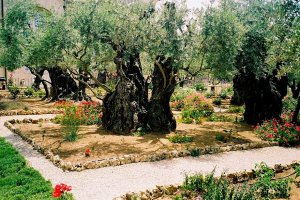
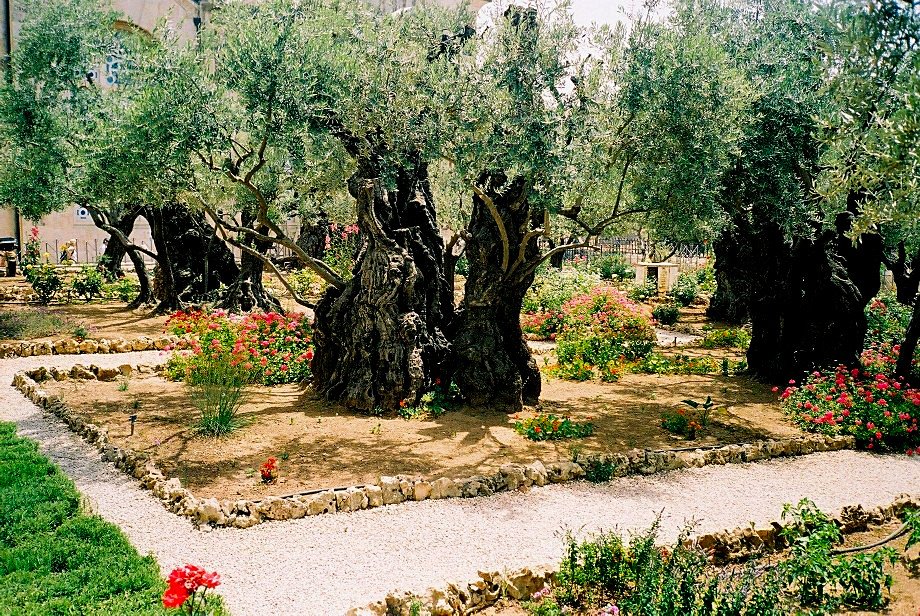
The picture is what the Garden looks like today. The site was/is a grove of olive trees (Gethsemane literally means “oil press” – gethsemane). Apparently it was a place where Jesus and the disciples often went to pray and engage the Scriptures. Today there is a church that has been built next to the Garden (as is the case with many of the “holy” sites — sites aren’t really holy – we just say that ;). For a very cool 3-D tour of the Garden and it’s relative distance from Jerusalem proper, click here.

The Garden of Gethsemane
[Jn 18:1-2-When Jesus had spoken these words, He went forth with His disciples over the ravine of the Kidron, where there was a garden, in which He entered with His disciples. Now Judas also, who was betraying Him, knew the place, for Jesus had often met there with His disciples.]

Matthew 26:36-46
36Then Jesus came with them to a place called Gethsemane [Lk 22:39as was His custom], and said to His disciples, “[ Lk 22:40-Pray that you may not enter into temptation][and] Sit here while I go over there and pray.”

37And He took with Him Peter and the two sons of Zebedee, and began to be grieved and distressed [Mk 14:32 (MSG)-He plunged into a sinkhole of dreadful agony]. [Lk 22:43-Now an angel from heaven appeared to Him, strengthening Him.]

38Then He said to them, “My soul is deeply grieved, to the point of death; remain here and keep watch with Me.”

39And He went a little beyond them, and fell on His face and prayed, saying, “My [Mk 14:36-Abba] Father, if it is possible, let this cup pass from Me; yet not as I will, but as You will.” [Lk 22:44-And being in agony He was praying very fervently; and His sweat became like drops of blood, falling down upon the ground.]

40And He came to the disciples and found them sleeping [Lk 22:45-from sorrow], and said to [Mk 14:37-Simon] Peter, “So, you men could not keep watch with Me for one hour?

41″Keep watching and praying that you may not enter into temptation; the spirit is willing, but the flesh is weak.”

42He went away again a second time and prayed, saying, “My Father, if this cannot pass away unless I drink it, Your will be done.”

43Again He came and found them sleeping, for their eyes were heavy [Mk 14:40-and they did not know what to answer Him].

44And He left them again, and went away and prayed a third time, saying the same thing once more.

45Then He came to the disciples and said to them, “Are you still sleeping and resting? Behold, the hour is at hand and the Son of Man is being betrayed into the hands of sinners.

46″Get up, let us be going; behold, the one who betrays Me is at hand!”

And BTW — Did Jesus really sweat drops of blood as (Dr.) Luke notes?
“And being in agony He was praying very fervently; and His sweat became like drops of blood, falling down upon the ground.” –Lk 22:44 (NAS)

This was written by the physician Luke, a well-educated man and a careful observer by profession. Luke is also the only gospel writer to mention the bloody sweat, possibly because of his interest as a physician in this rare physiological phenomenon, which spoke eloquently of the intense spiritual agony Jesus was suffering… (Dr. Henry M. Morris, The Defenders Bible, marginal notes for Luke 22:44)

Although this medical condition is relatively rare, according to Dr. Frederick Zugibe (Chief Medical Examiner of Rockland County, New York) it is well-known, and there have been many cases of it. The clinical term is “hematidrosis.” “Around the sweat glands, there are multiple blood vessels in a net-like form.” Under the pressure of great stress the vessels constrict. Then as the anxiety passes “the blood vessels dilate to the point of rupture. The blood goes into the sweat glands.” As the sweat glands are producing a lot of sweat, it pushes the blood to the surface – coming out as droplets of blood mixed with sweat. (Here’s a link to a medical dictionary.)