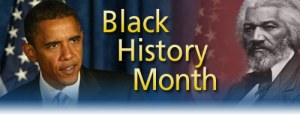
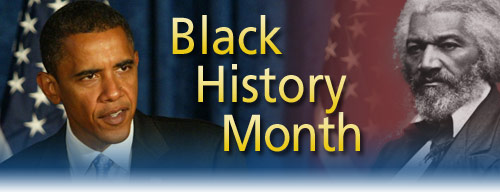
 Pictured to the right of President Obama (above) is Frederick Douglass, an American abolitionist, women’s suffragist, editor, orator, author, statesman, and reformer. Douglass is one of the most prominent figures in African-American and United States history.
William Lloyd Garrison & Harriet Tubman -Abolitionism & the Underground Railroad (1831)
The early abolition movement in North America was fueled both by slaves’ efforts to liberate themselves and by groups of white settlers, such as the Quakers, who opposed slavery on religious or moral grounds. Though the lofty ideals of the Revolutionary era invigorated the movement, by the late 1780s it was in decline, as the growing southern cotton industry made slavery an ever more vital part of the national economy. In the early 19th century, however, a new brand of radical abolitionism emerged in the North, partly in reaction to Congress’ passage of the Fugitive Slave Act of 1793 and the tightening of slave codes in most southern states. One of its most eloquent voices was William Lloyd Garrison, a crusading journalist from Massachusetts, who founded the abolitionist newspaper The Liberator in 1831 and became known as the most radical of America’s antislavery activists. Antislavery northerners—many of them free blacks—had begun helping fugitive slaves escape from southern plantations to the North via a loose network of safe houses as early as the 1780s. Known as the Underground Railroad, the organization gained real momentum in the 1830s and eventually helped anywhere from 40,000 to 100,000 slaves reach freedom. Harriet Tubman, its most celebrated —conductor,” was a former slave who married a free black man and escaped from Maryland to Philadelphia in 1849.
Jackie Robinson (1947)
By 1900, the unwritten color line barring blacks from white teams in professional baseball was strictly enforced. Jackie Robinson, a sharecropper’s son from Georgia, joined the Kansas City Monarchs of the Negro American League in 1945, after a stint in the U.S. Army (he earned an honorable discharge after facing a court–martial for refusing to move to the back of a segregated bus). His play caught the attention of Branch Rickey, general manager of the Brooklyn Dodgers, who had been considering bringing an end to segregation in baseball. Rickey signed Robinson to a Dodgers farm team that same year and two years later moved him up, making Robinson the first African–American player to play on a major league team. Robinson played his first game with the Dodgers on April 15, 1947; he led the National League in stolen bases that season, earning Rookie of the Year honors. Over the next nine years, Robinson compiled a .311 batting average and led the Dodgers to six league championships and one World Series victory. Despite his success on the field, however, he encountered hostility from both fans and other players. Members of the St. Louis Cardinals even threatened to strike if Robinson played; baseball commissioner Ford Frick settled the question by threatening to suspend any player who went on strike.
Martin Luther King Jr has A Dream (1963)
On August 28, 1963, some 250,000 people—both black and white—participated in the March on Washington for Jobs and Freedom, the largest demonstration in the history of the nation’s capital and the most significant display of the civil rights movement’s growing strength. After marching from the Washington Monument, the demonstrators gathered near the Lincoln Memorial, where a number of civil rights leaders addressed the crowd, calling for voting rights, equal employment opportunities for blacks and an end to racial segregation. The last leader to appear was the Baptist preacher Martin Luther King Jr. of the Southern Christian Leadership Conference (SCLC), who spoke eloquently of the struggle facing black Americans and the need for continued action and nonviolent resistance. —I have a dream,” King intoned, expressing his faith that one day whites and blacks would stand together as equals, and there would be harmony between the races: —I have a dream that my four little children will one day live in a nation where they will not be judged by the color of their skin but by the content of their character.” King’s improvised sermon continued for nine minutes after the end of his prepared remarks, and his stirring words would be remembered as undoubtedly one of the greatest speeches in American history. At its conclusion, King quoted an —old Negro spiritual: Free at last! Free at last! Thank God Almighty, we are free at last!’” King’s speech served as a defining moment for the civil rights movement, and he soon emerged as its most prominent figure.
The 44th President of the United States of America: Barack Obama (2008)
On January 20, 2009, Barack Obama was inaugurated as the 44th president of the United States. The product of an interracial marriage—his father grew up in a small village in Kenya, his mother in Kansas—Obama grew up in Hawaii but discovered his civic calling in Chicago, where he worked for several years as a community organizer on the city’s largely black South Side. After studying at Harvard Law School and practicing constitutional law in Chicago, he began his political career in 1996 in the Illinois State Senate and in 2004 announced his candidacy for a newly vacant seat in the U.S. Senate. He delivered a rousing keynote speech at that year’s Democratic National Convention, attracting national attention with his eloquent call for national unity and cooperation across party lines. In February 2007, just months after he became only the third African American elected to the U.S. Senate since Reconstruction, Obama announced his candidacy for the 2008 Democratic presidential nomination. After withstanding a tight Democratic primary battle with Hillary Clinton, the New York senator and former first lady, Obama defeated Senator John McCain of Arizona in the general election that November. Obama’s appearances in both the primaries and the general election drew impressive crowds, and his message of hope and change—embodied by the slogan —Yes We Can”—inspired thousands of new voters, many young and black, to cast their vote for the first time in the historic election.
Some links for more learning:

 SCRIPTURE READING – DAY 3
 Gregg A. Caruso