
Advent Devo – Prep for the Kingdom

The following has been was adapted from Advent Devotions by Goshen College.

Luke 3:1-6 (NRSV)
In the fifteenth year of the reign of Emperor Tiberius, when Pontius Pilate was governor of Judea, and Herod was ruler of Galilee, and his brother Philip ruler of the region of Ituraea and Trachonitis, and Lysanias ruler of Abilene, during the high-priesthood of Annas and Caiaphas, the word of God came to John son of Zechariah in the wilderness. He went into all the region around the Jordan, proclaiming a baptism of repentance for the forgiveness of sins, as it is written in the book of the words of the prophet Isaiah,

‘The voice of one crying out in the wilderness:
Prepare the way of the Lord,
make his paths straight.
Every valley shall be filled,
and every mountain and hill shall be made low,
and the crooked shall be made straight,
and the rough ways made smooth;
and all flesh shall see the salvation of God.” ‘

DEVO:
Prepare the way of the Lord. Do you remember the opening scene from the play Godspell? The show begins with the Voice of God declaring his supremacy: “My name is Known God and King. I am most in majesty, in whom no beginning may be and no end.” The company enters and takes the role of various philosophers throughout the ages: Socrates, Thomas Aquinas, Leonardo da Vinci, Edward Gibbon, Jean-Paul Sartre, Martin Luther, Friedrich Nietzsche, and Buckminster Fuller (In the revival, Gibbon, Luther, Nietzsche and Fuller were replaced by Galileo Galilei, Jonathan Edwards, Marianne Williamson, and L. Ron Hubbard). They sing fragments of their respective philosophies — first as solos and then in cacophonous counterpoint — in “Tower of Babble (Prologue).” In response to this, John the Baptist blows three notes on the shofar, to call the community to order. He then beckons them to “Prepare Ye (The Way of the Lord),” and baptizes the company. Jesus comes, also to be baptized. John responds by, instead, asking to be baptized by Jesus. Jesus explains that it is not his place to baptize; that he has come to “Save the People”.

We hear this passage from Luke, and the Old Testament Scripture to which it alludes (Isaiah 40:3-5), almost exclusively during the weeks leading up to Christmas, when we celebrate Jesus’ birth. Yet this chapter of Luke jumps us ahead about 30 years, to shortly before Jesus’ baptism. John the Baptist is not proclaiming Jesus’ birth but rather Jesus’ imminent ministry. And once Jesus comes on the scene a few verses later, he too prepares for what is to come with baptism, prayer, fasting and self-imposed exile into the desert.

Preparation for the Kingdom of God seems to be a continual and repetitive process, something we do even as we attempt to live out that Kingdom.

It reminds me of the old saying that if we wait to have children until we’re truly ready, we’ll never actually have them. Preparing the way of the Lord doesn’t end when Advent ends, but begins anew and continues – until all flesh shall see the salvation of God.

This passage also reminds us that God is concerned with all of humanity, not just the chosen few.

Luke’s list of important people in verses 1-3 not only placed John and Jesus in the proper historical context, but also highlighted the fact that Old Testament prophecy would not be fulfilled through the existing power structures, neither Roman nor Jewish. Instead, it would be heralded by a relative unknown who had been wandering around in the wilderness. Moreover, Jesus’ life and ministry would challenge existing traditions, beliefs and notions of religious propriety. Were the people of that time ready for the kind of salvation that didn’t conform to what was culturally and socially acceptable?

What about you/us today?
Christianity is NOT a Blind Faith

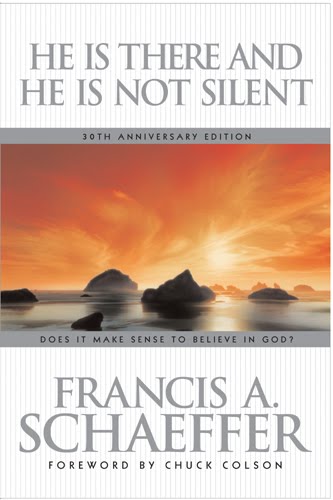
I started physical therapy for my new hip the other day and began a dialogue with the PT about spirituality.  One portion of out talk reminded me of one of my long-time favorite authors and articles…The late Christian author and philosopher Francis Schaeffer wrote a book entitled, He Is There and He Is Not Silent. There is an appendix in the book that addresses the issue of faith and whether or not we have the capacity to interact with God.  I thought I’d pass it on…

Schaeffer would say that the Christian faith is not a blind faith at all – but an invitation to interact with a loving and compassionate God – who is alive and more available than we could ever imagine.

He says, “One must analyze the word faith and see that it can mean two completely opposite things.
Suppose we are climbing in the Alps and are very high on the bare rock, and suddenly the fog shuts down. The guide turns to us and says that the ice is forming and that there is no hope; before morning we will all freeze to death here on the shoulder of the mountain. Simply to keep warm the guide keeps us moving in the dense fog further out on the shoulder until none of us have any idea where we are. After an hour or so, someone says to the guide, ‘Suppose I dropped and hit a ledge ten feet down in the fog. What would happen then?’ The guide would say that you might make it until morning and thus live. So, with absolutely no knowledge or any reason to support his action, one of the group hangs and drops into the fog. This would be one kind of faith, a leap of faith [or what has been called “blind faith”].

Suppose however, after we have worked out on the shoulder in the midst of the fog and the growing ice on the rock, we had stopped and heard a voice which said, ‘You cannot see me, but I know exactly where you are from your voices. I am on another ridge. I have lived in these mountains, man and boy, for over sixty years and I know every foot of them. I assure you that ten feet below you there is a ledge. If you hang and drop, you can make it through the night and I will get you in the morning.’

I would not hang and drop at once, but I would ask questions to try and ascertain if the man knew what he was talking about and if he was not my enemy. In the Alps, for example, I would ask him his name. If the name he gave me was the name of a family from that part of the mountains, it would count a great deal to me. In the Swiss Alps there are certain family names that indicate mountain families of that area. In my desperate situation, even though time was running out, I would ask him what to me would be adequate and sufficient questions, and when I became convinced by his answers, then I would hang and drop.

This is faith, but obviously it has no relationship to the other use of the word. As a matter of fact, if one of these is called faith, the other should not be designated by the same word. The historic Christian faith is not a leap of faith [or blind faith] …because He is not silent, and I am invited to ask the adequate and sufficient questions, not only in regard to details, but also in regard to the existence of the universe and its complexity and in regard to the existence of man. I am invited to ask adequate questions and sufficient questions and then believe Him and bow before Him metaphysically in knowing that I exist because He made man, and bow before Him morally as needing His provision for me in the substitutionary, propitiatory death of Christ.

So, how do we hear from God?  If you’ve been around MPVCC this year, no doubt you’ve heard me (and others) teach on this a lot!  I’ve also blogged fairly regularly on the subject.  Here is a link to one of those blogs – you can also type “listen” into the blog’s search engine…

HappyAdvent Season!

Declining vs Thriving Churches

Good food for thought…

Declining Congregational
Members are:
Thriving Congregational
Participants are:
Committed to the church
Committed to Christ
Managing committees
Deploying mission
Holding offices
Doing hands-on ministries
Making decisions
Making disciples
Trained for membership
On a life long development track
Serving at the church
Serving in the world
Preoccupied with raising money
Preoccupied with rescuing people
Retiring from church work
Finding personal fulfillment
Surveying internal needs
Pursuing constant personal growth
Eager to know everyone
Sensitized to community
Loyal to each other
Eager for everyone to know God
Building faith on information
Building faith on transformation
Perpetuating a heritage
Building faith on experience w/ Christ
Hanging on
Visioning a future