
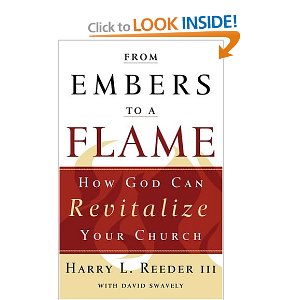
Principles of Church Revitalization

Excellent…

From Embers To A Flame: Principles of Church Revitalization
by Harry L. Reeder III

1. God’s glory is revealed in our weaknesses.
2. Guard your reputation in the eyes of the community.
3. Uphold the centrality of God’s grace.
4. Leave the 99 to seek the 1 (church revitalization is seeking to save the church that is faltering).
5. Revisit to strengthen, encourage, correct and restore what is left.
6. Remember[1] from where you have fallen when Christ was leading this church.
7. Believe that the God who won the victory in the past will win the victory in the present.
8. Connect the future with past victories in Christ.
9. Repent[2] of failures in the past that controls the present.
10.  Leaders must be an example by repenting first of past failures, and then lead members to repent.
11.  Provide restitution for past sins. Ask forgiveness and make right where possible especially with those who left hurt and confused.
12.  Focus on Body health and let God handle the increase.
13.  Be faithful with little and God will give big. Do the right things at the right time in the right way for the right reasons.
14.  All biblical teaching is exploring the depth of the gospel. You never get beyond the gospel for it is the alpha and omega of God’s revealed truth in Scripture. You can only go deeper.
15.  All ministries must focus on the gospel of grace to be life changing.
16.  Prayer precedes revitalization and creates unity with God’s will. Prayer affords the privilege of participating in God’s reconciliation of His elect. Then, by faith act on your prayers.
17.  Make a list of all weaknesses and threats from Satan’s attacks and pray over this list regularly.
18.  Make a list of all Scriptures related to church revitalization and pray using the words of Scripture that God’s will be done on earth as it is in heaven.
19.  Pray thanking God for the opportunities presented by the bad that has beset your church.
20.  Make a list of all opportunities to do His will, then pray and see His power change the circumstances.
21.  Recover [3] the “First things,” get back to the basics that God blessed. Rebuild on these strengths.
22.  Godly leadership precedes God given church growth.
23.  Affirm what has been done well and identify weaknesses.
24.  Godly people follow godly leaders who follow Jesus and seek God’s glory.
25.  Resources follow Godly vision for ministry. Visualize a future blessed by God.
26.  Worship is the context in which the Great Commission operates. Do not replace worship for Christians with evangelism to “seekers.” Gather for worship, scatter for evangelism.
27.  Diversify evangelism efforts; multiply opportunities for gospel communication.
28.  Small group network is best way to assimilate new people and build community. Protect health of small group.
29.  Qualified leaders who present sound doctrine and are able to refute those who contradict it must lead small groups. Must avoid dialogue in small groups that leads to a compromise of truth or pluralism of ideas that accepts every opinion as valid. Scripture rightly interpreted must be central, then fellowship and prayer for “one another.”
30.  The Christian life is 100% dependence on God’s grace and 100% disciplined by grace.
31.  For a congregation to remain healthy church discipline must be exercised according to Matt. 18 on a regular basis. “Sin in the camp” must be confronted.
32.  A healthy Body of believers will grow as God adds those He wants discipled to maturity. Church growth is a natural by-product of spiritual health.


[1] Rev. 2:5 – Remember, Repent, and Recover is Jesus’ formula for revitalization.

[2] Ibid.

[3] Ibid.

Random Reflections on the Prop 8 Ruling…

I have mixed emotions about yesterdays Prop 8 ruling. As an intentional follower of Christ, I hold a historic, orthodox, New Testament view of marriage. I am also cognizant of how we (Protestants at least) have allowed any moral authority on this issue to dissipate by collectively allowing our divorce rate to match (and some would say, exceed) that of the larger culture. If we can’t do marriage well, how can we weigh in on others? I am reminded of Paul’s words to the Corinthians that we are not to “judge” those outside the church, but that we are to judge ourselves – those of us inside the church (1 Cor 5:12). As active, intentional followers of Christ we would probably be wise to focus on removing the log from our own collective eye (Mat 7:3).

In my view, legislating morality is always Plan B. Plan A, according to my understanding of the Bible, is cultivating and growing in our relationship with Jesus Christ (personally and collectively), growing in sound doctrine, modeling authentic community, and learning how to love. (The first three, BTW, are intended to feed the fourth.)

I appreciate author and pastor Tim Keller’s approach here…In Prodigal God he quotes from The Lord of the Rings – the hobbits asking the ancient Treebeard whose side he is on: “I am not altogether on anybody’s side, because nobody is altogether on my side…[But] there are some things, of course, whose side I’m altogether not on.” Keller notes that Jesus’ own answer, through a parable, is similar. Jesus doesn’t pick a side yet singles out religious moralism as a particularly deadly spiritual condition (pg 13). I find religious moralism on both sides of the Prop 8 issue. I would prefer honest respectful dialogue.

In commenting on the Parable of the Prodigal (Keller would say it should be plural), Keller correctly identifies two basic ways people seek happiness: 1) moral conformity and 2) self-discovery. Each is a way of finding personal significance and worth, of addressing the ills of society, and for determining right from wrong. The elder brother in the parable illustrates the way of moral conformity, while the younger illustrates the way of self-discovery. Underneath both brothers’ sharply different patterns of behavior is actually the same motivation and aim – using their father to get the things on which their hearts are really fixed. For both, it was the wealth of the father, not the love of the father, that they believed would make them happy and fulfilled (pgs 29-39).  (If you’ve found yourself asking, “Why does he title the book Prodigal God?  That’s a great question…get the book.)

As I contemplate my life, I have spent various stints as both the younger and elder brother. In both, during my darker moments, I have sought the hand of God and not the heart of God.

Just last night Linda and I were reading a biography of the early church father, Athanasius (don’t ask). He defined sin as an abuse of freedom. We humans, he said, were originally given the ability to know God by looking at the creation (and seeing its otherwise inexplicable order and harmony) and noticing the image of God within ourselves. But we have turned away from the signs of God in creation and ourselves, and turned instead to the things of this world to satisfy ourselves – whether, I would add, it be moral conformity or self-discovery.

Perhaps you’ve heard the story of Ghandi’s encounter with a respected Christian missionary… Gandhi admired Jesus and often quoted from the Sermon on the Mount. Once when E. Stanley Jones met with Ghandi he asked him, “Though you quote the words of Christ often, why is that you appear to so adamantly reject becoming his follower?” Ghandi replied, “Oh, I don’t reject your Christ. I love your Christ. It’s just that so many of you Christians are so unlike your Christ.”

Somethings just don’t seem to change. Ann Rice is another, more recent example of someone, who “in the name of Christ,” quit the church.

This is yet another wake-up call for the us (inside the church). Not to react with religious moralism, but to respond with appropriate self-reflection, honesty, repentance, love – and a willingness to dialogue. In the great political cartoon strip of its day, Pogo declared, “We have met the enemy and it is us!”

8 PRACTICES OF EFFECTIVE MINISTRY

1. Clarify the winDefine what is important at every level of the organization.

2. Think steps, not programsBefore you start anything, make sure it takes you where you need to go.

3. Narrow the focusDo fewer things in order to make a greater impact.

4. Prep well and have short meetingsSay only what you need to say to the people who need to hear it.

5. Listen to outsidersFocus on who you’re trying to reach, not who you’re trying to keep.

6. Replace yourselfLearn to hand off what you do.

7. Evaluate, Evaluate, EvaluateTake time to evaluate your work

8. Celebrate WinsParty with your people.

Top 10 Church Trends

I am in the process of updating content on the PRISM website and have been researching church trends. The following are my top 10 picks to pay close attention to in these interesting days…

1. Attendance: The average number of people at U.S. Protestant church services has been declining: 1992:102, 1997:100, 1998:95, 1999:90, 2000:90, 2003:89.[1]

2. 68 million 10-35 year-olds are not believers and basically see the Church as meaningless and irrelevant. This is the emergence of the largest generational mission field in over a century. According to research, there are 80 million comprising the “Millennial Generation” (those born between the mid-70’s and early 2000’s). Estimates are that only 15% are Christian. The dominant attitude of this huge generation toward Christianity will be largely indifferent. Only 13% of the Millennials rank any type of spiritual matter as important to their lives. They are not angry at churches and Christians. They simply ignore us because they do not deem us as meaningful or relevant.[2]

3. “Moralistic therapeutic deism.” Having said the above, religion matters to many American teenagers. However, what most American teenagers call faith has been dubbed, “moralistic therapeutic deism, an interpersonal riff on American civil religion that tends to masquerade as Christianity but bears few similarities to the historic teachings of the Christian church and is mostly used to lubricate relationships.”[3]

4. Baby Boomers have tried it “all” and found no joy. The large Boomer generation may become more receptive to the gospel. This trend may counter other trends where adults tend to become less receptive to the gospel as they age.[4]

5. Family will be a key value for both Millennials and Boomers. For the Millennials, family is their most important value. Nearly 80% ranked family as the important issue in their lives. They said they had healthy relationships with their parents who, for the most part, are Boomers. Some churches say they are family friendly, but few actually demonstrate that value. Churches that reach both of these generations will make significant changes to become the type of churches that foster healthy family relationships.[5]

6. Neo-Calvinism, a cousin to the Reformation’s Lutheranism, is making a comeback – where glorifying God fulfills our satisfaction and purpose. In the 1700’s, Puritan preacher Jonathan Edwards promoted (his adaptation of) Calvinism, yet in the U.S. it was soon overtaken by movements like Methodism that were more impressed with human will. Evangelicalism suffered a loss of appetite for rigid doctrine – and the triumph of a friendlier, yet fuzzier Jesus.[6]

7. Missional and multi-site. The church of the 21st century will focus on reaching an area for Christ, instead of building a particular church. This makes the size and sometimes the location of a church irrelevant. Because of the changing zoning laws and the cost of construction, churches have more than one location and meet in buildings once used for something else. Stained glass windows, steeples, and pews are shifting from trends to fads.[7]

8. American Christians are biblically illiterate. Although most of them contend that the Bible contains truth and is worth knowing, and most of them argue that they know all of the relevant truths and principles, yet research shows otherwise. And the trend line is frightening: the younger a person is, the less they understand about the Christian faith.[8]

9. Conversion growth will replace transfer growth. Churches with a missional mindset will develop ministries for unchurched people rather than for people who grew up within a churched culture.[9]

10. Moving away from the “bell curve” toward the “well curve.” A Len Sweetism meaning the population is gravitating toward the ends or extremes and is lowest in the middle (the reverse of a bell curve). The well curve helps describe a number of church trends: how the church is moving theologically liberal and conservative, with the disappearance of the moderate; how churchgoers increasingly prefer megachurches and microchurches, but not mid-sized congregations; and how the church is both growing and losing prominence within the larger society. On the local church level, pastors and other church leaders need to pay attention to the well curve for another important reason: it describes how churchgoers participate in the life of a given congregation.[10]


[1] Barna, 2003.

[2] Based on research from LifeWay.

[3] Souls in Transition: The Religious and Spiritual Lives of Emerging Adults by Christian Smith, with Patricia Snell (Oxford University Press: 2009)

[4] Based on research from LifeWay.

[5] Based on research from LifeWay.

[6] Time Magazine – 10 Ideas Changing the World (March 12, 2009)

[7] Bill Easum, 2004.

[8] Barna, 2005.

[9] Bill Easum, 2004.

[10] Leadership Journal, July 2007.