Using The Lord’s Prayer As A Guide For Personal Devotions

“…As the deer pants for streams of water, so my soul pants for you, O God.

My soul thirsts for God, for the living God.

When can I go and meet with God?”    Psalm 42:1b, 2 (NIV)

A.  The goal of the Christian life is not to do more, be more loving, or joyful, or obedient – or even to try and be good.  The goal of the Christian life is Jesus Christ himself – to grow an intimate, passionate, dynamic relationship with our Lord and Savior, Jesus Christ.

B.  Seeking God First

The heart of our ministry is to the Lord.  Everything we are, have, and do comes from our intimacy with Christ. If we aren’t proactively seeking him to find out who he is and what he’s doing, we labor in vain.

Seeking God in worship and prayer is the most vital thing we do.

Only God can meet our deepest needs.  If we aren’t seeking him consistently (as a life­style), making time to seek him regularly, we’ll begin to look to others to meet our needs, and eventually be frustrated. (Contemporary idolatry: putting people or things in the place of God.)

C. Personal Devotional Time

  1. Begin the day before by getting enough sleep to be sufficiently refreshed for commun­ing with the Lord.
  2. Find a quiet and undisturbed place where you can be alone and without interruption.
  3. Begin by focusing on the Lord, and inviting the Holy Spirit to come to lead you in fellowship and intimacy.  You may want to use the acrostic A.C.T.S., which stands for a progression of Adoration, Confession, Thanksgiving, and SupplicationHelpful hint:  Have a separate pad of paper and pen available to record “to do” list items as they come to mind.  Writing them down will help you clear your mind and refocus your attention on God.
  4. Whether you read consecutively through each book the Bible or read topically, read the Bible devotionally, asking the Holy Spirit to speak to you.  (Reading 3-4 chapters a day will take you through the Bible in a year – or consider a Bible reading plan.
  5. Or/and, use the Lord’s Prayer (actually the model prayer) as a guide

Our Father in heaven, we honor Your holy name. . .

Worship the Lord!  Tell God how won­derful He is, thank Him for all He’s done, is doing, and will do in your life and the life of your family.  Pray and sing prayers of adoration to our heavenly Father.  Invite the Holy Spirit to come and teach you how to better worship the Father!

We ask that Your kingdom will come now. . .

George Ladd writes concerning the kingdom of God that, “we live in the presence of the future.”  The Christ Event (Jesus’ birth, ministry, death, resurrection, and ascension) established the kingdom of God on the earth, while Christ’s Second Coming will be the consummation of the kingdom of God on earth.  We have the great privilege of living between the two!  Pray for his righteousness, peace, joy, and power to be manifest in your life today (Romans 14:17).  Ask for his rule to be extend­ed in, and through you, your home, our church, our community, etc.

May Your will be done here on earth, just as it is in heaven. . .

Pray God’s revealed will back to him!  In other words, pray back to God what you know to be his will.  Pray for workers to be raised up for the fields which are white, for leaders of the nation, the state, for the churches, pastors, and leaders of the churches in and around Manchester (Jer. 29:7); pray for the Church to be filled with the presence and power of God; look up Scripture concerning prayer in the and pray them!  Pray back to God what He has shown you is His will concerning you, your family, our church.  Pray for Him to reveal His will in matters that are unclear to you – pray specifical­ly.  Pray for wis­dom.

Give us this day our daily bread…

Petition God concerning your needs.  Specifically define them, ask God for them, and trust Him to provide the resources you need, giving thanks for his mercy and provi­sion.  Remember to include Jesus’ entreaty – “yet not my will, but Thine be done” (Luke 22:42).

Forgive us our sins, just as we have for­given those who sin against us…

Invite the Holy Spirit to reveal those sins that you committed, in thought, lust, atti­tude, in words spoken, mo­tives of the heart, actions, lack of doing good when you knew to do it, etc.  Ask for specific forgiveness for each revealed item, then give thanks that as you confess your sins God is faithful and just to forgive them!  Then ask God to show you if you hold resentment or unforgiveness towards anyone.  Pray for the willingness to forgive – from the heart.  (Take time to meditate on the mercy and forgiveness of God, worship­ping Him for the sacrifice of Christ that cleanses us.)

Don’t bring us into temptation, but deliver us from the evil one…

Pray for the Holy Spirit to fill you so you won’t fulfill the lust of the flesh; pray for God to keep you from the things that tempt you, and to be strong on your behalf when the enemy tempts you.  Thank God that He that is in you is greater than the enemy, that you are His child, his friend, clothed in his armor, that in your weakness His strength is your resource.

For Thine is the kingdom, and the power, and the glory forever.  Amen

  1. This is not about us, this is about him.
  2. Write down a verse from your reading that was especially helpful, consider it throughout the day, praying it back to God.  Try to think of it often enough to have memorized it by the end of the day.
  3. Stay in touch!  Throughout the day talk to the Lord – casually as a friend, seeking him as you go, asking for wisdom, asking for his perspective, direction, etc.  When you veer off course, ask for immediate forgiveness.  Look for the Lord in the day, try to see what he’s doing and respond to his promp­tings, asking him to teach you as you go.
  4. If you’re married, after praying alone, pray to­gether for things you especially want to agree about: your family, children, marriage, work situa­tion, needs of the day, etc., or just worship together.  Pray for another.  Pray for healing when your spouse is sick.
  5. If you have children – or if the grandkids are spending the night, have a brief prayer with them before they leave for school, or before their day begins.  After dinner, take time (5-15 minutes) to read a few verses, dialoging about them (not lecturing) with the children, using relevant examples.  Pray for each one before they go to sleep.

Believing the Gospel Is the Work of Sanctification

by Tullian Tchividjian

When it comes to measuring spiritual growth and progress, our natural instincts revolve almost exclusively around behavioral improvement.

“Only the ‘toxin’ of God’s grace can reverse the way we typically think about Christian growth.”

For example, when we read passages like Colossians 3:5–17, where Paul exhorts the Colossian church to “put on the new self” he uses many behavioral examples: put to death “sexual immorality, impurity, passion, evil desire, and covetousness, which is idolatry.” He goes on and exhorts them to put away “anger, wrath, malice, slander” and so on. In v.12 he switches gears and lists a whole lot of things for us to put on: “kindness, humility, meekness, and patience,” just to name a few.

But what’s at the root of this good and bad fruit? What produces both the bad and good behavior Paul addresses here?

A Matter of Belief

Every temptation to sin is a temptation, in the moment, to disbelieve the gospel–the temptation to secure for ourselves in that moment something we think we need in order to be happy, something we don’t yet have: meaning freedom, validation, and so on. Bad behavior happens when we fail to believe that everything we need, in Christ we already have; it happens when we fail to believe in the rich provisional resources that are already ours in the gospel. Conversely, good behavior happens when we daily rest in and receive Christ’s “It is finished” into new and deeper parts of our being every day.

Colossians 3:5–17 provides an illustration of what takes place on the outside when something deeper happens (or doesn’t happen) on the inside.

Going Backward for Progress

In Philippians 2:12, when Paul tells us to “Work out your own salvation with fear and trembling,” he’s making it clear we’ve got work to do—but what exactly is the work? Get better? Try harder? Clean up your act? Pray more? Get more involved in church? Read the Bible longer? Clearly, it’s not a matter of whether or not effort is needed. The real issue is: Where are we focusing our efforts? Are we working hard to perform? Or are we working hard to rest in Christ’s performance for us?

He goes on to explain: “For it is God who works in you, both to will and to work for his good pleasure” (2:13). God works his work in you—which is the work already accomplished by Christ. Our hard work, therefore, means coming to a greater understanding of his work. In his Lectures on Romans, Martin Luther wrote, “To progress is always to begin again.” Real spiritual progress, in other words, requires a daily going backwards.

The Work of Belief

Christian growth does not happen by working hard to get something you don’t have. Rather, Christian growth happens by working hard to daily swim in the reality of what you do have. Believing again and again the gospel of God’s free, justifying grace every day is the hard work we’re called to.

This means that real change happens only as we continuously rediscover the gospel. The progress of the Christian life is “not our movement toward the goal; it’s the movement of the goal on us.”

Sanctification involves God’s attack on our unbelief—our self-centered refusal to believe that God’s approval of us in Christ is full and final. It happens as we daily receive and rest in our unconditional justification. As G. C. Berkouwer said, “The heart of sanctification is the life which feeds on justification.”

Growth in Grace

2 Peter 3:18 succinctly describes growth by saying, “But grow in the grace and knowledge of our Lord and Savior Jesus Christ.” Growth always happens “in grace.” The truest measure of our growth is not our behavior, it’s our grasp of grace — a grasp which involves coming to deeper and deeper terms with the unconditionality of God’s love.

It’s also growth in “the knowledge of our Lord and Savior Jesus Christ.” This doesn’t simply mean learning facts about Jesus. It means growing in our love for Christ because of what he has already earned and secured for us and then living in a more vital awareness of that grace. Our main problem in the Christian life is not that we don’t try hard enough to be good, but that we haven’t believed the gospel and received its finished reality into all parts of our life.

Take the Focus Away from You

Gerhard Forde insightfully (and transparently) calls into question the ways in which we typically think about sanctification and spiritual progress when he writes:

Am I making progress? If I am really honest, it seems to me that the question is odd, even a little ridiculous. As I get older and death draws nearer, I don’t seem to be getting better. I get a little more impatient, a little more anxious about having perhaps missed what this life has to offer, a little slower, harder to move, a little more sedentary and set in my ways. Am I making progress? Well, maybe it seems as though I sin less, but that may only be because I’m getting tired! It’s just too hard to keep indulging the lusts of youth. Is that sanctification? I wouldn’t think so! One should not, I expect, mistake encroaching senility for sanctification! But can it be, perhaps, that it is precisely the unconditional gift of grace that helps me to see and admit all that? I hope so. The grace of God should lead us to see the truth about ourselves, and to gain a certain lucidity, a certain humor, a certain down-to-earthness.

Remember, the Apostle Paul referred to himself as the chief of sinners at the end of his life. It was his ability to freely admit that which demonstrated his spiritual maturity—he had nothing to prove or protect because it wasn’t about him!

“Our main problem in the Christian life is not that we don’t try hard enough to be good, but that we haven’t believed the gospel and received its finished reality into all parts of our life.”

The more I focus on my need to get better, the worse I actually get. I become neurotic and self-absorbed. Preoccupation with my performance over Christ’s performance for me makes me increasingly self-centered and morbidly introspective. After all, Peter only began to sink when he took his eyes off Jesus and focused on how he was doing. As my friend Rod Rosenbladt wrote to me recently, “Anytime our natural incurvitas (fixture on self) is rattled, shaken, turned from itself to that man’s blood, to that man’s cross, then the devil take the hindmost!”

It Truly Is Finished

By all means work! But the hard work is not what you think it is; the hard work is washing your hands of you and resting in Christ’s finished work for you. Progress in obedience happens when our hearts realize God’s love for us does not depend on our progress in obedience.

This is a partial repost from Tullian Tchividjian’s blog Rethinking Progress. To read it in full click here.

The Great Commandment Pt 2 – Matthew 22:39

Love Your Neighbor as Yourself

I.   INTRO/REVIEW

A.   We have been looking at what the Bible refers to as the Great Commandment, which is for us, important preliminary vision passage because it synthesizes so much of the Scripture into two VERY straightforward commands.

B.    (It is quite important for us to understand that when the NT authors declare God’s commands for us to be holy and to love our neighbor, etc. These commands are not there to show our ability, but to reveal our inability – and to remind us of our continual dependence on the grace of God to do in us and through us what we cannot do on our own.)

C.    Matthew 22:33-40 (NAS): “Teacher, which is the great commandment in the Law?” And He said to him, “ ‘YOU SHALL LOVE THE LORD YOUR GOD WITH ALL YOUR HEART, AND WITH ALL YOUR SOUL, AND WITH ALL YOUR MIND.’ This is the great and foremost commandment. The second is like it, ‘YOU SHALL LOVE YOUR NEIGHBOR AS YOURSELF.’ On these two commandments depend the whole Law and the Prophets.” (Notice the order – and notice that Jesus was asked to answer with one commandment, but He gave them two…)

D.   We have multiplied this passage into two messages…

  1. Last week: “You shall love the Lord your God with all your heart, and with all your soul, and with all your mind – this is the great and foremost commandment.” (Click here to read that post.)
  2. Review of last week: How do we love God?
  • Come alive to God.
  • Find your true joy and delight in the message of the Gospel – and the Person of Jesus Christ.
  •  Come to grips with the idolatry that grips ALL of our lives.

(i)    Idolatry is not just a failure to obey God; it is setting our heart and affections on something, or someone other than God.

(ii)  This cannot be remedied by repenting that you have an idol – or by engaging willpower to try and live differently.

(iii) If we uproot our idols (through repentance) but fail to plant the love of God (or, delight in God) in its place, the idol will grow back – like mowing a weed.  Repentance and rejoicing must go together.

E.  This week: (v. 39)“You shall love your neighbor as yourself.”  And here’s the questions we’re asking as we unpack these verses…

  • What is God’s heart/vision for Southside Bible Fellowship?
  • And for you?

II.  BODY

A.   The life-changing context of this commandment:

 ‘YOU SHALL LOVE YOUR NEIGHBOR AS YOURSELF.’ 40 On these two commandments depend the whole Law and the Prophets.”

  1. The overwhelming commandment to “neighbor love.”  Who is my neighbor?  This passage retold in Luke 10 – and is followed by Jesus unpacking the Good Samaritan and Mary and Martha.
  2. John Piper: This is a staggering commandment. If this is what it means, then something unbelievably powerful and reconstructing will have to happen in our souls.  It seems to demand that I tear the skin off my body and wrap it around another person so that I feel that I am that other person; and all the longings that I have for my own safety, health, success, and happiness I now feel for that other person as though s/he were me.

B.    Loving God is invisible. It is an internal passion of the soul. But it comes to expression when we love others.  (Similar to James 2:18: “I will show you my faith by my works.”)

  1. Idolatry and pride are at the root of our sinfulness.  Pride is the desire for our own happiness apart from God and apart from the happiness of others in God.
  2. Pride is the pursuit of happiness anywhere but in the glory of God and the good of other people.

C.   So, Jesus says, “Love your neighbor as yourself.”  How do we get there from here? Four points (adapted from John Piper):

1.     Understand that our self-love is a creation of God.

  • Jesus says in effect: I start with your inborn, deep, defining human trait—your love for yourself.  It’s a given.  Jesus is saying, I don’t command it — I assume it.
  • We all have a powerful instinct of self-preservation and self-fulfillment. We all want to be happy, to live and love with satisfaction, we want enough food, we want enough clothes, we want a place to live, we want protection from violence, we want meaningful or important work, we want sincere and meaningful friendships, and we want our lives to count!  All this is self-love.
  • Self-love is the deep longing to diminish pain and to increase joy. That’s what Jesus starts with when he says, “as yourself.”
  • This is common to all people. We don’t have to learn it, it comes with our humanity. Our Father created it. These longings are natural…

2.     Make your self-seeking the measure of your self-giving.

  • When Jesus says, “Love your neighbor as yourself,” the word “as” is very radical: That’s a BIG word: It means: If you are energetic in pursing your own happiness, be AS energetic in pursuing the happiness of your neighbor. If you are creative in pursuing your own happiness, be AS creative in pursuing the happiness of your neighbor. If you are persevering in pursuing your own happiness, be AS persevering in pursuing the happiness of your neighbor.
  • In other words, Jesus is not just saying: seek for your neighbor the same things you seek for yourself, but also seek them in the same way—with the same zeal, energy, creativity, and perseverance. The same life and death commitment when you are in danger.  Make your own self-seeking the measure of your self-giving.
  • Here’s where this gets difficult: We feel that if we take Jesus seriously, we will not just have to love others “as we love ourselves,” but we will have to love others “instead of loving ourselves.”
  • See the handout: “Developing Practical Skills to Love Well”… (This handout should be in the foyer at SBF.)

3.     It’s the first commandment that makes the second doable.

  • This is why the first commandment is the first commandment.
  • If we try to accomplish the 2nd Commandment without FULLY engaging the 1st it will become the suicide of our own happiness.
  • The 1st commandment is the basis of the 2nd commandment. The 2nd  commandment is a visible expression of the 1st commandment.

4.     Make God the focus of your self-seeking.

  • Take all your self-love—all your longing for joy, hope, love, security, fulfillment, and significance—take all that, and take it to God, until He satisfies your heart, soul, and mind.
  • What you will find is that this is not a canceling out of self-love. This is a fulfillment and transformation of self-love. Self-love is the desire for life and satisfaction rather than frustration and death.
  • God says, “Come to me, and I will give you fullness of joy. I will satisfy your heart, soul, and mind with My glory. This is the first and great commandment…
  • And with that great discovery—that God is the never-ending fountain of our joy—the way we love others will be forever changed.
  • Our quest for joy and happiness becomes a life-long quest for God. And He can be be found [only] in the Person Jesus Christ.  (I wish “all paths” led to God, but they do not…)

III. CONCLUSION

A.   As we bring this to a close, we can say that our ultimate GOAL is to love God with all of our heart, soul, and strength – and the FRUIT is that we will splash His love onto people.

B.    God’s word for us this morning is that we embrace these commandments with tremendous focus and authenticity during this season of learning to express the redemptive love of God in and through SBF.

C.    Let these verses deeply touch and challenge your soul – and remake your priorities.

D.   Get alone with God and deal with Him about these things. Let’s not assume that we fully know what love is – or that love has the proper centrality in our lives.

E.    God is saying:  All of Scripture, all God’s plans for history, hang on these two great purposes: that 1) he be loved with all our heart, and 2) that we love each other as we love ourselves.

F.    A closing verse:  Gal 6:10 – “So then, while we have opportunity, let us do good to all people, and especially to those who are of the household of the faith.”

“Seeking the welfare” of the city of Manchester…

Below is an excellent quote from Howard Snyder that helps us to distinguish between church and kingdom.  We have started to learn the difference at Southside…

Basically kingdom ministry is the goal and and church becomes the fruit, or receptacle, of kingdom ministry.  What is kingdom ministry?  One of the most basic of definitions is: speaking the words and doing the works of Jesus.  Jesus spoke truth at all times, and His words emanated from a heart filled with of deep compassion, empathy, and unconditional love.  The works of Jesus include loving, serving, feeding, prayer for healing, washing feet, speaking the truth in love, a sensitivity to the heart of the Father, etc.  Someone has humorously stated that, “Jesus came to comfort the afflicted and afflict the comfortable.”

Here’s what Paul told the Corinthians:

“For what have I to do with judging outsiders? Do you not judge those who are within the church?”  1 Corinthians 5:12

Our goal and motivation with outsiders is to speak and act in such a way as to point them to a loving Creator God who is alive and available for an intimate relationship.  (Who wouldn’t want that!?!?)  Notice there is judgement for those of us inside the church.  The Greek word is krinō and it basically means “to call into question” (see also Acts 23:6, 24:21).  There is accountability for our actions as members of God’s Church.

Kingdom is a gospel word — along with grace and cross.  It’s when we hold these three gospel words in appropriate tension that we engage the appropriate biblical expression of the Gospel (e.g. kingdom and grace without the cross will lead us into pluralistic liberalism, kingdom and cross without grace will lead us into moralistic legalism).

With all this in mind consider Snyder’s words:

“The church gets in trouble whenever it thinks it is in the church business rather than the kingdom business. In the church business, people are concerned with church activities, religious behavior in spiritual things. In the kingdom business, people are concerned with kingdom activities, all human behavior and everything God has made, visible and invisible. Kingdom people see human affairs as saturated with scriptural meaning and kingdom significance. Kingdom people seek first the kingdom of God and its justice; church people often put church work above concerns of justice, mercy and truth. Church people think about how to get people into the church; Kingdom people think about how to get the church into the world. Church people worry that the world might change the church; Kingdom people work to see the church change the world… If the church has one great need, it is this: to be set free for the kingdom of God, to be liberated from itself as it has become in order to be itself as God intends.”[1]

Southside: Lets “go ye…” to Manchester.

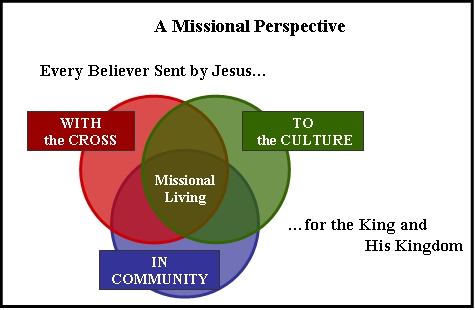
If you haven’t already, grab one of those Missional Prayer Guides in the foyer and fill it out (it’s pretty self-explanatory), place it in your Bible, and pull it out a few times a week to pray acquaintances, friends, and family across the page (right to left).  And don’t forget to use a pencil…


[1] Howard A. Snyder. Liberating the Church, The Ecology of Church and Kingdom, Inter-Varsity Press 1983:11.