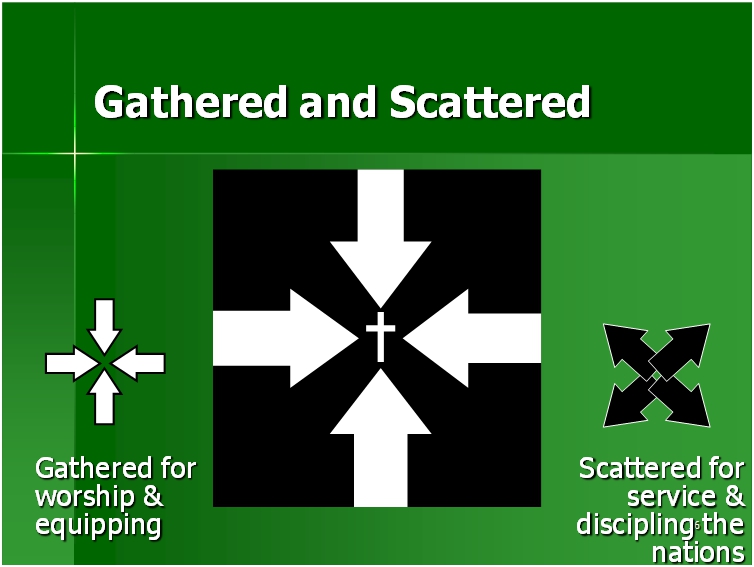
The Church Gathered and the Church Scattered

2 Corinthians 5:18-21

18 Now all these things are from God, who reconciled[1] [to settle accounts – as in a bank statement] us to Himself through Christ [who paid our debt – the cross is where God’s justice and God’s mercy kiss] and gave us the ministry of reconciliation, 19 namely, that God was in Christ reconciling the world to Himself, not counting their trespasses against them, and He has committed to us the word [logos, or doctrine] of reconciliation.

20 Therefore, we are ambassadors [diplomats, emissaries, representatives] for Christ, as though God were making an appeal through us [sometimes the best way to “preach” to someone is to listen to them]; we beg you on behalf of Christ, be reconciled to God. 21 He made Him who knew no sin to be sin on our behalf, so that we might become the righteousness of God in Him [THAT is the gospel – Jesus lived the life we should have lived and died the death we should have died. We don’t live in our own strength – we live IN Him – or His strength].

Did you know that there are currently 38,000 Pro-test-ant[2] denominations?  Catholics have multiple orders (Dominicans, Franciscans, Jesuits, etc.), but have managed to stay under the umbrella of Rome.

I. INTRO

I’d like to speak with you today about the Church GATHERED and the Church SCATTERED.  First, the nerdy Stuff…

  • Ecclesia (Latin) Greek – κκλησί, meaning “congregation” or “church.” The literal translation is “called out ones.”
  • Ecclesiology – Refers to the theological study of the Christian Church.

1. Who is the Church? (Not What…?) It is the body of all believing, or confessing, Christians.  SBF is a unique expression of the larger Body of Christ.

2. What is the authority of the Church?

  • Jesus is the head of the body, the Church (Col 1:18)
  • Jesus is the Senior Pastor. 1 Peter 5:4 identifies Jesus as the “Chief Shepherd.” [A church in transition shouldn’t get a pastor until they don’t really need one.]
  • The Bible is our highest and final authority. Sola Scriptura, not solo Scriptura.

3. What is the relationship between a believer and the Church? As believers we are to submit ourselves to Jesus – the Head and Chief Shepherd of the Church.  There are three overlapping commitments that make up a healthy and vibrant church experience:

  • Celebration (Worship)
  • Congregation (Identity needs met) Acts 2:42-47

42 “They were continually devoting themselves to the apostles’ teaching and to fellowship, to the breaking of bread and to prayer. 43 Everyone kept feeling a sense of awe; and many wonders and signs were taking place through the apostles. 44 And all those who had believed were together and had all things in common; 45 and they began selling their property and possessions and were sharing them with all, as anyone might have need. 46 Day by day continuing with one mind in the temple, and breaking bread from house to house, they were taking their meals together with gladness and sincerity of heart, 47 praising God and having favor with all the people. And the Lord was adding to their number day by day those who were being saved.”

  • Cell (Intimacy and accountability needs met)

James 5:16: Confess your sins to one another, and pray for one another so that you may be healed.”

4. How should the Church be governed?

8 Therefore it says, “WHEN HE ASCENDED ON HIGH,
HE LED CAPTIVE A HOST OF CAPTIVES,
AND HE GAVE GIFTS TO MEN.”  9 (Now this expression, “He ascended,” what does it mean except that He also had descended into the lower parts of the earth? 10 He who descended is Himself also He who ascended far above all the heavens, so that He might fill all things.) 11 And He gave some as apostles, and some as prophets, and some as evangelists, and some as pastors and teachers [also add elders and deacons], 12 for the equipping of the saints for the work of service, to the building up of the body of Christ; 13 until we all attain to the unity of the faith, and of the knowledge of the Son of God, to a mature man, to the measure of the stature which belongs to the fullness of Christ. 14 As a result, we are no longer to be children, tossed here and there by waves and carried about by every wind of doctrine, by the trickery of men, by craftiness in deceitful scheming; 15 but speaking the truth in love, we are to grow up in all aspects into Him who is the head, even Christ,

5. What does the Church do?  The church exists in two modes:

  • We gather for worship.
  • We scatter for mission.

II. BODY

We will now take a deeper look at what it means to gather for worship and scatter for mission

  • Gather for worship
  • Requires purposeful participation — moving from passive observation to active participation.

(Our identity) Eph 1: Blessed be the God and Father of our Lord Jesus Christ, who has blessed us with every spiritual blessing in the heavenly places in Christ, 4 just as He chose us in Him before the foundation of the world, that we would be holy and blameless before Him. In love 5 He predestined us to adoption as sons through Jesus Christ to Himself…”

Even before He made the world God chose you and adopted you, it gave Him great pleasure, God loved, chose, and adopted you.  You are His unique and special possession.

This is what we need to see: Coming is not an event; it is the fulfillment of God’s prehistoric (pre-history) desire.  God created Adam and Eve – it was good.  God wanted to be with people… (Some of you don’t even want to be with people J)

OT – they built a Tabernacle because God wanted to meet with His people.

It’s not our desire – it’s God’s desire – made possible by the blood of Jesus.  Church is not primarily about us – it’s primarily about God.

**We gather to, for, and around Jesus.

Our being here is all about Him – and sometimes competes with our expectations, needs, and desires.

Jesus is the head, the goal, chief shepherd – He’s the Sr. Pastor. He owns and loves the Church. He’s the object our worship, our preaching, and our mission.

The church is all about Him.  It’s not about music or the preaching – although, hopefully they are both focused on worshiping Jesus.

The music and the sermon are BOTH acts of worship (difference between a lecture and a sermon… “if people are taking notes at the end of a sermon it might not BE a sermon…”

If your Christianity is just about going to church then you don’t have Christianity, you have “Churchianity.”

Exalting only Jesus – giving all of our attention to Jesus

Sometimes it’s a sacrifice of praise (Hebs)

Our destination is always Jesus – give ourselves and assume a posture of personal humility, worship, and prayer.

Christ is present and available.

Ps 116:  1 I love the LORD because he hears my voice
and my prayer for mercy.
2 Because he bends down to listen,
I will pray as long as I have breath!
3 Death wrapped its ropes around me;
the terrors of the grave overtook me.
I saw only trouble and sorrow.
4 Then I called on the name of the LORD:
“Please, LORD, save me!”
5 How kind the LORD is! How good he is!
So merciful, this God of ours!
6 The LORD protects those of childlike faith;
I was facing death, and he saved me.
7 Let my soul be at rest again,
for the LORD has been good to me.
8 He has saved me from death,
my eyes from tears,
my feet from stumbling.
9 And so I walk in the LORD’s presence
as I live here on earth!
10 I believed in you, so I said,
“I am deeply troubled, LORD.”
11 In my anxiety I cried out to you,
“These people are all liars!”
12 What can I offer the LORD
for all he has done for me?
13 I will lift up the cup of salvation
and praise the LORD’s name for saving me.
14 I will keep my promises to the LORD
in the presence of all his people.

15 The LORD cares deeply
when his loved ones die.
16 O LORD, I am your servant;
yes, I am your servant, born into your household;
you have freed me from my chains.
17 I will offer you a sacrifice of thanksgiving
and call on the name of the LORD.
18 I will fulfill my vows to the LORD
in the presence of all his people—
19 in the house of the LORD
in the heart of Jerusalem.

Praise the LORD!

Scatter for mission

The term “missional church” may be a new term for you.  Here is the main idea:  We serve a missionary God, who crossed the ultimate cultural contexts to become one of us.  Jn 1:14 (MSG) The Word became flesh and blood, and moved into the neighborhood.

The Father sent the Son, the Son sent the Holy Spirit – and the Holy Spirit sends us.

Attractional model vs. a missional model.  In the end we want both.

What we are seeking to accomplish here at SBF can be defined as a “missional reorientation.”

At a very deep level we are redefining success:  It’s not about the 3 B’s (building, budget, and butts); it’s about how many people are we training and sending to be missionaries in their unique spheres of relationships.

Mat 28:18-20: 18 And Jesus came up and spoke to them, saying, “All authority has been given to Me in heaven and on earth. 19 Go therefore and make disciples of all the nations, baptizing them in the name of the Father and the Son and the Holy Spirit, 20 teaching them to observe all that I commanded you; and lo, I am with you always, even to the end of the age.”

Three things:

  1. All authority has been given to Jesus – and He is with us/you always. Our responsibility is basically twofold: a) stack kindling and b) splash (preach).  (D.L. Moody – At any moment we ought to be willing to preach, pray, or die.)
  2. “Go therefore” (Go ye) is the mission of the church.  Are we a “come ye” church, or a “go ye” church?
  3. Make disciples.  I’d like you to view every single person in your various spheres of relationship as a disciple…

[1] To “change or exchange” – it is God moving from hostility to friendship. Reconciliation is what God accomplishes, exercising His grace towards sinful humankind because of the sacrificial death of Christ in propitiatory [or appeasing] sacrifice under the judgment due to sin.

[2] The quotation “The lady doth protest too much, methinks.” comes from Shakespeare’s Hamlet, Act III, scene II. The phrase has come to mean that one can “insist so passionately about something not being true that people suspect the opposite of what one is saying.”

A New Paradigm From A Familiar Passage: What Does A Righteous Life Look Like?

Matthew 25:31- 46

by Gene Heacock (Feb 19, 2012)

(We’ve gotten behind on publishing posts. We’ll catch-up this week.)

“Christianity will always reproduce itself after its own kind” –A.W. Tozer

What kind are we?

Jesus is going away and the shadow of the cross looms over this passage.

  • JESUS WANTS YOU TO SUCCEED AND CAPTURE HIS HEART.
  • HE WANTS YOU TO BE LIKE HIM AND TO BE READY!!
  • HE WANTS YOU TO BE MORE LIKE HIM. HE IS HERE TO DO THAT!!  DO YOU SEE THAT??

3 Passages of preparation:

  1. Passion of our hearts for intimacy (25:1-13)
  2. Passion of stewardship (25: 14-30)
  3. Passion for Jesus heart of compassion  (25:31-46)

Computer as a paradigm to get a fresh look at this passage…

Surprises of what we though we lost stays and what we thought we saved got lost.  Passage although not a true parabolic form, has a spiritual left hook.  In the final day there will be surprises…

How many of you believe in a Devil?  I do — anyone who has a computer has to believe there is at least on territorial spirit hiding behind every terminal!

Computer story: Stop check program protects what you have done even if it is erased and other have saved everything that will eventually be erased.

Outline the sheep and the goats- Blind goats and seeing sheep

Righteousness is the key word in the Sermon on the Mount (Matthew 5-6)
2 Corinthians 5:21 we are to become key word process, growth journey spirit dependent

“The sermon of the mount is not a list of rules and regulations but rather it is description of the life we live when the Spirit has His way in our life ” –Oswald Chambers

Examine definition of uprightness scripturally and theologically describes a person whose way of th8knig and acting and doing is wholly conformed into the character of God

Saint Francis ” preach the gospel at all time use words if necessary ”

St Basil “Annunciations are many incarnations just a few “

Lets examine the text read and expand on verse 34-42

Description of a righteous life ( Life Of Jesus)

They serve people who can not pay them back
They are willing to expose them self to risk as they serve
They are kind to people who do no deserve it
They may have to suffer personal inconvenience as they serve
They go to places and do things no one ever think of doing

( WHO DOES THIS SOUND LIKE??)

The new paradigm in passage dumb sheep dumb goats- they were both dumb but one was blind and the other could see and from a Biblical world view the organ of sight is not the physical eye but rather the heart see verses 37 and 44

Illustration Subway train ride that changed a paradigm  Have you had one Do you need one??

Sheep Stories – Great Heroes are you not me or preachers or those who tour on stage for His name but rather those who have his heart and see people as He sees them and simply obey Jesus where they are.

SHEEP STORIES

  • A WEALTHY WOMAN FROM ATLANTA
  • A MIDDLE AGE WOMAN IN A GROCERY STORE
  • A HIGH SCHOOL STUDENT AND HIS BEST FRIEND WITH CANCER
  • A MECHANIC IN TORONTO WHO HAD ANOTHER BOSS

Where is your heart today and what do you see?

What will be on your computer screen in heaven?

A Generous Life #6 (of 6) 2 Corinthians 9:8-15

The Grace of God Is The Source of All True Generosity (2Cor 9:8-15)

I. INTRO

Today we will be considering the final 8 verses of 2 Cor 9 (8-15). Before we get there, I’d like to review the two most power-packed verses in the chapters we’ve been studying (2 Cor 8-9): 2 Cor 8:9 and 2 Cor 9:7

2 Cor 8:9 is the cornerstone, the basis, for any theology of stewardship or generosity – identifying Jesus Christ as the most generous life ever lived…

As Christians we face countless enemies to the welfare of our souls, be it pride, lust, bitterness, or envy. But few are as powerful and relentless as greed.  Greed has been deified  in our American culture…

What is the most effective counter-attack to this insidious force of greed? 2 Cor 8:9 is the key, the cornerstone – indeed the whole foundation – that holds the power to liberate our hearts from the grip of greed and release in us, and through us, the joy of generous giving:

2 Cor 8:9: For you know the grace of our Lord Jesus Christ, that though He was rich, yet for your sake He became poor, so that you through His poverty might become rich. (This is a concise and powerful theological statement that summarizes the gospel – a Christology.)

No one ever started so rich and became as poor as the Lord Jesus Christ.  And no one ever started out so poor and have become so rich as those who have placed their faith and trust in Jesus Christ for the forgiveness of sins.

Here is how Paul states it in Gal 2:20: I have been crucified with Christ; and it is no longer I who live, but Christ lives in me; and the life which I now live in the flesh I live by faith in the Son of God, who loved me and gave Himself up for me.”

What Paul is saying in 2 Cor 8:9 and in Gal 2:20 (and all throughout his writings, which make up much of the NT, is that IN CHRIST, we have access to an alternative life force: “and it is no longer I who live, but Christ lives in me; and the life which I now live in the flesh I live by faith in the Son of God, who loved me and gave Himself up for me.”

Martin Luther spoke of a “great exchange,” which refers to the way Christ’s sinless life and sacrificial death works to benefit the sinners that are united to him by faith: our sin is charged to Jesus and Jesus’ righteousness is credited to us. In essence it’s a transaction, an exchange: our sin for his righteousness.

2 Cor 9:7… “Each one must do just as he has purposed in his heart, not grudgingly or under compulsion, for God loves a cheerful giver.”

In v.7 we encounter a concise pattern for generous stewardship. There are six parameters:

  1. Universal (“Each one must do…”)
  2. Personal (“just as he has purposed in his heart”). (Many commentators say that if Paul had believed that we should begin our giving with a tithe, he would have reiterated that here…)
  3. Choice/Resolve (“as he has purposed“; the verb means: to choose or to make up your own mind about something.)  In the end only you and God will know if you’re sowing sparingly or bountifully.
  4. “Not Grudgingly,” or, without regret. Lit., “not out of sorrow.”
  5. “Not Under Compulsion. No force – psychological or otherwise; no manipulation, no moralism.
  6. Cheerful. The Greek word translated “cheerful” is hilaron, from which we get out English word “hilarious.”  This means that we find our joy, our delight, our pleasure in the generosity of Jesus Christ and we give out of a worshipful, joyful heart – as we remember what Jesus Christ has done.

II. BODY

There are two primary points for today:

  1. Vs. 8-12 The Promise of Abundance
  2. Vs. 13-15 The Results of Christian Stewardship

Let’s look at them individually…

1.  9:8-12: The promise to supply abundantly those who give generously.

Notice Paul’s “string of universals” in v. 8[1]“God is able to make all grace abound to you, that always having all sufficiency in everything, you may have an abundance for every good deed.”

Do you see them? All, always, all, everything, and every. That is a staggering promise for us as believers — and for your family, and for us as a church—simply staggering.

It’s quite similar to the promise of Jesus in Matthew 6:33: “Seek first the kingdom of God and [the gift of] his righteousness, and all these things will be added to you.”

Now, notice the word righteousness in vs. 9 and 10: “His righteousness abides forever,” and then in v.10 Paul speaks of “the harvest of your righteousness.” This is speaking of the great exchange: Christ’s righteousness becomes ours…

Notice also in v.10 that God does not stop with merely“multiplying our seed” (this is where the Prosperity Gospel folks fall short); but God will “multiply your seed for sowing (9:10).  The goal is not to merely multiply our own resources, but to sow that we might be generous beyond ourselves.  We do not “give to get.”  We give to get, to give again – and again, and again, and again…

In v.11 we see another use of more ‘universals’…”You will be enriched in everything (why?) “for all liberality producing thanksgiving to God (9:11). And not just our own thanksgiving, but the thanksgiving (to God) of those who are the recipients of our exchanged generosity.

2.  9:13-15: The results of generous Christian giving.

In v.13a – Our generosity brings glory (honor, worship, and praise) to God.

In v.13b – Our generosity functions as evidence, or proof, of the authenticity of our faith. “They [the recipients] will glorify God for your obedience to your confession of the gospel of Christ – and your liberality…”

In v.14 we see our generosity serves to increase and intensify affection and fellowship among Christians – and sparks gratitude for the grace of God.  (There are 39 verses in chapters 8-9. The word grace is used 10 times…)

In v. 15. “Thanks be to God for His indescribable gift!” We close our series by asking, “What is God’s ‘indescribable gift’?

Is it “the surpassing grace of God” in the Corinthians, mentioned in v. 14 (cf. 8:1)? Or is it God’s gracious gift of Jesus (8:9) who, though rich, impoverished himself to make us rich?  Which is it?

The answer is… both! Jesus Christ is THE Divine Gift which inspires ALL gifts.

And now, as we wind down our study of these two chapters in 2 Corinthians, a brief summary of the 10 principles of Christian stewardship is in order:

  1. Generosity is a work of Gods grace (2 Cor 8:1-6)
  2. Generosity is both a work of God’s grace and a choice (2 Cor 8:7)
  3. Generosity points us to the sacrifice of Christ (2 Cor 8:8-9)
  4. Generosity is measured proportionally (2 Cor 8:10-12)
  5. Generosity enables a holy equality (2 Cor 8:13-15)
  6. Generosity necessitates godly stewardship (2 Cor 8:16-24)
  7. Generosity begets generosity (2 Cor 9:1-5)
  8. Generosity is about sowing and reaping (2 Cor 9:6-12)
  9. Generosity is an evidence that someone is an active, intentional follower of Christ 
(2 Cor 9:13-14)
  10. Generosity promotes the worship of Jesus as God (2 Cor 9:15)

III. CONCLUSION

If we were to break down the population of the world into only 100 people, it would play out like this:

  • There would be 51 women and 49 men.
  • 70 people would be of a faith other than Christianity.
  • There would be 70 people of color; 30 would be white.
  • 80 would live in substandard housing (i.e. no running water or electricity, etc.)
  • 50 would be malnourished, living off of perhaps one small meal a day.
  • 70 would be illiterate and unable to read.
  • Fewer than 6 would live in the U.S., but those 6 would possess half the world’s wealth. (Even with the financial challenges that we face today, it doesn’t seem so bad when we consider there are approximately 6.6 billion people in the world today and close to half of that (over 3 billion) live on less than $2 a day!

To personalize this, go to http://www.globalrichlist.com/

I did and found out that, according to our household income, Linda and I are in the top .66% of the richest people in the world.

The website noted that if we donated just one hour’s salary

We could buy:

  • 25 fruit trees for farmers in Honduras to grow and sell fruit at their local market, and…
  • A First Aid kit for a village in Haiti.

$73 could purchase a new mobile health clinic to care for AIDS orphans in Uganda.

$2400 could purchase schooling for an entire generation of school children in an Angolan village.


[1] Barnett: 439.

A Generous Life #5 (of 6) 2 Cor 9:1-7

Reciprocity Reconstructed – 2 Cor 9:1-7

 I. INTRO

Where are we headed today?  The BIG IDEA is reciprocity reconstructed.

I would like to begin, however, with a review of our foundational verse in this series – and in this section (chapters 7-8): 2 Cor 8:9.

Then we’ll define, deconstruct and then reconstruct this concept of reciprocity – and then use that concept to help us unpack the three key verses in our passage today (primarily vs. 6,7, & 8).

Part of the teaching today will be a critique of the so-called Prosperity Gospel, sometimes referred to as Health & Wealth or Name It And Claim It.  Sadly, this message has seeped into the Evangelical landscape of North American Christianity.  And what’s even sadder is that it is being exported to third-world countries through infected missionaries and ministries.  But more about that in a few minutes…

Let’s begin by going back to our foundational verse for this series: 2 Cor 8:9, which identifies Jesus Christ as the most generous life ever lived…

2 Cor 8:9: For you know the grace of our Lord Jesus Christ, that though He was rich, yet for your sake He became poor, so that you through His poverty might become rich.

This is a rich (no pun intended :)) theological statement, which anchors this section on practical Christian stewardship. It identifies the ultimate example of (self) giving – how and why Jesus so fully and completely gave Himself (Christology).

This verse invites us to ask and answer three questions:

1. How rich was He?  No one ever started so rich as the Lord Jesus Christ.

Ps 50:12b: “For the world is Mine, and all it contains.”

2. How poor did He become? No one ever became as poor as the Lord Jesus Christ.

2 Cor 5:21: “For our sake He made Him to be sin who knew no sin, so that in Him we might become the righteousness of God.”

3. How rich do we become? No one ever started out so poor and have become so rich as those who have placed their faith and trust in Jesus Christ for the forgiveness of sins.

Eph 1:3 – Blessed be the God and Father of our Lord Jesus Christ, who has blessed us with every spiritual blessing in the heavenly places in Christ.” [no need for a second blessing]

Our “riches” in Christ include: Justification, forgiveness, sanctification, the Holy Spirit, partakers of the divine nature, new heart, new will, new creation, imperishable inheritance — the inheritance is Him.  We’ve been invited into the Trinitarian dance…

OK, with Paul’s lesson of Christology, let’s consider Reciprocity Reconstructed.  What does reciprocity mean? (Definition, Deconstruction, Reconstruction)

Definition: rec·i·proc·i·ty [res-uh-pros-i-tee] noun

A reciprocal state or relation.

Reciprocation; or mutual exchange.

Deconstruction: The word reciprocity has been adulterated by the (so called) Prosperity Gospel movement (i.e., “word of faith,” “positive confession,” “health & wealth gospel,” etc.) claims the Bible teaches financial (& physical) blessing is the will of God for Christians. Their doctrine teaches that:

  • Faith,
  • Positive speech, and
  • Donations to Christian ministries

Will always increase material wealth and physical health.  At the root of this “false” doctrine is their belief that God’s promise of dominion to Israel applies to Christians today.

Paul clearly warns against the desire to be rich. And by implication, he warns against ministries who stir up – and teach the desire to be rich.

1 Timothy 6:9-10: “Those who desire to be rich fall into temptation, into a snare, into many senseless and harmful desires that plunge people into ruin and destruction. For the love of money is a root of all kinds of evils. It is through this craving that some have wandered away from the faith and pierced themselves with many pangs.”

Reconstruction: The reciprocity of the gospel exchanges my sin for Christ’s righteousness. Martin Luther calls it, “the great exchange”…

Luther says, “This is that mystery which is rich in divine grace to sinners: wherein by a wonderful exchange our sins are no longer ours but Christ’s, and the righteousness of Christ not Christ’s but ours. He has emptied Himself of His righteousness that He might clothe us with it and fill us with it; and He has taken our evils upon Himself that He might deliver us from them.”

So, the Health & Wealth folks have cheapened the concept of reciprocity – and made it about materialism.  Kind of an Americanized brand of Christianity…

II. BODY – now let’s take these concepts and move into our passage for today…I’ll give a cursory view of the first five verses and then we’ll unpack vs. 6,7, & 8.

The ministry of giving in Corinth – 9:1-5:

  • Paul’s reminding them of their initial commitment to give – vv. 1-2.  Paul’s comment that the Corinthians’ initial zeal to give stirred up “most” (v.2) of the Macedonians is a healthy dose of realism.
  • In other words, not all the believers in Macedonia gave generously with joy in the midst of their poverty and affliction (cf. 8:1-5).
  • In vs. 3-5 we see Paul’s purpose in sending Titus –
    • Paul’s initial excitement has been somewhat tempered. Titus has come from Corinth with the discouraging report that the collection has, basically, been put “on the back burner.”
    • Paul expresses some disappointment here these verses.  Paul views stewardship and living out the generosity of Jesus as an important component of discipleship.  Paul had hoped they were farther along.
  • He is also attempting to prolong the friendly competition between the Macedonians and the Corinthians.

Verses 6-11 help us to understand and apply the principle of reciprocity in Christian giving…

In v.6 we encounter the illustration of “sowing” and “reaping”

Now I’m not a farmer (I could kill an artificial plant!), but in farming, what may initially appear to be a loss (“sowing”) – in due time, it will produce a gain (“reaping”). As one sows, so one reaps.

So, we need to ask what determines whether a gift is “sparing” or “bountiful”?  It is not determined by the quantity, but by:

  • The means of the giver (we learned from chapter 8 that giving is to be in proportion to our wealth (cf. 8:3,11,12; 1 Cor. 16:2); and
  • The heart (mind/mood) of the giver (it is possible to give a lot of money, but still be sowing “sparingly” (cf. 8:1-5; 9:5b).

In v.7 we encounter the pattern for generous stewardship. There are six parameters:

  1. Universal (“Let each one…”)
  2. Personal (“just as s/he has purposed in his heart”). Many commentators say that if Paul had believed that we should begin our giving with a tithe, he would have reiterated that here.
  3. Choice/Resolve (“as he has purposed;” this verb proaireomai, found only here in the NT, means: to choose deliberately or to make up your own mind about something.)  In the end only you and God will know if you are sowing sparingly or bountifully.
  4. “Not Grudgingly,” or, without regret. Lit., “not out of sorrow;” i.e., giving and then grieving over the fact that money is gone; thinking of all the things you could have purchased with the money.
  5.  “Not Under Compulsion. No force – psychological, guilt-driven, or otherwise.
  6. Cheerful. The Greek word translated “cheerful” is hilaron, from which we get out English word “hilarious.”  What does it mean to be a cheerful, or hilarious, giver?  It means that we find our joy, our delight, our pleasure in the generosity of Jesus Christ and we give out of a worshipful, joyful heart – as we remember what Jesus Christ has done.  Is it an act of faith?  Yes.  We sow and we wait…

III. CONCLUSION

What if the cheerfulness of responsive obedient giving is not there?

I’ll suggest three things[1]:

  1. Don’t say it doesn’t matter how you feel. Confess the sin of joylessness (yes, joylessness is a sin). Acknowledge the coldness of your heart.  (Money might be one of your root idols!)
  2. Pray earnestly that God would give to you, or restore, the joy of responsive obedience.
  3. Go ahead and do the outward dimension of your responsive obedience in the hope that the doing will rekindle the delight.

Paul envisions us joyfully and bountifully sowing in the light of God’s faithfulness — that we might give as a response to His joyful sacrifice and righteousness. (Heb 12:2: “For the joy set before Him He endured the cross.”)


[1] Adapted from John Piper, Desiring God: 248-249.