The Role of Prayer in Spiritual Awakening

OrrDr. J. Edwin Orr was a leading scholar of revivals who published detailed books about evangelical awakenings. His research discovered major spiritual awakenings about every fifty years following the great awakening from the mid-eighteenth century in which John and Charles Wesley, George Whitefield and Jonathan Edwards featured prominently. This article, based on one of Edwin Orr’s messages, is adapted from articles reproduced in the National Fellowship for Revival newsletters in New Zealand and Australia.

There has never been a spiritual awakening in any country or locality that did not begin in united prayer.

Dr A. T. Pierson once said, ‘There has never been a spiritual awakening in any country or locality that did not begin in united prayer.’ Let me recount what God has done through concerted, united, sustained prayer.

Not many people realize that in the wake of the American Revolution (following 17761781) there was a moral slump. Drunkenness became epidemic. Out of a population of five million, 300,000 were confirmed drunkards; they were burying fifteen thousand of them each year. Profanity was of the most shocking kind. For the first time in the history of the American settlement, women were afraid to go out at night for fear of assault. Bank robberies were a daily occurrence.

What about the churches? The Methodists were losing more members than they were gaining. The Baptists said that they had their most wintry season. The Presbyterians in general assembly deplored the nation’s ungodliness. In a typical Congregational church, the Rev. Samuel Shepherd of Lennos, Massachusetts, in sixteen years had not taken one young person into fellowship. The Lutherans were so languishing that they discussed uniting with Episcopalians who were even worse off. The Protestant Episcopal Bishop of New York, Bishop Samuel Provost, quit functioning; he had confirmed no one for so long that he decided he was out of work, so he took up other employment.

The Chief Justice of the United States, John Marshall, wrote to the Bishop of Virginia, James Madison, that the Church ‘was too far gone ever to be redeemed.’ Voltaire averred and Tom Paine echoed, ‘Christianity will be forgotten in thirty years.

Take the liberal arts colleges at that time. A poll taken at Harvard had discovered not one believer in the whole student body. They took a poll at Princeton, a much more evangelical place, where they discovered only two believers in the student body, and only five that did not belong to the filthy speech movement of that day. Students rioted. They held a mock communion at Williams College, and they put on anti-Christian plays at Dartmouth. They burned down the Nassau Hall at Princeton. They forced the resignation of the president of Harvard. They took a Bible out of a local Presbyterian church in New Jersey, and they burnt it in a public bonfire. Christians were so few on campus in the 1790’s that they met in secret, like a communist cell, and kept their minutes in code so that no one would know.

How did the situation change? It came through a concert of prayer.

There was a Scottish Presbyterian minister in Edinburgh named John Erskine, who published a Memorial (as he called it) pleading with the people of Scotland and elsewhere to unite in prayer for the revival of religion. He sent one copy of this little book to Jonathan Edwards in New England. The great theologian was so moved he wrote a response which grew longer than a letter, so that finally he published it is a book entitled ‘A Humble Attempt to Promote Explicit Agreement and Visible Union of all God’s People in Extraordinary Prayer for the Revival of Religion and the Advancement of Christ’s Kingdom on Earth, pursuant to Scripture Promises and Prophecies…’

Is not this what is missing so much from all our evangelistic efforts: explicit agreement, visible unity, unusual prayer?

1792-1800

This movement had started in Britain through William Carey, Andrew Fuller and John Sutcliffe and other leaders who began what the British called the Union of Prayer. Hence, the year after John Wesley died (he died in 1791), the second great awakening began and swept Great Britain.

In New England, there was a man of prayer named Isaac Backus, a Baptist pastor, who in 1794, when conditions were at their worst, addressed an urgent plea for prayer for revival to pastors of every Christian denomination in the United States.

Churches knew that their backs were to the wall. All the churches adopted the plan until America, like Britain was interlaced with a network of prayer meetings, which set aside the first Monday of each month to pray. It was not long before revival came.

When the revival reached the frontier in Kentucky, it encountered a people really wild and irreligious. Congress had discovered that in Kentucky there had not been more than one court of justice held in five years. Peter Cartwright, Methodist evangelist, wrote that when his father had settled in Logan County, it was known as Rogue’s Harbour. The decent people in Kentucky formed regiments of vigilantes to fight for law and order, then fought a pitched battle with outlaws and lost.

There was a Scotch-Irish Presbyterian minister named James McGready whose chief claim to fame was that he was so ugly that he attracted attention. McGready settled in Logan County, pastor of three little churches. He wrote in his diary that the winter of 1799 for the most part was ‘weeping and mourning with the people of God.’ Lawlessness prevailed everywhere.

McGready was such a man of prayer that not only did he promote the concert of prayer every first Monday of the month, but he got his people to pray for him at sunset on Saturday evening and sunrise Sunday morning. Then in the summer of 1800 come the great Kentucky revival. Eleven thousand people came to a communion service. McGready hollered for help, regardless of denomination.

Out of that second great awakening, came the whole modern missionary movement and it’s societies. Out of it came the abolition of slavery, popular education, Bible Societies, Sunday Schools, and many social benefits accompanying the evangelistic drive.

1858-1860

Following the second great awakening, which began in 1792 just after the death of John Wesley and continued into the turn of the century, conditions again deteriorated. This is illustrated from the United States.

The country was seriously divided over the issue of slavery, and second, people were making money lavishly.

In September 1857, a man of prayer, Jeremiah Lanphier, started a businessmen’s prayer meeting in the upper room of the Dutch Reformed Church Consistory Building in Manhattan. In response to his advertisement, only six people out of a population of a million showed up. But the following week there were fourteen, and then twenty-three when it was decided to meet everyday for prayer. By late winter they were filling the Dutch Reformed Church, then the Methodist Church on John Street, then Trinity Episcopal Church on Broadway at Wall Street. In February and March of 1858, every church and public hall in down town New York was filled.

Horace Greeley, the famous editor, sent a reporter with horse and buggy racing round the prayer meetings to see how many men were praying. In one hour he could get to only twelve meetings, but he counted 6,100 men attending.

Then a landslide of prayer began, which overflowed to the churches in the evenings. People began to be converted, ten thousand a week in New York City alone. The movement spread throughout New England, the church bells bringing people to prayer at eight in the morning, twelve noon, and six in the evening. The revival raced up the Hudson and down the Mohawk, where the Baptists, for example, had so many people to baptise that they went down to the river, cut a big hole in the ice, and baptised them in the cold water. When Baptists do that they are really on fire!

When the revival reached Chicago, a young shoe salesman went to the superintendent of the Plymouth Congregational Church, and asked if he might teach Sunday School. The superintendent said, ‘I am sorry, young fellow. I have sixteen teachers too many, but I will put you on the waiting list.’

The young man insisted, ‘I want to do something just now.’

‘Well, start a class.’

‘How do I start a class?’

‘Get some boys off the street but don’t bring them here. Take them out into the country and after a month you will have control of them, so bring them in. They will be your class.’

He took them to a beach on Lake Michigan and he taught them Bible verses and Bible games. Then he took them to the Plymouth Congregational Church. The name of that young man was Dwight Lyman Moody, and that was the beginning of a ministry that lasted forty years.

Trinity Episcopal Church in Chicago had a hundred and twenty-one members in 1857; fourteen hundred in 1860. That was typical of the churches. More than a million people were converted to God in one year out of a population of thirty million.

Then that same revival jumped the Atlantic, appeared in Ulster, Scotland and Wales, then England, parts of Europe, South Africa and South India anywhere there was an evangelical cause. It sent mission pioneers to many countries. Effects were felt for forty years. Having begun in a movement of prayer, it was sustained by a movement of prayer.

1904-1905

That movement lasted for a generation, but at the turn of the century there was need of awakening again. A general movement of prayer began, with special prayer meetings at Moody Bible Institute, at Keswick Conventions in England, and places as far apart as Melbourne, Wonsan in Korea, and the Nilgiri Hills of India. So all around the world believers were praying that there might be another great awakening in the twentieth century.

* * *

In the revival of 1905, I read of a young man who became a famous professor, Kenneth Scott Latourette. He reported that, at Yale in 1905, 25% of the student body were enrolled in prayer meetings and in Bible study.

As far as churches were concerned, the ministers of Atlantic City reported that of a population of fifty thousand there were only fifty adults left unconverted.

Take Portland in Oregon: two hundred and forty major stores closed from 11 to 2 each day to enable people to attend prayer meetings, signing an agreement so that no one would cheat and stay open.

Take First Baptist Church of Paducah in Kentucky: the pastor, an old man, Dr J. J. Cheek, took a thousand members in two months and died of overwork, the Southern Baptists saying, ‘a glorious ending to a devoted ministry.’

That is what was happening in the United States in 1905. But how did it begin?

* * *

Most people have heard of the Welsh Revival, which started in 1904. It began as a movement of prayer.

Seth Joshua, the Presbyterian evangelist, came to Newcastle Emlyn College where a former coal miner, Evan Roberts aged 26, was studying for the ministry. The students were so moved that they asked if they could attend Joshua’s next campaign nearby. So they cancelled classes to go to Blaenanerch where Seth Joshua prayed publicly, ‘O God, bend us.’

Evan Roberts went forward where he prayed with great agony, ‘O God, bend me.’

Upon his return he could not concentrate on his studies. He went to the principal of his college and explained, ‘I keep hearing a voice that tells me I must go home and speak to our young people in my home church. Principal Phillips, is that the voice of the devil or the voice of the Spirit?’

Principal Phillips answered wisely, ‘The devil never gives orders like that. You can have a week off.’

So he went back home to Loughor and announced to the pastor, ‘I’ve come to preach.’

The pastor was not at all convinced, but asked, ‘How about speaking at the prayer meeting on Monday?’

He did not even let him speak to the prayer meeting, but told the praying people, ‘Our young brother, Evan Roberts, feels he has a message for you if you care to wait.’

Seventeen people waited behind, and were impressed with the directness of the young man’s words.

Evan Roberts told his fellow members, ‘I have a message for you from God.

  • You must confess any known sin to God and put any wrong done to others right.
  • Second, you must put away any doubtful habit.
  • Third, you must obey the Spirit promptly.
  • Finally, you must confess your faith in Christ publicly.’

By ten o’clock all seventeen had responded. The pastor was so pleased that he asked, ‘How about your speaking at the mission service tomorrow night? Midweek service Wednesday night?’

He preached all week, and was asked to stay another week. Then the break came.

Suddenly the dull ecclesiastical columns in the Welsh papers changed:

‘Great crowds of people drawn to Loughor.’

The main road between Llanelly and Swansea on which the church was situated was packed with people trying to get into the church. Shopkeepers closed early to find a place in the big church.

Now the news was out. A reporter was sent down and he described vividly what he saw: a strange meeting which closed at 4.25 in the morning, and even then people did not seem willing to go home. There was a very British summary: ‘I felt that this was no ordinary gathering.’

Next day, every grocery shop in that industrial valley was emptied of groceries by people attending the meetings, and on Sunday every church was filled.

The movement went like a tidal wave over Wales, in five months there being a hundred thousand people converted throughout the country. Five years later, Dr J. V. Morgan wrote a book to debunk the revival, his main criticism being that, of a hundred thousand joining the churches in five months of excitement, after five years only seventyfive thousand still stood in the membership of those churches!

The social impact was astounding. For example, judges were presented with white gloves, not a case to try; no robberies, no burglaries, no rapes, no murders, and no embezzlements, nothing. District councils held emergency meetings to discuss what to do with the police now that they were unemployed.

In one place the sergeant of police was sent for and asked, ‘What do you do with your time?’

He replied, ‘Before the revival, we had two main jobs, to prevent crime and to control crowds, as at football games. Since the revival started there is practically no crime. So we just go with the crowds.’

A councilor asked, ‘What does that mean?’

The sergeant replied, ‘You know where the crowds are. They are packing out the churches.’

‘But how does that affect the police?’

He was told, ‘We have seventeen police in our station, but we have three quartets, and if any church wants a quartet to sing, they simply call the police station.’

As the revival swept Wales, drunkenness was cut in half. There was a wave of bankruptcies, but nearly all taverns. There was even a slowdown in the mines, for so many Welsh coal miners were converted and stopped using bad language that the horses that dragged the coal trucks in the mines could not understand what was being said to them.

That revival also affected sexual moral standards. I had discovered through the figures given by British government experts that in Radnorshire and Merionethshire the illegitimate birth rate had dropped 44% within a year of the beginning of the revival.

The revival swept Britain, Scandinavia, Germany, North America, Australasia, Africa, Brazil, Mexico, Chile.

As always, it began through a movement of prayer.

What do we mean by extraordinary prayer? We share ordinary prayer in regular worship services, before meals, and the like. But when people are found getting up at six in the morning to pray, or having a half night of prayer until midnight, or giving up their lunchtime to pray at noonday prayer meetings, that is extraordinary prayer. It must be united and concerted.

Originally given at the first National Prayer Conference, Dallas, TX, 1976, sponsored by Campus Crusade for Christ. Also available at www.jedwinorr.com

Advent Series – Celebrating Advent Means Encountering God’s JOY

Advent-1I. INTRO

Please turn to Luke 1.  Today we are going to look at a rather large portion of Scripture – 34 verses.  This passage is divided up into 3 sections:

  1. Vs. 46-55 are what scholars have identified as The Magnificat, which is Mary’s Joyful Song/Psalm/Canticle/Poem/Prayer/Hymn of Worship.  Magnificat is the Latin word for magnifies, or exalts in v. 46 as Mary begins her song with: “My soul magnifies the Lord…”
  2. In vs. 56-66 we have the Birth of John the Baptist.
  3. Then in vs. 67-80 we have The Benedictus — Zacharias’ Joyful Song/Psalm/Canticle/Poem/Prayer/Hymn of Worship.  Benedictus is the Latin word “Blessed,” which is the first word of Zacharias’ song in v. 68.

Before we jump into the passage I’d like to provide some (hopefully) relevant background and context:

There are several major songs/canticles identified throughout the Bible…

    • The (1st) Song of Moses (Ex 15:1-19) on the other side of the Red Sea
    • The (2nd) Song of Moses (Deut 32:1-43) when Joshua is commissioned.  This one might even be considered a sermon…
    • The Song of Hannah (1Samuel 2:1-10) at the conclusion of her barrenness — which Mary’s is most likely to be patterned after.
    • The Songs of Isaiah, Habakkuk, and Jonah all have recorded song of deliverance and worship…
    • The Songs of Mary & Zacharias (Luke 1:46-55; 68-79)

The Book of Psalms are a collection of songs of worship.  (We could even think of them as a hymnbook.)  These other psalms/songs are scattered throughout Scripture and each is a response of worship and gratitude when God had moved in great love, or power, or deliverance.

It’s not like watching The Music Man or South Pacific, or Glee – where the characters regularly breakout into song… What we can learn from the Jewish people is that when God moved in great love, or great power, or great deliverance – they stopped, they reflected, they took notice — and they worshipped.

Another insight that we can take notice of before we read the text is that God had been absolutely silent for 400 years![1]  That’s almost twice as long as the United States has existed — no inspired prophet, priest, or king spoke to the people on behalf of God.

At the close of the book of Malachi in the OT, the nation of Israel is back again in Palestine after their captivity, but they are still under the domination of the Babylonians.

When the NT opens we find the nation of Israel has been vanquished by Rome.  Israel was a puppet state – and Herod was the puppet King.

After 400 years of silence Luke records that Zacharias a Priest, in the course of his priestly duties, has an encounter with an angel sent from God.  Luke 1:12 tells us that when Zacharias saw Gabriel the angel he was “troubled” and that “fear gripped him.”  (You think?)

Zacharias and his wife Elizabeth are old she has been barren (much like Abraham and Sarah). Elizabeth is a cousin of Mary, who six months later also has a visitation from the angel Gabriel.

With that as our introduction, please turn to Luke 1:46…

46 And Mary said:

“My soul exalts the Lord,
47 And my spirit has rejoiced in God my Savior.
48 “For He has had regard for the humble state of His bondslave;
For behold, from this time on all generations will count me blessed.
49 “For the Mighty One has done great things for me;
And holy is His name.
50 “And His mercy is upon generation after generation
Toward those who fear Him.
51 “He has done mighty deeds with His arm;
He has scattered those who were proud in the thoughts of their heart.
52 “He has brought down rulers from their thrones,
And has exalted those who were humble.
53 “He has filled the hungry with good things;
And sent away the rich empty-handed.
54 “He has given help to Israel His servant,
In remembrance of His mercy,
55 As He spoke to our fathers,
To Abraham and his descendants forever.”

56 And Mary stayed with her about three months, and then returned to her home.

57 Now the time had come for Elizabeth to give birth, and she gave birth to a son. 58 Her neighbors and her relatives heard that the Lord had displayed His great mercy toward her; and they were rejoicing with her.

59 And it happened that on the eighth day they came to circumcise the child, and they were going to call him Zacharias, after his father. 60 But his mother answered and said, “No indeed; but he shall be called John.” 61 And they said to her, “There is no one among your relatives who is called by that name.” 62 And they made signs to his father, as to what he wanted him called. 63 And he asked for a tablet and wrote as follows, “His name is John.” And they were all astonished. 64 And at once his mouth was opened and his tongue loosed, and he began to speak in praise of God. 65 Fear came on all those living around them; and all these matters were being talked about in all the hill country of Judea. 66 All who heard them kept them in mind, saying, “What then will this child turn out to be?” For the hand of the Lord was certainly with him.

67 And his father Zacharias was filled with the Holy Spirit, and prophesied, saying:

68 “Blessed be the Lord God of Israel,
For He has visited us and accomplished redemption for His people,
69 And has raised up a horn of salvation for us
In the house of David His servant—
70 As He spoke by the mouth of His holy prophets from of old—
71 Salvation from our enemies,
And from the hand of all who hate us;
72 To show mercy toward our fathers,
And to remember His holy covenant,
73 The oath which He swore to Abraham our father,
74 To grant us that we, being rescued from the hand of our enemies,
Might serve Him without fear,
75 In holiness and righteousness before Him all our days.
76 “And you, child, will be called the prophet of the Most High;
For you will go on before the Lord to prepare His ways;
77 To give to His people the knowledge of salvation
By the forgiveness of their sins,
78 Because of the tender mercy of our God,
With which the Sunrise from on high will visit us,
79 To shine upon those who sit in darkness and the shadow of death,
To guide our feet into the way of peace.”

80 And the child continued to grow and to become strong in spirit, and he lived in the deserts until the day of his public appearance to Israel.

II. BODY

This morning we lit the JOY candle.  Certainly we hear – and hopefully feel — great JOY in these songs of Mary and Zacharias.

I find it interesting that a young woman and an old man – a youth and senior citizen, sing these two songs.  There is hope and longing – infused with JOY and expectation in these songs.

Joy is difficult to pin down and define…

  • One way to narrow it done is to distinguish JOY from happiness.
    • Happiness depends on “happenings.”  It comes from the same root word “happenstance,” which is circumstantial.
    • So, we begin to understand that happiness is external while JOY is internal.
  • Someone has defined JOY as: calm delight.
  • Another definition for JOY is: The positive confidence we feel from knowing & trusting God – regardless of our circumstances.”  As you can see that’s a lot different from happiness…
  • John Pier would say that Christian JOY is not natural.  He says envy or greed, ARE natural (for example), but JOY is not.  Christian JOY, Piper says, is spiritual and not natural.  And when something is spiritual, it must come from the Holy Spirit.

I have found that JOY will often follow a pattern and that almost all relationships and life ventures will follow a predictable pattern.  This pattern can be identified in three phases:

  • Romance — Our idealistic perceptions, expectations, and plans.
  • Disillusionment — To have an illusion is to have a false idea.  So, to be dis-illusioned is to have reality break in upon us.  This is a critical period when we encounter reality and disappointment.  Things don’t work out like we planned and we are tempted to turn back or give up.  The Disillusionment phase is not a bad phase.  It is a necessary and important step to go through.  We can embrace it as a time to dig deeper, to get in touch with God, and seek His face.  Disillusionment is like a fork in the road.  We can commit to follow our own will and desires – or we can take the road less travelled…
  • We experience the final phase of JOY when we positively work through Disillusionment.  By embracing the difficult phase of challenges and obstacles, we are able to align ourselves more fully with God’s heart and plans.

There is a story about a Hasidic rabbi who tells his people that if they study the Torah, it will put Scripture on their hearts.  One of the students asked, “Why on our hearts instead of in our hearts?”  The rabbi answered, “Only God can put Scripture inside.  But reading sacred text can put it on your hearts, and then when your hearts break, the holy words will fall inside.[2]

As I read and studied these two songs I found myself looking for insights from Mary and Zacharias into how to make deposits of JOY into my heart and soul.

A.  In Mary’s song I found two words that motivated me to consider more deeply the source of Mary’s JOY.  We sense her JOY right out of the gate when she begins her song with the words: “My soul exalts the Lord.  And my spirit has rejoiced in God my Savior” (vs. 46-47).  The two words are: humility and fear.

1.  Humility – V. 48 “For has had regard for the humble state of His bondslave.”

A few months ago we studied the Beatitudes, which are contained in the Sermon on the Mount (Mat 5-7).  And we identified them as the unlikely route to JOY.

What we found in the Beatitudes was that as we were willing to own our spiritual poverty, that God would take us on a journey through mourning, then meekness (or, brokenness), then a hunger and thirst for righteous, then mercy, and then purity of heart, which leads to us toward becoming peacemakers (instead of peacekeepers).  We also found out that when we live this way that persecution can be normative.  (We also discovered from the life Jesus that most persecution comes from religious people.)

Joy grows and deepens in our lives as we walk this road less travelled that begins with humility – owning our own issues.

2.  Fear — A healthy and holy fear of God will feed our JOY.  The second is a phrase found in v. 50: “And [God’s] mercy is upon generation after generation toward those who fear Him.”

There are many passages that speak to the fear of the Lord:

  • Ps 19:9 – The fear of the LORD is clean, enduring forever…
  • Ps 111:10 – The fear of the LORD is the beginning of wisdom.
  • Pro 8:13 begins to define the fear of the Lord saying, The fear of the LORD is to hate evil, pride, and arrogance…
  • Ps 130:4 is quite interesting, the psalmist says, But there is forgiveness with You, That You may be feared.  Apparently experiencing God’s forgiveness causes a holy, righteous, and healthy fear to grow in our hearts.

Ps 130:4 throws a wrench into the idea that the fear of God is disturbing, bad, or negative.

God’s forgiveness increases a healthy and holy fear of God.  What the Bible means by fear and what we mean by fear are two very different ideas.

The word fear does contain the idea of humility, awe, and amazement.  Yet the Biblical concept of fear must also contain JOY and wonder.  Because then grace and forgiveness wouldn’t increase it if it was a bad thing.

Healthy biblical fear of God requires us to live in the tension of boldness in knowing that God loves me and at the same time seeing and acknowledging my own depravity – that I am a sinner saved by grace.

These two perspectives grow together in the Christian life.  We call it living in the gospel tension – and the tension produces vitality.

If my self-image is based on my performance then I will feel bold and confident, but I will not be loving and humble toward others.

Or, if my performance is lacking and I’m not doing well, I will feel very humbled and will tend to be kind and sensitive to others – but not confident.

But the gospel brings them both together – I’m so sinful that God had to die for me – and at the same time I am so loved that Jesus was willing to die for me.

When we consider the word FEAR I would suggest that we see it as wonder-filled and bold humility.  It can’t mean “scared” because forgiveness wouldn’t increase it.

B.  In Zacharias’ Song I will just mention one important take-away: Zacharias had forward looking faith.

In one of his sermons John Piper stated that he thought Zacharias being struck deaf and dumb by the angel Gabriel was more a gift than a punishment.

During those nine months he was forced to be quiet, to think deeply, and ponder God and the Scriptures.

To communicate with his wife and others he needed to look into their eyes and learn how to communicate love and affection without words.

As a result of this forced “quiet time” Zacharias emerged with a whole new perspective and attitude.  This teaches us how important silence is.

Notice how his song contains a past tense perspective…

  • V. 68 – He has visited us…
  • V. 69 – He has raised up [protection]…
  • V. 74 – To grant us that we being delivered from the hand of our enemies might serve him without [the abusive kind of] fear…

And then Zacharias’ prophesy turns toward how his son will fit into god’s plan of redemption.

III. CONCLUSION

As we begin to close and prepare our heart’s to celebrate what Christ has done I want to leave you with three ways to grow a deeper and more fulfilling JOY in our lives:

  1. FOCUS ON Giving RATHER THAN Getting.
  2. FOCUS ON Healing RATHER THAN Hurting.
  3. FOCUS ON GOD’S Power RATHER THAN ON YOUR Problems.

I will pray as the band comes.  Please feel free to sit quietly and reflect before you get up to take communion – and we will conclude with worship.


[1] Scholars suggest there are 3 primary reasons why the Christian faith was able to spread so rapidly once it got started: (1) A common language across much of the world; (2) A good system of roads with government protection; and (3) A decline in moral standards because of pagan religions that made Christianity attractive to many people. Two of these factors originated during the period between the two Testaments – the “Inter-Testament Period.”

[2] Ann Lamott, Plan B: Further Thoughts On Faith: 73.

Advent Series – Celebrating Advent Means Yielding To God’s PEACE

Advent-1Luke 1:26-38

I. INTRO

What’s up with Advent?  The concept of Advent – and preparing our hearts over the course of several weeks for the Christmas season may be new to some of you – and it may be normative for others.

Let’s consider the scope and goals for a healthy and holy Advent:

    • Advent is about anticipating the birth of Jesus Christ.  (In the same way that Lent is about anticipating the death and resurrection of Jesus.)  Advent is generally between 22-29 days long (while Lent is 40).
    • Both are primarily about longing and desire. Augustine captures this longing and desire with his most famous quote from his journal – Confessions: “God, you have made us for Yourself, and our hearts are restless till they find their rest in You.”
    • Advent (and Lent) are also about anticipating that which is yet to come.
    • Arrival is one thing, fulfillment is quite another.  Meeting Christ is one thing, knowing Christ is another.
    • Advent is a time when we remind ourselves that we are waiting.  We want to wait expectantly. We want to wait together.
    • And if we’re honest we acknowledge that we wait with a bit of a dull ache because all is not right.  Something is missing.
    • Paul says in the beginning of 2 Corinthians 5 that there is a universal “groaning” that lingers just beneath the surface that will never go away this side of heaven.
    • Advent confronts the world system’s[1] corrosion of the heart with the insistence that God has not abandoned the world.  Hope is real and something magnificent is coming.
    • One theologian compares Advent to Jesus confronting the money changers at the Temple (Mat 21/Mk 11/Jn 2): Advent charges into the temple of cynicism[2] with a whip of hope, overturning the tables of despair, driving out the priests of that jaded cult, announcing there’s a new day, and it’s not like the one that came before it.[3]
    • Advent whispers to us in the dark that these momentary afflictions will give way to joy inexpressible and full of glory.

With this in mind please turn to Luke 1.  We will read verses 26-38…

26 “Now in the sixth month the angel Gabriel was sent from God to a city in Galilee called Nazareth, 27 to a virgin engaged to a man whose name was Joseph, of the descendants of David; and the virgin’s name was Mary. 28 And coming in, he said to her, “Greetings, favored one! The Lord is with you.” 29 But she was very perplexed at this statement, and kept pondering what kind of salutation this was. 30 The angel said to her, “Do not be afraid, Mary; for you have found favor with God. 31 And behold, you will conceive in your womb and bear a son, and you shall name Him Jesus. 32 He will be great and will be called the Son of the Most High; and the Lord God will give Him the throne of His father David; 33 and He will reign over the house of Jacob forever, and His kingdom will have no end.” 34 Mary said to the angel, “How can this be, since I am a virgin?” 35 The angel answered and said to her, “The Holy Spirit will come upon you, and the power of the Most High will overshadow you; and for that reason the holy Child shall be called the Son of God. 36 And behold, even your relative Elizabeth has also conceived a son in her old age; and she who was called barren is now in her sixth month. 37 For nothing will be impossible with God.” 38 And Mary said, “Behold, the bondslave of the Lord; may it be done to me according to your word.”

II. BODY

The three most significant and impactful words in this passage are found in verse 26:  “In the sixth month [that is, the sixth month of Elizabeth’s pregnancy with John the Baptist] the angel Gabriel was sent from God…”

Three words that change both the history and the future of humankind…

These three words mean that God condescended to come to us.  God, through Jesus Christ has made a way for us to receive a new identify as sons and daughters of the Living God.

These three words are what distinguish religion from the gospel of grace

These words mean that we no longer have to work to achieve our identity.  And that we now work from our identity and not for our identity.

These words clearly tell us that God initiated redemption.  This is the most fundamental fact about Christmas and about the incarnation. It all starts with God.  It all comes from God.  An angel was sent from God.

Christmas has no biblical meaning without God at the very center.  Christmas may have a sentimental meaning, and certainly Christmas has a commercial meaning but neither of those place God’s scandalous gift of redemption through grace at the center.

Christmas is about the Creator of the universe, who is not Himself a part of the universe who moves Himself, in the person of His Son, into the universe that He made.

John 1:14 (MSG) The Word became flesh and blood, and moved into the neighborhood…

And what makes this fact even more remarkable is that this created universe was – and still is – in active rebellion against its Maker, and yet God condescends to come into the universe that He made in order to save those who are in active rebellion against Him.  (Ants/Birds?)

One of the clearest statements in all the Bible is 1 Timothy 1:15, “Christ Jesus came into the world to save sinners.”

**So the first thing we need to know is that Christmas was initiated by God.

Advent and Christmas are all about embracing how this God relates to us and how we relate to Him.

What Luke describes in this passage are four overlapping yet distinct ways that tell us how a perfect, holy, and eternal God broke into His creation to save sinners.  And the 4th reason will tell us why.

Essentially, we’re asking the question, “How did Christmas happen and what is the result?”

So, how did this perfect, holy, and eternal God break into His creation to save sinners?

1.  God broke into the universe by doing the impossible.

Luke 1:37, “For nothing will be impossible with God.” Gabriel says this to Mary as the bottom line answer for how God can become a baby in the womb of a virgin.  When all our objections have spent themselves, there is a truth that remains: “Nothing will be impossible with God.”

What in your life, right now, seems impossible?  Maybe it’s a circumstance, maybe it’s a besetting sin, maybe it’s a loved one

Here’s what we need to hear today: “Nothing will be impossible with God.”  (DeVern Fromke: “Himpossible” – a bit cheezy)

2. God broke into the universe as part of it, without ceasing to be the uncreated God.

This is what we call the incarnation

Jesus Christ, is both “fully God and fully man.”  Contemporary theologian and author, Wayne Grudem says this is probably the most amazing miracle of the entire Bible – the eternal Son of God, Himself fully God, became fully human.

In so doing Jesus joined Himself to a human nature forever…bringing together both the infinite and the finite, [Jesus].

Jesus had to be fully human to serve as our perfectly obedient representative.  This is in contrast to Adam’s representative disobedience.  Jesus was willing to be born into this universe to become the unblemished sacrifice for your sin. [4]

3. God broke into the universe by choosing to enter through a virgin.

34 Mary said to the angel, “How can this be, since I am a virgin?” 35 The angel answered and said to her, “The Holy Spirit will come upon you, and the power of the Most High will overshadow you; and for that reason the holy Child shall be called the Son of God.

God chose to be conceived in the womb of a virgin so that the fatherhood of this child would be absolutely unique—Jesus is the Son of God, not the son of Joseph.  Although Joseph, who was a direct descendent of David, became His legal father (which was a fulfillment of one of several Messianic prophesies).

Jesus has a divine Father, not a biological human father.  He is therefore divine as God’s Son, and human as Mary’s son.  God chose to break into the universe by choosing to enter through a virgin.

Mary’s identity and calling were not achieved but received.  (This is the essence of the gospel.) (And this is what distinguishes Mary from Zacharias)

When we become active, intentional followers of Jesus our identity is changed.

As active, intentional followers of Christ we do not work for our identity we work from our identity – in what Christ has done.

The non-Christian is bound by the curse of having to work for their identity.

The Christian, like Mary, has a new identity and living out the gospel means that we live and work from our new identity.

Mary recognized this and surrendered to it.  And you can too.  (Her calling was different from yours but her surrender to God does not have to be.)

4.  God broke into the universe to establish a kingdom that will never end.  (This statement also addresses the “Why?” question…)

Luke 1:32b-33 says, “The Lord God will give to him the throne of his father David, 33 and he will reign over the house of Jacob forever, and of his kingdom there will be no end.”

Three words tell us that this person will be a king: Throne, Reign, and Kingdom.

What are the present implications of this everlasting kingdom?

With the birth of king Jesus an everlasting kingdom was established on the earth.

While this kingdom has been established, it has not yet been consummated.  The kingdom of God will be consummated when Jesus returns for His bride.  1 Cor 15:20-25 speaks to this moment of consummation:

20 But now Christ has been raised from the dead, the first fruits of those who are asleep. 21 For since by a man came death, by a man also came the resurrection of the dead. 22 For as in Adam all die, so also in Christ all will be made alive. 23 But each in his own order: Christ the first fruits, after that those who are Christ’s at His coming, 24 then comes the end, when He hands over the kingdom to the God and Father, when He has abolished all rule and all authority and power. 25 For He must reign until He has put all His enemies under His feet.

We have the privilege of living between the establishment of the kingdom of God and consummation of the kingdom of God.

Here’s an illustration – Oscar Cullman in his book Christ and Time writes about World War II:

  • D-Day – June 6, 1944 (the beginning of the end of the war; likened to the inbreaking of the Kingdom of God in Jesus Christ)
  • VE-Day – May 7/8, 1945 (when the Allied troops marched on Berlin; likened to the second coming of Jesus to receive His own).
  • Some of the fiercest fighting of World War II took place between D-Day and VE-Day; (likened to this present Church Age – we are in a war!)

That is what Luke tells us about how the infinite and absolute God broke into His universe

  • God broke into the universe by doing the impossible.
  • God broke into the universe and became part of it, without ceasing to be the uncreated God (incarnation).
  • God broke into the universe by choosing to enter through a virgin
  • God broke into the universe to establish a kingdom that will never end.

III.  CONCLUSION

I’d like to close by asking you to consider the difference between two very similar words.  They both involve worth…

  • Unworthy
  • Worthless

I submit to you today that you and I are unworthy but we are not worthless.

Romans 5:1-2 tells us exactly who we are in Christ:

Therefore, since we have been justified through faith, we have peace with God through our Lord Jesus Christ, through whom we have gained access by faith into this grace in which we now stand. And we rejoice in the hope of the glory of God.


[1] God loves the world (Jn 3:16) but hates the world-system with it’s greed, lust, abuse, and, exploitation.

[2] An attitude of scornful or jaded negativity, especially a general distrust of the integrity or professed motives of others. Cynicism is actually a Greek philosophy of the 4th century B.C. advocating the doctrines that virtue is the only good that the essence of virtue is self-control and individual freedom, and that surrender to any external influence is beneath the dignity of man.

[3] Rob Bell, Why Should We Care About Advent? Relevant Magazine, Nov 2010.

[4] Grudem, Christian Beliefs: 68.

New England’s Quiet Revial

Repost from Slate.

The pastor of a small church in rural Vermont is not the kind of guy you’d expect to speak with a slow North Carolina drawl. But Lyandon Warren felt a calling to New England ever since he heard a speaker in his college Christian Studies program explain that less than 3 percent of the region’s population is evangelical Christians. By his denomination’s definition, those numbers indicate an “unreached people group”—a whole population without a viable Christian community. “My heart was opened,” he says. “To be a foot-soldier on that battleground is a joy and a privilege.”

In 2006, Warren moved to Vermont to open a new Baptist church in a town whose last church had closed its doors the year before due to lack of attendance. His congregation, which meets in the closed church’s old white clapboard building, grew slowly but steadily, and in early September, Warren opened up a second new church in a nearby town. Similar churches have sprung up throughout the region: New England has become a mission field, and there are seeds of a revival sprouting.

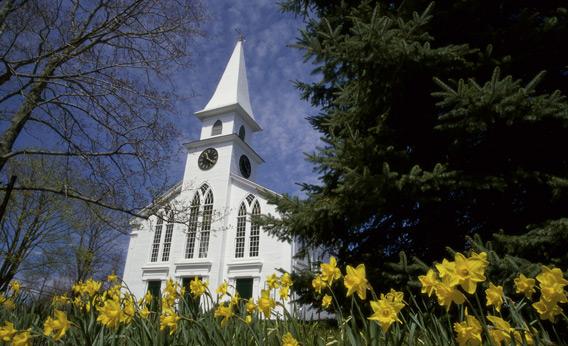
The Northeast is the historic cradle of American Christianity, and just about every postcard-ready town here boasts a white church with a steeple. But sometime between the Second Great Awakening and today, the region evolved into the most secular part of the country. In the words of one regional missions group, “pulpits that once boasted gospel preachers like Jonathan Edwards and George Whitefield now proclaim universalism, liberalism, and postmodernism.” A Gallup poll this year found that the four least-religious states in America are in New England. For evangelicals, the issue is more pointed: Evangelical researcher J.D. Paynehas found that of the five U.S. metro areas with the lowest percentage of evangelicals, New England cities are beat only by Mormon-dominated Provo, Utah. New England is relatively wealthy and educated, and overall, its population is shrinking and aging. That’s why some Christians see New England as “hard soil”—and desperate for re-evangelizing. There’s a palpable sense of momentum growing among evangelicals in New England, who say this hard soil may soon bear fruit thanks to institutional efforts, individual leaders, and an intangible sense of energy often credited to the Holy Spirit. But do they have any hope of success in the most proudly and profoundly secular region in America?

The movement to convert New Englanders looks something like the recent evangelical focus on Western Europe, another traditionally Christian region that is now broadly unchurched. One popular approach is “church planting,” in which a pastor moves to a new location to found a new church that he hopes will eventually spawn several others, and so on. Because the method eventually produces indigenous churches, it’s considered a more reliable and organic path to growth than traditional “outsider” evangelism. To generalize broadly, church-planters tend to be young and Web-savvy, are almost always male (with a supportive wife), and often share a conviction that orthodox theology needn’t be burdened by the trappings of traditional worship. Think overhead projectors, not organs.

Many of New England’s church-planters are sent by denominations based in (or at least biggest in) the South. The North American Mission Board, the Southern Baptist church planting organization that sent Lyandon Warren to Vermont, helps plant about 20 new churches in the Northeast each year, according to Jeff Christopherson, who heads the group’s efforts in Canada and the Northeast. And that’s just one organization. The Northeast has sprouted a remarkable crop of churchplanting organizations and conferences, college campus ministries, and public events like Christian music festivals. Collin Hansen, editorial director of the Gospel Coalition, an influential national church network, recently called these “the best of times for Christians in New England.”

Stephen Um is pastor at Boston’s Citylife Presbyterian Church and a leader in the movement to re-evangelize the region. Born in Seoul but raised and educated mostly in Massachusetts, Um founded his church just over 10 years ago with a base group of 12 people. Citylife now meets in two locations in Boston, including a hotel conference center on Boston Common, and attracts between 700 and 800 people—a highly educated congregation that’s about one-half white and one-half Asian—every Sunday. Um calls what’s happening in New England a “quiet revival.” He speculates that since the drivers of the revival are small churches spread throughout a largely rural area, it doesn’t get the kind of media attention that megachurches attract.

Um is also the founder of the Center for Gospel Culture, which he calls a “catalyzing center” for mobilizing and recruiting Christian leaders in the region. The group hosted a regional conference in October with the Gospel Coalition. The event was designed “to encourage the development of this organic gospel movement.” The 1,200-person-capacity event space he reserved sold out by mid-September. The event drew representatives of about 270 different churches representatives from about 40 networks and denominations.

Um’s rapid success in expanding his own congregation is unusual here. In New England, he estimates, it usually takes a talented pastor 10 years to build a new church of 100 people. By contrast, he says, even an average pastor can plop down in South Carolina or Tennessee and grow from 50 to 300 attendees a year. “But that’s a Christendom culture,” Um says. “You set up shop and people come.” Up north, it’s a “post-church, post-Christian” environment. “You come to Boston and you see all the beautiful historic churches, but from my perspective they don’t preach the gospel.”

Though many pastors are encouraged by the changes they observe, they acknowledge that it’s more difficult to attract people to church in New England than in other parts of the country. Brandon Levering moved to the Boston suburbs from the Midwest to lead an established Evangelical Free Church last year. Levering wrote in a recent blog post for the Gospel Alliance New England (“Promoting Gospel Renewal in New England”): “Many of us came to New England specifically to see the gospel take root in what has become one of the least-reached regions in North America.” He’s happy in his church and says the people here are friendlier than he and his wife had been warned, but overall, “people just don’t seem as interested in the things of faith here.”

Still, some evangelicals are now convinced they have a real chance of long-term success in the most proudly and profoundly secular region of America. Jeffrey Bass, executive director of the Emmanuel Gospel Center in Boston, gave a talk in December to a group of church leaders in which he, like Um, described a “quiet revival” taking place in Boston. Though the population has dipped slightly below its level in 1970, the number of churches has almost doubled, and the number of people attending church has more than tripled in that same period. As evangelist Tom Miyashiro, who leads a youth outreach program that he says reaches up to 4,000 Connecticut school-age kids a year, told me, “I don’t think there’ll be a megachuch in New England anytime soon, like a Joel Osteen-type church. But a lot of leaders are attracted here because of the challenge, and a lot of young people who understand New England will grow up into Christian service. In 20 years, we’ll be dealing with a whole different beast.”

Not all Christians in New England welcome the movement with open arms. Emily Heath is pastor of West Dover Congregational Church in Vermont, which she describes as progressive and egalitarian—just the kind of place that some fear is insufficiently orthodox. Heath says she sees “a growing undercurrent of fundamentalism in New England,” and it bothers her to see her own thriving church characterized as lifeless by local conservatives. “I’ve read that on their websites, and it’s like, Huh, my church feels pretty alive. We’re growing.” On Easter Sunday this year, an evangelical church-planting team from Atlanta opened a new church the next town over.

But confronting wary locals comes with the territory of missionary work. The pastors who have come to New England say they come with a calling of love, service, and, yes, transformation. “This movement is not a political movement,” Um says. “This is happening on an organic, grassroots level from people with a burden for pursuing the common good and loving their neighbor, but still holding onto an orthodox doctrine.”

And after all, the work of spreading the gospel is not new here. The royal charter of the Massachusetts Bay Colony, drafted in 1691, states that this was the very purpose of the colony: “to win and incite the natives of the country to the knowledge and obedience of the only true God and Savior of mankind, and the Christian faith.” As some new New Englanders see it, that’s even more true today. The question is how the natives will respond.