The Tipping Point

My brother visited for a few days and he was reading Malcolm Gladwell‘s newest book – Outliers. He repeatedly spoke of how much he was enjoying it, so I went out and bought a copy for myself. This conjured up in me a desire to review the concepts of his first book — The Tipping Point. Here’s a quote from Outliers jacket cover: “In The Tipping Point Malcolm Gladwell changed the way we understand the world. In Blink he changed the way we think about thinking. Outliers will transform the way we understand success.”

The following is adapted from Business Summaries. To read the whole article click here

The Big Idea
A business and science writer presents a book that is full of brilliant, fascinating and groundbreaking ideas that should affect the way every thinking person sees the world around him, or her. It is a must-read material for educators, parents, marketers, business people and policymakers. It shows how small changes can make a big difference (which brings to mind both Mother Theresa and The Fifth Discipline by Peter Senge).

The book contains an analysis of the strategies people apply to influence and mold its direction. It is a reaffirmation of the potential for change and the power of intelligent action. It is a road map to change, with a profoundly hopeful message — that one imaginative person applying a well-placed lever can move the world, shape, and engineer the course of social epidemics.

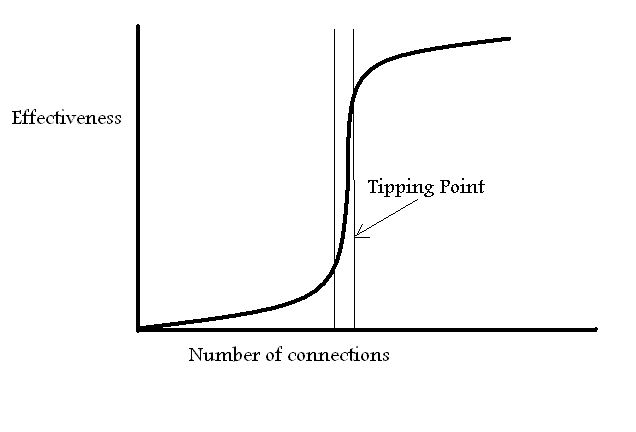
Ideas, products, messages and behaviors spread just like viruses do. These often spread like outbreaks of infectious disease. Just as a single sick person can start an epidemic of flu, so too can a few fare-beaters and graffiti artists fuel a subway crime wave, or a satisfied customer fill the empty tables of a new restaurant. These are social epidemics. The moment they take off, when they reach their critical mass, is the Tipping Point. The Tipping Point is one dramatic moment in an epidemic when everything can change all at once.

The three characteristics of epidemic:

  1. Contagiousness
  2. Little causes can have big effects
  3. Change happens not gradually but at one dramatic moment

All epidemics have Tipping Points. The world of a Tipping Point is a place where the unexpected becomes expected, where radical change is more that possibility.

Epidemics are a function of:

  • The people who transmit infectious agents
  • The infectious agent itself
  • The environment in which the infectious agent is operating

1. The Law of the Few
One critical factor in epidemics is the nature of the messenger. The message itself is something that can be passed on. A pair of shoes, a warning, an infection, a new movie can become highly contagious and tip simply if associated with a particular kind of person.

The Law of the Few suggests that what we think of as inner states – preferences and emotions–are powerfully and imperceptibly influenced by seemingly inconsequential personal influences.

CHAPTER 1: The Three Rules Of Epidemics

2. The Stickiness Factor
In epidemics, the content of the message matters too. Is the message, the food, the movie, or the product memorable?

3. The Power of Context
The Power of Context says that human beings are a lot more sensitive to their environment than they may seem.

Success of any kind of social epidemic is heavily dependent on the involvement of people with a particular and rare set of social gifts. The Law of the Few says that there are exceptional people out there who are capable of starting social epidemics, and can make it tip.

The three kinds of people that control the word-of-mouth epidemics are:

  • Connectors – the social glue, they spread the message
  • Mavens – the databank, they provide the message
  • Salesmen – the select group of people who have the skills to persuade people unconvinced of what they hear

Connectors are people with a special gift for bringing the world together. They link us up to the world – people whom we rely more heavily than we realize. Word-of-mouth epidemics are the work of Connectors.

What makes someone a Connector?

  1. They know lots of people.
  2. Their importance is a function of the kinds of people they know.
  3. People whom all of us can reach in only a few steps because they occupy many different worlds and subcultures and niches. Their ability to span many different worlds is a function of something intrinsic to their personality, some combination of curiosity, self-confidence, sociability, and energy.
  4. They are at the center of events.

CHAPTER 2: The Law of the Few: Connectors, Mavens, and Salesmen endlessly fascinating.

Maven is one who accumulates knowledge and is happy to pass it around. S/he is usually not a persuader.

Mavens are not passive collectors of information. They are not just obsessed with how to get the best deal on a product. What sets them apart is that once they figure out how to get that deal, they will tell you about it. Mavens are persons with on a lot of different products or prices or places. They like to be helpers in the marketplace. They connect people to the marketplace and have the inside scoop. Mavens are socially motivated.

Salesmen are charismatic people that can infect others with their emotions without saying anything and with the briefest of exposures. What makes the Salesmen in our lives so effective?

  • Little things can apparently make as much difference as the big things.
  • Nonverbal cues are more important than verbal cues. How we say things may matter more than what we actually say.
  • Persuasion always works in ways that we do not appreciate.

What makes someone so persuasive?
It’s more than eloquence. It’s more of the subtle, the hidden, and the unspoken. Super-reflex is a fundamental physiological ability. To have a powerful or persuasive personality, one must have the ability to draw others into her rhythms and dictate the terms of the interaction, ability to conduct conversation on his terms, and the ability to create synchrony. Salesmen can build a level of trust and rapport in a much shorter time than most people. (It seems to me that emotionally healthy salesmen will always seek to do what is best for the person or group and not use persuasiveness in self-serving ways.)

CHAPTER 4: The Power of Context (Part One): The Power of Context says that we are more than sensitive to changes in context. And the kinds of contextual changes that are capable of tipping an epidemic are very different than we might ordinarily suspect. For instance, crime is the inevitable result of disorder. The Broken Windows theory says that if a window is broken and left unrepaired, people walking by will conclude that no one cares. In a city, relatively minor problems like graffiti, public disorder, and aggressive panhandling are all the equivalent of broken windows, invitations to more serious crimes.

The impetus to engage in a certain kind of behavior is not coming from a certain kind of person but from a feature of the environment.

Broken Windows theory and the Power of Context are one and the same. They are both based on the premise that an epidemic can be reversed or tipped by tinkering with the smallest details of the immediate environment.

The essence of the Power of Context is that our inner states are the result of our outer circumstances. We need to remember that small changes in context can be just as important in tipping epidemics, even though the fact appears to violate some of our most deeply held assumptions about human nature.

Environmental Tipping Points are things that we can change. We can fix broken windows and clean up graffiti and change the signals that invite crime in the first place. Crime can be more than understood, it can be prevented.

Small, close-knit groups have the power to magnify the epidemic potential of a message or idea.
As human beings, we can only handle so much information at once. We get overwhelmed once we pass a certain boundary. Our intellectual capacity and our ability to process raw information is limited. We clearly have a channel capacity for feelings as well. The most interesting natural limit is our social channel capacity.

The Rule of 150 suggests that the size of a group is one of those subtle contextual factors that can make a big difference. If we want groups to serve as incubators for contagious messages, then we have to keep groups below the 150 Tipping Point. Above that point, there will be structural impediments to the ability of the group to agree and act with one voice. Once the Tipping Point is crossed, group members begin to behave very differently as they become divided and alienated.

It says that congregants of a rapidly expanding church, or the members of a social club, or anyone in a group activity banking on the epidemic spread of shared ideals needs to be particularly cognizant of the perils of bigness. Crossing the 150 line is a small change that can make a big difference.

The kind of bond in small groups is a kind of peer pressure – knowing people well enough that how they see you matters. Peer pressure is much more powerful because it drives people to live up to what is expected of them.

The advantage of adhering to the Rule of 150 is that it provides a mechanism to make the flow of new ideas and information to move around the organization to tip– to go from one person or to the entire group all at once. You can exploit the bonds of memory and peer pressure.
The phenomenal book Secrets of Ya-ya Sisterhood, the widely spread early Christian church, Wesley’s Methodism and Gore Associates have successfully embraced and applied the Rule of 150.

CHAPTER 5: The Power of Context (Part Two): The Magic Number One Hundred and Fifty
Why did Airwalk tip? Airwalk tipped primarily because its advertising was founded very explicitly on the principles of epidemic transmission. The advertising company used dramatic images–single photographs showing the Airwalk user relating to his shoes in some weird way. In one, a young clad girl is holding up a shiny vinyl Airwalk shoe like a mirror and using it to apply lipstick.

The advertising firm Lambesis served as the Connectors, Mavens and Salesmen for
Airwalk. The Connectors, Mavens and Salesmen simply take ideas and information from a highly specialized world and translate them into language the rest of us can understand. They are the translators. To make an idea contagious, they alter it in such a way that extraneous details are dropped and others are exaggerated so that the message itself comes to acquire a deeper meaning.

The most sophisticated analysis of this process of translation comes from the study of rumors, the most contagious of all social messages.

Studies suggest that suicide can be contagious. Suicides lead to more suicides. Suicide stories are a kind of natural advertisement for a particular response to your problems. The death of people in highly publicized suicides give others “permission” to die. This serves as Tipping Point in suicide epidemics.

Tipping Point Lessons

First Lesson
: Starting epidemics requires concentrating resources on a few key areas. The Law of the Few says that Connectors, Mavens and Salesmen are responsible for starting word-of-mouth epidemics.

Second Lesson: The world, as much as we want to, does not accord with our intuition. Those who are successful at creating social epidemics do not just do what they think is right. They deliberately test their intuitions. To make sense of social epidemics, we must first understand that human communication has its own set of very unusual and counterintuitive rules.

Third Lesson: What must underlie successful epidemics is a bedrock belief that change is possible– that people can radically transform their behavior or beliefs in the face of the right kind of impetus. This contradicts some of the most ingrained assumptions we hold about ourselves and each other. We think we are autonomous and inner-directed, that who we are and how we act is something permanently set by our genes and our temperament.

Fourth Lesson: We are actually powerfully influenced by our surroundings as shown by the following examples:

  • Taking the graffiti off the walls of New York subway turned New Yorkers into better citizens.
  • Telling seminarians to hurry turned them into bad citizens.
  • The suicide of a charismatic young Micronesian set off an epidemic of suicides that lasted for a decade.
  • Putting a little gold box in the corner of a Columbia Record Club advertisement suddenly made record buying by mail seem irresistible.

If there is difficulty and volatility in the world of the Tipping Point, there is a large measure of hopefulness as well. Merely by manipulating the size of a group, we can dramatically improve its receptivity to new ideas. By tinkering with the presentation of information, we can significantly improve its stickiness. By finding and reaching those few special people who hold so much social power, we can engineer the course of social epidemics.

The Tipping Point reaffirms the potential for change and the power of intelligent action. The world may seem like an immovable, implacable place, but it is not. With the slightest push in just the right place, it can be tipped.

Adult Formation & Discipleship in the Present Cultural Milieu

Objective: A response to postmodern influence on adulthood and results in churches based on personal reflections on the following three books…

  • Dan Kimball, The Emerging Church. Zondervan, 2003.
  • Eddie Gibbs, ChurchNext. InterVarsity Press, 2000.
  • Robert B. Webber, The Younger Evangelicals. Baker, 2002.

The current cultural milieu includes a growing contingent of postmodern, post-Christian, post-seeker-sensitive (Kimball: 26), postliterate (Gibbs: 124) and post-Constantinian (Webber: 117) followers of Jesus Christ. Webber refers to them as “younger evangelicals,” Gibbs identifies them as “Gen Xers,” and Kimball utilizes the term “emerging generations.” For the sake of continuity I prefer (and will use) Kimball’s term to describe the new movement of leaders and churches affecting the cause of Christ around the world. For me, the term “emerging generations” includes “younger evangelicals” and “Gen Xers,” yet does not limit this movement to a time frame. Furthermore, this essay is divided into three sections, each responding to the questions listed above.

Significant Challenges to Discipleship
The numbers of people with a postmodern perspective are growing. This is evidence that we are entering into “postmodernity,” an as-yet still ill-defined borderland in which central modern values like objectivity, analysis, and control are becoming less compelling. These values are being superseded by postmodern values like mystery, wonder, and authenticity. The implication is that forms of Christianity that have thrived in modernity are unlikely to survive the transition. Gibbs acknowledges the pull of both modernity and postmodernity that tug at churches across the landscape (p. 121). Webber states that a major problem of the (transitional paradigm) market-driven church is that it is so immersed with the culture that it has become enmeshed with it (p. 132) leaving the church without much depth or prophetic punch. Dallas Willard has stated that the greatest need of collective humanity is the renovation of the heart – we have been formed and now we need to be transformed (2002: 14).

Both Webber and Kimball identify many of the significant challenges to discipleship through the use of comparison charts. Kimball’s chart comparing the modern church with the emerging church contains several keys to effective discipleship for the emerging church (p. 215). Discipleship, he writes, is to be holistic and not compartmentalized; discipleship is communal, not individualized; discipleship is more than knowledge and belief, it is active; discipleship is more than education, it is spiritual formation; discipleship is at the center of the mission of the church; and discipleship occurs through experience and participation, instead of presentations and teaching. In my opinion the most compelling insight is that being a disciple means that we are on an evangelistic mission. To be called IS to be sent.

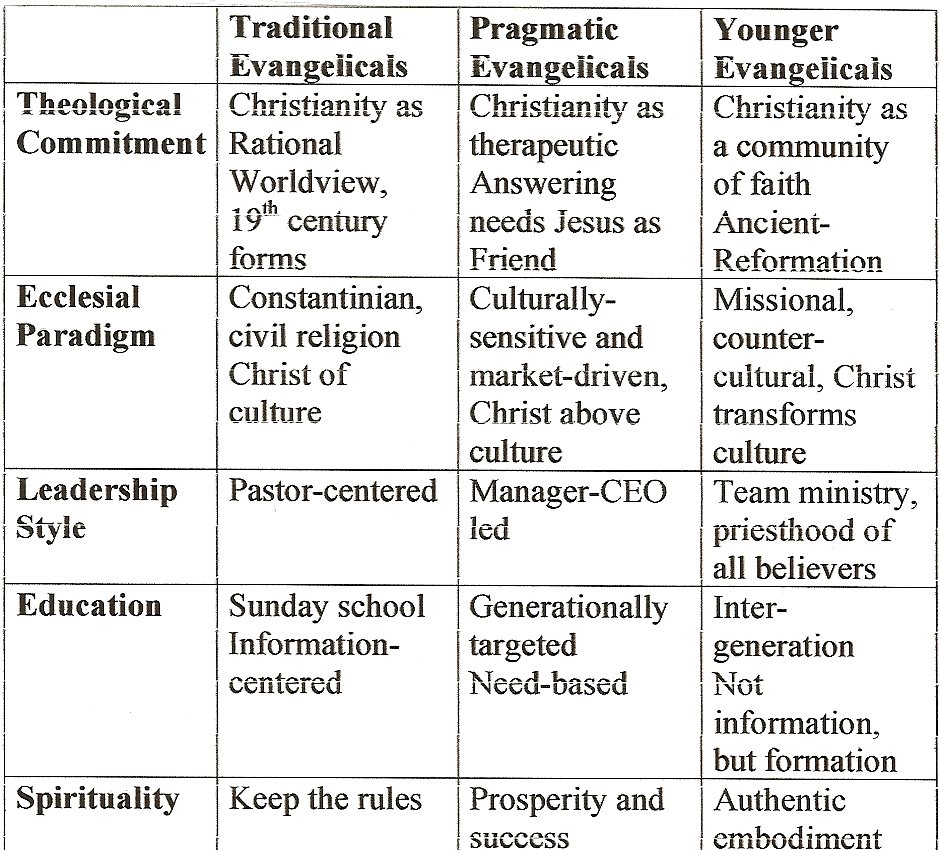
Webber’s taxonomy of evangelical history delineates between three progressive forces within the broader scope of evangelicalism over the last fifty (plus) years and includes “traditional evangelicals” who were the dominant force between 1950 and 1975 (the Billy Graham types), “pragmatic evangelicals” who dominated the last twenty-five years of the twentieth century (the church growth movement types), and the “younger evangelicals” (what Kimball would peg as emerging). Webber describes the “younger evangelicals” as “evangelical in their faith and practice but very different than traditional or pragmatic evangelicals of the twentieth century.” Five of the distinctives caught my attention…

Ministry Affectation

These above challenges affect our ministry of formation and discipleship of adults in some of the following ways:

Theological commitment: The challenge to emerging discipleship is to proactively move theology beyond the head and psyche and into the heart. Gibbs speaks of the relationship between right teaching and authentic experience, stating that biblical theology (in the Ancient-Reformation tradition) looks to the Bible for a pattern of experience followed by proposition (p. 126).

Ecclesial Paradigm: The challenge to emerging discipleship is the shift from being a “come ye” church to becoming a “go ye” church (attractional vs. missional) by envisioning every member to become an active missionary (or evangelist – see above). In both the pre-Constantinian and now post-modern paradigms, the church does not SEND missionaries, nor does it have a missionary “program.” Instead, it IS a mission (Webber: 121).

Leadership Style: The challenge to emerging discipleship is giving up control and allowing accountability to become a two-way street. Needing to be right does not shape the new leadership, according to Webber, nor does meeting needs drive it. Instead, it arises out of (1) a missiological understanding of the church, (2) theological reflection, (3) spiritual formation, and (4) cultural awareness.

Education: The challenge to emerging discipleship is to develop more fluid forms of learning that are distinct from modern business and academic structures and that don’t feel programmed but embrace the mystery, awe, and wonder of God’s transforming work (Kimball: 217). The classroom approach had created a bottleneck of leadership development with several disadvantages: People can only be developed who can come to the classes, people are very busy and it’s hard for them to find both the travel and classroom time, semester or quarter systems means that timing is non-flexible, trainees leave workshops having bonded to the workshop facilitator and not to the leader who will actually mentor them in the church’s real world, the classroom is an artificial environment, and a bottleneck is caused by the limited number of folks one facilitator can work with in a classroom environment. Seacoast Church in Charleston, South Carolina noticed these limitations and developed two significant new breakthrough strategies :

  1. They multiplied those developing leaders by empowering all of their current leaders to develop leaders. So instead of relying on a master facilitator, Seacoast now relies on current leaders to develop protégés up to their own level of leadership.
  2. While relying on this mentor-protégé model, Seacoast marshaled into service the free education program Moodle so that the information-transfer piece of leadership development could be handled online at the convenience of the protégé. At the end of each lesson, each student meets with their coach and sets an expectation of when the next lesson will be completed. Moreover, the coach provides each developing leader with real-life assignments, actual leadership experiences, and spiritual friendship.

Currently Seacoast has transitioned from having one Leadership Developer to having over 600 utilizing this online tool.

Additionally, according to Gibbs, as we transition from modernity to postmodernity the church must focus on saints (not celebrities), in part by replacing pulpiteers with poets and prophets (p. 122). The implication of that statement affects one of our significant challenges – the Bible is not a scientific manual to diced and dissected (about 25% of the Bible’s contents, is poetry ). Poets will bring art, wonder, and imagination back into our gatherings while prophets will bring passion and focus to our distinctive missional call.

Crucial Responses

1. Measure success missionally by looking at what our practices produce as people are sent out into the community to love, care, and serve as Jesus did. The emerging church is more of a mindset than a model (Kimball: 14-15).

2. We must continue to welcome course corrections and the new demand for honesty and accountability (Gibbs: 121).

3. Embrace the reality of the emerging culture’s radical pluralism (Gibbs: 125) in both the sociological and philosophical sense – and work from there. The sociological pluralism reality: there are numerous distinct ethnic, religious, and cultural groups present in the global culture. There is common grace; look for God “in the other.” The philosophical pluralism reality: the belief that truth is composed of many ultimate substances and that no single explanatory system or view of reality can account for all the phenomena of life. This is what Kimball was speaking to regarding Smith’s quote about the great challenge of the preacher being to put up the clothesline (p. 171). The emerging audience no longer has a Judeo-Christian worldview. Today we need to initially engage people by becoming storytellers (p. 172) and through contextualizing the Jesus story as Paul did in Acts 17.

4. Give people an authentic and transcendent spiritual event (Kimball: 26). Prayerfully design and prepare worship services that have the potential to become, “a form of sacred lovemaking, transcending the routinized rituals that so often structure the human-divine communication” (Gibbs quoting Miller: 129). Many emerging churches are including aspects of Catholic and Orthodox spirituality, Lectio divina, Taizé prayer, and Celtic spirituality in their gatherings. Perhaps part of the attraction to the ancient rituals is that they foster a depth and stability that most of the emerging generations never have known?

Modern and postmodern worldviews are ebbing and flowing within our emerging culture – and churches. This will be true of the next several years, if not decades. Church leaders will need to be informed and be able to serve as interpreters among the generations. Postmodernity needs critiquing just as much as modernity. Central to our faith is the claim that the Jesus story may be contextualized for every culture. Moreover, it’s important that we hold onto some aspects of modernity without absolutizing them. We must, I believe, live and be willing to minister in the dynamic tension between the two. In this regard I believe the Church has an amazing opportunity to help shape whatever is coming on the heels of modernity.

A Book Review Unpacking a "Rule of Life"

Living Faith Day by Day: How the Sacred Rules of Monastic Traditions Can Help You Live Spiritually in the Modern World by Debra K. Farrington. (This book review was written by my friend, CRM colleague, and former classmate Jean Gill.)

Living Faith Day by Day is both a basic primer and useful workbook for those seeking to learn more about “rules of life.” The author defines a rule of life as a collection of guidelines, covering all aspects of our lives, which help us keep God at the center of everything that we do (p. 4). She goes on to explain that “a personal rule is a response, first and foremost, to the God who loaves us more than we will ever completely understand. It helps us to make God the focus of every activity and thought in our life” (p. 17).

Farrington begins this very enlightening and practical book by inviting the reader to understand the rich history of rules of living and their application to life today. She also gives some very practical guidelines for creating and practicing rules, including helpful hints such as including joy, play and fun, the need to determine the amount of structure is needed for each person, having accountability, and being realistic in the amount of material to include in the rule if it is to be truly followed. Farrington then spends one chapter each on eight rules that have been commonly used in traditions throughout the ages: seeking God, prayer, work, study, spiritual community, care of our body, reaching out, and hospitality. Each of these chapters begins with an introduction giving some basic thoughts on this subject followed by between four and eight actual rules of life gathered from various traditions with commentary on each rule. Each subsection concludes useful questions that encourage further understanding and practical application.

Responding to proactive questions…

What is at the heart of the practice of sacred rules that has allowed them to remain in use in Christian communities for nearly two millennia?

At the heart of each rule of life is the believer’s desire to seek and love God. “To live a rule is to choose God, and to place God at the center of your world, rather than focus on yourself…We choose to follow a rule because we have chosen God, and living a rule helps us to keep choosing God as the focus of every part of our life” (p. 35). The various rules are simply means by which we make space and priority for God in the various parts of our lives: work, study, or relationships with others. These rules touch at the very heart of the Christian life as they encourage the believer to put into practice what Jesus exhorted us to do: to love God and to love our neighbor. These are simply practical tools that give structure and guidance and allow us to prioritize our lives in such as to honor the commands of Scripture.

What rule or practice did I find most helpful or challenging in my own life?

The chapter on “work” was very stimulating and challenging for me and tied in nicely with some of the important concepts I gleaned from Kenneson’s chapter on “Cultivating Patience in the Midst of Productivity”. Both chapters gave helpful insights that challenged modern culture’s drive to be productive, and the barrier this can be in our own spiritual growth. Farrington began this chapter by quoting a rule of life from the Jerusalem Community, “By choosing to work as hard as possible, but not more than you ought, not primarily in view of a perishable end but one that last forever, you are to stand free and challenging in a world where work has been overrated into a religion and often into a sacred cow…” (p. 89). As a full-time Christian worker who lives in two driven cultures, the US and Japan, I find myself in a continual battle against being seduced by the false allure of productivity. The author gives helpful examples of rules that attempt to counter this continual pull in our modern lives. Especially helpful was the concept that, in our work, we are cooperating with God in His work to redeem the fallen world. She also encourages her readers to be grateful for the gift of work – it is merely a tool, not an end in and of itself. The encouragement to listen carefully to the wisdom of community was also helpful and reminded me that nearly all work is done, to some extent, as part of a group, and all members need to be valued and acknowledged for the role they play. Farrington also encourages her readers to admit our limitations and to remember that our productivity is not a measure of our worth to God.

Were they any recurring themes that carried across these various rules that have important spiritual implications?

In reading Farrington’s book, I observed two key themes that ran throughout the text: that we as believers are to be the presence of God in the lives of others, and that the work God gives us to do on earth is His call for us to partner with Him in redeeming (Farrington uses the term “co-creating”) the world. Both are big-picture concepts that tap into the heart of God in sending Jesus to earth: to be present with man as Immanuel, to redeem man from sin, and to be part of the process of living out the Kingdom of God in this world as we anticipate it’s final restoration when Christ returns.

SUMMARY AND APPLICATION
Debra Farrington’s book has given me a much deeper understanding of and appreciation for the sacred rules that have been handed down through the monastic traditions. Rather than the tendency to think of them as rigid rules to teach self discipline, this text instead reveals the heart of these rules: to help us make space in our lives for God and the things that are important to Him. These rules also give practical guidance in how to more fully know God and to be His presence in the lives of other people.

Farrington’s book can be a very a useful tool in mentoring and coaching ministry leaders. I feel it will have to be used with some caution so that it is not just taken out of context and turned into another avenue to enforce rules and regulations within a Christian community or for an individual believer. The opening chapters that explain the background and key principles of these rules of life are important to understand before attempting to read and apply any of the examples of rules offered by Farrington. Yet I think this will be very useful in aiding leaders in ministry bring proper perspective to the many demands on their lives. It can also help them prioritize their lives in ways that allows them to know God more deeply and be His presence in the lives of the people to whom they minister.

New Normal: Men and Women Together in Ministry

There needs to be a “new normal” when it comes to staff and leadership relationships at MPVCC. As we endeavor to research, think, and pray about an “official” set of guidelines, the following article should help us. The list below has been adapted from an article in Youth Specialties by Kara Hall. Ms. Hall is a youth ministry professor at Azusa Pacific University and coordinates the Women’s Youth Network. She also serves as the research assistant for Youth Specialties and is co-author of the Good Sex: Youth Leader’s Curriculum. She uses Samson’s story as a springboard to create healthy relationships with co-workers of the opposite sex. To read the whole article click here. (FYI note, the author’s last name in the article is different from her last name on the book.)

When it comes to relationships with the opposite gender, we all need others to hold us accountable. We need others to walk around in our lives, pull back the curtains from our hearts and souls, and reveal any sin and confusion that, in the name of leadership, we try so hard to keep hidden.

1. Develop accountability relationships. Prayerfully identify people with whom you can meet regularly. Make a covenant of complete honesty. Give them permission to ask tough questions about any part of your life—from money and sex to workload and prayer. That way, when the time comes, you’ll have a safe place to share any confusing or inappropriate boundaries that are creeping up in your working relationships.

2. Be honest about unhealthy attractions. If you’re married or seriously dating, decide at what point you’ll tell your partner about any unhealthy attractions. Talk ahead of time about what level of disclosure is best for your relationship given who each of you are, how you communicate, and how committed you are.

3. Beware of any environment that smacks of dating. At times, we will need to meet alone with a professional colleague or volunteer staff of the opposite sex. Sometimes colleagues meet in an office (with the door open!), other times at a restaurant or a coffee house. But when meeting, pick Denny’s instead of Chez Romantique, and have breakfast or lunch instead of dinner, and tell your spouse, or accountability partner about it beforehand.

4. Know your colleague’s significant other. If I’m going to be working closely with a man, I try to go on a walk or have lunch with his wife or girlfriend. Instead of being threatening to her, I want her to know that I’m cheering for both her and their relationship.

5. Get a personal life. Last week I was at a Women’s Youth Network meeting with a handful of other women. Some of them started joking about how their ministry schedules prevented them from having a personal life. Ten years ago I would’ve joined right in; today, I’m alarmed. Men and women who are so immersed in ministry that they lack outside lives are prime candidates for inching, or perhaps racing, past emotional boundaries.

Maybe you’ve started to wonder if you’re emotionally enmeshed with someone of the opposite gender. Resist the temptation to let your busyness and routine drown out the question. Start an accountability relationship by seeking out someone to talk to about it this week. The very same grace that allows us to have a relationship with God is the same grace that enables us to have healthy relationships with each other.