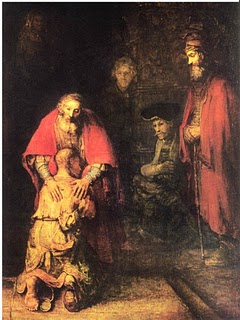
Soul Shift #4 – Our Father In Heaven, Part 1: Healing the Father Wound

SoulShift

“Pray, then, in this way: ‘Our Father who is in heaven…” –Matthew 6:9a

This morning we want to take aim at the concept of the father wound…

As we lean into this season of prayer — and seek to (by God’s grace, mercy, and power) move from ‘ordinary’ prayer to ‘extraordinary’ prayer we must first acknowledge that we tend to view God through the lens of our earthly fathers.  And many people have had difficult relationships with their earthly fathers and, consequently, have great difficulty transitioning to viewing God as a good and loving Father.

If you did not feel safe, protected, affirmed, and secure in your father’s presence, you may spend your entire life looking for a place of comfort and rest.  And some people grow-up without a father in the home – for a variety of reasons.

The National Fatherhood Initiative informs us that, according to the U.S. Census Bureau, 24 million children in America — one out of three — live in biological father-absent homes.  Consequently, there is a “father factor” in nearly all of the social issues facing America today.

Children’s first impressions about men come from their early experiences with their father – or the lack thereof.

The Father/Daughter Relationship forms the daughter’s opinions of what men are — or should be, how they should act, especially towards her, and how she should be with them. The father’s behavior towards women shapes the way she learns to relate to men. If the father withdrew his affection at the time she entered puberty, the wound only goes deeper.

The father is to model how to give and receive affection and tenderness while demonstrating the proper use of strength and power.

Part of the father’s responsibility is to lovingly prepare his daughter for the major shifts that take place as she moves from child to adolescent to young woman and beyond. Unfortunately, many father’s, themselves, had trouble adjusting and many others just weren’t available to teach her to venture out from the protected realm of the home to deal with each new phase and its physical and social adjustments.

The Father/Son Relationship forms the son’s opinions of how he is supposed to act and how he should treat women. Too often, however, the father wasn’t around to present a healthy model for his son. (Remember the Cats In the Cradle lyrics?  It’s a very sad song…)

From Strength in Weakness by Andrew Comiskey — a book about sexual and relational healing…

“Though the [heavenly] Father intended for us to be roused and sharpened by our fathers, we find more often than not that our fathers were silent and distant, more shadow than substance in our lives. This kind of a ‘shadow’ presence is not what our heavenly Father intended for our relationships with our earthly fathers.

The first half of the 20th century really messed up fatherhood – and has impacted succeeding generations.

A Perception of the 20th Century

  • WW I gave way to the “Roaring Twenties” a season of subdued hedonism. (Subdued in comparison to our current hedonistic culture!)
  • The Great Depression followed the Roaring Twenties… 
  • And then WW II followed the Great Depression.
  • If your father or grandfather grew up in the Great Depression it means they never had a chance to have a childhood.
  • Tom Brokaw wrote in his 1998 book The Greatest Generation, “it is, I believe, the greatest generation any society has ever produced.”  He argued that these men and women fought not for fame and recognition, but because it was the right thing to do. When they came back they rebuilt America into a superpower.”  That’s the upside.  There also a downside — an emotional passivity.  The Depression and WW II had inflicted some severe emotional (and spiritual) woundedness.
  • And for those of us who were born after WW II there was an economic and baby boom — and consequently our fathers tended to give us ‘things’ but not themselves.  We must keep in mind our fathers and not been fathered well either.
  • And then there was the ‘60’s and 70’s.  We had legitimate longs and desires, but looked for them in the wrong places.
  • Those first 60-70 years of the 20th century has greatly affected several generations of men – and fatherhood.

I share these things to provide us with some perspective.  You may not have received what you needed from your father – but consider that he probably didn’t either.

So, here we are in the 21st century.  And the whole concept of what constitutes a family, let alone fatherhood has become very twisted and confused.

Men today face the confusing challenge of learning to balance power with sensitivity, strength with feeling, and mind with heart — sometimes all on our own.

Some of us encounter significant difficulty here because we get stuck viewing our heavenly Father through the lens of our earthly fathers.

For some the transition is easy and instantaneous for others it becomes a very difficult and arduous journey.

Regardless of parental devotion, no parent can fulfill all of the child’s wants, needs, or desires.

While these wounds can be inflicted with intent, many are unintentional yet still affect the child throughout life.

Consider Malachi 4 – The Final Chapter of the OT

4:1-6: “For behold, the day is coming, burning like a furnace; and all the arrogant and every evildoer will be chaff; and the day that is coming will set them ablaze,” says the Lord of hosts, “so that it will leave them neither root nor branch.” “But for you who fear My name, the sun of righteousness will rise with healing in its wings; and you will go forth and skip about like calves from the stall. You will tread down the wicked, for they will be ashes under the soles of your feet on the day which I am preparing,” says the Lord of hosts.

“Remember the law of Moses My servant, even the statutes and ordinances which I commanded him in Horeb for all Israel.

“Behold, I am going to send you Elijah the prophet before the coming of the great and terrible day of the Lord. He will restore the hearts of the fathers to their children and the hearts of the children to their fathers, so that I will not come and smite the land with a curse.”

As the Old Testament closes, God makes known that He is not by any means finished with His plan for the world. There is a great day of victory coming and there will be preparations for it so that the people of God will be ready.

That is what we would expect at the end of the Old Testament—a bridge between old and new—a look back at the faithful work of God in the past and a look forward to the final victory.

The Malachi text is the final passage in the Old Covenant.  It is quite significant in that its promise — and warning, frame the very doorway to the New Covenant, the threshold to the coming Messiah.

In verse 6 we see one of the effects of God’s mercy—and an unexpected one at that.

When Elijah preaches, and cries out for people to get ready to meet on the great and terrible day of the Lord, what happens?

Verse 6:

“And he will turn the hearts of fathers to their children and the hearts of children to their fathers, lest I come and smite the land with a curse.”

It implies that the brokenness in this world between children and fathers reflects the brokenness between humanity and God. That is, restoring relationship with the Father is, in fact, the very focus of God’s saving power in this world.

Thus, Jesus came to reconcile humanity to the Father (John 14:8-13). Nowhere in this world is the incentive for that reconciliation more keenly felt than in relationship with our earthly fathers.

The father-wound portrayed in the Malachi text is the difference between what your father has given you (or not given you) and what our heavenly Father God wants to give you. Thus, every person on the planet bears some form of a father wound.

No pain strikes more deeply into a person’s heart than being abandoned emotionally and/or physically by Dad. No pain, therefore, more directly beckons the saving power of God the Father.

A full 400 years after Malachi wrote those words under the inspiration of the Holy Spirit, the New Covenant dawns with the announcement of the birth of the Messiah

In Luke 1:13-17:

The angel said to him, “Do not be afraid, Zacharias, for your petition has been heard, and your wife Elizabeth will bear you a son, and you will give him the name John…. 17 It is he who will go as a forerunner before Him in the spirit and power of Elijah, to turn the hearts of the fathers back to the children, and the disobedient to the attitude of the righteous, so as to make ready a people prepared for the Lord.”

There is evidence in other parts of the NT that John the Baptist is not the final, or only, “spirit and power of Elijah”…

John the Baptist may be a forerunner to an “Elijah Company,” and Elijah ‘task-force,’ if you will — of men being raised up to walk in and to impart the Father’s love to a generation that is longing for significance and purpose in life.

The pattern of distant unavailable father’s has been repeated throughout the 20th century.

It’s not about trying to BE their fathers or mothers, it’s about being able to introduce them to “our Father in heaven” (and heaven, by the way is more of a perspective than a zip-code – more about that next week).

Defining the Father’s Love

The four Greek words for ‘love’…

  • STORGE – family (instinctual) love
  • PHILEO – brotherly/sisterly (friendship) love (tender affection)
  • EROS – Romantic or erotic love
  • AGAPE – Unconditional or sacrificial love

“But God demonstrates his own love [AGAPE] for us in this:  While we were still sinners, Christ died for us.”   Romans 5:8 (NIV)

We generally focus on AGAPE when defining the Father’s love in a theological sense.

His unconditional love and on the cross concern for us is demonstrated in Christ’s death for us (Rom. 5:8).

This foundational truth is assumed to be common knowledge among most Christians but that is not the primary focus today…

Let’s now consider God’s PHILEO love:

John 5:20: “For the Father loves [PHILEO] the Son and shows Him all he does.”

In attempting to define the Father’s love in a more experiential sense we can focus on His PHILEO – His demonstrated tender affection for us.  The PHILEO of the Father for the Son is described above in John 5:20.

The ministry of Jesus apparently flowed out of a continual experience of His Father’s PHILEO love.  Within the intimacy of this relationship, Jesus could sense His Father’s presence and hear His Father’s voice, thus perceiving what the Father was saying and doing.

John 16:27: (Jesus) “…The Father himself loves [PHILEO] you because you have loved [PHILEO] me and believed that I came from God.” (NIV)

The PHILEO love of the Father for believers is described in John 16:27 (see above).  Our communication with God apparently is to flow out of our continual experience of our Father’s PHILEO for us.

Whereas AGAPE focuses on a truth about God, PHILEO seems to focus more on the touch from God.  This touch of love is missing from many Christian’s lives.

The “Abba” Cry/Longing

Romans 8:15: “For you did not receive a spirit that makes you a slave again to fear, but you received the Spirit of sonship.  And by him we cry, ‘Abba, Father.'”

Galatians 4:6: “Because you are sons, God sent the Spirit of his Son into our hearts, the Spirit who calls out, ‘Abba, Father.'”

  • According to Jewish rabbinical teachings, slaves were forbidden to address the head of the family by the affectionate title, “Abba.”
  • “Abba” approximates “papa” or “daddy” and implies unwavering trust.
  • “Father” expresses intelligent comprehension of the relationship.
  • Together the two reveal the trusting love and intelligent confidence of a secure son or daughter.

The chief activity of the Holy Spirit is to:

  • Draw us into a vital relationship with the Father.  Our “Abba Father” is not only the source of everything in both creation and redemption, He is also the goal of everything.
  • Prompt in us the “Abba” cry/longing; which is first and foremost the basis of our worship.

Luke 15:11-31 – This parable of the prodigal sons confronts our false assumptions about what pleases God.

11Jesus continued: “There was a man who had two sons. 12The younger one said to his father, ‘Father, give me my share of the estate.’ So he divided his property between them.

13″Not long after that, the younger son got together all he had, set off for a distant country and there squandered his wealth in wild living. 14After he had spent everything, there was a severe famine in that whole country, and he began to be in need. 15So he went and hired himself out to a citizen of that country, who sent him to his fields to feed pigs. 16He longed to fill his stomach with the pods that the pigs were eating, but no one gave him anything.

17″When he came to his senses, he said, ‘How many of my father’s hired men have food to spare, and here I am starving to death! 18I will set out and go back to my father and say to him: Father, I have sinned against heaven and against you. 19I am no longer worthy to be called your son; make me like one of your hired men.’ 20So he got up and went to his father.

“But while he was still a long way off, his father saw him and was filled with compassion for him; he ran to his son, threw his arms around him and kissed him.

21″The son said to him, ‘Father, I have sinned against heaven and against you. I am no longer worthy to be called your son.’

22″But the father said to his servants, ‘Quick! Bring the best robe and put it on him. Put a ring on his finger and sandals on his feet. 23Bring the fattened calf and kill it. Let’s have a feast and celebrate. 24For this son of mine was dead and is alive again; he was lost and is found.’ So they began to celebrate.

25″Meanwhile, the older son was in the field. When he came near the house, he heard music and dancing. 26So he called one of the servants and asked him what was going on. 27’Your brother has come,’ he replied, ‘and your father has killed the fattened calf because he has him back safe and sound.’

28″The older brother became angry and refused to go in. So his father went out and pleaded with him. 29But he answered his father, ‘Look! All these years I’ve been slaving for you and never disobeyed your orders. Yet you never gave me even a young goat so I could celebrate with my friends. 30But when this son of yours who has squandered your property with prostitutes comes home, you kill the fattened calf for him!’

31″ ‘My son,’ the father said, ‘you are always with me, and everything I have is yours. 32But we had to celebrate and be glad, because this brother of yours was dead and is alive again; he was lost and is found.’ “

Healing the Father Wound 

1.  Surrender to the Father’s initiating love.

    • The father moves toward both sons… in order to express his love and bring them in.
    • It’s not repentance that causes the father’s love – but the reverse.  It’s surrendering to the father’s love that brings about repentance.

2.  Refuse to be emotionally passive.  (This was primarily the sin of the older brother, but the traveling prodigal was also willing to resign himself to this.)

    • Emotional Passivity is repressed, self-imposed oppression of emotions based on an unmet longing for acceptance – usually from our fathers.  This repression, or self-imposed oppression, generates anger that if allowed to turn inward will eventually express itself as either chronic depression, or passive-aggressive behavior.
    • Awakening the passive soul begins with confessing the sin of deadening our soul and making conscious choices to (go ahead and) feel the sadness, the grief, the sorrow — and ultimately the joy. (We have learned some of the principles of healthy grief and loss as we have sought to integrate emotional health into our discipleship process.)
      • Sadness opens the heart to what was meant to be and is not. 
      • Grief opens the heart to what was not meant to be and is. 
      • Sorrow breaks the heart as it exposes the damage we’ve done to others as a result of our unwillingness to wildly pursue God’s grace and truth.

3.  Refuse to mistrust.

    • Reengages the God-given desire to be concerned about the temporal and eternal destiny of those who have harmed us.  This transfers trust to God and releases us to care, to be kind, and to authentically comfort others.
    • It is not being gullible or stupid – “be wise as serpents and harmless as doves” (Mat. 10:16).
    • To care is to use all that we are for the good of others while not walling off the deep parts of our soul.
    • The process towards deep caring begins with admitting there is sadness.
    • Grief admits there are scars that can be removed only in heaven.
    • Godly sorrow begins to develop when we begin to see that our demand for God to prove He cares is a mockery of the Cross (which sufficient proof of His trustworthiness).

4.  Refuse to deny holy passion.

    • Passion can be defined as the deep response of the soul to life:  the freedom to rejoice and the freedom to weep.
    • A refusal to deny, or despise, passion embraces both pain and pleasure.
    • A fear of passion makes it nearly impossible to be fully present with other people.
    • It’s refusing to flee back into the numbing – whatever that is
    • It is admitting that while I may be a mess, I AM ALIVE — and there is hope!

The Upside Down Life (#1) – An Indepth Look At Matthew 5:1-16

The Way In Is the Way On.  An Overview of the Beatitudes…

I. INTRO

I have been serving here at SBF for 11 months now – and I can tell you that everything we have been studying up to this point has been preparing us for the study we are about to embark on…

We will take our time and work through the first 16 verses of Mathew 5.  These are also the first 16 verses of the most famous sermon of all time – The Sermon on the Mount (SOTM), which consist of chapters 5-7.  They are all red-letter verses, in other words these are the words of Jesus.

Here’s what John Stott the late pastor, author, and missiologist has said about the SOTM:

“The Sermon on the Mount is probably the best-known part of the teaching of Jesus, though arguably it is the least understood, and certainly it is the least obeyed. It is the nearest thing to a manifesto that he ever uttered, for it is his own description of what he wanted his followers to be and to do.”[1]

Now, reading the SOTM only takes about 10 minutes so it’s widely thought that Matthew is giving us the “Cliff Notes” version (i.e., highlights).

We need to make some theological distinctions as we lean into the Beatitudes and the SOTM…

Some of the theological roots of SBF include what’s known as a dispensational[2] view of the Bible.

Dispensationalists and most of the rest of Evangelicalism would differ on the interpretation and application of the Beatitudes (and the SOTM).

Classical dispensationalism would argue that the Beatitudes (and the SOTM) are not gospel but pertain to life in the millennial kingdom after to the second coming of Christ.[3] (If you have a Scofield Study Bible – that would emphasize the classical view of dispensationalism.)

It should be noted that there are more moderate views of dispensationalism.  If you have a Ryrie Study Bible – he’s a more moderate dispensationalist.  Yet he would still believe that primary fulfillment of the Beatitudes (and the SOTM) are in the millennial kingdom.[4] (Popular contemporary dispensationalists include John MacArthur and Charles Swindoll.  I have also heard that John MacArthur has become more moderate in his dispensationalism, but I don’t have first hand knowledge of that.  Charles Swindoll would also be considered a more moderate dispensationalist.)

The basic evangelical approach is to recognize that the kingdom of God has come in the person and work of Jesus. (Mk 1:15: “kingdom of God is at hand; repent and believe in the gospel). This “kingdom now” theological perspective teaches that Jesus established the kingdom of God (KOG) at His first coming and will consummate the KOG at His second coming – and we live in the age (or dispensation) between the two.  One theologian, George Ladd, has said we live in the presence of the future – between the already and the not yet.[5]

So, how will this affect our study of the Beatitudes?  I believe the Beatitudes (and the SOTM) ARE for today – and that they are the means to allowing the gospel to be worked into our lives – and then through our lives to others.

Here’s how I would say it: “The Gospel is not advice, it is news.”  (Jared Wilson, Gospel Wakefulness, Crossway 2011: 188.)  It is the ultimate Good News.  I would suggest to you that Sunday Services are not primarily the place to give advice… Gospel-centered (or Christ centered) change (i.e., sanctification) is rooted first and foremost in remembrance. We are to remind one another primarily of what Christ Jesus has done, not what we must do.

We cannot commend what we do not cherish.  -John Piper

And the essence of Christian maturity is when the Gospel – or, what Christ has done — gets worked IN – and then THROUGH our lives – which is what I’d like to spend our remaining time considering – and this will be the main intent of our series.

Today we will take a look at the Beatitudes.  Allow me to offer a few introductory thoughts.

II. BODY

Contained in the Beatitudes are eight qualities that characterize the life of Jesus Christ, and therefore, through conversion, they begin to characterize our life in Jesus Christ.  Jesus calls us to follow him, surrender to Him, and to depend upon His strength and power.

The word beatitude comes from the Latin word meaning “blessed.”

More specifically the word means exalted joy, or true happiness. (Joy is not always exuberant, but can also be described as calm delight in even the most adverse circumstances.  Joy fueled Paul’s contentmentPhil 4:11.)

With the beatitudes, Jesus dives into our innermost being probing the heart and raising the question of motive.  (This is why, at face value, it’s harder to be a Christian than Jewish…)

What made Jesus a threat to everyone and the reason He was eventually killed was that in His encounters with people (particularly the religious leaders), He exposes what they were on the inside.  Some people find it liberating – others hate it.  (Mat 23:27: hypocrites and whitewashed tombs.)

The Beatitudes, I have come to see, is our surrendered response to the Gospel.  I see the Beatitudes as a step-by-step spiritual formation process that moves us toward spiritual depth and maturity.  This becomes cyclical as we grow deeper and deeper in our faith.  The Beatitudes become the outworking of the Gospel IN and THROUGH our lives.

1. Blessed are the poor in spirit…

“You’re blessed when you’re at the end of your rope.  With less of you there is more of God and his rule.” (Petersen – MSG)

Another translation renders this verse, “Happy are those who know their need for God.” (JBP)

What does it mean to be “poor in spirit”?  A desperateness of soul that is weary of living in it’s own strength and longs for God’s mercy and grace to come and refresh the soul.  In a word, it is DESPERATION.

Prodigal Sons (Lk 15:11-32) The younger prodigal came to the end of himself (v.17) and though he had no idea of the Father’s love, made his way home.

In the recovery movement this would be similar to steps 1 & 2:

  • Step 1 – We admitted we were powerless over our addiction – that our lives had become unmanageable.
  • Step 2 – Came to believe that a Power greater than ourselves could restore us to sanity.

2. Blessed are those who mourn…

I have a river of sin in my life – with 3 primary tributaries…

  1. Original sin (Adam & Eve traded the presence of God for the knowledge of God – and that’s been our core tendency ever since…).
  2. Family of origin issues. (We all have negative traits and generational sin patterns that we bring into our Christian experience.  Are you in touch with yours?)
  3. My own dumb choices.

As we are honest about the sin that has infected us there will be a transforming grief and accompanying repentance, that surfaces – not only for our own lives, but also for the injustice, greed, lust, and suffering that grips our world.

I want to own my sin everyday.[6]

This is where the upside down life comes into play.  The Beatitudes are counterintuitive (paradox: seeming contradiction).  We go down to go up; death precedes resurrection; we get to joy by traveling through grief.  Our soul wants to find a way around grief, but God says, “No, you must travel through grief – and the good news is, He says, “I’ll go with you and we will do it in My strength and power.”

The way of the Gospel is a death and resurrection cycle…

**The gospel has the greatest potential to captivate us when we understand that we are more depraved than we ever realized and simultaneously more loved that we ever dared to imagine.

3. Blessed are the meek…

Rick Warren would say, “Meekness is not weakness, but the power of your potential under Christ’s control.”  The concept of meekness describes a horse that has been broken.  We can either surrender to Christ and invite His breaking, or remain the undisciplined and wild stallion.

Grieving over sin and suffering grows meekness in us and delivers us into a humble learning posture (disciple means learner).

4. Blessed are those who hunger and thirst for righteousness…Spiritual hunger and thirst is the growing desire to be empty of those things that don’t reflect God, and initiates a deep longing for wholeness in our lives.

5. Blessed are the merciful…

Mercy is entering into another persons feelings – attempting to see things from another person’s perspective – all with understanding AND acceptance…just like Jesus has done for us.

As we receive God’s mercy we begin to give mercy – to ourselves and to others.

6. Blessed are the pure in heart… Mercy cleanses our heart and restores purity to our lives.

Did you know that your virginity CAN be restored?

2 Cor 11:2For I am jealous for you with a godly jealousy; for I betrothed you to one husband, so that to Christ I might present you as a pure virgin.

7. Blessed are the peacemakers…

Purity gives way to a personal serenity and peacefulness.  Peace is not the absence of conflict, but the absence of anxiety in the midst of inevitable conflict – and when others encounter it, they want it too.

Our Western concept of peace needs to be considered in the light of the ancient Hebrew concept of peace, which is SHALOM — and means more than our limited understanding of peace (i.e., the lack of conflict).

Biblical SHALOM means a universal flourishing, wholeness and delight; a rich state of affairs in which natural needs are satisfied, natural gifts are fruitfully employed — all under the arc of God’s love. Shalom is the way things ought to be.

Neal Plantinga – “the webbing together of God, humans, and all creation in equity, fulfillment, and delight.”

I will also say there is a difference between a peacemaker and a peacekeeper.

To be a peacemaker does not mean peace at any cost.  Peacekeeping creates a false peace.  Many of us live out our lives with this false peace and say nothing or do nothing to change it—in churches, homes, work places, marriages.

Examples:

  • Someone makes inappropriate sexual comments to you at work.  You know its not accidental because its repetitive and degrading.  But you keep your mouth shut because you know they’ll threaten your job or make you miserable if you say anything.
  • A family member makes a scene at a family gathering.  It embarrasses you, the rest of the family, but you say nothing.  You keep the peace because to go there would unearth a lot of stuff that you just aren’t willing to deal with.
  • Your spouse makes insulting remarks to you or humiliates you publicly through critical tone of voice.  It grates on you.  But you keep silent because you want to keep the peace.

8. Blessed are the persecuted… Living life from a kingdom of God perspective will place us in conflict with those that oppose it (usually it’s “religious,” moralistic people!).

III. CONCLUSION

Without the knowledge of our extreme sin, the payment of the Cross seems trivial and does not electrify or transform.  But without the knowledge of Christ’s completely satisfying life and death, the knowledge of sin would crush us – or move us to deny and repress it.

By walking the way of the Beatitudes we hold our depravity and the Cross in a healthy and dynamic tension that will lead to transformation and renewal.


[1] The Message of the Sermon on the Mount, InterVarsity Press, 1978:15.

[2] Dispensationalism is a theological system that teaches biblical history is best understood in light of a number of successive administrations (dispensations) of God’s dealings with humankind. It maintains fundamental distinctions between God’s plans for national Israel and for the New Testament Church, and emphasizes prophecy of the end-times and a pre-tribulation rapture of the church prior to Christ’s Second Coming.

[3] As one dispensationalist put it, “this Sermon cannot be taken in its plain import and be applied to Christians universally…It has been tried in spots, but…it has always been like planting a beautiful flower in stony ground or in a dry and withering atmosphere” (I. M. Haldeman, The Kingdom of God, p. 149).

[4] The moderate dispensationalist [still] views the primary fulfillment of the Sermon and the full following of its laws as applicable to the Messianic kingdom” (Dispensationalism Today, 107-08).

[5] A good primer on this alternative to dispensationalism view would be the “The Gospel of the Kingdom” by George Ladd.

[6] “None is righteous, no, not one.” Romans 3:10 (ESV)
And you were dead in the trespasses and sins in which you once walked, following the course of this world, following the prince of the power of the air, the spirit that is now at work in the sons of disobedience.” Eph 2:1-2 (ESV)

HECED – An Important Biblical Concept

God’s Lovingkindness I will betroth you to Me in…lovingkindness (Hosea 2:19c)

“How precious is Your lovingkindness, O God! And the sons of men take refuge under the shadow of Your wing.” –Psalm 37:6

When all the forces of hell seem to be raging about you — in your body, heart, or mind— when you can’t trust in your own ability to keep yourself securely tucked away under his wings, remember: no one and nothing is able to pry his hand open or keep his betrothed from his love. We persevere because of God’s invincible love.[1]

“Because thy lovingkindness is better than life, my lips shall praise thee.” —Psalm 63:3

Hosea saw the relationship between God and Israel as that of a husband[2] with the attendant attributes of commitment, righteousness, justice, lovingkindness, compassion, and faithfulness. Through this enacted prophecy Hosea learned that at the core of the covenant is God’s profound love for his people. God seeks a response of surrender that will lead to a deep and abiding intimacy with God.

Lovingkindness — HESED (Hebrew)

That God acts in hesed (or sometimes spelled checed) has been described as the “classic message of Hosea.”[3]

Hesed occurs 176 times in the Old Testament from Gen 19:19 – Jonah 4:2, 121 times in the Psalms (or 70%). The most significant feature of this term is that God gives hesed to us in absolute freedom. Whether it’s God or people acting in lovingkindness, hesed is given of the “helper’s” own free will. Additionally, hesed always argues for loyalty of love.[4]

Hesed can be difficult to translate into English because embedded in it’s meaning is the unbreakable covenant bond that God initiates with his people.

A good, working definition of hesed is: the covenant, consistent, relentless, pursuing, lavish, extravagant, unrestrained, loyal, and one-way love of God.

The promises God makes are not conditional. God is NOT saying, “If you do this, then I will do that.” There are no “if’s” in these promises of God. There are no time limits, no cancellation clauses.

And so, while hesed has the feelings of love, kindness, mercy, and affection it is defined primarily by the unconditional steadfast, loyal, and trustworthiness of God’s covenant with his people.

In the Old Testament, God’s anger and wrath is expressed within the constraint of the unbreakable covenant bond, and is for the purpose of restoring the mutuality of that bond.  While God’s covenant bond is unbreakable and unconditional, it is not an “anything goes” relationship. It is a bond that has a purpose: so that we will be a blessing.  And the nature of this blessing is justice: right relationships with all – as well as harmony and well-being for all (SHALOM).

Pastor and author Rob Bell has an interesting take on God’s wrath.[5] He says the problem we face is not that God is angry with us, but that we think God is angry with us. Thus, Jesus’ purpose wasn’t to change God’s mind about us, but to change our mind about God: to notify us of God’s lack of anger[6] and to free us from the prison of our misconceptions so that we can truly live well. The place of church and religious ritual is to remind us of our standing with God and freedom to live lives of sacrifice and service.  What do YOU think?


[1] Elyse Fitzpatrick, A Steadfast Heart, P&R 2006: 77.

[2] Norman D. Snaith, Mercy and Sacrifice. A Study of the Book of Hosea, SCM Press, 1953: 40, 52.

[3] Van Gemeren, Willem, A. Interpreting the Prophetic Word, Acadamie 1990: 114.

[4] Harris, Archer, & Waltke, 1980.

[5] Rob Bell, “the god’s aren’t angry” Tour, 2007.

[6] Bell would say that God’s wrath is more about passion than anger.

The Fruit of Repentance

Produce fruit in keeping with repentance.  –Matthew 3:8

…They should repent and turn to God, performing deeds in keeping with their repentance. –Acts 26:20

Repentance is a decisive reorientation of one’s life away from self and toward God. Commenting on Matthew 3:8 John Calvin writes, “Repentance is an inward matter, which has its seat in the heart and soul, but afterwards yields its fruits in a change of life.”[1]

When John the Baptist told the Jewish people that they must bring forth fruit in keeping with repentance, what did he mean?

There are three additional questions that will help to understand what the Bible means by fruit:

1.     What is repentance?

a)     The Greek verb that is translated repent in the New Testament is metanoia. The word literally means to think after. It suggests the idea of thoughtful reflection regarding a deed after the commission of it. In the case of a sinful action, the idea would be a retrospection of the act and the subsequent feeling of godly sorrow that leads to repentance (see 2 Cor 7:9-10).

b)    Thomas Watson, an English Puritan (ca. 1620-1686) said, “Repentance is a grace of God’s Spirit whereby a sinner is inwardly humbled and visibly reformed.”[2]

c)     Repentance involves a God-initiated resolve to acknowledge the wrongful conduct and surrender ourselves to the empowering grace of God, which alone will accomplish in us and through us what we have never been able to accomplish on our own.

d)    Dan Allender, a contemporary Christian educator and author, writes that repentance is “an about face movement from denial and rebellion to truth and surrender…[that] involves the response of humble hunger, bold movement, and wild celebration when faced with the reality of our fallen state and the grace of God…It is a shift in perspective as to where life is found…It is melting into the warm arms of God, received when it would be so understandable to be spurned.”[3]

e)     Paul writes that, godly sorrow leads to repentance (2 Corinthians 7:10). The repentance of this text is life reformation, not mere grief over the act.

2.     What is the significance of the expression, in keeping with repentance? (NKJ: worthy of; AMP: consistent with.)

a)     The expression in keeping with is the Greek word axios and originally had to do with objects that were of equal weight, i.e., one item corresponds to another in weight. The metaphorical use in the NT may be employed regarding actions — either good or bad.

b)    The change of life that is characteristic of repentance must correspond to the gravity and nature of the offence. Otherwise, it is not biblical repentance.

3.     What is implied by the phrase, produce fruit?

a)     The Greek word for fruit is karpos and means “the visible expression of [God’s] power working inwardly and invisibly, [and] the character of the fruit being evidence of the character of the power producing it (see Mat 7:16). Just as the visible expressions of hidden lusts are the works of the flesh, so the invisible power of the Holy Spirit in those who are brought into [a] living union with Christ (see Jn 15:2-8, 16) produces ‘the fruit of the Spirit’ (Gal 5:22).”[4]

b)    In addition to the fruit of the Spirit what does it mean to produce the fruit of repentance? Here are a some signs of fruit that will typically be found in a truly repentant person[5]:

i)      Repentant people are willing to confess all their sins, not just the sins that got them in trouble. A house isn’t truly clean until we open every closet and sweep every corner. People who truly desire to be clean are completely honest about their lives. No more secrets. Christian psychologist and author Larry Crabb defines integrity as pretending about nothing.[6]

ii)    Repentant people face the pain that their sin caused others. They invite the victims of their sin (anyone hurt by their actions) to express the intensity of emotions that they feel — anger, hurt, sorrow, and disappointment. Repentant people do not give excuses or shift blame. They made the choice to hurt others, and they take full responsibility for their behavior.

iii)   Repentant people ask forgiveness from those they hurt. They realize that they can never completely “pay off” the debt they owe their victims. Repentant people don’t pressure others to say, “I forgive you.” Forgiveness is a journey, and people need time to deal with the hurt before they can forgive. All that penitent people can do is admit their indebtedness and humbly request the undeserved gift of forgiveness.

iv)   Repentant people remain accountable to a small group of mature Christians. They gather a group of friends around themselves who hold them accountable to a plan for honest living. They invite the group to question them about their behaviors.

v)    Repentant people accept their limitations. They realize that the consequences of their sin (including the distrust) will last a long time, perhaps the rest of their lives. They understand that they may never enjoy the same freedom that other people enjoy. Adulterers, for example, would be wise to place strict limitations on their time with members of the opposite sex. That’s the reality of their situation, and they willingly accept their boundaries.

vi)   Repentant people are faithful to the daily tasks God has given them. We serve a merciful God who delights in giving second chances. God offers repentant people a restored relationship with him and a new plan for life. Consider Hosea’s promise to rebellious Israel:

Come, let us return to the Lord. He has torn us to pieces but he will heal us; he has injured us but he will bind up our wounds. After two days he will revive us; on the third day he will restore us, that we may live in his presence. (Hosea 6:1-2)

The conscientious student of the Bible is led to conclude that any repentance, without the full compliment of the elements that define that term, is simply not a biblical repentance.


[1] John Calvin, Commentary on Matthew, Mark, & Luke, Vol 1.

[2] Thomas Watson, The Doctrine of Repentance, Banner of Truth, 1999: 18.

[3] Dan Allender, The Wounded Heart, Navpress, 1990: 217.

[4] W. E. Vine, Vine’s Expository Dictionary of New Testament Words, Vol 2, Revell 1940: 143.

[5] Adapted from the article Six Signs of Genuine Repentance by Bryce Klabunde.

[6] Larry Crabb, Finding God, Zondervan 1993: 16.