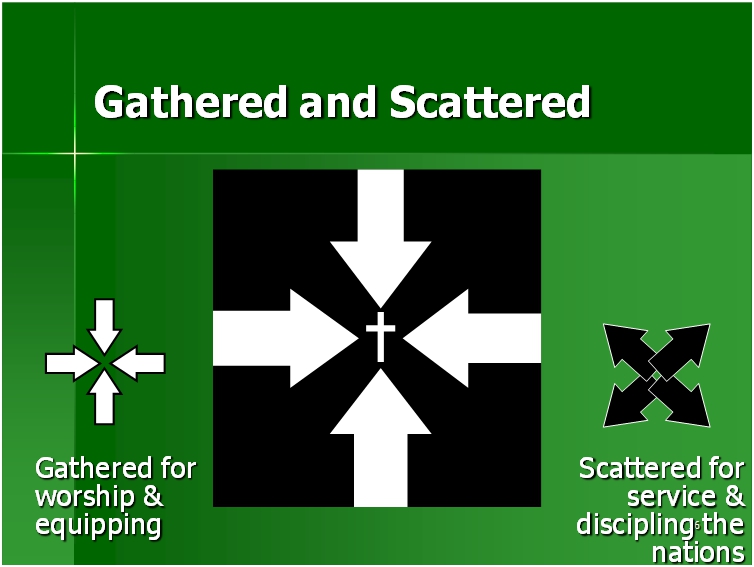
The Church Gathered and the Church Scattered

2 Corinthians 5:18-21

18 Now all these things are from God, who reconciled[1] [to settle accounts – as in a bank statement] us to Himself through Christ [who paid our debt – the cross is where God’s justice and God’s mercy kiss] and gave us the ministry of reconciliation, 19 namely, that God was in Christ reconciling the world to Himself, not counting their trespasses against them, and He has committed to us the word [logos, or doctrine] of reconciliation.

20 Therefore, we are ambassadors [diplomats, emissaries, representatives] for Christ, as though God were making an appeal through us [sometimes the best way to “preach” to someone is to listen to them]; we beg you on behalf of Christ, be reconciled to God. 21 He made Him who knew no sin to be sin on our behalf, so that we might become the righteousness of God in Him [THAT is the gospel – Jesus lived the life we should have lived and died the death we should have died. We don’t live in our own strength – we live IN Him – or His strength].

Did you know that there are currently 38,000 Pro-test-ant[2] denominations?  Catholics have multiple orders (Dominicans, Franciscans, Jesuits, etc.), but have managed to stay under the umbrella of Rome.

I. INTRO

I’d like to speak with you today about the Church GATHERED and the Church SCATTERED.  First, the nerdy Stuff…

  • Ecclesia (Latin) Greek – κκλησί, meaning “congregation” or “church.” The literal translation is “called out ones.”
  • Ecclesiology – Refers to the theological study of the Christian Church.

1. Who is the Church? (Not What…?) It is the body of all believing, or confessing, Christians.  SBF is a unique expression of the larger Body of Christ.

2. What is the authority of the Church?

  • Jesus is the head of the body, the Church (Col 1:18)
  • Jesus is the Senior Pastor. 1 Peter 5:4 identifies Jesus as the “Chief Shepherd.” [A church in transition shouldn’t get a pastor until they don’t really need one.]
  • The Bible is our highest and final authority. Sola Scriptura, not solo Scriptura.

3. What is the relationship between a believer and the Church? As believers we are to submit ourselves to Jesus – the Head and Chief Shepherd of the Church.  There are three overlapping commitments that make up a healthy and vibrant church experience:

  • Celebration (Worship)
  • Congregation (Identity needs met) Acts 2:42-47

42 “They were continually devoting themselves to the apostles’ teaching and to fellowship, to the breaking of bread and to prayer. 43 Everyone kept feeling a sense of awe; and many wonders and signs were taking place through the apostles. 44 And all those who had believed were together and had all things in common; 45 and they began selling their property and possessions and were sharing them with all, as anyone might have need. 46 Day by day continuing with one mind in the temple, and breaking bread from house to house, they were taking their meals together with gladness and sincerity of heart, 47 praising God and having favor with all the people. And the Lord was adding to their number day by day those who were being saved.”

  • Cell (Intimacy and accountability needs met)

James 5:16: Confess your sins to one another, and pray for one another so that you may be healed.”

4. How should the Church be governed?

8 Therefore it says, “WHEN HE ASCENDED ON HIGH,
HE LED CAPTIVE A HOST OF CAPTIVES,
AND HE GAVE GIFTS TO MEN.”  9 (Now this expression, “He ascended,” what does it mean except that He also had descended into the lower parts of the earth? 10 He who descended is Himself also He who ascended far above all the heavens, so that He might fill all things.) 11 And He gave some as apostles, and some as prophets, and some as evangelists, and some as pastors and teachers [also add elders and deacons], 12 for the equipping of the saints for the work of service, to the building up of the body of Christ; 13 until we all attain to the unity of the faith, and of the knowledge of the Son of God, to a mature man, to the measure of the stature which belongs to the fullness of Christ. 14 As a result, we are no longer to be children, tossed here and there by waves and carried about by every wind of doctrine, by the trickery of men, by craftiness in deceitful scheming; 15 but speaking the truth in love, we are to grow up in all aspects into Him who is the head, even Christ,

5. What does the Church do?  The church exists in two modes:

  • We gather for worship.
  • We scatter for mission.

II. BODY

We will now take a deeper look at what it means to gather for worship and scatter for mission

  • Gather for worship
  • Requires purposeful participation — moving from passive observation to active participation.

(Our identity) Eph 1: Blessed be the God and Father of our Lord Jesus Christ, who has blessed us with every spiritual blessing in the heavenly places in Christ, 4 just as He chose us in Him before the foundation of the world, that we would be holy and blameless before Him. In love 5 He predestined us to adoption as sons through Jesus Christ to Himself…”

Even before He made the world God chose you and adopted you, it gave Him great pleasure, God loved, chose, and adopted you.  You are His unique and special possession.

This is what we need to see: Coming is not an event; it is the fulfillment of God’s prehistoric (pre-history) desire.  God created Adam and Eve – it was good.  God wanted to be with people… (Some of you don’t even want to be with people J)

OT – they built a Tabernacle because God wanted to meet with His people.

It’s not our desire – it’s God’s desire – made possible by the blood of Jesus.  Church is not primarily about us – it’s primarily about God.

**We gather to, for, and around Jesus.

Our being here is all about Him – and sometimes competes with our expectations, needs, and desires.

Jesus is the head, the goal, chief shepherd – He’s the Sr. Pastor. He owns and loves the Church. He’s the object our worship, our preaching, and our mission.

The church is all about Him.  It’s not about music or the preaching – although, hopefully they are both focused on worshiping Jesus.

The music and the sermon are BOTH acts of worship (difference between a lecture and a sermon… “if people are taking notes at the end of a sermon it might not BE a sermon…”

If your Christianity is just about going to church then you don’t have Christianity, you have “Churchianity.”

Exalting only Jesus – giving all of our attention to Jesus

Sometimes it’s a sacrifice of praise (Hebs)

Our destination is always Jesus – give ourselves and assume a posture of personal humility, worship, and prayer.

Christ is present and available.

Ps 116:  1 I love the LORD because he hears my voice
and my prayer for mercy.
2 Because he bends down to listen,
I will pray as long as I have breath!
3 Death wrapped its ropes around me;
the terrors of the grave overtook me.
I saw only trouble and sorrow.
4 Then I called on the name of the LORD:
“Please, LORD, save me!”
5 How kind the LORD is! How good he is!
So merciful, this God of ours!
6 The LORD protects those of childlike faith;
I was facing death, and he saved me.
7 Let my soul be at rest again,
for the LORD has been good to me.
8 He has saved me from death,
my eyes from tears,
my feet from stumbling.
9 And so I walk in the LORD’s presence
as I live here on earth!
10 I believed in you, so I said,
“I am deeply troubled, LORD.”
11 In my anxiety I cried out to you,
“These people are all liars!”
12 What can I offer the LORD
for all he has done for me?
13 I will lift up the cup of salvation
and praise the LORD’s name for saving me.
14 I will keep my promises to the LORD
in the presence of all his people.

15 The LORD cares deeply
when his loved ones die.
16 O LORD, I am your servant;
yes, I am your servant, born into your household;
you have freed me from my chains.
17 I will offer you a sacrifice of thanksgiving
and call on the name of the LORD.
18 I will fulfill my vows to the LORD
in the presence of all his people—
19 in the house of the LORD
in the heart of Jerusalem.

Praise the LORD!

Scatter for mission

The term “missional church” may be a new term for you.  Here is the main idea:  We serve a missionary God, who crossed the ultimate cultural contexts to become one of us.  Jn 1:14 (MSG) The Word became flesh and blood, and moved into the neighborhood.

The Father sent the Son, the Son sent the Holy Spirit – and the Holy Spirit sends us.

Attractional model vs. a missional model.  In the end we want both.

What we are seeking to accomplish here at SBF can be defined as a “missional reorientation.”

At a very deep level we are redefining success:  It’s not about the 3 B’s (building, budget, and butts); it’s about how many people are we training and sending to be missionaries in their unique spheres of relationships.

Mat 28:18-20: 18 And Jesus came up and spoke to them, saying, “All authority has been given to Me in heaven and on earth. 19 Go therefore and make disciples of all the nations, baptizing them in the name of the Father and the Son and the Holy Spirit, 20 teaching them to observe all that I commanded you; and lo, I am with you always, even to the end of the age.”

Three things:

  1. All authority has been given to Jesus – and He is with us/you always. Our responsibility is basically twofold: a) stack kindling and b) splash (preach).  (D.L. Moody – At any moment we ought to be willing to preach, pray, or die.)
  2. “Go therefore” (Go ye) is the mission of the church.  Are we a “come ye” church, or a “go ye” church?
  3. Make disciples.  I’d like you to view every single person in your various spheres of relationship as a disciple…

[1] To “change or exchange” – it is God moving from hostility to friendship. Reconciliation is what God accomplishes, exercising His grace towards sinful humankind because of the sacrificial death of Christ in propitiatory [or appeasing] sacrifice under the judgment due to sin.

[2] The quotation “The lady doth protest too much, methinks.” comes from Shakespeare’s Hamlet, Act III, scene II. The phrase has come to mean that one can “insist so passionately about something not being true that people suspect the opposite of what one is saying.”

A Generous Life #5 (of 6) 2 Cor 9:1-7

Reciprocity Reconstructed – 2 Cor 9:1-7

 I. INTRO

Where are we headed today?  The BIG IDEA is reciprocity reconstructed.

I would like to begin, however, with a review of our foundational verse in this series – and in this section (chapters 7-8): 2 Cor 8:9.

Then we’ll define, deconstruct and then reconstruct this concept of reciprocity – and then use that concept to help us unpack the three key verses in our passage today (primarily vs. 6,7, & 8).

Part of the teaching today will be a critique of the so-called Prosperity Gospel, sometimes referred to as Health & Wealth or Name It And Claim It.  Sadly, this message has seeped into the Evangelical landscape of North American Christianity.  And what’s even sadder is that it is being exported to third-world countries through infected missionaries and ministries.  But more about that in a few minutes…

Let’s begin by going back to our foundational verse for this series: 2 Cor 8:9, which identifies Jesus Christ as the most generous life ever lived…

2 Cor 8:9: For you know the grace of our Lord Jesus Christ, that though He was rich, yet for your sake He became poor, so that you through His poverty might become rich.

This is a rich (no pun intended :)) theological statement, which anchors this section on practical Christian stewardship. It identifies the ultimate example of (self) giving – how and why Jesus so fully and completely gave Himself (Christology).

This verse invites us to ask and answer three questions:

1. How rich was He?  No one ever started so rich as the Lord Jesus Christ.

Ps 50:12b: “For the world is Mine, and all it contains.”

2. How poor did He become? No one ever became as poor as the Lord Jesus Christ.

2 Cor 5:21: “For our sake He made Him to be sin who knew no sin, so that in Him we might become the righteousness of God.”

3. How rich do we become? No one ever started out so poor and have become so rich as those who have placed their faith and trust in Jesus Christ for the forgiveness of sins.

Eph 1:3 – Blessed be the God and Father of our Lord Jesus Christ, who has blessed us with every spiritual blessing in the heavenly places in Christ.” [no need for a second blessing]

Our “riches” in Christ include: Justification, forgiveness, sanctification, the Holy Spirit, partakers of the divine nature, new heart, new will, new creation, imperishable inheritance — the inheritance is Him.  We’ve been invited into the Trinitarian dance…

OK, with Paul’s lesson of Christology, let’s consider Reciprocity Reconstructed.  What does reciprocity mean? (Definition, Deconstruction, Reconstruction)

Definition: rec·i·proc·i·ty [res-uh-pros-i-tee] noun

A reciprocal state or relation.

Reciprocation; or mutual exchange.

Deconstruction: The word reciprocity has been adulterated by the (so called) Prosperity Gospel movement (i.e., “word of faith,” “positive confession,” “health & wealth gospel,” etc.) claims the Bible teaches financial (& physical) blessing is the will of God for Christians. Their doctrine teaches that:

  • Faith,
  • Positive speech, and
  • Donations to Christian ministries

Will always increase material wealth and physical health.  At the root of this “false” doctrine is their belief that God’s promise of dominion to Israel applies to Christians today.

Paul clearly warns against the desire to be rich. And by implication, he warns against ministries who stir up – and teach the desire to be rich.

1 Timothy 6:9-10: “Those who desire to be rich fall into temptation, into a snare, into many senseless and harmful desires that plunge people into ruin and destruction. For the love of money is a root of all kinds of evils. It is through this craving that some have wandered away from the faith and pierced themselves with many pangs.”

Reconstruction: The reciprocity of the gospel exchanges my sin for Christ’s righteousness. Martin Luther calls it, “the great exchange”…

Luther says, “This is that mystery which is rich in divine grace to sinners: wherein by a wonderful exchange our sins are no longer ours but Christ’s, and the righteousness of Christ not Christ’s but ours. He has emptied Himself of His righteousness that He might clothe us with it and fill us with it; and He has taken our evils upon Himself that He might deliver us from them.”

So, the Health & Wealth folks have cheapened the concept of reciprocity – and made it about materialism.  Kind of an Americanized brand of Christianity…

II. BODY – now let’s take these concepts and move into our passage for today…I’ll give a cursory view of the first five verses and then we’ll unpack vs. 6,7, & 8.

The ministry of giving in Corinth – 9:1-5:

  • Paul’s reminding them of their initial commitment to give – vv. 1-2.  Paul’s comment that the Corinthians’ initial zeal to give stirred up “most” (v.2) of the Macedonians is a healthy dose of realism.
  • In other words, not all the believers in Macedonia gave generously with joy in the midst of their poverty and affliction (cf. 8:1-5).
  • In vs. 3-5 we see Paul’s purpose in sending Titus –
    • Paul’s initial excitement has been somewhat tempered. Titus has come from Corinth with the discouraging report that the collection has, basically, been put “on the back burner.”
    • Paul expresses some disappointment here these verses.  Paul views stewardship and living out the generosity of Jesus as an important component of discipleship.  Paul had hoped they were farther along.
  • He is also attempting to prolong the friendly competition between the Macedonians and the Corinthians.

Verses 6-11 help us to understand and apply the principle of reciprocity in Christian giving…

In v.6 we encounter the illustration of “sowing” and “reaping”

Now I’m not a farmer (I could kill an artificial plant!), but in farming, what may initially appear to be a loss (“sowing”) – in due time, it will produce a gain (“reaping”). As one sows, so one reaps.

So, we need to ask what determines whether a gift is “sparing” or “bountiful”?  It is not determined by the quantity, but by:

  • The means of the giver (we learned from chapter 8 that giving is to be in proportion to our wealth (cf. 8:3,11,12; 1 Cor. 16:2); and
  • The heart (mind/mood) of the giver (it is possible to give a lot of money, but still be sowing “sparingly” (cf. 8:1-5; 9:5b).

In v.7 we encounter the pattern for generous stewardship. There are six parameters:

  1. Universal (“Let each one…”)
  2. Personal (“just as s/he has purposed in his heart”). Many commentators say that if Paul had believed that we should begin our giving with a tithe, he would have reiterated that here.
  3. Choice/Resolve (“as he has purposed;” this verb proaireomai, found only here in the NT, means: to choose deliberately or to make up your own mind about something.)  In the end only you and God will know if you are sowing sparingly or bountifully.
  4. “Not Grudgingly,” or, without regret. Lit., “not out of sorrow;” i.e., giving and then grieving over the fact that money is gone; thinking of all the things you could have purchased with the money.
  5.  “Not Under Compulsion. No force – psychological, guilt-driven, or otherwise.
  6. Cheerful. The Greek word translated “cheerful” is hilaron, from which we get out English word “hilarious.”  What does it mean to be a cheerful, or hilarious, giver?  It means that we find our joy, our delight, our pleasure in the generosity of Jesus Christ and we give out of a worshipful, joyful heart – as we remember what Jesus Christ has done.  Is it an act of faith?  Yes.  We sow and we wait…

III. CONCLUSION

What if the cheerfulness of responsive obedient giving is not there?

I’ll suggest three things[1]:

  1. Don’t say it doesn’t matter how you feel. Confess the sin of joylessness (yes, joylessness is a sin). Acknowledge the coldness of your heart.  (Money might be one of your root idols!)
  2. Pray earnestly that God would give to you, or restore, the joy of responsive obedience.
  3. Go ahead and do the outward dimension of your responsive obedience in the hope that the doing will rekindle the delight.

Paul envisions us joyfully and bountifully sowing in the light of God’s faithfulness — that we might give as a response to His joyful sacrifice and righteousness. (Heb 12:2: “For the joy set before Him He endured the cross.”)


[1] Adapted from John Piper, Desiring God: 248-249.

1 John 5:14-21 (#14) Finale!

I.  INTRO

We’re landing the plane today in our 1 John series – His Light, Our Delight

A week ago Wed I was on a plane from DC to Manchester.  Before we took off the Captain came on and told us the flight was going to be bumpy – and it was…

As we close out 1 John (and as we prepare our hearts for Christmas) I would like to begin our study today be reminding us of the human condition…And I should warn you that it may get a bit turbulent as we prepare to land the plane.

Last June reTURN/CRM conducted a diagnostic here at SBF.  (A 1-page version is available in the lobby.)  Well, Scripture has also conducted a diagnostic of the human heart and I would like to let the Word of God speak to us this morning regarding what has gone wrong with humanity.  It takes a humble courage to embrace the truth about ourselves…

Here is my thesis: We simply cannot fix what’s wrong with us.  With all of our advances in science, technology, and clinical therapies the human heart remains as Jeremiah said 17:9: “more deceitful than all else and is desperately sick; Who can understand it?”

  • Ps 14:3 – They have all turned aside, together they have become corrupt;
    There is no one who does good, not even one.
  • Prov 20:9 – Who can say, “I have cleansed my heart, I am pure from my sin”?
  • Rom 3:9-12 — What then? Are we [Jews] better than they? Not at all; for we have already charged that both Jews and Greeks are all under sin; 10 as it is written,  “THERE IS NONE RIGHTEOUS, NOT EVEN ONE; 11 THERE IS NONE WHO UNDERSTANDS, THERE IS NONE WHO SEEKS FOR GOD; 12 ALL HAVE TURNED ASIDE, TOGETHER THEY HAVE BECOME USELESS; THERE IS NONE WHO DOES GOOD, THERE IS NOT EVEN ONE.”  All of us have one singular thing in common…our base commonality is that we are sinners incapable of righteousness.
  • Rom 3:23 – For all have sinned and fall short of the glory of God.
  • Eph 2:1-3 – And you were dead in your trespasses and sins, 2 in which you formerly walked according to the course of this world, according to the prince of the power of the air, of the spirit that is now working in the sons of disobedience. 3 Among them we too all formerly lived in the lusts of our flesh, indulging the desires of the flesh and of the mind, and were by nature children of wrath…”

The NT authors invite us to bear in mind that God’s commands for us to be holy and love our neighbor, etc. are not there to show our ability, but to reveal our inability and to remind us of our continual dependence on the grace of God to do in us and through us what we cannot do (accomplish) on our own.

Before we move into our text for this morning I am going to say something very difficult to you.  I will say it because I love you and I want to be able to say at the end of my time here that, I did not shrink from declaring to you the whole purpose of God” (Acts 20:27).

The core issue with you and me is not that we sometimes DO the wrong things, the problem is we were born with something very wrong inside of us.  We are born in a corrupted state of being.  We were born with a sin infection.

If your default mode is that you’re basically a good person who occasionally does bad things then you have not understood the Bible – or the Gospel.

The greatest hindrance to your joy and happiness is you.  (Merry Christmas!)

Here is what I want to say as we move into our text for this morning:  There is good news…The gateway for ever increasing joy for you and for me is an understanding that surly we were brought forth into a state of inequity that surely we have a bent toward rebellion.  Our joy and delight begin with embracing our depravity.  The way to a sure hope is to embrace hopelessness…it seems counter-intuitive to us.  Another way to say it is – the unlikely route to joy is repentance (Dan Allender, The Wounded Heart).

Eph 2:4-5 – But God, being rich in mercy, because of His great love with which He loved us, 5 even when we were dead in our [sin], made us alive together with Christ (by grace you have been saved)…”

Whether from the pen of Moses, Paul, or other biblical authors, “But God” appears in various forms hundreds of times in the Bible. To understand these two words as they are used in Scripture is to understand the gospel. James Montgomery Boice wrote, “May I put it quite simply? If you understand those two words—but God’—they will save your soul. If you recall them daily and live by them, they will transform your life completely.” “But God” marks God’s relentless, merciful interventions in human history. It teaches us that God does not wait for us to bring ourselves to him, but that he acts first to bring about our good. Without the “But God” statements in the Bible, the world would be completely lost in sin and under judgment.

God’s response to our rebellion is nothing short of spectacular, which takes us into our passage for today…

II.  BODY

There are three main points in these final eight verses.  In our remaining time, I’d like to go back and walk through them, viewing them in the light of the biblical truth – that we were brought forth in a state of rebellion and iniquity – and our only hope is God’s mercy and grace, which transforms us from the inside out.

1.  Verses 14-17 – God loves (or longs) to give us what we pray for

This is the confidence which we have before Him, that, if we ask anything according to His will, He hears us. 15 And if we know that He hears us in whatever we ask, we know that we have the requests which we have asked from Him. 16 If anyone sees his brother committing a sin not leading to death, he shall ask and God will for him give life to those who commit sin not leading to death. There is a sin leading to death; I do not say that he should make request for this. 17 All unrighteousness is sin, and there is a sin not leading to death.

So, the big picture assertion, or promise here is that God loves, or longs to provide what we pray for.  John is saying that if we know that He hears us, then we know we have the answer (assurance).  But did you notice a couple of elephants hanging around in those verses?

The elephants are found in verses 14 & 16: (v.14) IF we ask anything according to His will… and v. 16: There is a sin leading to death

Elephant #1 – V. 14 — This can be a troubling qualification because Scripture doesn’t speak a lot to the problem of unanswered prayer, though it does give us at least three clues, which I want to pass on to you…

  • 1 Peter 3:7 teaches that strained interpersonal relationships, especially between husband and wife, hinder prayer:  “Likewise, husbands, live with your wives in an understanding way, showing honor to the woman as the weaker vessel, since they are heirs with you of the grace of life, so that your prayers may not be hindered.”
  • James 4:3 teaches that prayers aimed at merely enhancing our own private pleasure will go unheardYou ask and do not receive, because you ask wrongly, to spend it on your passions.
  • 1 John 3:22 implies that if we are actively, willfully disobedient to God’s commandments, our prayers won’t be answered“and whatever we ask we receive from him, because we keep his commandments and do what pleases him.” (The first work of obedience is to listen.)

Elephant #2 – V. 16 – There is a sin leading to death.” This verse has provoked widespread discussion.

This is where the Catholics affirm their concept of mortal[1] vs. venial sins.

However, it seems clear that the one who sins unto death is not a Christian (although s/he my think they are).  Here is what most scholars believe is the most likely interpretation: This is the sin of blasphemy against the Holy Spirit.

It is the deliberate, open-eyed rejection of known truth. Ascribing the mighty works of Jesus to the devil.  (John may have been referencing Christopher Hitchens types of their day…)

The Pharisees committed this sin.  And there are those whom John refers to earlier in 1 John as antichrists would also fall into this category.  They were children of the devil, not children of God (3:19).  Such sin, Jesus said would never be forgiven – in this life, or in the life to come.

  • Mark 3:29“but whoever blasphemes against the Holy Spirit never has forgiveness, but is guilty of an eternal sin.”
  • Mat 12:31-32“Therefore I say to you, any sin and blasphemy shall be forgiven people, but blasphemy against the Spirit shall not be forgiven. 32 Whoever speaks a word against the Son of Man, it shall be forgiven him; but whoever speaks against the Holy Spirit, it shall not be forgiven him, either in this age or in the age to come.” 

2.  Three Affirmations (“We knows”) John Stott calls them three clear, candid, bold, dogmatic certainties — which summarize the truths that have been shared in the earlier parts of the letter.

  • 1st Affirmation – (v. 18) – We know that no one who is born of God sins; but He [Jesus] who was born of God keeps him, and the evil one does not touch him.
    • The phrase “born of God” literally means “begotten” and indicates a new birth.
    • New birth results in new behavior.  John Stott writes, “Sin and the child of God are incompatible.  They may occasionally meet; [but] they cannot live together in harmony.”[2] (Besetting sins?)
    • If we have Christ, we have the power for deliverance from sin.
    • This is what we are praying when we say in the Lord’s Prayer: “deliver us from evil” (Mat 6:13b).
  • 2nd Affirmation – (v. 19) – We know that we are of God, and that the whole world lies in the power of the evil one.”
    • God remains the source of our spiritual life and being.
    • We should not attribute to the “evil one” too much power.  The word “lies” indicates that the “whole world” is but unconsciously asleep in the embrace of Satan.
    • John draws a very clear and dogmatic line here: We are either 1) awake and “of God” (or in God), or 2) we are slumbering in the arms of Satan.  There is no third category.
  • 3rd Affirmation – (v. 20) – We know that the Son of God has come, and has given us understanding so that we may know Him who is true; and we are in Him who is true, in His Son Jesus Christ. This is the true God and eternal life.
    • This final affirmation is the most fundamental.  Both redemption and revelation belong to God.
    • The gospel is not concerned merely with the truth that God has given us certain things, but that He has come. (“O come, O come Emmanuel – and ransom captive Israel…”)
    • And notice that the Christian is in Christ — sharing His very life.
    • John has told us that Jesus is light (1:5), He is love (4:8), and he is concluding his epistle by saying that Jesus is the only true source of life itself (see also Jn 5:26).

3.  The Concluding ExhortationGuard [NIV, KJ: keep] yourself from idols (5:21).

At first glance this concluding, or final, exhortation might seem a bit odd…

(And the NIV & KJ translations also make it a bit confusing[3]…There is a “keeping” (v.18) accomplished by Christ – and there is a “guarding” that we are responsible for.  The NIV & KJ translate the words the same, but they are different…)

  • Keeping (tēreō) – Expresses watchful care and is suggestive of present possession.  As in, Jesus Christ will – and is keeping us.
  • Guarding (phylassō) – A helpful synonym for this v.21 word may be: beware.  So, the NASB translation is a little clearer here.  “Guard yourselves, or beware, of idols.”  In other words, have a working knowledge or understanding (with accountability) of the areas where you attempt find comfort and joy in ways other than Jesus Christ.
  • So, God keeps – and our responsibility, through sanctifying grace, is to be on guard, or to beware of idolatry creeping into our lives.  In Christ we are empowered to find our joy, our comfort, our delight in Him.

One of the best definitions for idolatry is when we “make good things ultimate things” (Keller, Counterfeit Gods).  Another excellent descriptor is from Jerry Bridges book  Bookends of the Christian Life where he describes idols as our “functional saviors.”

Sometimes our surface sins are only symptoms of a deeper problem. Underneath every external sin is a heart idol—a false god that has eclipsed the true God in our thoughts or affections.  Some scholars would say we don’t really have a sin problem, we have a worship problem.  In this context all sin is idolatry.  And every time we choose sin we have chosen to find our comfort, joy, or delight in something (or someone) other than God.

III.  CONCLUSION

To sum-up: in our His Light, Our Delight study John leans in to an associated group of churches undergoing conflict to (re-) mold their concept of God and life within the church. By carefully describing salvation and its fruit in a Christian’s life, John brilliantly defines what a Christian is by clarifying the borders of our faith with the elements of light, truth, and love.  John, an eyewitness to the ministry, death, resurrection, and ascension of Jesus –  as well as His most intimate earthly friend, enables us to discern where we are in our lives and carefully sets our focus on where we could and can be as we press in to wholeheartedly love God and one another.

A baseline for truth is seeking to understand the clearest concept of God, Jesus Christ, and humanity.  Love is the way we imitate Christ in sacrificially relating to one other.  His light is the reflection of holiness stemming from Christ dwelling in us through the sanctifying grace of the Holy Spirit – causing us to delight in what He has done.  We wouldn’t want a Christianity without these three elements as John has defined them.  It would no longer be what Jesus Christ taught and revealed to us.  Because of this, we are exhorted to surrender to God’s transforming love and to love one another in ways that are consistent with how Jesus Christ revealed Himself to us.


[1] From a Catholic perception a mortal sin is a grave sin that ruptures our link to God’s saving grace.

[2] Stott, John. The Letters of John, Tyndale NT Commentaries Vol. 19, IVP Accademic 1964 & 1988: 192.

[3] We know that no one who is born of God sins; but He [Jesus] who was born of God keeps him, and the evil one does not touch him.

1 John 1:5-2:2

I. INTRO

A.  Last Sunday we saw from verses 3 and 4 that John makes the message of Christ (call it theology, or doctrine) the basis of all significant Christian fellowship.

B.  Ecc 4:12, “A cord of three strands is not quickly broken.”

C.  1:3: “What we have seen and heard we proclaim to you so that you may have fellowship with us.” In order to create and nurture deep (honest) Christian fellowship we have to acknowledge that Jesus Christ is at the center – and who He is and what He taught is both the standard and the ultimate goal of our lives.

D.  This week:

1.  God Is Light – 1 John 1:5-10

This is the message we have heard from Him and announce to you, that God is Light, and in Him there is no [notice John’s use of absolute terms] darkness at all. 6 If we say that we have fellowship with Him and yet walk in the darkness, we lie and do not practice the truth; 7 but if we walk in the Light as He Himself is in the Light, we have fellowship with one another, and the blood of Jesus His Son cleanses us from all sin. 8 If we say that we have no sin, we are deceiving ourselves and the truth is not in us. 9 If we confess our sins, He is faithful and righteous to forgive us our sins and to cleanse us from all unrighteousness. 10 If we say that we have not sinned, we make Him a liar and His word is not in us. [From this we get an idea of what some of the false teachers have been preaching…]

2:18 – Antichrists, 
2) 2:22 – Liars/Antichrists, 3) 2:26 – Deceivers
, 4) 3:7 – Deceivers
, 5) 4:1 – False Prophets, 6) 4:3 – Antichrists

2.  Jesus Christ Is Our Advocate (and Propitiation) — 1 John 2:1-2

[Grandpa Pastor John] 1My little children, I am writing these things to you so that you may not sin. And if anyone sins, we have an Advocate with the Father, Jesus Christ the righteous; 2 and He Himself [He became] is the propitiation for our sins; and not for ours only, but also for those of the whole world.

II.    BODY

A.  There are 2 parts to this message.

1.  God is Light

a.  Here is the overall structure of verses 5-10:

1)  Verse 5 is the foundation: God is light.

2)  Verses 6-7 are the application: Walk in the Light.

3)  Verses 8-10 are the clarification: No one can claim to be without sin.

b.  Walking in darkness destroys fellowship with God – and authentic fellowship with one another.  We are as sick as our secrets.

2.  Jesus Christ is our Advocate (2:1) – and our Propitiation (2:2).

B.  God is light

1.  We could talk about the fact that everything in the universe cycles, or circles, around the sun.

2.  We could talk about photosynthesis – the chemical process that converts carbon dioxide into organic compounds using the energy from sunlight.

3.  Does the Bible ever talk about what it means to “walk in the light”?  Yes, Jesus, in the Sermon on the Mount is quite clear about what it means to walk in the light.  View them as stepping stones – as we continuously cycle through the Beatitudes we will continue to grow deeper in God

4.  The Beatitudes (Matthew 5:3-10) A lifeline to spiritual formation

a.  The Beatitudes (Mat. 5:3-12) describe eight qualities that characterize the life of Jesus Christ, and therefore our life in Jesus Christ.  Following is an overview of how one unfolds into the next… (This, BTW, will be the pathway for our transition season here at SBF…)

1) Blessed are the poor in spirit… [Blessed are those who know their need for God]. To enter into God’s kingdom, we are invited to admit that we have come to the end of ourselves and are in need of God’s help and care.  It’s the realization that, “I can’t get there from here;”  “I killed Christ;” “I am more depraved…”

2) Blessed are those who mourn… As we are honest about our own sinful tendencies there will be a transforming grief, or repentance, that surfaces – not only for our own lives, but also for the injustice, greed, and suffering that grips our world.

3) Blessed are the meek…Grieving over sin and suffering places us in a humble posture that helps us become life-long learners (disciple means learner). Meekness is not weakness, but the power of your potential under Christ’s control – like a broken horse. (Take you, break you, and give you.)  As meek people we become learners (disciples).

4) Blessed are those who hunger and thirst for righteousness…To be hungry and thirsty is the desire to be empty of those things that don’t reflect God, and initiates a deep longing for wholeness in our lives.

5) Blessed are the merciful…As we receive God’s mercy we begin to give mercy – to ourselves and to others.

6) Blessed are the pure in heart… Mercy cleanses our heart and restores purity to our lives. 2 Cor 11:2  – For I am jealous for you with a godly jealousy; for I betrothed you to one husband, so that to Christ I might present you as a pure virgin.

7) Blessed are the peacemakers… Purity gives way to a personal serenity and peacefulness. Peace is not the absence of conflict, but the absence of anxiety in the midst of inevitable conflict – and when others encounter it, they want it too.  Peacemakers vs. peacekeepers.  False peace at any price.

8) Blessed are the persecuted… Living life from a kingdom of God perspective will place us in conflict with those that oppose it (susually it’s “religious” people!).

C.  Let’s go back to 1 John and look at chapter 2:1-2.  1My little children, I am writing these things to you so that you may not sin. And if anyone sins, we have an Advocate with the Father, Jesus Christ the righteous; 2 and He Himself is the propitiation for our sins; and not for ours only, but also for those of the whole world.

1.  Jesus Christ is our Advocate and our Propitiation.

a.  Advocate

1) Greek: paraklētos

2) Lit., “called to one’s side,” i.e., to one’s aid. It was used in a court of justice to denote a legal assistant, counsel for the defense, or, one who pleads another’s cause, an intercessor.

3) Or Comforter when speaking of the Holy Spirit, in Jhn 14:16; 15:26; and 16:7.

b.  Propitiation

1) Greek: hilasmos

2) Propitiation is a term that we don’t use regularly. It is possible to go through high school and college and never to learn the meaning of this word.

3)  If we have to learn a big word, then let’s do it by giving to it a short definition: Propitiation refers to satisfaction.  Remember Mick Jagger and the Rolling Stones?  “I can’t get no satisfaction…” Well Mick, yes you can. Another word is appeasement.

4)  The personal means by whom God shows mercy to the sinner who believes on Christ as the One provided. In the former passage He is described as “the propitiation for our sins; and not for ours only, but also for the whole world.” God is holy… God’s wrath = anger (at sin) and longing (for His children to find their comfort and joy in Him).

III.  CONCLUSION

A.  The final word of the text is that we must not keep this consolation for ourselves alone. “And he is not the propitiation for our sins only, but for the sins of the whole world.”

B.  CS Lewis:  The Christian doesn’t think God will love us because we’re good, but that God will make us good because He loves us.

C.  Without the knowledge of our extreme sin, the payment of the Cross seems trivial and does not electrify or transform.

D.  But without the knowledge of Christ’s completely satisfying life and death, the knowledge of sin would crush us – or move us to deny and repress it.

E.  By walking in the light we hold our depravity and the Cross in a healthy and dynamic tension that will lead to transformation and renewal.