The Great Commandment Pt 1 – Matthew 22:33-40

I.  INTRO

A.   We are going to take the next couple of weeks and look at what the Bible refers to as the Great Commandment.  An important preliminary vision passage because it synthesizes so much of the Bible into two pretty straightforward commands.

B.    Matthew 22:33-40 (NAS): “Teacher, which is the great commandment in the Law?” And He said to him, “ ‘YOU SHALL LOVE THE LORD YOUR GOD WITH ALL YOUR HEART, AND WITH ALL YOUR SOUL, AND WITH ALL YOUR MIND.’ This is the great and foremost commandment. The second is like it, ‘YOU SHALL LOVE YOUR NEIGHBOR AS YOURSELF.’ On these two commandments depend the whole Law and the Prophets.” (Notice the order.  Loving people id the outflow of loving God.)

C.    We will divide this passage up into two messages…

  1. This week: “You shall love the Lord your God with all your heart, and with all your soul, and with all your mind – this is the great and foremost commandment.”
  2. Next week: “You shall love your neighbor as yourself.”

D.   Here are two important questions…

  1. What is God’s heart for Southside Bible Fellowship?  And for you?
  2. What is God’s VISION for us during this transition season?  Vision will focus us.  Vision will restrain us – Pro 29:18 (NAS): “Where there is no vision, the people are unrestrained…” 

II.   BODY

A.   “You shall love the Lord your God with all your heart, and with all your soul, and with all your mind – this is the great and foremost commandment” is a quote from Deut 6:5 and is:

1.     Part of the Shema Yisrael (Heb word for hear), vs. 4-9. The Shema is the central prayer in the Jewish prayer book and is usually the first section of Scripture that a Jewish child learns – as well as the prayer that is most often said each morning and evening by the Jewish people.

4 “Hear, O Israel! The LORD is our God, the LORD is one! 5 You shall love the LORD your God with all your heart and with all your soul and with all your might. 6 These words, which I am commanding you today, shall be on your heart. 7 You shall teach them diligently to your sons and shall talk of them when you sit in your house and when you walk by the way and when you lie down and when you rise up. 8 You shall bind them as a sign on your hand and they shall be as frontals on your forehead. 9 You shall write them on the doorposts of your house and on your gates.”

2.     Rabbi Julian Sinclair: Oneness, [or] unity, is the aspiration of love, and love emerges from a perception of unity. This insight is also expressed in the Shema: its first line declares God’s unity, and ends with the word “one.” Then follows the mitzvah [commandment] to love God. Love comes out of a sense of God’s unity pervading all things.

3.     In the Torah (the first 5 books of the Bible) there are 613 commandments (explicit and implicit).

4.     The 10 Commandments (Ex 20 & Deut 5) are understood to be the root commands — revealing God’s standard of holiness.  They also reveal our need for a Savior.

  • Gal 3:24Therefore the Law has become our tutor to lead us to Christ, so that we may be justified by faith.”
  • The Law is like a dentists mirror – it can point out decay, but can’t do anything about it.

5.     In Deut 5 – the previous chapter, we find the second listing of the 10 Commandments (also in Ex 20).

  • The first two commandments speak to the issue of idolatry:  #1 is Deut 5:7 – “You shall have no other God’s before me.”
  • The 2nd Commandment states – Deut 5:8-10: “You shall not make for yourself an idol, or any likeness of what is in heaven above or on the earth beneath or in the water under the earth. 9 You shall not worship them or serve them; for I, the LORD your God, am a jealous God, visiting the iniquity of the fathers on the children, and on the third and the fourth generations of those who hate Me, 10 but showing lovingkindness to thousands, to those who love Me and keep My commandments.”

6.     Theologians think that if someone were to be able to keep the first commandment the others would not be a problem – because they all have to do with idolatry.

7.     Martin Luther:  All those who do not at all times trust God and do not in all their works or sufferings, life and death, trust in His favor, grace, and good-will, but seek His favor in other things or in themselves, do not keep this [First] Commandment, and practice real idolatry.

8.     Tim Keller:  Sin isn’t only doing bad things, it is more fundamentally making good things into ultimate things. Sin is building your life and meaning on anything, even a very good thing, more than on God. Whatever we build our life on will drive us and enslave us. Sin is primarily idolatry.

9.     So, what are we saying? All 613 unchangeable commandments of the Torah can be summed-up in these two verses (or 6 words): Love God and love your neighbor. Every person on the planet has this built-in longing to deeply connect with God and people.  We were designed, created to be worshippers.  This, then, becomes the grand objective and passion of every human heart.  Augustine said it well:  “Our heart’s are restless until they find their rest in God.”

B.    Years ago Rick Warren said something that, I think, begins to put this into perspective: “A great commitment to the Great Commandment and the Great Commission will grow a great [Christian and a great] church.”

  1. A key and critical question is, how will this commitment be expressed?
  2. The Church (at least in N America) has placed an emphasis on the Great Commission without a sufficient understanding and practice of the Great Commandment.
  3. John Piper:  Passion for God in worship precedes the offer of God in evangelism because we cannot commend what we do not cherish.
  4. I believe this is THE most critical issue facing Southside Bible Fellowship during this season – duty or delight.

C.    So, if we are to “LOVE THE LORD YOUR GOD WITH ALL YOUR HEART, AND WITH ALL YOUR SOUL, AND WITH ALL YOUR MIND” our question is – How do we get there from here?

1.     Come alive to God.  Ephesians 2:1-10 An explanation of the Gospel…

 1 And you were dead in your trespasses and sins, 2 in which you formerly walked according to the course of this world, according to the prince of the power of the air, of the spirit that is now working in the sons of disobedience. 3 Among them we too all formerly lived in the lusts of our flesh, indulging the desires of the flesh and of the mind, and were by nature children of wrath, even as the rest. 4 But God, being rich in mercy, because of His great love with which He loved us, 5 even when we were dead in our transgressions, made us alive together with Christ (by grace you have been saved), 6 and raised us up with Him, and seated us with Him in the heavenly places in Christ Jesus, 7 so that in the ages to come He might show the surpassing riches of His grace in kindness toward us in Christ Jesus. 8 For by grace you have been saved through faith; and that not of yourselves, it is the gift of God; 9 not as a result of works, so that no one may boast. 10 For we are His workmanship, created in Christ Jesus for good works, which God prepared beforehand so that we would walk in them. 

2.     Find your true joy and delight in the message of the Gospel – and the Person of Jesus Christ.

  • My prayer for us as a community of believers: “That we would experience Jesus Christ, the sovereign, risen, living, Lord of the universe; and that He would continue to become THE source and content of our real hope and joy.”
  • One of the most important discoveries we will ever make is:  God is most glorified in you when you am most satisfied in Him (John Piper). This is to be the motor that drives our lives.  This concept, I believe, will be key to this transition season here at SBF.
  • Tragically most of us have been taught that duty, not delight, is the way to glorify God. But here is what the Great Commandment is instructing us to do: To delight in God is your duty!
  • John 15:11-12 (AMP) – “I have told you these things, that My joy and delight may be in you, and that your joy and gladness may be of full measure and complete and overflowing. This is My commandment: [or, out of that joy and delight] that you love one another [just] as I have loved you.”

3.     Come to grips with the idolatry that grips ALL of our lives.

a.     Tim Keller:[1] One of the main ways to read the Bible is as the ages-long struggle between true faith and idolatry. In the beginning, human beings were made [created] to worship and serve God, and to rule over all created things in God’s name (Gen 1:26­–28).

Rom 1:21–25 — Paul understands that original sin as an act of idolatry:

21 For even though they knew God, they did not honor Him as God or give thanks, but they became futile in their speculations, and their foolish heart was darkened. 22 Professing to be wise, they became fools, 23 and exchanged the glory of the incorruptible God for an image in the form of corruptible man and of birds and four-footed animals and crawling creatures.

 24 Therefore God gave them over in the lusts of their hearts to impurity, so that their bodies would be dishonored among them. 25 For they exchanged the truth of God for a lie, and worshiped and served the creature rather than the Creator, who is blessed forever. Amen.

b.     Instead of living for God, we began to live for ourselves, or our work, or for material goods. We reversed the original intended order. And when we began to worship and serve created things, paradoxically, the created things came to rule over us.

1 John 5:20-21“And we know that the Son of God has come, and has given us understanding so that we may know Him who is true; and we are in Him who is true, in His Son Jesus Christ. This is the true God and eternal life. 21 Little children, [speaking to believers] guard yourselves from idols.”

c.     What is idolatry?

  • It exchanging the truth for a lie.
  • Putting our trust in other saviors – “momentary functional saviors,”
  •  “Exchanging God for pitiful substitutes.” (John Piper),
  • Whoever or whatever we give central value to,
  • Whatever controls us is our Lord.

d.     David Powlison writes in Seeing with New Eyes[2]: The most basic question which God poses to each human heart: “Has something or someone besides Jesus the Christ taken title to your heart’s functional trust, preoccupation, loyalty, service, fear, or delight?

e.     Here are some questions that will bring some of our idol systems to the surface:

  • What do I worry about the most?
  • What, do you really want, or expect out of life?
  • What do I use to comfort myself on a bad day?  Cope?  Release valves?
  • What preoccupies me?
  • A Puritan writer from the 17th century said: Our religion is what we do with our solitude (What do you daydream about?).
  • For what do you want to be known?
  • What prayer, unanswered, what make you seriously question God?

f.      Root idols vs. branch (surface) idols:  Lust, like rape, is hardly ever about sex – it’s about self-image, it’s about anxiety, it’s about fear.  These are some of the root idols that seek to control our lives – they are the sin behind the sin…

III.         CONCLUSION

A.   How do we replace our idols?[3]

B.    Idolatry is not just a failure to obey God; it is setting our heart and affections on something, or someone other than God. This cannot be remedied by repenting that you have an idol – or by engaging willpower to try and live differently.

C.    Here’s the final passage for today…

Colossians 3:1-3 (Put On the New Self)

1Therefore if you have been raised up with Christ, keep seeking the things above, where Christ is, seated at the right hand of God. 2 Set your mind on the things above [i.e., YOU SHALL LOVE THE LORD YOUR GOD WITH ALL YOUR HEART, SOUL, AND MIND], not on the things that are on earth. 3 For you have died [to sin, to idolatry] and your life is hidden with Christ in God.

D.   We are invited to rest in, appreciate, rejoice in what Jesus has done through his hideous death – and resurrection.

E.    Jesus must become more beautiful to your imagination, more attractive to your heart, than your idols.

F.    If we uproot our idols (through repentance) but fail to plant the love of God (or, delight in God) in its place, the idol will grow back – like mowing a weed.

G.   Repentance and rejoicing must go together.

[1] “Talking About Idolatry in a Postmodern Age.”

[2] Pgs. 132-40.

[3] Adapted from Counterfeit Gods by Tim Keller, pgs. 170-172.

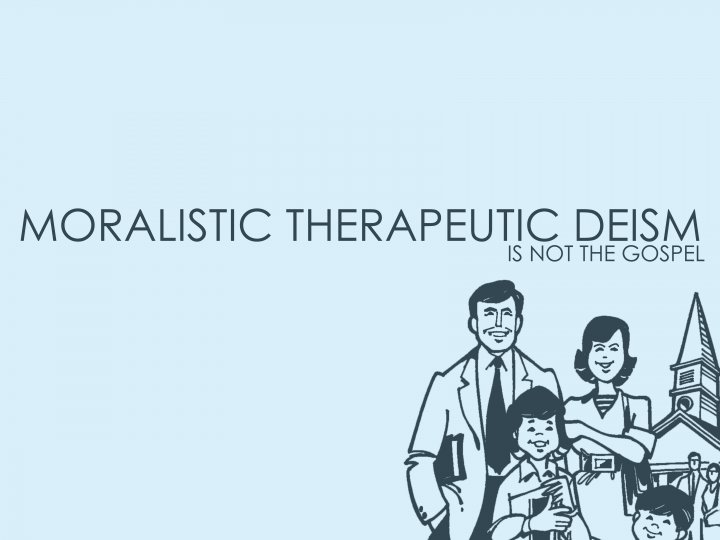
Moralistic Therapeutic Deism – Pt 2 (Teens Are Listening To Us)

It is easy to get caught in the trap of moralism.  You might be asking, “What is moralism?”  Moralism seeks to achieve growth or “Christian maturity” through behavior modificationConsider the following descriptions:

  1. One of the most seductive false gospels is moralism, which can take many forms and can emerge from any number of political and cultural impulses. Nevertheless, the basic structure of moralism comes down to this — the belief that the Gospel can be reduced to improvements in behavior.
  2. Moralism is a religious attitude that tends to look down on unbelievers from a self-righteous position by comparing our supposed moral superiority to theirs. It is as if we believe our entrance into Christianity is by grace but that our growth in Christ is due to maintaining a (NT) moral code.
  3. Those who believe this fall into the trap (perhaps subconsciously) of believing that grace alone (Sola gratia) is insufficient for sanctification. The New Testament authors invite us to bear in mind that God’s commands for us to be holy and love our neighbor etc. are not there to show our ability, but to reveal our inability (e.g., Rom 3:19-20) and to remind us of our continual dependence on the grace of God to do in us and through us what we cannot do (accomplish) on our own.

The pursuit of all things Christian must be anchored in the grace of God or it will be doomed to failure.  Grace is at the heart of the gospel, and without a clear understanding of the gospel and grace we can easily slip into moralism, which bears little resemblance to what the gospel offers us.

Dr. R. Albert Mohler, Jr., president of The Southern Baptist Theological Seminary in Louisville, Kentucky, writes the following about a disturbing and discouraging trend in American Christianity, which adds to the false gospel of moralism

The “Moralistic Therapeutic Deism”[1] that these researchers [sadly] identify as the most fundamental faith posture and belief system of American teenagers appears, in a larger sense, to reflect the culture as a whole. Clearly, this generalized conception of a belief system is what appears to characterize the beliefs of vast millions of Americans, both young and old.

This is an important missiological observation–a point of analysis that goes far beyond sociology. As Christian Smith and Melinda Lundquist Denton explained, Moralistic Therapeutic Deism “is about inculcating a moralistic approach to life. It teaches that central to living a good and happy life is being a good, moral person. That means being nice, kind, pleasant, respectful, responsible, at work on self-improvement, taking care of one’s health, and doing one’s best to be successful.” In a very real sense, that appears to be true of the faith commitment, insofar as this can be described as a faith commitment, held by a large percentage of Americans. These individuals, whatever their age, believe that religion should be centered in being “nice”– a posture that many believe is directly violated by assertions of strong theological conviction.

Moralistic Therapeutic Deism is also “about providing therapeutic benefits to its adherents.” As the researchers explained, “This is not a religion of repentance from sin, of keeping the Sabbath, of living as a servant of sovereign divinity, of steadfastly saying one’s prayers, of faithfully observing high holy days, of building character through suffering, of basking in God’s love and grace, of spending oneself in gratitude and love for the cause of social justice, et cetera. Rather, what appears to be the actual dominant religion among U.S. teenagers [according to the study] is centrally about feeling good, happy, secure, at peace. [Good insight!] It is about attaining subjective well-being, being able to resolve problems, and getting along amiably with other people.”

In addition, Moralistic Therapeutic Deism presents a unique understanding of God. As Smith explains, this amorphous faith “is about belief in a particular kind of God: one who exists, created the world, and defines our general moral order, but not one who is particularly personally involved in one’s affairs–especially affairs in which one would prefer not to have God involved. Most of the time, the God of this faith keeps a safe distance.”

Smith and his colleagues recognize that the deity behind Moralistic Therapeutic Deism is very much like the deistic God of the 18th-century philosophers. This is not the God who thunders from the mountain, nor a God who will serve as judge. This undemanding deity is more interested in solving our problems and in making people happy. “In short, God is something like a combination Divine Butler and Cosmic Therapist: he is always on call, takes care of any problems that arise, professionally helps his people to feel better about themselves, and does not become too personally involved in the process.”

Obviously, Moralistic Therapeutic Deism is not an organized faith. This belief system has no denominational headquarters and no mailing address. Nevertheless, it has millions and millions of devotees across the United States and other advanced cultures, where subtle cultural shifts have produced a context in which belief in such an undemanding deity makes sense. Furthermore, this deity does not challenge the most basic self-centered assumptions of our postmodern age. Particularly when it comes to so-called “lifestyle” issues, this God is exceedingly tolerant and this religion is radically undemanding.

As sociologists, Smith and his team suggest that this Moralistic Therapeutic Deism may now constitute something like a dominant civil religion that constitutes the belief system for the culture at large. Thus, this basic conception may be analogous to what other researchers have identified as “lived religion” as experienced by the mainstream culture.

Moving to even deeper issues, these researches claim that Moralistic Therapeutic Deism is “colonizing” Christianity itself, as this new civil religion seduces converts who never have to leave their congregations and Christian identification as they embrace this new faith and all of its undemanding dimensions.

Consider this remarkable assessment: “Other more accomplished scholars in these areas will have to examine and evaluate these possibilities in greater depth. But we can say here that we have come with some confidence to believe that a significant part of Christianity in the United States is actually [only] tenuously Christian in any sense that is seriously connected to the actual historical Christian tradition, but is rather substantially morphed into Christianity’s misbegotten step-cousin, Christian Moralistic Therapeutic Deism.”

They argue that this distortion of Christianity has taken root not only in the minds of individuals, but also “within the structures of at least some Christian organizations and institutions.”

How can you tell? “The language, and therefore experience, of Trinity, holiness, sin, grace, justification, sanctification, church, . . . and heaven and hell appear, among most Christian teenagers in the United States at the very least, to be supplanted by the language of happiness, niceness, and an earned heavenly reward.”

This radical transformation of Christian theology and Christian belief replaces the sovereignty of God with the sovereignty of the self. In this therapeutic age, human problems are reduced to pathologies in need of a treatment plan. Sin is simply excluded from the picture, and doctrines as central as the wrath and justice of God are discarded as out of step with the times and unhelpful to the project of self-actualization.

All this means is that teenagers have been listening carefully. They have been observing their parents in the larger culture with diligence and insight. They understand just how little their parents really believe and just how much many of their churches and Christian institutions have accommodated themselves to the dominant culture. They sense the degree to which theological conviction has been sacrificed on the altar of individualism and a relativistic understanding of truth. They have learned from their elders that self-improvement is the one great moral imperative to which all are accountable, and they have observed the fact that the highest aspiration of those who shape this culture is to find happiness, security, and meaning in life. 

This research project demands the attention of every thinking Christian. Those who are prone to dismiss sociological analysis as irrelevant will miss the point. We must now look at the United States of America as missiologists once viewed nations that had never heard the gospel. Indeed, our missiological challenge may be even greater than the confrontation with paganism, for we face a succession of generations who have transformed Christianity into something that bears no resemblance to the faith revealed in the Bible. The faith “once delivered to the saints” is no longer even known, not only by American teenagers, but by most of their parents. Millions of Americans believe they are Christians, simply because they have some historic tie to a Christian denomination or identity.

We now face the challenge of evangelizing a nation that largely considers itself Christian, overwhelmingly believes in some deity, considers itself fervently religious, but has virtually no connection to historic Christianity. Christian Smith and his colleagues have performed an enormous service for the church of the Lord Jesus Christ in identifying Moralistic Therapeutic Deism as the dominant religion of this American age. Our responsibility is to prepare the church to respond to this new religion, understanding that it represents the greatest competitor to biblical Christianity.


[1] This quote is from the book: Souls in Transition: The Religious and Spiritual Lives of Emerging Adults by Christian Smith, with Patricia Snell, Oxford University Press, Sept 2009.

The Gospel and the Beatitudes (Matthew 5:3-10)

This is a sermon I spoke at three services at Shiloh Community Church in Orleans MI last weekend (Palm Sunday).  I focused primarily on poor in spirit, mourning, and peacemaking

It’s Palm Sunday and we are remembering and celebrating the triumphal entry of The Servant King Jesus – arriving into Jerusalem to the praise and adulation of the multitude — and less than a week later, he is to be brutally and shamefully murdered…

  1. Next week is the high point of the Christian calendar as we celebrate the resurrection of Jesus Christ from the dead.
  2. Jesus triumphed over death and hell and bridged the gap between our utter depravity and God’s standard of holiness. (To miss the mark by even a little is still to have missed the mark.)
  3. We call this sacrifice the Gospel – or Good News.

I believe it is Tim Keller who reminds us that the Gospel is not advice, it is news.  It is the ultimate Good News.  He suggests that weekend services are not primarily the place to give advice… Gospel-centered (or Christ-centered) change is rooted in remembrance. We are to remind one another of what Christ Jesus has done, not what we must do.

We cannot commend what we do not cherish.  -John Piper

The essence of Christian maturity is when the Gospel – or, what Christ has done — gets worked in – and then through our lives, which is what I’d like to spend our remaining time considering.

Turn to Matthew 5 where we will take a look at the Beatitudes.  While you’re turning, allow me to offer a few introductory thoughts.

What is Christian conversion? Christian conversion, or salvation, occurs when genuine repentance and sincere faith in Jesus intersect.

  1. These are not two separate actions – but one motion with two parts:
    • As we turn to Christ for salvation we turn away from the sin that we are asking Jesus Christ to forgive us from. (Rom 3:23 – All have sinned and fallen short of God’s standard.)
    • Neither repentance nor faith come first – they must come at the same time.
  2. They are two sides of the same coin.[1]

Contained in the Beatitudes are eight qualities that characterize the life of Jesus Christ, and therefore, through conversion, they begin to characterize our life in Jesus Christ.  Jesus calls us to follow him through life and to depend upon his strength and power.

The word beatitude comes from the Latin word meaning “blessed.”

  1. More specifically the word means exalted joy, or true happiness. (Joy is calm delight in even the most adverse circumstances.  Joy fueled Paul’s contentment.)
  2. With the beatitudes, Jesus dives into our innermost being probing the heart and raising the question of motive.
  3. What made Jesus a threat to everyone and the reason He was eventually killed was that in His encounters with people (particularly the religious leaders), He exposes what they were on the inside.  Some people find it liberating – others hate it.

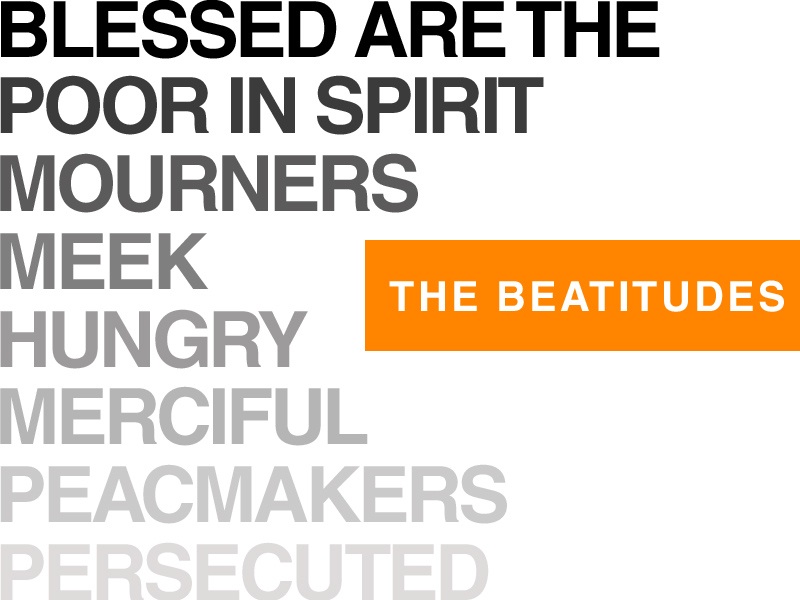
The Beatitudes, I have come to see, are our surrendered response to the Gospel.  I view the Beatitudes as a step-by-step spiritual formation process that moves us toward spiritual depth and maturity.  This becomes cyclical as we grow deeper and deeper in our faith.  The Beatitudes become the outworking of the Gospel in and through our lives.

Matthew 5:3-10…

3“Blessed are the poor in spirit, for theirs is the kingdom of heaven.

 4“Blessed are those who mourn, for they shall be comforted.

 5“Blessed are the meek (gentle), for they shall inherit the earth.

 6“Blessed are those who hunger and thirst for righteousness, for they shall be satisfied.

 7“Blessed are the merciful, for they shall receive mercy.

 8“Blessed are the pure in heart, for they shall see God.

 9“Blessed are the peacemakers, for they shall be called sons of God.

 10“Blessed are those who have been persecuted for the sake of righteousness, for theirs is the kingdom of heaven.

Following is an overview and how one unfolds into the next…The first two are foundational to the Gospel blossoming in and through our lives…

1.  Blessed are the poor in spirit…

a.  “You’re blessed when you’re at the end of your rope.  With less of you there is more of God and his rule.” (MSG)
b.  Another translation renders this verse, “Happy are those who know their need for God.” (JBP)
c.  What does it mean to be “poor in spirit”?  A desperateness of soul that is weary of living in it’s own strength and longs for God’s mercy and grace to come and refresh the soul.  In a word, it is DESPERATION.
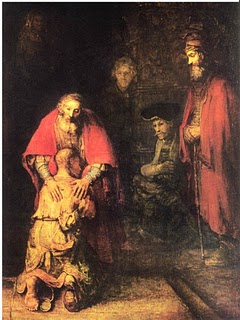
d.  Consider the Prodigal Sons (Lk 15)…

2.  Blessed are those who mourn…

a.  I have a river of sin in my life – with 3 primary tributaries…

#1 – Original sin (Adam & Eve traded the presence of God for the knowledge of God – and that’s been our core tendency ever since…

#2 – Family of origin issues

#3 – My own dumb choices.

b.  As we are honest about the sin that has infected us there will be a transforming grief and accompanying repentance, that surfaces – not only for our own lives, but also for the injustice, greed, lust, and suffering that grips our world.

c.  I want to own my sin everyday.[2]

d.  This is counter intuitive (paradox – seeming contradiction).  We go down to go up; death precedes resurrection; we get to joy by traveling through grief.  Our soul wants to find a way around grief, but God says, “No, you must travel through grief – and the good news is, He says, “I’ll go with you and we will do it in My strength and power.”

e.  The way of the Gospel is a death and resurrection cycle…

f.  The gospel has the greatest potential to captivate us when we understand that we are more depraved than we ever realized and simultaneously more loved that we ever dared to imagine.

g.  I don’t mind inviting you to question your own salvation today.  If our default mode is, “I’m basically a good person…” then we simply have not understood the gospel.

3.  Blessed are the meek…

a.  Rick Warren would say, “Meekness is not weakness, but the power of your potential under Christ’s control.”

b.  The concept of meekness describes a horse that has been broken.  We can either surrender to Christ and invite the breaking, or remain the undisciplined and wild stallion.

c.  Grieving over sin and suffering grows meekness in us and delivers us into a humble learning posture (disciple means learner).

4.  Blessed are those who hunger and thirst for righteousness…Spiritual hunger and thirst is the growing desire to be empty of those things that don’t reflect God, and initiates a deep longing for wholeness in our lives.

5.  Blessed are the merciful…

a.  Mercy is entering into another persons feelings – attempting to see things from another person’s perspective – all with understanding AND acceptance…just like Jesus has done for us.

b.  As we receive God’s mercy we begin to give mercy – to ourselves and to others.

6.  Blessed are the pure in heart…

a.  Mercy cleanses our heart and restores purity to our lives.

b.  Did you know that your (spiritual and emotional) virginity CAN be restored?

2 Cor 11:2For I am jealous for you with a godly jealousy; for I betrothed you to one husband, so that to Christ I might present you as a pure virgin.

7.  Blessed are the peacemakers…

a.  Purity gives way to a personal serenity and peacefulness.  Peace is not the absence of conflict, but the absence of anxiety in the midst of inevitable conflict – and when others encounter it, they want it too.

b.  Our Western concept of peace needs to be considered in the light of the ancient Hebrew concept of peace, which is SHALOM — and means more than our limited understanding of peace (i.e., the lack of conflict).

Biblical SHALOM speaks of a universal flourishing, wholeness and delight; a rich state of affairs in which natural needs are satisfied, natural gifts a fruitfully employed — all under the arc of God’s love. Shalom is the way things ought to be.

Neal Plantinga – “the webbing together of God, humans, and all creation in equity, fulfillment, and delight.”

c.  There is a difference between a peacemaker and a peacekeeper.

To be a peacemaker does not mean peace at any cost.

Peacekeeping creates a false peace.

Many of us live out our lives with this false peace and say nothing or do nothing to change it—in churches, homes, work places, and our marriages.

Examples:

(i)  A family member makes a scene at a family gathering.  It embarrasses you, the rest of the family, but you say nothing.  You keep the peace because to go there would unearth a lot of stuff that you just aren’t willing to deal with.

(ii) Your spouse makes insulting remarks to you or humiliates you publicly through critical tone of voice.  It grates on you.  But you keep silent because you want to keep the peace.

d.  We struggle with this false peace because the conventional wisdom of the day is that its better to keep the peace than to make the peace and there is a very real difference.

e.  Keeping this false peace insures that real issues, real concerns, and real problems are never dealt with.

f.  A façade, or veneer, of peace in that there is calm but the reality is the tension is still there.

g.  True peacemakers will challenge and disrupt the false peace.

h.  Jesus didn’t have a problem disrupting the false peace of his day.

i.  The whole history of redemption, climaxing in the death and resurrection of Jesus is God’s strategy to bring about a just and lasting peace between rebel man and himself and between man and man (Eph 2:14-22)

j.  Colossians 1:19-20 puts it like this,

“For God was pleased to have all his fullness dwell in him, and through him to reconcile to himself all things, whether things on earth or things in heaven, by making peace through his blood, shed on the cross.”

k.  True peacemakers will give people the benefit of the doubt while graciously bringing up concerns

l.  But true peacemakers will deal with what is real.  FIRST IN THEIR OWN LIVES…

m.  True peacemakers will steward the conflict they find themselves in because God will often use conflict to develop things in our lives that are developed in no other way.

8.  Blessed are the persecuted… Living life from a kingdom of God perspective will place us in conflict with those that oppose it (often times it’s “religious” people!).

Without the knowledge of our extreme sin, the payment of the Cross seems trivial and does not electrify or transform.

But without the knowledge of Christ’s completely satisfying life and death, the knowledge of sin would crush us – or move us to deny and repress it. By walking the way of the Beatitudes we hold our depravity and the Cross in a healthy and dynamic tension that will lead to transformation and renewal.


[1] Wayne Gudem, Systematic Theology, p. 713.

[2] “None is righteous, no, not one.” Romans 3:10 (ESV)
And you were dead in the trespasses and sins in which you once walked, following the course of this world, following the prince of the power of the air, the spirit that is now at work in the sons of disobedience.” Eph 2:1-2 (ESV)

The Fruit of Repentance

Produce fruit in keeping with repentance.  –Matthew 3:8

…They should repent and turn to God, performing deeds in keeping with their repentance. –Acts 26:20

Repentance is a decisive reorientation of one’s life away from self and toward God. Commenting on Matthew 3:8 John Calvin writes, “Repentance is an inward matter, which has its seat in the heart and soul, but afterwards yields its fruits in a change of life.”[1]

When John the Baptist told the Jewish people that they must bring forth fruit in keeping with repentance, what did he mean?

There are three additional questions that will help to understand what the Bible means by fruit:

1.     What is repentance?

a)     The Greek verb that is translated repent in the New Testament is metanoia. The word literally means to think after. It suggests the idea of thoughtful reflection regarding a deed after the commission of it. In the case of a sinful action, the idea would be a retrospection of the act and the subsequent feeling of godly sorrow that leads to repentance (see 2 Cor 7:9-10).

b)    Thomas Watson, an English Puritan (ca. 1620-1686) said, “Repentance is a grace of God’s Spirit whereby a sinner is inwardly humbled and visibly reformed.”[2]

c)     Repentance involves a God-initiated resolve to acknowledge the wrongful conduct and surrender ourselves to the empowering grace of God, which alone will accomplish in us and through us what we have never been able to accomplish on our own.

d)    Dan Allender, a contemporary Christian educator and author, writes that repentance is “an about face movement from denial and rebellion to truth and surrender…[that] involves the response of humble hunger, bold movement, and wild celebration when faced with the reality of our fallen state and the grace of God…It is a shift in perspective as to where life is found…It is melting into the warm arms of God, received when it would be so understandable to be spurned.”[3]

e)     Paul writes that, godly sorrow leads to repentance (2 Corinthians 7:10). The repentance of this text is life reformation, not mere grief over the act.

2.     What is the significance of the expression, in keeping with repentance? (NKJ: worthy of; AMP: consistent with.)

a)     The expression in keeping with is the Greek word axios and originally had to do with objects that were of equal weight, i.e., one item corresponds to another in weight. The metaphorical use in the NT may be employed regarding actions — either good or bad.

b)    The change of life that is characteristic of repentance must correspond to the gravity and nature of the offence. Otherwise, it is not biblical repentance.

3.     What is implied by the phrase, produce fruit?

a)     The Greek word for fruit is karpos and means “the visible expression of [God’s] power working inwardly and invisibly, [and] the character of the fruit being evidence of the character of the power producing it (see Mat 7:16). Just as the visible expressions of hidden lusts are the works of the flesh, so the invisible power of the Holy Spirit in those who are brought into [a] living union with Christ (see Jn 15:2-8, 16) produces ‘the fruit of the Spirit’ (Gal 5:22).”[4]

b)    In addition to the fruit of the Spirit what does it mean to produce the fruit of repentance? Here are a some signs of fruit that will typically be found in a truly repentant person[5]:

i)      Repentant people are willing to confess all their sins, not just the sins that got them in trouble. A house isn’t truly clean until we open every closet and sweep every corner. People who truly desire to be clean are completely honest about their lives. No more secrets. Christian psychologist and author Larry Crabb defines integrity as pretending about nothing.[6]

ii)    Repentant people face the pain that their sin caused others. They invite the victims of their sin (anyone hurt by their actions) to express the intensity of emotions that they feel — anger, hurt, sorrow, and disappointment. Repentant people do not give excuses or shift blame. They made the choice to hurt others, and they take full responsibility for their behavior.

iii)   Repentant people ask forgiveness from those they hurt. They realize that they can never completely “pay off” the debt they owe their victims. Repentant people don’t pressure others to say, “I forgive you.” Forgiveness is a journey, and people need time to deal with the hurt before they can forgive. All that penitent people can do is admit their indebtedness and humbly request the undeserved gift of forgiveness.

iv)   Repentant people remain accountable to a small group of mature Christians. They gather a group of friends around themselves who hold them accountable to a plan for honest living. They invite the group to question them about their behaviors.

v)    Repentant people accept their limitations. They realize that the consequences of their sin (including the distrust) will last a long time, perhaps the rest of their lives. They understand that they may never enjoy the same freedom that other people enjoy. Adulterers, for example, would be wise to place strict limitations on their time with members of the opposite sex. That’s the reality of their situation, and they willingly accept their boundaries.

vi)   Repentant people are faithful to the daily tasks God has given them. We serve a merciful God who delights in giving second chances. God offers repentant people a restored relationship with him and a new plan for life. Consider Hosea’s promise to rebellious Israel:

Come, let us return to the Lord. He has torn us to pieces but he will heal us; he has injured us but he will bind up our wounds. After two days he will revive us; on the third day he will restore us, that we may live in his presence. (Hosea 6:1-2)

The conscientious student of the Bible is led to conclude that any repentance, without the full compliment of the elements that define that term, is simply not a biblical repentance.


[1] John Calvin, Commentary on Matthew, Mark, & Luke, Vol 1.

[2] Thomas Watson, The Doctrine of Repentance, Banner of Truth, 1999: 18.

[3] Dan Allender, The Wounded Heart, Navpress, 1990: 217.

[4] W. E. Vine, Vine’s Expository Dictionary of New Testament Words, Vol 2, Revell 1940: 143.

[5] Adapted from the article Six Signs of Genuine Repentance by Bryce Klabunde.

[6] Larry Crabb, Finding God, Zondervan 1993: 16.