Prayer of Examen

The Prayer of Examen is a daily spiritual exercise credited to Ignatius of Loyola (1491-1556), who encouraged fellow believers to engage in the practice for developing a deeper level of spiritual sensitivity and for recognizing and receiving the active presence of the Holy Spirit. At the heart of the practice is the desire to become increasingly aware of God’s presence and the Holy Spirit’s movement throughout our day.
The Daily Examen becomes a prayerful reflection on the events of the day in order to detect God’s presence and discern his commitment to us and direction for us.  The Examen is a practice for the Church that can help us see God’s hand at work in our whole experience.

Ignatius thought that the Examen was a gift that came directly from God, and that God wanted it to be shared as widely as possible. One of the few conventions of prayer that Ignatius made for the Jesuit order was a requirement that Jesuits practice the Examen twice daily—at noon and at the end of the day. It’s a habit that Jesuits, and many other Christians, practice to this day.

This is a simple version of the five-stage Daily Examen that Ignatius practiced:

  1. Become aware of God’s presence. (This is referred to in contemplative literature as “stilling,” and means to take the opportunity to dial down and become attentive to God’s presence.)
  2. Review the day with gratitude.
  3. Pay attention to your emotions.
  4. Choose one feature of the day and pray from it.
  5. Look toward tomorrow.

“Take, Lord, receive all my liberty, my memory, my understanding, and my entire will. All I have and call my own. Whatever I have or hold, you have given me. I restore it all to you and surrender it wholly to be governed by your will. Give me only your love and grace and I am rich enough and ask for nothing more.”  — Ignatius of Loyola

Check out examen.me.

Principles of Church Revitalization

Excellent…

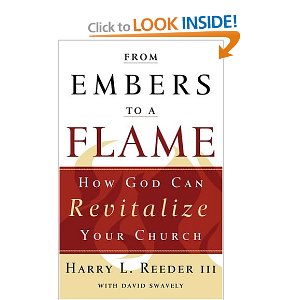
From Embers To A Flame: Principles of Church Revitalization
by Harry L. Reeder III

1. God’s glory is revealed in our weaknesses.
2. Guard your reputation in the eyes of the community.
3. Uphold the centrality of God’s grace.
4. Leave the 99 to seek the 1 (church revitalization is seeking to save the church that is faltering).
5. Revisit to strengthen, encourage, correct and restore what is left.
6. Remember[1] from where you have fallen when Christ was leading this church.
7. Believe that the God who won the victory in the past will win the victory in the present.
8. Connect the future with past victories in Christ.
9. Repent[2] of failures in the past that controls the present.
10.  Leaders must be an example by repenting first of past failures, and then lead members to repent.
11.  Provide restitution for past sins. Ask forgiveness and make right where possible especially with those who left hurt and confused.
12.  Focus on Body health and let God handle the increase.
13.  Be faithful with little and God will give big. Do the right things at the right time in the right way for the right reasons.
14.  All biblical teaching is exploring the depth of the gospel. You never get beyond the gospel for it is the alpha and omega of God’s revealed truth in Scripture. You can only go deeper.
15.  All ministries must focus on the gospel of grace to be life changing.
16.  Prayer precedes revitalization and creates unity with God’s will. Prayer affords the privilege of participating in God’s reconciliation of His elect. Then, by faith act on your prayers.
17.  Make a list of all weaknesses and threats from Satan’s attacks and pray over this list regularly.
18.  Make a list of all Scriptures related to church revitalization and pray using the words of Scripture that God’s will be done on earth as it is in heaven.
19.  Pray thanking God for the opportunities presented by the bad that has beset your church.
20.  Make a list of all opportunities to do His will, then pray and see His power change the circumstances.
21.  Recover [3] the “First things,” get back to the basics that God blessed. Rebuild on these strengths.
22.  Godly leadership precedes God given church growth.
23.  Affirm what has been done well and identify weaknesses.
24.  Godly people follow godly leaders who follow Jesus and seek God’s glory.
25.  Resources follow Godly vision for ministry. Visualize a future blessed by God.
26.  Worship is the context in which the Great Commission operates. Do not replace worship for Christians with evangelism to “seekers.” Gather for worship, scatter for evangelism.
27.  Diversify evangelism efforts; multiply opportunities for gospel communication.
28.  Small group network is best way to assimilate new people and build community. Protect health of small group.
29.  Qualified leaders who present sound doctrine and are able to refute those who contradict it must lead small groups. Must avoid dialogue in small groups that leads to a compromise of truth or pluralism of ideas that accepts every opinion as valid. Scripture rightly interpreted must be central, then fellowship and prayer for “one another.”
30.  The Christian life is 100% dependence on God’s grace and 100% disciplined by grace.
31.  For a congregation to remain healthy church discipline must be exercised according to Matt. 18 on a regular basis. “Sin in the camp” must be confronted.
32.  A healthy Body of believers will grow as God adds those He wants discipled to maturity. Church growth is a natural by-product of spiritual health.


[1] Rev. 2:5 – Remember, Repent, and Recover is Jesus’ formula for revitalization.

[2] Ibid.

[3] Ibid.

A Simple Way To Pray

“Prayer is a very precious medicine, one that helps and never fails.” Martin Luther

Luther’s advice to his barber on how an ordinary person could pray without distraction: “I do not want you to recite all these words in [or, as] your prayer. That would make it nothing but idle chatter and prattle. Rather do I want your heart to be stirred and guided concerning the thoughts which ought to be comprehended in the Lord’s Prayer.”

10 Commandments – Exodus 20:2–17
2 I am the Lord your God, who brought you out of the land of Egypt, out of the house of slavery;
3 Do not have any other gods before me.
4 You shall not make for yourself an idol, whether in the form of anything that is in heaven above, or that is on the earth beneath, or that is in the water under the earth.
5 You shall not bow down to them or worship them; for I the Lord your God am a jealous God, punishing children for the iniquity of parents, to the third and the fourth generation of those who reject me,
6 but showing steadfast love to the thousandth generation of those who love me and keep my commandments.
7 You shall not make wrongful use of the name of the Lord your God, for the Lord will not acquit anyone who misuses his name.
8 Remember the Sabbath day and keep it holy.
9 For six days you shall labor and do all your work.
10 But the seventh day is a Sabbath to the Lord your God; you shall not do any work—you, your son or your daughter, your male or female slave, your livestock, or the alien resident in your towns.
11 For in six days the Lord made heaven and earth, the sea, and all that is in them, but rested the seventh day; therefore the Lord blessed the Sabbath day and consecrated it.
12 Honor your father and your mother, so that your days may be long in the land that the Lord your God is giving you.
13 You shall not murder.
14 You shall not commit adultery.
15 You shall not steal.
16 You shall not bear false witness against your neighbor.
17 You shall not covet your neighbor’s house; you shall not covet your neighbor’s wife, or male or female slave, or ox, or donkey, or anything that belongs to your neighbor.

The Lord’s Prayer – Matthew 6:9-13
Our Father in heaven,
hallowed be your name,
your kingdom come,
your will be done,
on earth as in heaven.
Give us today our daily bread.
Forgive us our sins
as we forgive those who sin against us.
Lead us not into temptation
but deliver us from evil.
[For the kingdom, the power, and the glory are yours now and for ever.] Amen.

Apostle’s Creed
I believe in God, the Father Almighty,
the Maker of heaven and earth,
and in Jesus Christ, His only Son, our Lord:
Who was conceived by the Holy Ghost,
born of the virgin Mary,
suffered under Pontius Pilate,
was crucified, dead, and buried;
He descended into hell. [See Calvin]
The third day He arose again from the dead;
He ascended into heaven,
and sitteth on the right hand of God the Father Almighty;
from thence he shall come to judge the quick and the dead.
I believe in the Holy Ghost;
the holy catholic church;
the communion of saints;
the forgiveness of sins;
the resurrection of the body;
and the life everlasting.
Amen.

Stages of Renewal

I listened to a lecture the other day that concluded with Mark Driscoll quoting Rick Warren on seven stages of renewal.  I can certainly see the pattern to be accurate in my experience and I thought it was very succinctly stated.

I have incorporated some of my thoughts and experience to each of the seven stages and conclude with two quotes that, from my viewpoint, help us to to engage the stages.

1. Personal renewal is about loving God and begins with acknowledging Jesus Christ as our greatest treasure and the object of worship. Personal renewal occurs as we recognize our spiritual poverty and surrender afresh to loving care and instruction of a God who is alive and available. The outflow of this active and intentional surrender is prayer, the reading and study of Scripture, and a growing worship of Jesus and connectedness with him – which renews us from the inside out.

2. Relational renewal is about authentically loving others.  As we embrace personal renewal with Jesus an initial effect is that we have new hope for people and pursue them in love. If married, relational renewal begins with our spouse. And, if we are parents our children ensue. Relational renewal allows us to be authentic around others, stop pretending and performing, and simply be in loving community where we are known and know others, with deep gratitude for the work of the gospel.

3. Missional renewal awakens in us a hope and love for the Great Co-mission. Once we have personal and relational renewal, the result is that God’s people want to be on mission together doing what God calls the church to accomplish. Without personal renewal, a church cannot have relational renewal. And, without both a church has no life or unity that allows them to press forward on mission with God together.

4. Internal cultural renewal happens as the fruit of personal, relational, and missional renewal forms a new culture of grace internally and new passion for lost people externally. In a church this results in people trusting their leaders and one another more, wanting to spend more time together, worshiping with greater intensity, and hanging out longer after services – as they begin to realize they are becoming a unified community.  This also increases innovation, a willingness to risk, and a burgeoning missiology.

5. Structural renewal is necessary once the personal, relational, missional, and internal renewals have been initiated and creates the need to change how a church operates. What structures have hindered growth?  What structures can be implemented so the church won’t have a bottleneck as the church grows? There is no perfect structure in Scripture because every situation is different. Rick Warren speaks of changing structures just about every year at Saddleback. We can’t put new wine in old wineskins. As a church begins to get healthier and healthier, the structure needs to change.

6. Institutional renewal happens when Christianity’s institutions change. Institutions – like seminaries and denominations are usually the last ones to change; they have difficulty with the change process. Unfortunately, institutions generally exist to preserve the change of the previous generation. It’s like a tree – the growth of a tree is not on the trunk but on the new branches. Institutions are like trunks. They provide stability not innovation.  Innovation happens at the local church level.

7. External cultural renewal is the fruit of personal, relational, missional, internal, structural, and institutional renewal. It might be best described as the outworking of Acts 2:43-47: A renewed sense of awe, wonders and signs taking place, refreshed and authentic community, mutual identification amongst classes and cultures, equality, unity, enthusiastic joy, heartfelt praise, favor with all the people, and salvations.

Here are two quotes that seem to reflect the attitude that initiates the process:

Charles Spurgeon was converted on January 6, 1850, and on February 1 he wrote the following prayer of consecration:

“O great and unsearchable God, who knows my heart, and tries all my ways; with a humble dependence upon the support of Your Holy Spirit, I yield up myself to You; as Your own reasonable sacrifice, I return to You your own. I would be forever, unreservedly, perpetually Yours; while I am on earth, I would serve You; and may I enjoy you and praise You for ever! Amen.”

James Burns, in Revival, Their Laws and Leaders writes:

“To the church, a revival means humiliation, a bitter knowledge of unworthiness and an open humiliating confession of sin on the part of her [pastors] and people.  It is not the easy and glorious thing many think it to be, who imagine it filled the pews and reinstated the church in power and authority.  It comes to scorch before it heals; it comes to [convict] people for their unfaithful witness, for their selfish living, for their neglect of the cross, and to call them to daily renunciation and to a deep and daily consecration.  That is why a revival has ever been unpopular with large numbers within the church.  Because it says nothing to them of power, or of ease, or of success; it accuses them of sin; it tells them they are dead; it calls them to awake, to renounce the world [system] and to follow Christ.”