God’s Mission Becomes Our Mission

I. INTRO

Last week we turned an important corner in the life of this church with our Sacred Assembly.  Today, I’d like for us to consider the mission of God’s Church – and more specifically this church, Southside Bible Fellowship.

By way of introduction, God has a MISSION, a MEANS, and a METHOD.

1. What is the MISSION of God?

God’s mission is the manifestation of His own glory.

“For the earth will be filled

With the knowledge of the glory of the Lord,

As the waters cover the sea.” Habakkuk 2:14

What is God’s glory?  God’s glory is the shining forth of the perfection of all of God’s attributes.

God’s supreme desire is that He might be known and enjoyed above all things.

God seeks to be recognized as supremely worthy, supremely splendid, and supremely valuable. God’s glory is sensed when we feel the reality of His presence, goodness, and superiority.

2. The MEANS of God’s mission is Jesus Christ and the work He did on the cross.

We call this the gospel.  God creates, calls, rescues, redeems, saves, restores, restrains, and grants — all to the end that we may find our true comfort, joy, and delight in Him.

The gospel is the historical narrative of the triune God orchestrating the reconciliation and redemption of a broken creation and fallen creatures, from Satan, sin and its effects to the Father and each other through the birth, ministry, death, resurrection, ascension — and future return of the substitutionary Son by the power of the Spirit for God’s glory and the Church’s joy. (We see summary statements of this throughout Scripture – both Old and New Testaments.)

To be “gospel-centered” means to both see and live out this narrative as the central theme, or singular story line, of the Bible.  It is central. It is singular.

The gospel stands at the center of God’s redemptive plan, and in it we see Him most clearly for Who He is and what He has done.

3. The METHOD of God’s mission is you and me – the Church.  In a nutshell we (the Church) are all called to live as missionaries in our current life station and cultural context.

Family, friends, neighbors, co-workers – all our social networks.

If you were preparing to be a missionary in Malaysia what activities would best prepare you?

We are to begin the discipleship process BEFORE conversion.  (This is where most churches get it wrong…think about it – we start discipling our kids before they’re converted…)

II. BODY

Having identified God’s MISSION, MEANS, and METHOD I would like to spend the rest of our time considering the mission of the church – and specifically this church – SBF as we enter into a new season of ministry…

The mission of the Church universal is: To glorify God by making disciples through embodying the gospel of Jesus Christ.

God’s mission and the mission of His Church are inseparably linked. If God’s mission is to be glorified through the redemption and reconciliation of a people, the Church’s mission must orient around the glory of God and seek to glorify Him through redemption and reconciliation.

2 Corinthians 5:17-20 – “Therefore if anyone is in Christ, he is a new creature; the old things passed away; behold, new things have come. 18 Now all these things are from God, who reconciled us to Himself through Christ and gave us the ministry of reconciliation, 19 namely, that God was in Christ reconciling the world to Himself, not counting their trespasses against them, and He has committed to us the word of reconciliation.

20 Therefore, we are ambassadors for Christ, as though God were making an appeal through us; we beg you on behalf of Christ, be reconciled to God. 21 He made Him who knew no sin to be sin on our behalf, so that we might become the righteousness of God in Him.

The mission of the Church is highlighted in these verses. As those who have been reconciled to God through the gospel of Jesus Christ, we are now ambassadors of reconciliation to a lost and broken world. We plead, urge, implore, reason, pray, serve, preach, teach and gather to see God glorified through reconciliation.

We also see the mission of the church in the more familiar Matthew 28:19-20:

Go therefore and make disciples of all the nations, baptizing them in the name of the Father and the Son and the Holy Spirit, 20 teaching them to observe all that I commanded you; and lo, I am with you always, even to the end of the age.”

A suggested mission for SBF: To glorify God through making disciples.  We will accomplish this through:

  1. Gospel-centered worship
  2. Gospel-centered prayer
  3. Gospel-centered community
  4. Gospel-centered service
  5. Gospel-centered mission.

1. Gospel-Centered Worship

All of life is worship. Every thought, word, desire, and deed involves the ascribing of worth and value – glory. Each attitude, affection and activity is an expression of our allegiance, whether to our Creator or His creation. God is alone worthy of our worship.

Worship is related to every area of our lives. We are called to eat, drink, speak, think, and work to the glory of God (1 Corinthians 10:31 – whatever you do, do all to the glory of God”). Worship cannot be narrowed down to a particular time and place as if God does not claim authority over certain aspects of our lives. There are no neutral desires or deeds; everything is an expression of worship.

Gospel-centered worship is to be pursued in every facet of our lives as we consider how all encompassing the gospel is to us. Gospel-centered worship is nurtured through:

The gathering of God’s people in a weekend worship service. Within this venue, we worship God by remembering the gospel through preaching, teaching, singing, praying and celebrating the ordinances of baptism and communion. Each presents an opportunity for the church to receive, remember, respond and rejoice in the work of our great King.

Gospel-centered worship also means that we orient our lives (between Sundays) around learning how to worship God and bring Him glory through our thoughts, words, and deeds.  Again, 1 Corinthians 10:31 becomes our holy objective – whatever you do, do all to the glory of God”

1 Corinthians 10:31, Psalm 145:1-21, Isaiah 43:6-7, Colossians 3:1-17

2. Gospel-Centered Prayer

Turn with me to Exodus 33:15-18 –“Then [Moses] said to [God], “ If Your presence does not go with us, do not lead us up from here. 16 For how then can it be known that I have found favor in Your sight, I and Your people? Is it not by Your going with us, so that we, I and Your people, may be distinguished from all the other people who are upon the face of the earth? 17 The Lord said to Moses, “I will also do this thing of which you have spoken; for you have found favor in My sight and I have known you by name.” 18 Then Moses said, “I pray You, show me Your glory!

What we have here is the greatest request we could ever make of God.  It transcends any other request that we could ask of God.

It’s an unrelenting desire to engage the presence of God.

If you want to know the real you, listen for what you pray for involuntarily.  Listen to the spontaneous prayers that irrupt from your heart.

Moses’ prayer is a reflex of the heart.  It reveals what he REALLY wants.

What is it that you involuntarily pray for?  What is the unrehearsed outburst of your soul…

God loves it when we address Him in prayer as the END and not simply a MEANS.  If you’re like me it’s easy to fall into the trap of seeing God as the MEANS to our true desires instead of seeing God as the END of all our desires.  We seek God for jobs, for relationships, for good health, for material things – and all those are good yet the ultimate value is God Himself.

The prayer that most delights God is the prayer that makes Him our most passionate desire.

Jonathan Edwards concluded the most essential difference between a Christian and a moralist is that a Christian obeys God out of the sheer delight in who He is. The gospel means that we are not obeying God to get anything but to give him pleasure because we see his worth and beauty. Therefore, the Christian is able to draw power out of the contemplation of God (i.e., prayer). The moralist will usually only come and petition God for things…

Gospel-centered prayer, is making God the END and not the MEANS — rather than anxious petitioning.

3. Gospel-Centered Community

We worship a triune God, Who has eternally existed as Father, Son and Holy Spirit. In identifying the tri-unity of God, we recognize that God is communal. The Godhead has perpetually dwelt in perfect harmony, unity, joy, and love. Bearing the image of God, we are called to reflect this reality. We are called to be communal creatures imaging the community of our Creator.

Though each Christian has a personal relationship with God, that relationship is not individual or private. The Christian faith is not intended to be lived in isolation. We were made for community – relationship with God and with each other.

The local church is not merely a place that we attend but a people to whom we belong. The Bible calls us members of the body (1 Corinthians 12:12-31) with the expectation that we contribute to the body for the glory of God and the good of His people.

Gospel-centered community is a radical call amid a culture of mere attendance and casual involvement. It involves mutual love, care, consistency and authenticity as we seek to adorn the person and work of Christ with our lives. Where these elements are lacking, we have moved away from gospel-centered community and into the realm of social clubs.

Gospel-centered community is primarily expressed through Community Groups that meet during the week, or Sunday School classes that meet before the service on Sunday mornings. Groups are not perfect and those who participate in them will find them messy at times. However, our hope is that group members will be radically committed to reform from within. This takes time, prayer, effort, patience, love, trust and hope.

Acts 2:42-47, Hebrews 3:12-13, 1 Corinthians 12:12-31

4. Gospel-Centered Service

Gospel-centered service is motivated by the reconciling work of God and seeks to extend His grace and mercy to others for His glory and not our own. It is an expression of love and stewardship of grace marked by humility, generosity and hospitality and empowered by a passion for the glory of God.

Service can and should be pursued in various ways by all recipients of varied grace. Those who have been impacted by the gospel have countless opportunities – both formal and informal – to serve others by greeting at the doors of the church, following up guests who will be visiting our church, volunteering to work with our children and youth, teaching, singing, serving communion, giving financially to the needs of others, opening their homes to their neighbors, etc.

John 13:1-20, 1 Peter 3:8-11, 2 Corinthians 8:1-9:15

5. Gospel-Centered Mission

We are used to thinking of mission in terms of funding and sending missionaries to work in other countries to share the plan of salvation with unreached people groups.

If there is an unreached people group in the United States, it is New Englanders. A recent Gallup poll placed the six states of New England in the top ten least religious states in the nation.

Those in New England who attend evangelical churches hover between 1- 3% of the population. There is a higher percentage of evangelical Christian churchgoers in Mormon Utah than in New Hampshire!

Gospel-centered mission is the recognition that each one of us is sent by God as a missionary into our own sphere of relationships – family, friends, neighbors, co-workers – where we boldly promote the gospel through collaborative expressions of mercy and generosity.

We serve a missionary God: The Father sent the Son, the Son sent the Holy Spirit, and the Holy Spirit sends us.

Let me just say that I am more of a fan of mining the vein of our current relational sphere than I am into organizing what we’ve known as “street witnessing.”  And I am more of a fan of initially engaging our relational network through learning how to listen.  In our culture at this moment in history, we will earning the right to speak through first of all learning how to listen.

2 Corinthians 5:11-2, Matthew 28:18-20, Mt. 4:19; John 20:21; Acts 16:20; 17:6, and to make disciples of all nations Matt. 28:18-20; Acts 1:8
The Church Gathered and the Church Scattered

2 Corinthians 5:18-21

18 Now all these things are from God, who reconciled[1] [to settle accounts – as in a bank statement] us to Himself through Christ [who paid our debt – the cross is where God’s justice and God’s mercy kiss] and gave us the ministry of reconciliation, 19 namely, that God was in Christ reconciling the world to Himself, not counting their trespasses against them, and He has committed to us the word [logos, or doctrine] of reconciliation.

20 Therefore, we are ambassadors [diplomats, emissaries, representatives] for Christ, as though God were making an appeal through us [sometimes the best way to “preach” to someone is to listen to them]; we beg you on behalf of Christ, be reconciled to God. 21 He made Him who knew no sin to be sin on our behalf, so that we might become the righteousness of God in Him [THAT is the gospel – Jesus lived the life we should have lived and died the death we should have died. We don’t live in our own strength – we live IN Him – or His strength].

Did you know that there are currently 38,000 Pro-test-ant[2] denominations?  Catholics have multiple orders (Dominicans, Franciscans, Jesuits, etc.), but have managed to stay under the umbrella of Rome.

I. INTRO

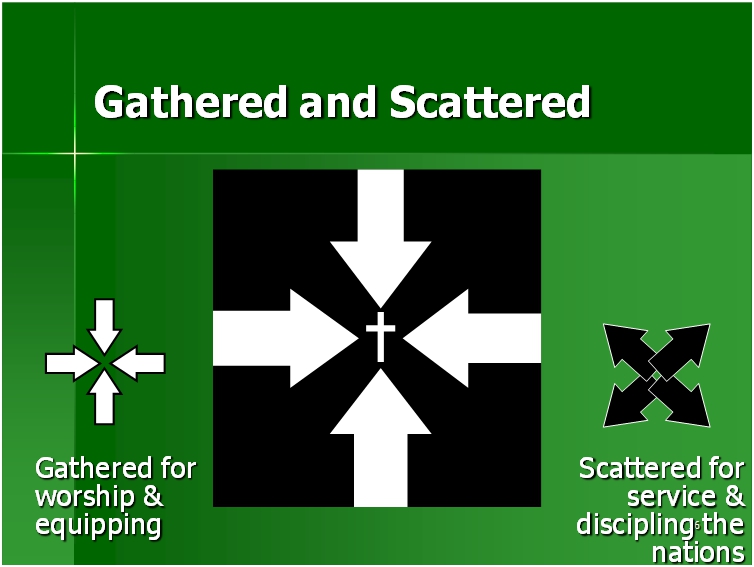
I’d like to speak with you today about the Church GATHERED and the Church SCATTERED.  First, the nerdy Stuff…

  • Ecclesia (Latin) Greek – κκλησί, meaning “congregation” or “church.” The literal translation is “called out ones.”
  • Ecclesiology – Refers to the theological study of the Christian Church.

1. Who is the Church? (Not What…?) It is the body of all believing, or confessing, Christians.  SBF is a unique expression of the larger Body of Christ.

2. What is the authority of the Church?

  • Jesus is the head of the body, the Church (Col 1:18)
  • Jesus is the Senior Pastor. 1 Peter 5:4 identifies Jesus as the “Chief Shepherd.” [A church in transition shouldn’t get a pastor until they don’t really need one.]
  • The Bible is our highest and final authority. Sola Scriptura, not solo Scriptura.

3. What is the relationship between a believer and the Church? As believers we are to submit ourselves to Jesus – the Head and Chief Shepherd of the Church.  There are three overlapping commitments that make up a healthy and vibrant church experience:

  • Celebration (Worship)
  • Congregation (Identity needs met) Acts 2:42-47

42 “They were continually devoting themselves to the apostles’ teaching and to fellowship, to the breaking of bread and to prayer. 43 Everyone kept feeling a sense of awe; and many wonders and signs were taking place through the apostles. 44 And all those who had believed were together and had all things in common; 45 and they began selling their property and possessions and were sharing them with all, as anyone might have need. 46 Day by day continuing with one mind in the temple, and breaking bread from house to house, they were taking their meals together with gladness and sincerity of heart, 47 praising God and having favor with all the people. And the Lord was adding to their number day by day those who were being saved.”

  • Cell (Intimacy and accountability needs met)

James 5:16: Confess your sins to one another, and pray for one another so that you may be healed.”

4. How should the Church be governed?

8 Therefore it says, “WHEN HE ASCENDED ON HIGH,
HE LED CAPTIVE A HOST OF CAPTIVES,
AND HE GAVE GIFTS TO MEN.”  9 (Now this expression, “He ascended,” what does it mean except that He also had descended into the lower parts of the earth? 10 He who descended is Himself also He who ascended far above all the heavens, so that He might fill all things.) 11 And He gave some as apostles, and some as prophets, and some as evangelists, and some as pastors and teachers [also add elders and deacons], 12 for the equipping of the saints for the work of service, to the building up of the body of Christ; 13 until we all attain to the unity of the faith, and of the knowledge of the Son of God, to a mature man, to the measure of the stature which belongs to the fullness of Christ. 14 As a result, we are no longer to be children, tossed here and there by waves and carried about by every wind of doctrine, by the trickery of men, by craftiness in deceitful scheming; 15 but speaking the truth in love, we are to grow up in all aspects into Him who is the head, even Christ,

5. What does the Church do?  The church exists in two modes:

  • We gather for worship.
  • We scatter for mission.

II. BODY

We will now take a deeper look at what it means to gather for worship and scatter for mission

  • Gather for worship
  • Requires purposeful participation — moving from passive observation to active participation.

(Our identity) Eph 1: Blessed be the God and Father of our Lord Jesus Christ, who has blessed us with every spiritual blessing in the heavenly places in Christ, 4 just as He chose us in Him before the foundation of the world, that we would be holy and blameless before Him. In love 5 He predestined us to adoption as sons through Jesus Christ to Himself…”

Even before He made the world God chose you and adopted you, it gave Him great pleasure, God loved, chose, and adopted you.  You are His unique and special possession.

This is what we need to see: Coming is not an event; it is the fulfillment of God’s prehistoric (pre-history) desire.  God created Adam and Eve – it was good.  God wanted to be with people… (Some of you don’t even want to be with people J)

OT – they built a Tabernacle because God wanted to meet with His people.

It’s not our desire – it’s God’s desire – made possible by the blood of Jesus.  Church is not primarily about us – it’s primarily about God.

**We gather to, for, and around Jesus.

Our being here is all about Him – and sometimes competes with our expectations, needs, and desires.

Jesus is the head, the goal, chief shepherd – He’s the Sr. Pastor. He owns and loves the Church. He’s the object our worship, our preaching, and our mission.

The church is all about Him.  It’s not about music or the preaching – although, hopefully they are both focused on worshiping Jesus.

The music and the sermon are BOTH acts of worship (difference between a lecture and a sermon… “if people are taking notes at the end of a sermon it might not BE a sermon…”

If your Christianity is just about going to church then you don’t have Christianity, you have “Churchianity.”

Exalting only Jesus – giving all of our attention to Jesus

Sometimes it’s a sacrifice of praise (Hebs)

Our destination is always Jesus – give ourselves and assume a posture of personal humility, worship, and prayer.

Christ is present and available.

Ps 116:  1 I love the LORD because he hears my voice
and my prayer for mercy.
2 Because he bends down to listen,
I will pray as long as I have breath!
3 Death wrapped its ropes around me;
the terrors of the grave overtook me.
I saw only trouble and sorrow.
4 Then I called on the name of the LORD:
“Please, LORD, save me!”
5 How kind the LORD is! How good he is!
So merciful, this God of ours!
6 The LORD protects those of childlike faith;
I was facing death, and he saved me.
7 Let my soul be at rest again,
for the LORD has been good to me.
8 He has saved me from death,
my eyes from tears,
my feet from stumbling.
9 And so I walk in the LORD’s presence
as I live here on earth!
10 I believed in you, so I said,
“I am deeply troubled, LORD.”
11 In my anxiety I cried out to you,
“These people are all liars!”
12 What can I offer the LORD
for all he has done for me?
13 I will lift up the cup of salvation
and praise the LORD’s name for saving me.
14 I will keep my promises to the LORD
in the presence of all his people.

15 The LORD cares deeply
when his loved ones die.
16 O LORD, I am your servant;
yes, I am your servant, born into your household;
you have freed me from my chains.
17 I will offer you a sacrifice of thanksgiving
and call on the name of the LORD.
18 I will fulfill my vows to the LORD
in the presence of all his people—
19 in the house of the LORD
in the heart of Jerusalem.

Praise the LORD!

Scatter for mission

The term “missional church” may be a new term for you.  Here is the main idea:  We serve a missionary God, who crossed the ultimate cultural contexts to become one of us.  Jn 1:14 (MSG) The Word became flesh and blood, and moved into the neighborhood.

The Father sent the Son, the Son sent the Holy Spirit – and the Holy Spirit sends us.

Attractional model vs. a missional model.  In the end we want both.

What we are seeking to accomplish here at SBF can be defined as a “missional reorientation.”

At a very deep level we are redefining success:  It’s not about the 3 B’s (building, budget, and butts); it’s about how many people are we training and sending to be missionaries in their unique spheres of relationships.

Mat 28:18-20: 18 And Jesus came up and spoke to them, saying, “All authority has been given to Me in heaven and on earth. 19 Go therefore and make disciples of all the nations, baptizing them in the name of the Father and the Son and the Holy Spirit, 20 teaching them to observe all that I commanded you; and lo, I am with you always, even to the end of the age.”

Three things:

  1. All authority has been given to Jesus – and He is with us/you always. Our responsibility is basically twofold: a) stack kindling and b) splash (preach).  (D.L. Moody – At any moment we ought to be willing to preach, pray, or die.)
  2. “Go therefore” (Go ye) is the mission of the church.  Are we a “come ye” church, or a “go ye” church?
  3. Make disciples.  I’d like you to view every single person in your various spheres of relationship as a disciple…

[1] To “change or exchange” – it is God moving from hostility to friendship. Reconciliation is what God accomplishes, exercising His grace towards sinful humankind because of the sacrificial death of Christ in propitiatory [or appeasing] sacrifice under the judgment due to sin.

[2] The quotation “The lady doth protest too much, methinks.” comes from Shakespeare’s Hamlet, Act III, scene II. The phrase has come to mean that one can “insist so passionately about something not being true that people suspect the opposite of what one is saying.”

1 John 5:6-13 (#13)

I.  INTRO – Assurance of Eternal Life

Review:

Where we are as a church – and where we’re headed.  We’ll start at 30,000 feet and then land in our 1 John passage for today.

As a church we are “rebooting” theologically.  What does that mean?

First of all, it does NOT mean we are changing our doctrinal statement.

What it DOES mean is that we intend to be Christ-centered, or gospel-centered, in all our preaching and teaching.[1]  There are two basic reasons for this:

  1. Not only is the gospel of Jesus Christ necessary for our salvation, but the gospel is also essential for our growth (or sanctification) in Christ.[2]
  2. (How does that happen?) A Christ-centered, or gospel-centered approach will focus more on what Christ has done, than on what we should do.

We believe that the Westminster Assembly got it right in 1646 with the Westminster Shorter Confession of Faith when they determined the “chief end of [humankind] is to glorify God and enjoy Him forever.”  Or, as John Piper has said, “to glorify God BY enjoying Him forever.”

Where we’re headed (See the bulletin insert):

3 Summits scheduled 6-weeks apart to reaffirm values, mission, and vision in preparation for calling a permanent pastor.

The first one is Sat, Jan 14th from 9am-1pm.  A working lunch and childcare will be provided.

If you’re 13+, we’d like for you to be there.  Sign-ups start today.

Sign-up sheet – or email Beth in the office.

**The more we accomplish in the next 6-7 months, the higher caliber pastor we will attract to SBF.

Next week in the bulletin we will provide you with a calendar of the significant events for Jan-Jun of 2012.  This will include:

  1. The 3 Summits
  2. At least 3 Concerts of Prayer where we will gather as a congregation – both to learn more about prayer and to pray.  These will also include extended times of worship.
  3. And regular Sunday morning updates to keep everyone informed on what is happening (twice a month).

In Sept we embarked on a study of 1 John.  Today marks our 13th week.

Why study 1st John?  As we have been saying – the gospel of John was written that we might believe while 1 John we written that we might know.

Assurance is the key theme of 1 John.  There are two parts to this assurance:

1.  The first is an objective assurance that Jesus (and Christianity) are true.  Jesus claimed to be God.

  • Jn 14:9 – Anyone who has seen me has seen the Father.
  • Jn 10:33 – We’re stoning you “for blasphemy, because you, a mere man, claim to be God.”
  • Mark 14:61b-62   [61b] – “Again the high priest asked him, ‘Are you the Christ, the Son of the Blessed One?’  [62] ‘I am,’ said Jesus.”
  •  Luke 22:66-70  [66] – “At daybreak the council of the elders of the people, both the chief priests and teachers of the law, met together, and Jesus was led before them…[70] They all asked, ‘Are you then the Son of God?’  He replied, ‘You are right in saying I am.’”
  • In 1 John 1:1 he reminds his readers that he was an eye-witness of Jesus – he beheld Him with his eyes and touched Him with his hands and refers to Jesus as “the Word of Life.”
  • Jesus was either a liar, a lunatic, or He was telling the truth (trillema).  John is asserting in this letter that Jesus and Christianity are true (objective assurance).

2.  The second aspect of assurance John is speaking to is the subjective assurance of our own standing in Christ.

To use John’s language of what it means to be a Christian…

  • To have been born of God
  • To know God
  • To live in God
  • To enjoy an intimate personal communion with Him – which John says, is eternal life.

On Thur we sent out an eNEWS that quoted 19th century British theologian and pastor J.C. Ryle, who said:

Another way to describe assurance is assured hope.

  • A person may have saving faith in Christ, and yet never enjoy an assured hope.
  • To believe and have a glimmering hope of acceptance is one thing, to have delight and joy and peace in our believing — and to abound in hope, is quite another!
  • S/He that has faith does well.  But s/he that has assurance does far better — sees more, feels more, knows more, enjoys more.[3]

Last week (Gene) taught from 1 Jn 4:17-5:5 and made three excellent points:

  1. (vs. 4:17-18) Being perfected in love is a process.
  2. (vs. 4:19-21) People are in your life for a purpose (i.e., conflict can be redemptive).
  3. (vs. 5:1-5) Passion for God’s presence prepares the heart to obey.

Today we will look at the most difficult passage in 1 John – 5:6-13…

II.  BODY

John draws some very clear lines in this passage (as he has throughout the letter): v.12 – “S/He who has the Son has the life; s/he who does not have the Son of God does not have the life.” John is saying that it is infinitely important for us to know if we have the Son. (We would do well to remember Ryle’s point: A person may have saving faith in Christ, and yet never enjoy assurance.)

Then in v.13 John writes, “These things I have written to you who believe in the name of the Son of God, in order that you may know that you have eternal life.” (2-fold assurance)

There are two words I’d like to look at more closely today from v.13, asking the questions, 1) What does it mean to believe? And 2) What does it mean to know?

1.  What does it mean to believe?

  • The Greek word is the verb pisteuō (from the same root as the word for faith) and occurs about 250 times in the NT. Matthew uses the word 10 times, Mark 10, Luke 9, John’s Gospel 99 times – and 9 times in 1 John.
  • Now I have both bad news and good news for you…
    • The bad news is that not all belief is saving belief.
    • Look with me at John 2:23-25: Now when He was in Jerusalem at the Passover, during the feast, many believed in His name, observing His signs which He was doing. 24 But Jesus, on His part, was not entrusting Himself to them, for He knew all men, 25 and because He did not need anyone to testify concerning man, for He Himself knew what was in man.
    • There is evidently a belief that does not save us.
    • James 2:19 – …the demons also believe…
    • Paul exhorts the church in Corinth to, “Examine yourselves, to see whether you are in the faith” (2 Cor 13:5).
    • This is the kind of examination that John is referring to in 1 John 5:12-13.

In 1859 a French tightrope walker named Charles Blondin, became the first person to cross 160 feet above Niagara Falls on a tightrope.  He walked several times – back and forth. The large crowd gathered and a buzz of excitement ran along both sides of the riverbank. The crowd “Oooohed!” and “Aaaaahed!” as Blondin carefully walked across one dangerous step after another.  One trip across he was blindfolded and pushing a wheel-barrow. Upon reaching the other side, it’s said that the crowd’s applause was louder than the roar of the falls! Blondin suddenly stopped and addressed his audience: “Do you believe I can carry a person across in this wheelbarrow?” The crowd enthusiastically shouted, “Yes, yes, yes. You are the greatest tightrope walker in the world. You can do anything!” “Okay,” said Blondin, “Who will get in the wheelbarrow??”  No-one did!

    • To merely give intellectual assent does NOT save us.
  • So, what’s the good news?  The good news is that there is a belief that does save.
    • To “believe” means the active acceptance of the message about Jesus.
    • This means there is a surrender, or active ongoing submission to Jesus…
    • This is the kind of belief, or faith, that 1 Jn 5:5 is speaking about: “Who is the one who overcomes the world, but he who believes that Jesus is the Son of God?” (He who gets in the wheelbarrow.)

2.  What does it mean to know? (1 Jn 5:13 John writes, “These things I have written to you who believe in the name of the Son of God, in order that you may know that you have eternal life.”)

  • The Greek word is echō.  It speaks of a joining – like a marriage.
  • This question takes us back to 1 Jn 5:7-8: “For there are three that testify: 8 the Spirit and the water and the blood; and the three are in agreement.”
  • These are the verses that have confounded biblical scholars… Theologians refer to this verse as the “Johannine Comma.” And most commentators agree that it is some form of Trinitarian reference.  Matthew Henry, the 18th century devotional commentator, simply refers to this verse as, “a trinity of heavenly witnesses.”

Let’s consider each one:

  1. The (Holy) Spirit testifies.
  • Turn to Roms 8.  This chapter is about life in the power of the HS.
  • Let’s begin in v.15 For you have not received a spirit of slavery leading to fear again, but you have received a spirit of adoption as sons by which we cry out, “Abba! Father!” 16 The Spirit Himself testifies with our spirit that we are children of God, 17 and if children, heirs also, heirs of God and fellow heirs with Christ, if indeed we suffer with Him so that we may also be glorified with Him.
  • Here’s a test/quiz to see if you know…
    • What grip does fear have on your life?
    • When you suffer, do you turn TO God, or AWAY from God?  Do you turn TO God’s people, or turn AWAY from God’s people?
    • Prov 18:1 – “S/He who separates himself seeks his own desire, he quarrels against all sound wisdom.”

2.  What is the “water and the blood”?

  • Some scholars think the water is a reference to the birth of Jesus and the blood is a reference to His death on the cross.
  • Look at John 19:34-35: “But one of the soldiers pierced His side with a spear, and immediately blood and water came out. 35 And he [John] who has seen has testified, and his testimony is true; and he knows that he is telling the truth, so that you also may believe.”
    • Jesus suffered from hypovolemic shock (low blood volume) during his beatings – and when he fell while carrying the cross…
    • This hypovolemic shock causes fluid to gather in the sack around the heart and around the lungs.
  • Others have speculated that the water and blood are references to the sacraments of baptism and communion.

III.  CONCLUSION

  1. What’s the bottom line?  Is your belief a saving belief?  Have you gotten in the wheelbarrow?  This is the objective response that John is looking for.
  2. To use Paul’s language from Romans 8:15-16, is there a “spirit of adoption” resident in your heart?  Has, “the Spirit Himself testified with your spirit that you are a child of God”?  This is the subjective response that John is looking for.

This is how the gospel works for our sanctification…We are well aware of our depravity AND we have a growing witness and testimony of our Heavenly Father’s sovereign call ON our lives and transforming presence IN our lives.


[1] Someone has said, “The main thing is to keep the main thing the main thing.”

[2] Justification (declared righteousness) and Sanctification (growing in righteousness), the process of sanctification must flow out of the reality of justification.

[3] Adapted from the essay Faith and Assurance by J. C. Ryle.

Start A Community Group!!

Community Groups:

One of the goals of this transition season at Southside is to see multiple groups of individuals and families sharing life together and living life on mission – serving the city and each other. We are seeking to be theological, relational, and missional. This can occur in multiple ways.

Community Groups will be a venue in which believers and unbelievers alike can gather together to dialogue about what is being taught in our Sunday gatherings. There are at least four integral components of a community group: 1) Worship – to meet with God and to know Him is our highest priority. 2) Conversational Prayer and Mutual Ministry – having a conversation together with God is an essential way to build unity; first by praising God and then by praying in response to the needs expressed. 3) Application of the Bible – we will seek not just to talk about the Bible, or about each other. Rather, we want our groups to seek to be transformed by the truth of the Gospel. So we will do our best to apply the truths learned to our everyday lives. 4) Sharing a Life – there’s nothing like an honest testimony to illustrate what is being taught.  When a person shares with the group, s/he feels more a part of the group. The objective of the leader is not to be the authority or even the teacher, but the guide.

Also, Community Groups are missional communities that will act as missionary teams, seeking the good of their unchurched family, friends, co-workers, and neighbors. They will be concerned with praying for and serving their sphere of relationships in such a way as to let them know that we are Christ’s disciples because we love one another.

Finally, and most simply stated, our community groups are networks of Christ-centered relationships. They are friends seeking to learn how to “speak the truth in love” to one another. They spend time together, meet one another’s needs, watch one another’s kids, bear one another’s burdens, encourage one another, challenge one another, hold one another accountable, rejoice with one another, weep with one another, correct one other, be corrected by one another.

This is gospel community. It is not natural. It is not easy. It is messy. It can be frustrating. But it is good, and it will change you.

Gathering for Worship:

This is perhaps what most people think of as “Going to Church.” Church, however, is not an event, or a ceremony – it is people. Those who have been saved by God’s grace have been saved into God’s family, into a community. So it is only natural for local pockets of this family to come together and celebrate what God has done in Jesus. We come together to celebrate the truth of the gospel and to rehearse the gospel by singing it, praying it, hearing it preached, and seeing it in communion and (God-willing) baptism. We come together to encourage and be equipped for lives on mission. Expect mostly expositional preaching (verse by verse through books of the bible), seeking to exalt Christ and unpack the gospel in every text. Expect communion often, if not every week, (we like remembering the gospel as many times in as many ways as possible.) Expect to be told the truth – no pulled punches. We won’t “Go to church.” The Church will gather.

Discipleship (Life-Long Learning)

We believe that gospel-centered (or Christ-centered) living will make us desperate for theology and that our worship gathering will whet your appetite for theology. However we see a huge need for an ever-increasing understanding of our faith. We live in an age of skepticism and relativity. In many places Christ and the church have been pushed to the margins of society instead of existing at the center. We believe that Christianity is a relational worldview that is complex, beautiful, and meaningful. We believe that if we are going to be effective missionaries we must understand our Bibles, love what it teaches, and proclaim its contents. We all have a lot to learn, and we envision venues within Southside that will take time to work through learning the central truths of our faith.