
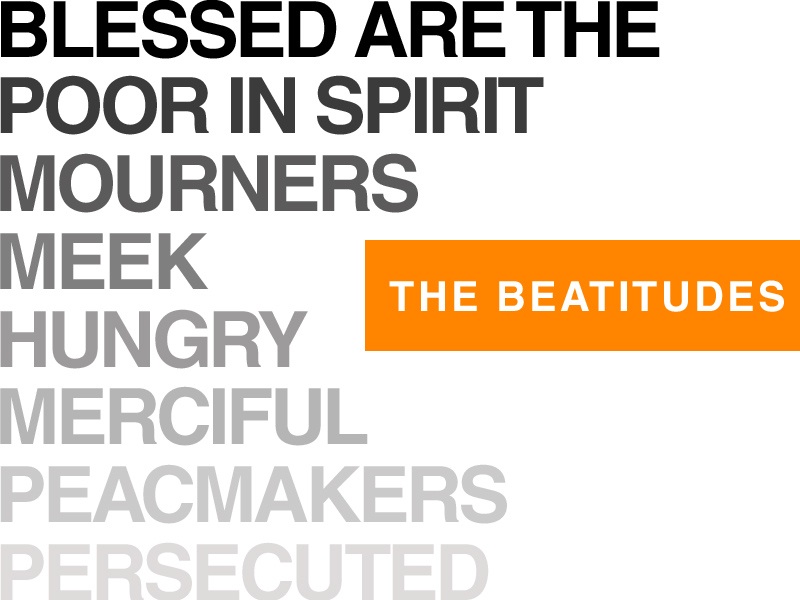
 This is a sermon I spoke at three services at Shiloh Community Church in Orleans MI last weekend (Palm Sunday). I focused primarily on poor in spirit, mourning, and peacemaking…
It’s Palm Sunday and we are remembering and celebrating the triumphal entry of The Servant King Jesus – arriving into Jerusalem to the praise and adulation of the multitude — and less than a week later, he is to be brutally and shamefully murdered…
- Next week is the high point of the Christian calendar as we celebrate the resurrection of Jesus Christ from the dead.
- Jesus triumphed over death and hell and bridged the gap between our utter depravity and God’s standard of holiness. (To miss the mark by even a little is still to have missed the mark.)
- We call this sacrifice the Gospel – or Good News.
I believe it is Tim Keller who reminds us that the Gospel is not advice, it is news. It is the ultimate Good News. He suggests that weekend services are not primarily the place to give advice… Gospel-centered (or Christ-centered) change is rooted in remembrance. We are to remind one another of what Christ Jesus has done, not what we must do.
We cannot commend what we do not cherish. -John Piper
The essence of Christian maturity is when the Gospel – or, what Christ has done — gets worked in – and then through our lives, which is what I’d like to spend our remaining time considering.
Turn to Matthew 5 where we will take a look at the Beatitudes. While you’re turning, allow me to offer a few introductory thoughts.
What is Christian conversion? Christian conversion, or salvation, occurs when genuine repentance and sincere faith in Jesus intersect.
- These are not two separate actions – but one motion with two parts:
- As we turn to Christ for salvation we turn away from the sin that we are asking Jesus Christ to forgive us from. (Rom 3:23 – All have sinned and fallen short of God’s standard.)
- Neither repentance nor faith come first – they must come at the same time.
- They are two sides of the same coin.[1]
Contained in the Beatitudes are eight qualities that characterize the life of Jesus Christ, and therefore, through conversion, they begin to characterize our life in Jesus Christ. Jesus calls us to follow him through life and to depend upon his strength and power.
The word beatitude comes from the Latin word meaning “blessed.”
- More specifically the word means exalted joy, or true happiness. (Joy is calm delight in even the most adverse circumstances. Joy fueled Paul’s contentment.)
- With the beatitudes, Jesus dives into our innermost being probing the heart and raising the question of motive.
- What made Jesus a threat to everyone and the reason He was eventually killed was that in His encounters with people (particularly the religious leaders), He exposes what they were on the inside. Some people find it liberating – others hate it.
The Beatitudes, I have come to see, are our surrendered response to the Gospel. I view the Beatitudes as a step-by-step spiritual formation process that moves us toward spiritual depth and maturity. This becomes cyclical as we grow deeper and deeper in our faith. The Beatitudes become the outworking of the Gospel in and through our lives.
Matthew 5:3-10…
3“Blessed are the poor in spirit, for theirs is the kingdom of heaven.
4“Blessed are those who mourn, for they shall be comforted.
5“Blessed are the meek (gentle), for they shall inherit the earth.
6“Blessed are those who hunger and thirst for righteousness, for they shall be satisfied.
7“Blessed are the merciful, for they shall receive mercy.
8“Blessed are the pure in heart, for they shall see God.
9“Blessed are the peacemakers, for they shall be called sons of God.
10“Blessed are those who have been persecuted for the sake of righteousness, for theirs is the kingdom of heaven.
Following is an overview and how one unfolds into the next…The first two are foundational to the Gospel blossoming in and through our lives…
1. Blessed are the poor in spirit…
a. “You’re blessed when you’re at the end of your rope. With less of you there is more of God and his rule.” (MSG)
b. Another translation renders this verse, “Happy are those who know their need for God.” (JBP)
c. What does it mean to be “poor in spirit”? A desperateness of soul that is weary of living in it’s own strength and longs for God’s mercy and grace to come and refresh the soul. In a word, it is DESPERATION.
d. Consider the Prodigal Sons (Lk 15)…
2. Blessed are those who mourn…
a. I have a river of sin in my life – with 3 primary tributaries…
#1 – Original sin (Adam & Eve traded the presence of God for the knowledge of God – and that’s been our core tendency ever since…
#2 – Family of origin issues
#3 – My own dumb choices.
b. As we are honest about the sin that has infected us there will be a transforming grief and accompanying repentance, that surfaces – not only for our own lives, but also for the injustice, greed, lust, and suffering that grips our world.
c. I want to own my sin everyday.[2]
d. This is counter intuitive (paradox – seeming contradiction). We go down to go up; death precedes resurrection; we get to joy by traveling through grief. Our soul wants to find a way around grief, but God says, “No, you must travel through grief – and the good news is, He says, “I’ll go with you and we will do it in My strength and power.”
e. The way of the Gospel is a death and resurrection cycle…
f. The gospel has the greatest potential to captivate us when we understand that we are more depraved than we ever realized and simultaneously more loved that we ever dared to imagine.
g. I don’t mind inviting you to question your own salvation today. If our default mode is, “I’m basically a good person…” then we simply have not understood the gospel.
3. Blessed are the meek…
a. Rick Warren would say, “Meekness is not weakness, but the power of your potential under Christ’s control.”
b. The concept of meekness describes a horse that has been broken. We can either surrender to Christ and invite the breaking, or remain the undisciplined and wild stallion.
c. Grieving over sin and suffering grows meekness in us and delivers us into a humble learning posture (disciple means learner).
4. Blessed are those who hunger and thirst for righteousness…Spiritual hunger and thirst is the growing desire to be empty of those things that don’t reflect God, and initiates a deep longing for wholeness in our lives.
5. Blessed are the merciful…
a. Mercy is entering into another persons feelings – attempting to see things from another person’s perspective – all with understanding AND acceptance…just like Jesus has done for us.
b. As we receive God’s mercy we begin to give mercy – to ourselves and to others.
6. Blessed are the pure in heart…
a. Mercy cleanses our heart and restores purity to our lives.
b. Did you know that your (spiritual and emotional) virginity CAN be restored?
2 Cor 11:2For I am jealous for you with a godly jealousy; for I betrothed you to one husband, so that to Christ I might present you as a pure virgin.
7. Blessed are the peacemakers…
a. Purity gives way to a personal serenity and peacefulness. Peace is not the absence of conflict, but the absence of anxiety in the midst of inevitable conflict – and when others encounter it, they want it too.
b. Our Western concept of peace needs to be considered in the light of the ancient Hebrew concept of peace, which is SHALOM — and means more than our limited understanding of peace (i.e., the lack of conflict).
Biblical SHALOM speaks of a universal flourishing, wholeness and delight; a rich state of affairs in which natural needs are satisfied, natural gifts a fruitfully employed — all under the arc of God’s love. Shalom is the way things ought to be.
Neal Plantinga – “the webbing together of God, humans, and all creation in equity, fulfillment, and delight.”
c. There is a difference between a peacemaker and a peacekeeper.
To be a peacemaker does not mean peace at any cost.
Peacekeeping creates a false peace.
Many of us live out our lives with this false peace and say nothing or do nothing to change it—in churches, homes, work places, and our marriages.
Examples:
(i) A family member makes a scene at a family gathering. It embarrasses you, the rest of the family, but you say nothing. You keep the peace because to go there would unearth a lot of stuff that you just aren’t willing to deal with.
(ii) Your spouse makes insulting remarks to you or humiliates you publicly through critical tone of voice. It grates on you. But you keep silent because you want to keep the peace.
d. We struggle with this false peace because the conventional wisdom of the day is that its better to keep the peace than to make the peace and there is a very real difference.
e. Keeping this false peace insures that real issues, real concerns, and real problems are never dealt with.
f. A façade, or veneer, of peace in that there is calm but the reality is the tension is still there.
g. True peacemakers will challenge and disrupt the false peace.
h. Jesus didn’t have a problem disrupting the false peace of his day.
i. The whole history of redemption, climaxing in the death and resurrection of Jesus is God’s strategy to bring about a just and lasting peace between rebel man and himself and between man and man (Eph 2:14-22)
j. Colossians 1:19-20 puts it like this,
“For God was pleased to have all his fullness dwell in him, and through him to reconcile to himself all things, whether things on earth or things in heaven, by making peace through his blood, shed on the cross.”
k. True peacemakers will give people the benefit of the doubt while graciously bringing up concerns
l. But true peacemakers will deal with what is real. FIRST IN THEIR OWN LIVES…
m. True peacemakers will steward the conflict they find themselves in because God will often use conflict to develop things in our lives that are developed in no other way.
8. Blessed are the persecuted… Living life from a kingdom of God perspective will place us in conflict with those that oppose it (often times it’s “religious” people!).
Without the knowledge of our extreme sin, the payment of the Cross seems trivial and does not electrify or transform.
But without the knowledge of Christ’s completely satisfying life and death, the knowledge of sin would crush us – or move us to deny and repress it. By walking the way of the Beatitudes we hold our depravity and the Cross in a healthy and dynamic tension that will lead to transformation and renewal.
[1] Wayne Gudem, Systematic Theology, p. 713.
[2] “None is righteous, no, not one.” Romans 3:10 (ESV)
“And you were dead in the trespasses and sins in which you once walked, following the course of this world, following the prince of the power of the air, the spirit that is now at work in the sons of disobedience.” Eph 2:1-2 (ESV)

 Gregg A. Caruso