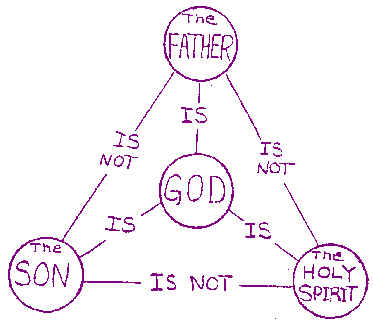
Trinitarian Dance

C.S. Lewis described the Trinity as a “dance” saying, “God is not a static thing…but a dynamic, pulsating activity, a life, almost…a kind of dance” (Mere Christianity, p 136).

Tim Keller elaborates on this concept in the Reason for God in Chapter 14 – The Dance of God (pgs 214-221):

I believe that Christianity makes the most sense out of our individual life stories and out of what we see in the world’s history. In the last six chapters I have been arguing that the Christian understanding of where we came from, what’s wrong with us, and how it can be fixed has greater power to explain what we see and experience than does any other competing account. It is time to draw together the various threads of the narrative we have been examining and view the story line of Christianity as a whole. The Bible has often been summed up as a drama in four acts – creation, fall, redemption and restoration.

The divine dance
Christianity, alone among the world faiths, teaches that God is triune. The doctrine of the Trinity is that God is one being who exists eternally in three persons: Father, Son and Holy Spirit. The Trinity means that God is, in essence, relational.

The Gospel writer John describes the Son as living from all eternity in the ‘bosom of the Father’ (John 1:18), an ancient metaphor for love and intimacy. Later in John’s Gospel, Jesus, the Son, describes the Spirit as living to ‘glorify’ him (John 16:14). In turn, the Son glorifies the Father (17:4) and the Father, the Son (17:5). This has been going on for all eternity (17:5b).

What does the term ‘glorify’ mean? To glorify something or someone is to praise, enjoy and delight in them. When something is useful you are attracted to it for what it can bring you or do for you. But if it is beautiful, then you enjoy it simply for what it is. Just being in its presence is its own reward. To glorify someone is also to serve or defer to him or her. Instead of sacrificing their interests to make yourself happy, you sacrifice your interests to make them happy. Why? Your ultimate joy is to see them in joy.

What does it mean, then, that the Father, Son and Holy Spirit glorify one another? If we think of it graphically, we could say that self-centeredness is to be stationary, static. In self-centeredness we demand that others orbit around us. We will do things and give affection to others, as long as it helps us meet our personal goals and fulfils us.

The inner life of the triune God, however, is utterly different. The life of the Trinity is characterized not by self-centeredness but by mutually self-giving love. When we delight and serve someone else, we enter into a dynamic orbit around him or her, we centre on the interests and desires of the other. That creates a dance, particularly if there are three persons, each of whom moves around the other two. So it is, the Bible tells us. Each of the divine persons centers upon the others. None demands that the others revolve around him. Each voluntarily circles the other two, pouring love, delight and adoration into them. Each person of the Trinity loves, adores, defers to and rejoices in the others. That creates a dynamic, pulsating dance of joy and love. The early leaders of the Greek church had a word for this – perichoresis. Notice the root of our word ‘choreography’ within it. It means literally to ‘dance or flow around’.

The Father…Son…and Holy Spirit glorify each other…At the center of the universe, self-giving love is the dynamic currency of the Trinitarian life of God. The persons within God exalt, commune with, and defer to one another… When early Greek Christians spoke of perichoresis in God they meant that each divine person harbors the others at the center of his being. In constant movement of overture and acceptance each person envelops and encircles the others. (In The Reason For God, Keller quotes from Cornelius Plantinga – Engaging God”s World, from which the above paragraph is taken.)

In Christianity God is not an impersonal thing nor a static thing – not even just one person – but a dynamic pulsating activity, a life, a kind of drama, almost, if you will not think me irreverent, a kind of dance. . . . [The] pattern of this three-personal life is . . . the great fountain of energy and beauty spurting up at the very centre of reality.

The doctrine of the Trinity overloads our mental circuits. Despite its cognitive difficulty, however, this astonishing, dynamic conception of the triune God is bristling with profound, wonderful, life-shaping, world-changing implications.

The dance of love
If there is no God, then everything in and about us is the product of blind impersonal forces. The experience of love may feel significant, but evolutionary naturalists tell us that it is merely a biochemical state in the brain.

But what if there is a God? Does love fare any better? It depends on who you think God is. If God is unipersonal, then until God created other beings there was no love, since love is something that one person has for another. This means that a unipersonal God was power, sovereignty and greatness from all eternity, but not love. Love then is not of the essence of God, nor is it at the heart of the universe. Power is primary.

However, if God is triune, then loving relationships in community are the ‘great fountain…at the center of reality’.

When people say, ‘God is love,’ I think they mean that love is extremely important, or that God really wants us to love. But in the Christian conception, God really has love as his essence. If he was just one person he couldn’t have been loving for all eternity. If he was only the impersonal all-soul of Eastern thought, he couldn’t have been loving, for love is something persons do. Eastern religions believe the individual personality is an illusion, and therefore love is, too. Chesterton wrote, ‘For the Buddhist…personality is the fall of man, for the Christian it is the purpose of God, the whole point of his cosmic idea.’ It is the purpose of God because he is essentially, eternally, interpersonal love…

The dance of creation
Jonathan Edwards on reflecting on the interior life of the triune God, concluded that God is infinitely happy. Within God is a community of persons pouring glorifying, joyful love into one another…

Returning to the dance
…When Jesus died for you he was, as it were, inviting you into the dance…when we discern Jesus moving toward us and encircling us with infinite, self-giving love, we are invited to put our lives on a whole new foundation…

BTW, you can find an excellent unpublished essay on the Trinity by Edwards here.

Random Thoughts From My Stickies

I use the application “stickies” on my Mac to make notes to myself and to collect random thoughts, quotes, or pithy sayings to contemplate or study. Following are some random thoughts from the last few weeks. Sorry I didn’t always record the source…

*God’s perfection doesn’t merely reject or punish evil: it overwhelms it with good.

*Grace – God’s love for tomorrow coming into our life today

*Love – Shared hope (Kim McManus)

*There is a difference between obligation obedience and covenantal obedience

*Shalom results from living in the tension of…

  1. Contentment (Phil 4:6-7)
  2. Justice – making things right (Lk 18:7b-18a) “Shalom-makers”
  3. Righteousness – right relationship, navigate the relationship (Rom 8:31-39)
  4. Loyalty
  5. Community (Col 3:12-17)
  6. Wholeness
  7. Integrity
  8. Salvation

*Paradigm shift  — Gap between stimulus and response (Covey)

*Rules keep us immature

*Virtue comes as a result of moral effort – It’s like learning a new language, it becomes second nature

*We don’t need to learn our love language as much as we need to learn the language of love

*Learn to think Christianly

*The nature of virtue ethics

*The Spirit works to re-humanize us

*Love is not our duty, it is our destiny

*Take a nurturing response toward your emtional self, listen to the emotional self in the presence of God (Ps 139:1-3), draw your emotional self toward God, stay and wait/receive in God’s presence (Ps 46:10; Lk 10:42) — It is scary to be deeply revealing in God’ presence.

*Soul ache

*God comes to you disguised as your life. –Paula D’Arcy

*Every person we meet is Jesus in a distressing disguise.  –Mother Theresa

*Worship is the primary means to transformation

*Gideon and God test one another. God is available for interaction. Invitation to be bold (vs foolish). We are free to be bold.

*God “tests” us to reveal our hearts to ourselves (he already knows).

*OT is brutal and filled with war. The NT concept is that our battle is NOT against flesh and blood (Eph 6).

*Glory of God is among the poor.  –Joel Green

*Take calcium to sleep better

*Spiritual Formation – Intentionally partnering with the work of the Holy Spirit to help people learn to love the Lord their God with all of their heart, mind, soul, and strength.

*Joy does not mean the absence of sorrow, but the capacity to rejoice in the midst of it.  –Gordon Fee

*Bidden or not bidden, God is present. Erasmus/Jung

*God is the goal of God – John Piper

The embrace of faith, like any embrace, is visible.  –Scot McKnight, Dancing Grace (Chap 13)

*Marriage is a duel to the death which no man of honour should decline.
I refuse to die while I am still alive.
–GK Chesterton – Man Alive

Stages of Renewal

I listened to a lecture the other day that concluded with Mark Driscoll quoting Rick Warren on seven stages of renewal.  I can certainly see the pattern to be accurate in my experience and I thought it was very succinctly stated.

I have incorporated some of my thoughts and experience to each of the seven stages and conclude with two quotes that, from my viewpoint, help us to to engage the stages.

1. Personal renewal is about loving God and begins with acknowledging Jesus Christ as our greatest treasure and the object of worship. Personal renewal occurs as we recognize our spiritual poverty and surrender afresh to loving care and instruction of a God who is alive and available. The outflow of this active and intentional surrender is prayer, the reading and study of Scripture, and a growing worship of Jesus and connectedness with him – which renews us from the inside out.

2. Relational renewal is about authentically loving others.  As we embrace personal renewal with Jesus an initial effect is that we have new hope for people and pursue them in love. If married, relational renewal begins with our spouse. And, if we are parents our children ensue. Relational renewal allows us to be authentic around others, stop pretending and performing, and simply be in loving community where we are known and know others, with deep gratitude for the work of the gospel.

3. Missional renewal awakens in us a hope and love for the Great Co-mission. Once we have personal and relational renewal, the result is that God’s people want to be on mission together doing what God calls the church to accomplish. Without personal renewal, a church cannot have relational renewal. And, without both a church has no life or unity that allows them to press forward on mission with God together.

4. Internal cultural renewal happens as the fruit of personal, relational, and missional renewal forms a new culture of grace internally and new passion for lost people externally. In a church this results in people trusting their leaders and one another more, wanting to spend more time together, worshiping with greater intensity, and hanging out longer after services – as they begin to realize they are becoming a unified community.  This also increases innovation, a willingness to risk, and a burgeoning missiology.

5. Structural renewal is necessary once the personal, relational, missional, and internal renewals have been initiated and creates the need to change how a church operates. What structures have hindered growth?  What structures can be implemented so the church won’t have a bottleneck as the church grows? There is no perfect structure in Scripture because every situation is different. Rick Warren speaks of changing structures just about every year at Saddleback. We can’t put new wine in old wineskins. As a church begins to get healthier and healthier, the structure needs to change.

6. Institutional renewal happens when Christianity’s institutions change. Institutions – like seminaries and denominations are usually the last ones to change; they have difficulty with the change process. Unfortunately, institutions generally exist to preserve the change of the previous generation. It’s like a tree – the growth of a tree is not on the trunk but on the new branches. Institutions are like trunks. They provide stability not innovation.  Innovation happens at the local church level.

7. External cultural renewal is the fruit of personal, relational, missional, internal, structural, and institutional renewal. It might be best described as the outworking of Acts 2:43-47: A renewed sense of awe, wonders and signs taking place, refreshed and authentic community, mutual identification amongst classes and cultures, equality, unity, enthusiastic joy, heartfelt praise, favor with all the people, and salvations.

Here are two quotes that seem to reflect the attitude that initiates the process:

Charles Spurgeon was converted on January 6, 1850, and on February 1 he wrote the following prayer of consecration:

“O great and unsearchable God, who knows my heart, and tries all my ways; with a humble dependence upon the support of Your Holy Spirit, I yield up myself to You; as Your own reasonable sacrifice, I return to You your own. I would be forever, unreservedly, perpetually Yours; while I am on earth, I would serve You; and may I enjoy you and praise You for ever! Amen.”

James Burns, in Revival, Their Laws and Leaders writes:

“To the church, a revival means humiliation, a bitter knowledge of unworthiness and an open humiliating confession of sin on the part of her [pastors] and people.  It is not the easy and glorious thing many think it to be, who imagine it filled the pews and reinstated the church in power and authority.  It comes to scorch before it heals; it comes to [convict] people for their unfaithful witness, for their selfish living, for their neglect of the cross, and to call them to daily renunciation and to a deep and daily consecration.  That is why a revival has ever been unpopular with large numbers within the church.  Because it says nothing to them of power, or of ease, or of success; it accuses them of sin; it tells them they are dead; it calls them to awake, to renounce the world [system] and to follow Christ.”

Post Valentine’s Day Thoughts

Learning to love well…

It’s been said that loving well is the essence of true spirituality. Loving well involves authentic interaction (or communication) with God, with ourselves, and with other people.

“Love reveals the beauty of another person to themselves”  –Jean Vanier, friend and mentor of Henri Nouwen

Jesus epitomized – and modeled spiritual and emotional health for us.

[Jesus said], “‘Love the Lord your God with all your passion and prayer and intelligence.’ This is the most important, the first on any list. But there is a second to set alongside it: ‘Love others as well as you love yourself.’ These two commands are pegs; everything in God’s Law and the Prophets hangs from them.” –Matt 22:37-40 (MSG)

The religious leaders of Jesus’ day were not able to make the same connection with people as he did. They were competent, diligent, zealous, they were absolutely committed to having God as the Lord of their lives…they memorized entire books of the Hebrew Scriptures, they prayed five times a day, they faithfully tithed off all their increase — plus gave money to the poor, and they evangelized – yet there is little evidence that they delighted in people.

The word incarnate come from a Latin word that means – in – flesh. Jesus choose to limit himself to the confines of human history and a human body.

John 1:14 in the MSG translation says:

“The WORD became flesh and blood and moved into the neighborhood. We saw the glory with our own eyes.”

Today the incarnated presence of God is intended to be the Church – identified in the Bible as the Body of Christ.

3 Dynamics of Incarnational Life…

1. Enter another’s world. James 1:19; Philippians 2:5-8

“Understand [this], my beloved brethren. Let every [person] be quick to hear [a ready listener], slow to speak, slow to take offense and to get angry.” James 1:19 (AMP)

What does it mean to enter “another’s” world?

To care means, first of all, to be present for each other. — Henri Nouwen

What does it mean to be fully present, or become “a ready listener”?

  • Put your own agenda on hold
  • Look people in the eye
  • Practice reflective listening:
  • Allow the other person to speak until their thought is completed
  • Try and restate their thoughts in your own words
  • Don’t try to fix people.
  • Be cognizant of body-language (only 10% of communication is verbal!)
  • Validate people’s feelings. We can validate without being in agreement. (Feelings are neither right, nor wrong, they just are.)
  • Try not to become defensive…

2. Hold on to your world. Ephesians 2:10; John 15:15

“For [you] are God’s masterpiece. He has created [you] anew in Christ Jesus, so [you] can do the good things he planned for [you] long ago.” Eph 2:10, NLT (singular & plural)

In The Emotionally Healthy Church Pete Scazzero states that this dynamic (holding on to our world) is the most difficult and challenging principle to apply. He asserts…

“It is the key to conflict resolution. It is the key to responding in a mature loving way when other people push and challenge your desires, values, and goals inside or outside the church. It is the key to serving as a leader, in any capacity…Without this ability to hold on to yourself, it is not possible to be an imaginative, creative leader who breaks from the status quo and leads people to new places.” (p. 185)

What does it mean to “hold on to your world”?

  • Recognize that we almost always have a choice. (The choice often involves choosing between “peacekeeper” or “peacemaker.”) Peacemakers create false peace.
  • Determine and set clear boundaries:
  • Identify and be clear about limits. Don’t allow people to make demands of you. Allow people to make requests, but not demands. If you hear a request that makes you uncomfortable, your discomfort may be a signal that this is an attempt to invade your boundaries.
  • Learn to say The Graceful “NO.”

“Good boundaries attract good friends.”

3. Live in the tension of both. 1 Corinthians 13:4-7; Matthew 22:37-40

“Love is patient and kind. Love is not jealous or boastful or proud or rude. It does not demand its own way. It is not irritable, and it keeps no record of being wronged. It does not rejoice about injustice but rejoices whenever the truth wins out. Love never gives up, never loses faith, is always hopeful, and endures through every circumstance.” 1 Cor 13:4-7 (thought to be a description, not a definition)

  • Living in the tension of another’s world and your own world happens when we are willing to authentically connect with people across our differences (including religion and politics). Civil, or respectful, dialogue…
  • When authentic, incarnational Christian love, or spirituality, is released in a relationship God’s presence is manifest.
  • When we ignore conflict we create a false peace. Jesus was murdered because He disrupted the false peace all around him. True peacemaking disrupts the false peace.

“Do not suppose that I have come to bring peace to the earth. I did not come to bring peace, but a sword.” Matt 10:34

  • We cannot have true peace in the Church, or society, with pretense and façade.

To care means, first of all, to be present for each other. –Henri Nouwen