The Art of Servicing Growth and Momentum in the Local Church

Abstract

This post explores the dynamics and challenges local churches face during periods of growth, emphasizing the importance of creating effective systems and frameworks to manage these changes. It highlights the distinction between goals and results, emphasizing that church growth is not the ultimate objective but a byproduct of deeper spiritual engagement and community service.


In the Church world, we often confuse the fruit for the goal. Here are some examples:

  • Church growth is not the goal but the fruit. The goal is prayerful partnering with the Holy Spirit to build an infrastructure that will care for, instruct, and disciple members and attendees and strategically serve the surrounding community.
  • The church is not the goal but the fruit of kingdom ministry. This is why Jesus stayed 40 days after the resurrection and spoke “of the things concerning the kingdom of God” (Acts 2:3b).
  • The Great Commission is not the goal but the fruit of active and passionate engagement with the Great Commandment. This is stated well in the opening lines of the Westminster Shorter Catechism, “What is the chief end of [humankind]?” The catechist is then to respond, “[Humankind’s] chief end is to glorify God and enjoy him forever.”
  • Obedience is not the goal but the fruit of active and ongoing surrender to God’s empowering grace, which will do in us and through us what we cannot do on our own. Paul navigates this as he moves from the end of Romans 7 into Romans 8.

With that said, let’s consider the art of servicing growth and momentum in the local church…

As Churches Grow Dynamics Change

When churches are smaller, relationships carry things; in larger churches competencies need to carry things, and organizational systems, including policies and procedures, need to be re/designed and implemented to correspond to growth. The lack of appropriate systems can create a condition of ambiguity that increases the chances for unnecessary conflict to erupt. In the larger church, the guests and visitors are different kinds of “shoppers.” Relational equity that the staff once enjoyed when the church was smaller, when all were treated as part of the family, is replaced by the demands for performance and competency that are much more exacting. A larger and larger percentage of the congregation is going to be “competency expecting,” placing sometimes unrealistic demands on the staff that are not mitigated by the relational coziness that had been enjoyed by the older, earlier congregants.

If there are no agreed-upon updated operational systems it means leaders have not engaged in pre-thinking different scenarios, which introduces unnecessary anxiety into the system, which can also lead to conflict, which can be the result of unmet expectations because the church has overpromised and underdelivered.

In the larger church, there is a more fragile system to deal with. After growth spurts it’s very common for some people not to make the transition to a larger church where they won’t know everyone. Some people will hunger for the more relational approach of the past. This can also cause conflicts if it’s not managed well. Typically, when a church grows (past barriers), some of the staff, who cannot migrate from minister roles to team building equipper roles, choose to go back to smaller churches because the satisfactions they need and the relationships they desire are found in smaller churches, which is not wrong. This discontinuity can also cause conflict if not managed well. There is a saying in family systems theory that the presenting issues are rarely the real issue. Many of these conflicts can be resolved through a growing understanding of family systems theory. It is helpful to remember that all conflict is an opportunity—to know God and one another better.

There Are Mandatory Disciplines for Serving Momentum

Surges will continue if leaders service them. However, the growth catapults the congregation into a new dilemma. In smaller congregations, most problems are solved informally by the way people behave. The demands are not such that they require a systems style of thinking.  In a larger church, leaders can’t ignore problems and have them go away. 

After a season of growth, a church will develop “stretch marks.” The church may have more people than their systems are capable of assimilating (e.g. not enough small groups or enough leaders in place) and the church can get caught between two systems of ministry delivery. There’s a system of ministry delivery at the Sunday service level that remains basically constant (music, preaching, CM, etc.). The pulpit looks the same to everybody. What changes, however, are the things that are done under the umbrella of the Sunday service. Is the ministry being done by professionals or volunteers? In a larger church, the ministry needs to be increasingly mediated by volunteers. There is a need to create multiple systems that are suitable for volunteers to do the work of ministry. Volunteers do not have the same proficiencies as professionals have (e.g., teaching skills, Bible knowledge, etc.). Real ministry increasingly needs to be accomplished in smaller groups where conversational and facilitation skills are developed. There is a need, at that point, to create far more structures/systems that are led by lay people with lay levels of skill and higher relationship factors to bring people along. The proficiencies needed are less because there are higher quantities of relationships involved. (People will survive while their lay leaders are searching out answers for them; whereas, if a professional doesn’t have an answer for them, they will be less likely to stay connected.) Attendees are bonded by their relationships – it’s a social factor that attracts people, holds them, works with them, and supports them over time.

The staff is required to move from providing ministry to assuring that ministry is provided. Thus, a BIG shift must occur. A whole new delivery infrastructure must be configured. The staff needs to move from being “all-powerful,” super-trained, super-competent, “do most of the ministry” people to making sure that the lay leaders can operate effectively in loving and caring for people. This requires that staff adopt the technology of facilitating ministry through building teams. The hindrance is that it’s counterintuitive. The staff will have to lose the ability to minister alone and use every direct ministry opportunity to train lay people for ministry. The staff (and board) needs to move from a “shepherd” mentality to a “rancher” mentality.

Stephen Covey wrote about the difference between “production” and “production capacity” (PC).[1] Consider how much production a staff or elder is capable of. Every once in a while s/he can double their production, but only for the short-term—and then s/he needs some recovery time. But if staff can “clone” themselves, they can double, triple, quadruple, etc. their production capacity. Eventually, this can lead to exponential growth. It’s a strategy of lay ministry enlargement that we see in 2 Timothy 2:2, which states, “The things which you have heard from me in the presence of many witnesses, entrust these to faithful [people] who will be able to teach others also.”

Again, the staff needs to see themselves as “minister-makers” instead of ministers. There is a difference between ministers and leaders; ministers build people and leaders build groups, or teams, of people. It’s like the wings of a bird, the church needs both to fly straight. This doesn’t happen through proclamation alone; it involves proactively building a leadership development pipeline along with discipleship/spiritual formation pathways. The hand-off to lay leaders occurs in steps. Lay leaders are the key to maximizing a church’s potential. So, the question becomes, “How will we recruit, train, deploy, mentor, and nurture lay leaders to a high level of competence so that they’re actually caring for people reliably and effectively?” And it is wise to help leaders develop skills for life, not just church work.

There is a need to define and update the roles of both vocational and volunteer staff with clarity so that all will see that lay leadership is a privilege they are capable of. (Not to see themselves as “waterboys” for the professionals but to see themselves as ministry leaders in their own right.) Systems must be in place to provide strategic support to lay leaders.

Leaders need to be coached to replace themselves. New leaders are incubated as attention is given to the development of apprentices. Give prayerful and purposeful attention to replicating leaders. The best place to train a leader is at the shoulder or elbow of another leader. Coaching is only effective when apprentices are present. Wherever there’s the absence of apprentices, the coaching is deficient.

A Systems Approach to Leadership

One of the keys to functioning in a healthy manner as a church is for the leaders to look at the church as a system rather than a collection of isolated people.”[2] As stated earlier, a lack of awareness of the church as a family system could cause a congregation in times of conflict to focus on symptoms rather than the more complex systemic issues.

Churches exhibit both organizational and family characteristics. In both cases, the challenge is to think systematically about the way problems arise and see both successes and problems as a sum of the whole, rather than as individual parts.[3]

Six family system theory concepts frequently affecting the church:

  1. Maintenance of origins (Homeostasis) — the tendency to habitually preserve principles and practices within the organization, even when they are detrimental.
  2. Problems-symptoms/root (Process and Content) — the incapability of leaders solving a problem without first understanding the root source of the problem.[4]
  3. Non-anxious presence — the ability of the leader to define his or her life apart from the surrounding pressures of ministry, thus freeing the leader to have a clear head when dealing with problems.
  4. Over responsibility (Overfunctioning) — the tendency for leaders to take responsibility for problems for which they are not responsible, thus allowing others to maintain irresponsible behavior patterns.
  5. Triangulation of relationships — when two people, are at odds with one another one (or both) triangle one or more people into the problem and it magnifies and multiplies the conflict. Triangulation is a form of gossip.
  6. Identified patient (or scapegoat) — a leader who begins to exhibit the symptoms of a dysfunctional system can be made to appear to be the problem when in reality the problem is the system that created the symptoms.[5]

Organizationally, churches may be viewed from a series of perspectives:

  1. Structural factors — including roles, goals, and the structures and systems that make the church work.
  2. Relational factors — focusing on developing a fit between people, their gifts/skills, and the jobs they do.
  3. Political factors — involving power, conflict, control, and coalitions that form within the church.
  4. Cultural factors — involving the shared values, corporate stories, heroes, and milestones that give a corporate culture to the organization.[6] Each of the system concepts and organizational perspectives gives important clues to understanding the life of the church.

Governance Issues

There are many different ways to govern a church. A policy-based governance model occurs when the church board makes decisions through the use of clear and consistent policy, based on biblical directives. Policies are the beliefs and values that consistently guide or direct how a church board arrives at decision-making.

Policies are articulated carefully as the board prayerfully considers what the Holy Spirit is saying to them in their unique context and seeks to build the infrastructure to accomplish the vision.

The fundamental principles of a policy-based governance model have their roots in biblical principles including:

  • Servant Leadership
  • Mutual Accountability
  • Empowerment with constraint
  • Clarity of Values
  • Integrity
  • Role Clarity
  • Distinguishing between ‘ends’ (board role) and ‘means’ (staff role)

Administration Issues

As churches grow larger, the staff needs to learn how to do things that boards used to do when the church was smaller. It used to be that the board managed everything, and the staff did the ministry. As the church grows and develops, boards need to look at policy and approval issues while the staff does the planning and managing. The ministry is done by the lay leaders who are under the care and development of the staff.

A very significant shift occurs when a smaller church becomes a larger church. In the larger church the board oversees, the staff leads and manages, and members do the “work of the ministry” (Eph. 4). In the smaller church the board leads and manages, the staff does the ministry, and the lay people receive the ministry. The larger church paradigm is an essential shift in thinking. Administration must be placed around what the Holy Spirit wants and is doing in a congregation. The aim is to protect koinōnía so that it can continue to move the church forward.

Initial Goals for Staff Members in the Larger Church

Once updated role descriptions and specific goals and objectives are established the Executive Pastor’s role is to serve the staff and the leaders by coaching/equipping/resourcing them toward the accomplishment of the mission and vision of the church, as well to direct them toward the fulfillment of their own personal calling and unique contributions to the kingdom of God. 

A system of regular developmental performance reviews based on their capacity to build and oversee ministry teams needs to be established.

A system for the staff to report on both their maintenance goals as well as their proactive goals will help to keep everyone on the same page. In many churches, the staff will spend around 90% of their time doing ministry and around 10% equipping others to accomplish ministry. In a larger church, those percentages should be reversed over an agreed-upon time frame.

A lack of organizational systems can significantly contribute to workplace conflict in several ways:

  • Unclear Roles and Responsibilities: When an organization lacks clear systems for defining and communicating roles and responsibilities, it often leads to:
  • Staffing ambiguities: Employees may be unsure who is responsible for specific tasks or decisions, leading to conflict over ownership and accountability.
  • Overlap in duties: Multiple people may end up trying to do the same work, causing frustration and inefficiency.
  • Tasks falling through the cracks: Important responsibilities may be neglected because of a lack of clarity.

Ninety+ percent of churches need to improve their communication channels. Without proper communication systems in place:

  • Information silos can develop, where departments or teams where crucial information is not passed along.
  • Misunderstandings become more common due to incomplete or inaccurate information being passed along.
  • Lack of transparency can breed mistrust and suspicion among staff (and congregants).

In the absence of structured resource management systems there will almost always be resource allocation issues:

  • Competition for limited resources intensifies, as departments contend for budget, personnel, or equipment without clear allocation processes.
  • Perceived inequitable distribution of resources can lead to resentment and conflict between teams or individuals.

Poorly defined or inconsistent performance management systems can result in:

  • Lack of common performance standards across different departments or roles can lead to perceived unfairness.
  • Unclear criteria for promotions or raises can cause frustration among employees.
  • Ineffective feedback mechanisms, leave employees unsure about their performance and career progression.

Without clear decision-making systems:

  • Power struggles may emerge as individuals or departments seek to influence decisions.
  • Delayed or inconsistent decisions can create uncertainty and frustration among team members.
  • Lack of buy-in for decisions made without proper collaboration or transparency.

The absence of conflict resolution policies and systems can lead to:

  • Unresolved conflicts fester and escalate over time.
  • Inconsistent handling of disputes creates perceptions of favoritism or unfairness.
  • Avoidance of addressing conflicts, resulting in decreased productivity and morale.

Conclusion

When we mistake the biblical fruit for organizational goals we may miss out on the interior growth that is necessary for long-term effectiveness in church life. With that being said, churches are wise to implement clear organizational systems, policies, and procedures that address these infrastructure areas, which can significantly reduce the potential for conflict and create a more harmonious and productive work environment. Effective systems provide structure, clarity, appropriate accountability, and fairness, which are essential for minimizing workplace conflicts and fostering collaboration.

[1] Stephen R. Covey, The 7 Habits of Highly Effective People, Simon & Schuster, 1989: 54, 109, 138, 243.

[2] Ronald Richardson, Creating a Healthier Church: Family Systems Theory, Leadership, and Congregational Life, Minneapolis, MN: Fortress Press, 1996: 26.

[3] Edwin H. Friedman, Generation to Generation, Guilford Press, 1985:216.

[4] Tim Keller referred to this as “the sin beneath the sin.”

[5] Woodrow Kroll, The Vanishing Ministry, Kregel, 1991:32.

[6] Malphurs, Leading Leaders: 118.

Advent Love

From a sermon preached at Calvary Church Pacific Palisades on December 24, 2023.

Merry Christmas! Thank you for joining us this Christmas Eve afternoon. You may not have noticed that we have a short Advent Season this year. Advent is a four-Sunday anticipatory journey leading up to the traditional Christmas Eve (or Day) Service. But this year the fourth Sunday of Advent IS today (Christmas Eve), so we are combining the fourth Sunday of Advent with Christmas Eve and this afternoon we will be considering Advent Love.

There is a very popular and free Bible app called YouVersion that has been downloaded more than 700 million times in the U.S. and around the world. In 2023 the longing for hope is reflected in a list of the top 10 verses that users searched for. The No. 1 verse for the third year running was, “So do not fear, for I am with you; do not be dismayed, for I am your God,” — Isaiah 41:10. Other popular searches included more familiar verses like, “For God so loved the world, that He gave His only begotten Son, that whoever believes in Him shall not perish, but have eternal life.” –John 3:16. And “For I know the plans that I have for you,’ declares the LORD, ‘plans for welfare and not for calamity to give you a future and a hope.’”  –Jeremiah 29:11

This is a verse that had a strong effect on me when I was 20 years old. I had an encounter with God a few months after reading this verse. A friend who became a Jesus follower gave me a used Bible. I took it home and sat it on the dining room table wondering where I should start, so I just opened the book and looked down and Jer 29:11 was highlighted, so I read it and thought, “Well, there’s two things I don’t have yet – a future and a hope. I should probably keep looking into this Christian thing…”

Hope, as most of you know, is a traditional Advent theme and one that we addressed three weeks ago in our Advent series, Good News, Great Joy. We have looked at the Advent themes of HOPE, PEACE, and JOY. By way of reminder, here’s a (very) succinct overview…

Advent HOPE is a life-shaping certainty that our ultimate future is found in the eternal love and glory of God. A holy and practiced HOPE can overwhelm whatever grief we may be experiencing.

Advent PEACE is not merely the absence of conflict or fear but an unshakeable confidence and trust in God’s wise and good control over our lives.

Advent JOY is delight and gladness in God and His salvation for the sheer beauty and worth of who God is. The counterfeit of JOY is mere happiness.

And for the next few minutes, we will be considering Advent Love.

Why these themes?

Because of the incarnation of Jesus, the Christ we now have an awakened HOPE that gives way to an abiding PEACE, which blossoms into a fragrant JOY that causes God’s sacrificial LOVE to flourish.

I have a non-traditional advent verse for us to consider today… “See what great love the Father has lavished on us, that we should be called children of God! And that is what we are!”  –1 John 3:1a (NIV) [notice the exclamation points…] Just a bit of context…John was the sole remaining survivor of the original 12 apostles who had intimate and eyewitness friendships with Jesus — and John is likely between 85-90 years old as he’s writing this letter.

John wrote the Gospel of John, and he also wrote first, second, and third John. The Gospel of John was written that we might believe. The Letters of John were written that we might know – as in having assurance. Assurance that the Christian faith is true. Assurance of our own salvation. Assurance of God’s love for us, which I’d like to focus on today.

I’d like to draw out two aspects of this verse as we consider God’s Advent LOVE…

  1. The FOCUS of God’s great love.
  2. John’s EXPERIENCE of God’s great love.

The FOCUS will be fairly familiar to many of us, but considering John’s EXPERIENCE may offer a fresh perspective for some of us. With that said, here’s the big idea for us to reflect on this Christmas Eve:

There is a difference between knowing ABOUT God and truly KNOWING God.

Let’s look at these two aspects one at a time…

  1. The FOCUS of God’s great love.

The first thing we need to notice in 1 John 3:1a is that “The Father has lavished great love upon us.” [I love that word lavish…]

The Greek word for great in this verse literally means “from what country?” If we were to contemporize the phrase it would mean that this love is “unworldly,” or, out of this world. (used 7x’s throughout the NT). This same word is used in Lk 1:29 when the angel Gabriel appeared to Mary and told her she was “favored, and the Lord was with her.” She was “pondering this ‘unworldly’ salutation.” This word is also used in Mat 8:27 when Jesus spoke and calmed the ragging sea and the disciples looked at each other in the boat and basically said, “Who is this guy?!?”

The Greek word for love in 1 Jn 3:1 is agape. Simply stated, AGAPE LOVE is a sacrificial serving that reaches out to people who don’t deserve it. (“For God so loved the world…”) C. S. Lewis wrote a book entitled The Four Loves in which he unpacks four different Greek words for love. Lewis uses the word charity to describe agape love. Lewis writes that charitable love allows us “to love what is not naturally loveable; lepers, criminals, enemies, morons, the sulky, the superior, and the sneering.”[1]

What does it mean that we are “called children of God”? It’s not just an expression, there is a theological order of salvation. First, there is an outward call that people hear with the ears of faith, which leads to regeneration where God sovereignly imparts spiritual life into the hearers, which leads to conversion where we confess our sin and selfishness and then willingly surrender to the call of God, which then leads to justification where we are instantaneously and legally forgiven of all of our sins, which then leads to our adoption wherein God makes us members of His family. And this adoption includes becoming “partakers of the divine nature” (1 Pet 1:3-4.) And with this gift of divine nature, we then begin the lifelong journey of sanctification (or transformation).

Think of God as Judge and Jury. He declares us “not guilty.” Then He gets up and comes around the bench, takes off His robe, and adopts you into His family. One theologian says that “God gives [us] His own life and love in adoption.”[2]

This is the kind of love you and I are invited into…Advent and celebrating Christmas gives us space to step back and reorient our lives to both receive God’s love as well as to share God’s love.

2. John’s EXPERIENCE of God’s great love.

The old KJV translates this verse as, “Behold, what manner of love the Father hath bestowed upon us, that we should be called the sons [lit children] of God.” Most English translations do not do justice to the Greek rendition. In the NIV translation, at least have the exclamation points at the end of the first two sentences. A literal translation might be: “Look at the sort of love the Father has given us!” [3]

So, what’s happening here? As John is writing about assurance and thinking about what he’s about to write, he gets caught up in worship and adoration. And we, the readers, experience John experiencing God. Grammatically, these verses can be described as parenthetical, meaning they could have been or should have been placed in parenthesis.

This sort of outburst of spontaneous worship and exaltation happens (at least) two other times in the NT. Paul, in writing to the Ephesians in chapter 1:3-14 there is one run-on sentence of 202 words where we readers experience Paul experiencing God. And the same thing happens in Peter’s doxology in 1 Pet 1:3-9. In each instance, we experience each author experiencing God.

Here’s what’s happening…In 1 John 3:1-3, John goes from knowing to beholding. John goes from understanding to standing under – and he’s not just writing about it – he’s demonstrating it to us. It’s like the truth of Scripture becoming radioactive and gushing out of our head and traveling the 18 inches from our head to our heart and then flooding through our soul. Still, another way to think about this is like lightning striking a lightning rod and all of that energy coursing through the rod. Has that happened to you? Have you had an encounter with God where you experienced His love and delight?

This is what I want for every person in this room (or who watches this online). That, by God’s grace and mercy our knowledge ABOUT God would be converted to a personal and experiential knowledge OF God.

Think of a father dropping his son off to college and as the son walks his father to the car, the father stops and grabs his son kisses him, looks him in the eyes, and says: “I love you son and there is NOTHING I wouldn’t do for you to help you become the man that God has called you to be – including die for you.” And the son weeps. Why? It’s not new information. The son already knew his father loved him. But the information becomes new, and he experiences his father’s love in a new and profound way.[4]

When the truth about God, or the truth about our identity as a child of God becomes real to us – it flows out into every other part of our lives.

My longing to understand God’s love and grace exploded into a whole new reality when I realized that Hosea REALLY, REALLY, REALLY loved Gomer.

D.L. Moody a 19th-century American evangelist and pastor was walking up Wall Street in New York City…and amid the bustle and hurry of that city…the power of God fell upon him as he walked…and he had to hurry off to the house of a friend and ask that he might have a room by himself. In that room, he stayed alone for hours [as] the Holy Spirit moved upon him filling his soul with such joy that he had to ask God to withhold His hand, lest he die on the spot from…joy. [5] I want this for you and for me.

As we close and prepare to go on our merry way, I’d like to repeat a verse that I shared earlier. It’s one of the most searched verses from the YouVersion app… “For I know the plans that I have for you,’ declares the LORD, ‘plans for welfare and not for calamity to give you a future and a hope.’”  –Jeremiah 29:11

That’s a pretty encouraging verse, right? And then let’s look at Jeremiah 29:12-13… “Then you will call upon Me and come and pray to Me, and I will listen to you. 13 You will seek Me and find Me when you search for Me with all your heart.”

God has plans for you and me. And He is inviting us to come to Him and pray. Notice that He says that we will find Him (or experience Him) when we search for Him with ALL of our hearts.

It’s not that we need to be all heart all the time. But there is a wholeheartedness that God is looking and waiting for. Have you made your whole heart available to God?

What if your relationship to God is not based on your spiritual resume, but based on the spiritual resume of Jesus, who lived a life of perfect obedience because you and I couldn’t? What if you and I are radically loved because of what Jesus has done? The astonishing and life-changing message of Christmas is that God didn’t just declare his love; he demonstrated it. God didn’t just tell us what love is; He showed it to us, and God is willing and wanting to show up in our lives to reveal Himself and His love to us.

Our cultural symbol for love is a heart because the emphasis is on how we feel. But the Bible’s symbol for love is a cross—a demonstrated and sacrificial agape love that reaches out to people who don’t deserve it. My prayer for you, for me, and for Calvary Church this Christmas is that there would be a refreshed wholeheartedness that would position us for a fresh encounter with the living and loving God.


[1] The CS Lewis Signature Classics, Harper One 2017: 828.

[2] Kyle Strobel. Formed for the Glory of God, IVP 2013: 43.

[3] Colin Kruse. The Letters of John (Pillar New Testament Commentary Series). 1 John 3:1-3.

[4] Adapted from Tim Keller, which is adapted from Thomas Goodwin (1600-1680), an English Puritan theologian and preacher.

[5] R.A. Torrey. Why God Used D.L. Moody, 1923: 51-55.

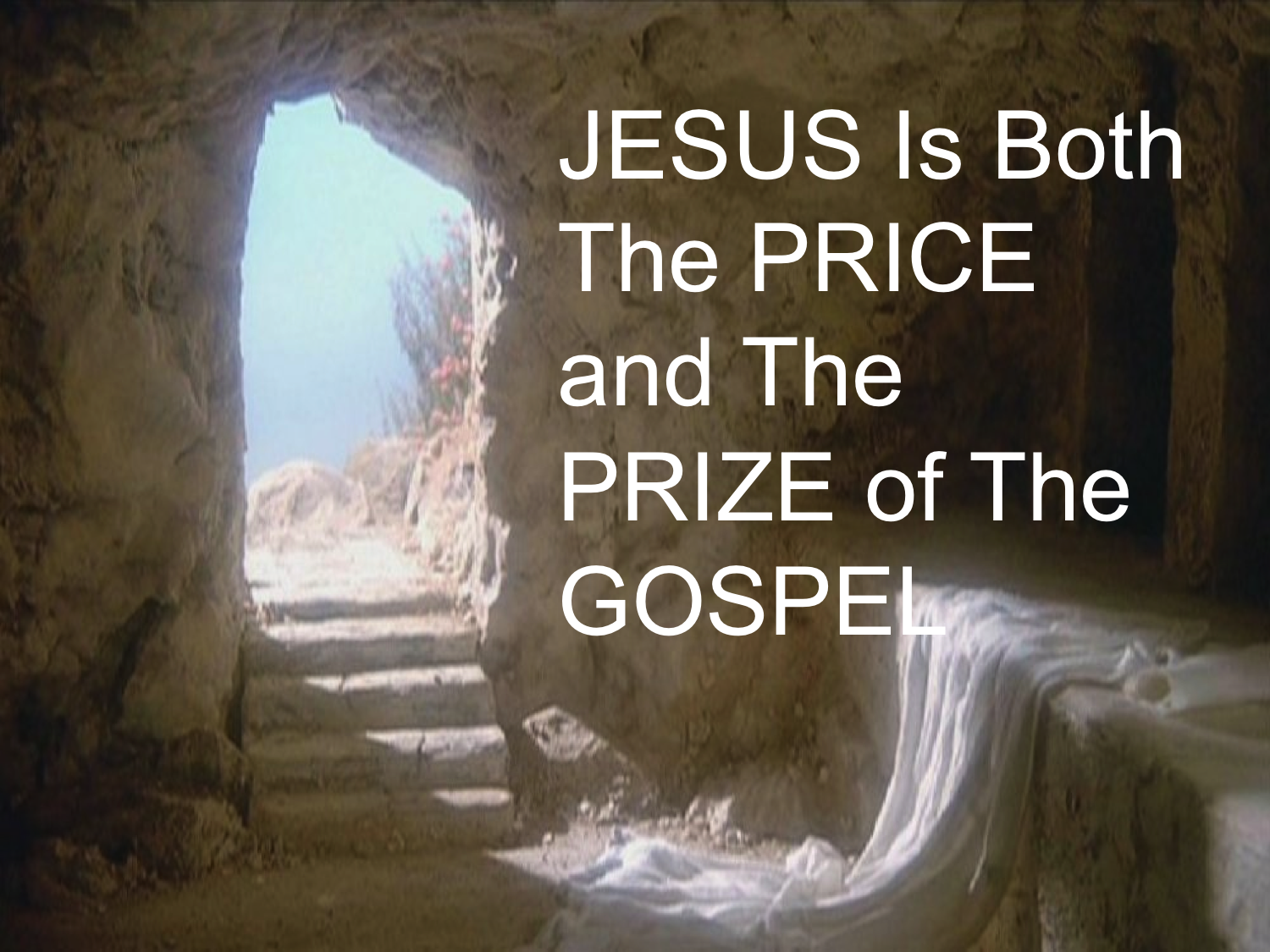
JESUS Is Both The PRICE and The PRIZE of The Gospel

Easter 2013The title of the message today is, “JESUS is Both The PRICE and The PRIZE of The GOSPEL.”[1]

Read Romans 5:6-11…

For while we were still helpless, at the right time Christ died for the ungodly. For one will hardly die for a righteous man; though perhaps for the good man someone would dare even to die. But God demonstrates His own love toward us, in that while we were yet sinners, Christ died for us. Much more then, having now been justified by His blood, we shall be saved from the wrath of God through Him. 10 For if while we were enemies we were reconciled to God through the death of His Son, much more, having been reconciled, we shall be saved by His life. 11 And not only this, but we also exult in God through our Lord Jesus Christ, through whom we have now received the reconciliation.

I find that there is much confusion regarding the meaning (or the message) of the GOSPEL – both in our culture as well as in the Evangelical Church (which is our tribe).

The word “gospel” as you probably know, means GOOD NEWS and is used about 90 times in the New Testament.

Before we get (back) to our text in Romans 5, I would like to make four points to help us grasp the uniqueness of the GOSPEL.  Hopefully, these points will set us up to more fully appreciate both the PRICE and the PRIZE of the GOSPEL…

1.  The GOSPEL represents a distinctive THIRD WAY to both view and live our lives.[2]

  • Traditionally we have tended to view only two types of people:
  • The religious/spiritual, or
  • The irreligious/secular.[3]
  • The GOSPEL is neither religious nor irreligious (secular), but is something else entirely (e.g., Prodigal Sons in Luke 15).
  • The GOSPEL is a third way of relating to God that comes to us by:  grace alone, through faith alone, through the finished work of Jesus Christ alone.
  • This third way, this “grace way,” is exclusive to Christianity.
  • The Christian GOSPEL cannot and does not mix with or blend with any other religious system or philosophy of life.
  • In fact, the GOSPEL is meant to replace the whole concept of religion.
  • I would add that the GOSPEL also does not mix or blend with political liberalism — or conservatism.

2.  The GOSPEL is not good advice, it is good news. 

  • The GOSPEL is not something that we do, but something that has been done for us – and something we must respond to. 
  • In Peter’s first sermon recorded in Acts 2 he was preaching to the gathered Jews and twice he told them, ‘you killed Christ’ (2:23, 36). (Acts 2:37: “Repent, be baptized, and you will receive the gift of the Holy Spirit.”)

3.  The GOSPEL is the good news that we can be saved, or rescued, from the coming wrath at the end of the age (1 Thess 1:10 – “Jesus…rescues us from the wrath to come”).

  • Let’s consider the word “wrath” for a moment… You might say, ‘I don’t like the idea of the wrath of God. I prefer a God of love.’
  • Tim Keller writes, “The problem is that if you want a loving God, you have to have an angry God. Please think about it. Loving people can get angry, not in spite of their love but because of it. In fact, the more closely and deeply you love people in your life, the angrier you can get. Have you noticed that? When you see people who are harmed or abused, you get mad…Your senses of love and justice are activated together, not in opposition to each other. If you see people destroying themselves or destroying other people and you don’t get mad, it’s because you don’t care…The more loving you are, the more ferociously angry you will be at whatever harms your beloved. And the greater the harm, the more resolute your opposition will be.[4]
  • God is unwaveringly holy.  The only way into His presence is sinless perfection.  And that brings us to number 4…

4.  The GOSPEL is news about what has been accomplished by Jesus Christ to reconcile our relationship with God. 

  • Jesus left the comfort and security of heaven and condescended to become a human.  He lived a sinless life so that we could be reconciled to God. The conflict has ended. 
  • Colossians 2:21-22: 21 And although you were formerly alienated and hostile in mind, engaged in evil deeds, 22 yet He has now reconciled you in His fleshly body through death, in order to present you before Him holy and blameless and beyond reproach.
  • Becoming an active intentional follower of Jesus Christ is about a change in status.  We are either “in Christ” or not.  (Used approx. 90 times; “in him” is also used about 80 times…)
  • **Once we find ourselves “IN Christ,” we no longer work FOR (religion) His acceptance (or approval), but FROM (the GOSPEL) His acceptance (and approval).
  • **Obedience is not the obligation of the GOSPEL (or the Christian).  Finding our delight, our comfort, and our JOY in Christ is the obligation of the Christ-follower.  Obedience becomes the fruit, not the goal. (God is not opposed to effort, He’s opposed to earning.) Psalm 87:7: “All my springs of joy are in you.”
  • **The GOSPEL is not about something we do, it is about what has been done for us.

With the above in mind I would like to ask and address two questions:

1.  What is the PRICE? (Rom 5:6-8)

  • The price of the gospel is the death of Jesus Christ.
  • Verse 6: “Christ died for the ungodly.”
  • Verse 8: “But God… Christ died for us.”
  • God loved us while we were still in our sin and paid a PRICE so that we might have an infinite PRIZE. That PRICE was the death of his Son. And we find PRIZE in verses 9-11…

2.  What is the PRIZE? (Rom 9-11)

  • The gospel is the good news that God in Christ paid the PRICE of suffering, so that we could have the PRIZE of enjoying Him forever. God paid the PRICE of his Son to give us the PRIZE of Himself.
    • Justification: God’s forgiveness of the past, together with His acceptance for the future (J.I. Packer).[5]
    • Freedom from the wrath of God — we are saved to BE WITH Him, who is our PRIZE.
    • Reconciliation: The removal of the barrier of sin between God and humankind and now we enjoy absolute and unhindered access to Him (2 Corinthians 5:18: “Christ reconciled us to himself and gave us the ministry of reconciliation”).
    • Exultation (NIV – boast, NKJ – rejoice): The highest good of the good news is finding our JOY in God.  The fullest, deepest, sweetest good of the gospel is God Himself, being delighted in and enjoyed by His redeemed people.
  • The PRIZE of the gospel is the Person who paid the PRICE. The gospel-love God gives is ultimately the gift of Himself. This is what you were made for. This is what Christ came to restore.
  • “In your presence there is fullness of joy; at your right hand are pleasures forevermore” (Psalm 16:11).
  • The GOSPEL message is not that if you follow Him, everything’s going to go well, everything is going to work. The good news, the gospel of Jesus Christ is that you get Him and He’s enough no matter what circumstance comes! 

CONCLUSION

“Imagine yourself as a living house. God comes in to rebuild that house. At first, perhaps, you can understand what He is doing. He is getting the drains right and stopping the leaks in the roof and so on; you knew that those jobs needed doing and so you are not surprised. But presently He starts knocking the house about in a way that hurts abominably and does not seem to make any sense. What on earth is He up to? The explanation is that He is building quite a different house from the one you thought of – throwing out a new wing here, putting on an extra floor there, running up towers, making courtyards. You thought you were being made into a decent little cottage: but He is building a palace. He intends to come and live in it Himself.”   — C.S. Lewis, Mere Christianity

Communion: Rom 5:9: We have been justified by His blood…

When we see the blood in the Bible we can know that it’s a summarized or an abbreviation of the gospel message.  (There are other words that are used by the NT writers as summations of the GOSPEL — including cross, kingdom, and grace.)

Jesus said in Matthew 26:26-28…

26 While they were eating, Jesus took some bread, and after a blessing, He broke it and gave it to the disciples, and said, “Take, eat; this is My body.” 27 And when He had taken a cup and given thanks, He gave it to them, saying, “Drink from it, all of you; 28 for this is My blood of the covenant, which is poured out for many for forgiveness of sins.

We practice an open communion… yet keep in mind 1 Cor 11:28-29:

28 But a man must examine himself, and in so doing he is to eat of the bread and drink of the cup. 29 For he who eats and drinks, eats and drinks judgment to himself if he does not judge the body rightly.


[1] Adapted from a sermon by John Piper.

[2] Adapted from Tim Keller. Center Church, Zondervan 2012:28-30.

[3] Or, moral conformity (moralism) vs. self-discovery (secularism). See Prodigal God by Tim Keller.

[4] Tim Keller. King’s Cross: The Story of the World in the Life of Jesus, Dutton 2011: 176-78.

[5] J.I. Packer. Knowing God, pp. 206-207.

Soul Shift #5 – Our Father In Heaven, Part 2

SoulShiftI. INTRO

I used to play a game at home when my children were younger – much younger.  In this game they might have asked for money for their allowance, or we may have been playing a board game, with dice – and I would have what they wanted in my hands –and I would pretend to suddenly fall asleep. They would start giggling and laughing and crawl all over me while attempting to pry what they wanted from my clinched fists.  Those were some beautiful moments of giggles and joyful laughter and mutual longing – they were longing for the things I held in my hands; I was longing for our closeness, our innocence, and wanting those fleeting moments of sheer joy to last forever.

For me this is a picture of the activity of prayer – while we love God sometimes we are focused more on the gifts in God’s hands rather than hand of God Himself (someone described it as seeking the hand of God and not the face of God) – we pray fervently for the new job, or the return of health.  When we gain the prizes we are delighted and, often, our focus turns to the prize — and away form the momentary closeness of the good Giver Himself.

We are in a series on prayer that we are calling “Soul Shift,” where, as individuals, as couples, as families, and as a church we are asking God to move us from ‘ordinary’ prayer to ‘extraordinary’ prayer.  What does that mean?

It means that when we speak or teach about prayer in church it’s easy for all of us to instantly feel guilty.  A sermon on prayer can amount to a drive-by guilt-ing.

Is there anyone among us who is satisfied with their prayer life?

So, today, let’s not talk about – or, even think too much about what WE SHOULD DO, but let’s take a few minutes to consider WHAT JESUS CHRIST HAS DONE.

If we can lift the eyes of our hearts to see WHAT JESUS CHRIST has accomplished FOR US it will lift the “eyes of our hearts” (Eph 1:17) in worship, in adoration, in joy, in expectancy, and in delight.  It will draw prayer out of us…

Our goal, our objective is that we would leave here today more fully delighting in the Giver than in the gifts.  (Some people’s prayers go something like this: “God, if You get me out of this mess, I won’t bother You until the next one!”)

In our study of prayer we are looking primarily at what has been called The Lord’s Prayer in Mat 6.  (There is a more compact version of the same prayer in Luke 11.)  This prayer is not meant to be prayed ritualistically, but to be viewed as a pattern for prayer.

Here’s the bottom line: **We don’t need to make bigger commitments about prayer, what we really need is to think and to believe truer thoughts about God — thoughts that are shaped by the gospel, by what Jesus Christ has already done on our behalf.

We are called to work, love, to worship, and to pray FROM His righteousness, not FOR His righteousness.  That is the gospel in a nutshell – we work, serve, love, and worship FROM a growing understanding that the death and resurrection of Jesus Christ has won the heart and ear of God on our behalf.

Hebs 4:16: “Therefore let us draw near with confidence to the throne of grace, so that we may receive mercy and find grace to help in time of need.”

We come to God through Jesus Christ.  We don’t have to earn the ear of God in prayer – Jesus has earned the ear of God for us, He has won God’s ear and God’s heart for us — so we come to God in prayer.

The Lord’s Prayer is best used as a model for prayer –or, we could think of it as template – to launch us out into a place or a perspective of reflection, adoration, and gratitude.

For the next few weeks we will be looking at the individual phrases of this model prayer… learning to delight in the Giver of all good gifts.

What we will learn is 1) the initial focus is upward, with its first three requests having to do with God’s glory and 2) the remaining three requests are for our well-being. God first, humanity second – that is the ideal order of prayer.  His glory before our desires.[1]

II. BODY

Today I would like us to look at the opening phrase of The Lord’s Prayer:  “Our Father in heaven.”  Simply stated:

  • The word, “Our” — speaks of community. 
  • The word, “Father” speaks of family.
  • The phrase, “in heaven” speaks of majesty, transcendence (time, space, understanding, etc.), and authority. 

Let’s take some time and briefly consider each one…

1. What does the word “Our” tell us about community?

  • We have left the land of “me” and entered the land of “we.” [2]
  • The Lord’s Model Prayer begins with the acknowledgement that we have been invited out of isolation and into both the joy and the challenge of community.
  • Here’s a simple way to say it: Pro 27:17: “As iron sharpens iron, so one [person] sharpens another.”
  • There are at least three primary and legitimate needs of every human being:
    1. The need to feel authentically human
    2. The need to belong
    3. The need to have a sense of destiny and purpose
  • It is in the heart of God to fully meet these needs in every person. 
  • The first and most important step is through conversion and regeneration, which is the restoration of our individual relationship’s with the living God
  • The next step is through significant relationships with each other
  • Some people find it helpful to think in terms of a cross (), with our relationship with God signifying the vertical and our relationships with each other signifying the horizontal – the cross, and subsequently, Christianity is all about engaging and pursuing both the horizontal and vertical aspects of faith.
  • Our culture, unfortunately, sidetracks us with counterfeit opportunities for community.  The neighborhood bar is possibly the best facsimile there is for the fellowship Christ desires to give His church.  The bar is an imitation — dispensing liquor instead of grace, escape rather than reality — yet it is tolerant, it is ac­cepting, it is inclusive, and it is virtually unshockable.  You can tell people secrets in a bar and they usually don’t tell others or even want to.  Bars flourish not because most people are alcoholics, but be­cause God has put into the human heart the desire to know and be known (Cheers!), to love and be loved.  There are scores of people who seek to medicate their shame and pain for the price of a few beers, drinking their courage instead of turning humbly to Christ.
  • With the opening word of the model prayer Jesus is welcoming us into community.

2. What does the word “Father” tell us about family?

  • With the words, “Our Father,” Jesus is welcoming us into the family of God and identifying Himself as our older brother.
  • The Aramaic word for Father is ABBA.
  • Last week we spoke about the “Abba” Cry/Longing
    • Romans 8:15“For you did not receive a spirit that makes you a slave again to fear, but you received the Spirit of sonship.  And by him we cry, ‘Abba, Father.’”
    • Galatians 4:6“Because you are sons, God sent the Spirit of his Son into our hearts, the Spirit who calls out, ‘Abba, Father.’”
  • According to Jewish rabbinical teachings, slaves were forbidden to address the head of the family by the affectionate title, “Abba.”
  • “Abba” approximates “papa” or “daddy” and implies unwavering trust.
  • “Father” expresses intelligent comprehension of the relationship.
  • Together the two reveal the trusting love and intelligent confidence of a secure son or daughter.

3. What do the words, “In heaven” tell us about authority?

  • It may be helpful to view heaven as a perspective and not a physical place, like a zip code.  God is omnipresent (always present everywhere).
  • God’s omnipresence reminds us of His transcendent nature.  Transcendence is a theological term referring to the relation of God to creation.
  • And so “our Father Who is in heaven” is “other” or beyond His creation.
  • God is independent and different from His creatures: Isa 55:8-9 “For My thoughts are not your thoughts, Nor are your ways My ways,” declares the Lord. “For as the heavens are higher than the earth, So are My ways higher than your ways And My thoughts than your thoughts.”
  • Being beyond His creation and not limited by it or to it. This simple understanding of transcendence makes our privilege of approaching Him intimately like a son or daughter would their earthly father, all the more humbling and praiseworthy.
  • Our transcendent God is also the omnipresent God and is never farther than a prayer away!

III. CONCLUSION

  • Pastor and theologian Arthur Pink, in his book The Beatitudes and the Lord’s Prayer, says, that in these four words: “Our Father in Heaven,”there is a “blessed balance.”[3]
  • The first two words: “Our Father” teach us about the nearness and dearness of God’s relationship to us through Jesus Christ – and they inspire us to confidence and love for God.
  • The second two words: “in heaven,” Pink says, should fill us with humility and awe.
  • He says the first two words (“Our Father”) without the second tends toward an “unholy familiarity.”  And the second two words (“in heaven”) without the first two produces “coldness and dread.”
  • **When we combine these two lofty concepts for the purpose of adoration and prayer we see a marriage of God’s unfathomable love with His immeasurable holiness.
  • In the coming week will you consider giving the best five minutes of your day to God?  Before moving to quickly to petitionary prayer, will you take 3-5 minutes of worship and adoration?  Will you worship God and ask God to open your heart afresh to the wonder, to the reality of what Jesus Christ has accomplished on our behalf.
  • Begin by thinking of it this way:
    1. No one has ever been so rich and became so poor as Jesus Christ.  He left the richness, the perfect love, and perfect communion within the Trinity of heaven.  He condescended to become a man and live a perfect, sinless life so that you and I could enjoy confidant access to a holy and righteous God.
    2. No one has ever been so poor and become so rich as those who’s hearts are awakened to the reality of what Jesus Christ has done – on our behalf.  Has your heat been awakened to that gift?
  • We said at the start that we want to focus more on what Jesus Christ HAS DONE than on what we SHOULD DO.  I invite you to spend a few moments in quiet contemplation…you and I don’t have to work to earn God’s favor.  The perfect, sinless life of Jesus has already accomplished that.  We own our own sin, we repent (surrender), and we believe that we have been made righteous and perfectly acceptable in the presence of a holy God…

[1] Hughes, R. K. Sermon on the Mount: The Message of the Kingdom. Crossway Books.

[2] Shane Claiborne and Jonathan Wilson-Hartgrove. Becoming the Answer to Our Prayers: Prayer for Ordinary Radicals: 18.

[3] Baker Books 1982:80-81.