A History of Spiritual Discernment

This article is an excerpt from Discerning God’s Will Together: A Spiritual Practice for the Church, (Upper Room: 1997) by Danny E. Morris & Charles M. Olsen.

The practice of discernment has roots in the Judeo-Christian tradition. Human awareness of the presence of God prompts questions: God, what are you up to in the world? What is my part in it? The conviction that divine guidance operates in the human world invites us into a process of discernment.

Discernment was developed in the practice of the early church fathers and mothers and worked out in the experience of the faithful. In the 1600s, St. Ignatius put forth the now classical “Spiritual Exercises” on discernment. What emphases on discernment were occurring after the Jerusalem church in Acts 15 and before Ignatius presented the Spiritual Exercises? The tradition of discernment is remarkable.

Origen, in the third century, saw human thoughts coming from three sources: God, evil spirits, and good spirits. If people could trace their thoughts (discern the spirits), they could find a way to give themselves to the proper spirit, for people are moved by the spirits to good or evil. (2)

John Cassian, in the fourth century, followed Origen’s lead. His twenty-four Conferences presented a study of the Egyptian ideal of a monk. The subject of the second conference was discernment. He saw three sources of thought: God (illumination of Holy Spirit), the devil (who makes sin attractive), and ourselves (thoughts of what we have done or heard). “We must therefore keep a close eye on this threefold scheme of our thoughts and we must exercise wise discretion concerning them as they surface in our hearts. Right from the beginning, we will scrutinize their origins and their causes, deciding our necessary reaction to them in the light of who it is that suggests them.” (3)

Cassian said that discernment is the eye and lamp of the body; he referred to the biblical image of the sound eye that produces light for the body and the diseased eye that makes darkness. The monk who discerns:

  • is kept from veering to the left in carelessness and sin, sluggishness of spirit, and pretext of control;
  • is kept from veering to the right in stupid presumption and excessive fervor beyond restraint. (4)

Cassian also offered the image of the test applied by the money-changer who discerned true gold. We are to place thoughts on the scales of our heart and weigh them with exacting care.

  1. Is it filled with what is good for all?
  2. Is it heavy with the fear of God?
  3. Is it genuine in the feelings which underlie it?
  4. Is it lightweight because of human show or because of some thrust toward novelty?
  5. Has the burden of vainglory lessened its merit or diminished its luster?” (1:21) (5)

For Cassian, humility was the path for the search. A monk was to openly disclose his thoughts to his spiritual guide. Self-disclosure and obedience, which produces humility, leads to discernment.

John Climacus, in the sixth century, had great respect for the insights of Cassian. Climacus was selected to be the abbott at Sinai after living for years as a hermit in the desert. In an effort to be a wise abbott, he wrote The Ladder of Divine Ascent, presenting thirty steps for monks to consider. Step number twenty-six is on discernment. He cites Cassian’s work on discernment, which he calls a “beautiful and sublime” philosophy: “From humility comes discernment, from discernment comes insight, and from insight comes foresight. And who would not run this fine race of obedience when such blessings are there ahead of him?” (6) The steps in Climacus’ ladder were arranged in juxtaposition to one another. We should not be surprised to see that number four, “Obedience,” was matched with number twenty-six, “Discernment.”

In Ladder of Divine Ascent, Climacus presents three progressive stages of discernment.

  1. For beginners it is self-understanding;
  2. For intermediates, the spiritual capacity to distinguish the good from what is opposed to it;
  3. For the advanced, direct God-given light, which affects people and the world around them. (7)

The focus of discernment in the early church remained on individuals and on interpersonal relationships. Sensitivity to communal discernment had not yet been developed.

The church in the east and the church in the west developed different patterns of wisdom in discernment and decision making.

The eastern church looked to the wisdom of mystics and ascetics. Bishops sought communal wisdom for the good of the community. Desert fathers and mothers returned to villages where people looked to them for wisdom. The Philokalia (1782) pulled together important sources on discernment, from the fourth to the fifteenth centuries, which would guide the pilgrim in the spiritual life. (8) When God spoke through a spiritual ascetic, debate ended; the ascetic’s capacity to sway others was enormous because discernment was viewed as a gift of God.

Because of their emphasis on the Holy Spirit, the Orthodox churches offer us a unique gift: an understanding of experience through trinitarian structures. The Orthodox see in threes, discerning the presence of God beyond, with, and in experience.

The western church adapted itself to the patterns of the Roman Empire. Early on, Roman law and styles of deliberation were introduced in the church. The great councils of the western church had their roots in the Roman senate, a deliberative body. As the senate debated issues of state, the church argued over issues of doctrine. Participants stood one at a time and presented their arguments, citing authorities who would support them. Then members of the council voted to agree, disagree, or abstain.

The Roman Catholic Church was hierarchical. Cardinals, the great princes of the church, were primary authority figures. The unity of the church was grounded in the authority of the pope. In the western church, discernment was focused by the importance of authority, tradition, unity, and continuity.

Even the monasteries reflected the decision-making patterns of the church in Rome, but with some adaptations. Each monastery had a chapter room where discussion and debate took place. The abbot or abbess may or may not have made final decisions, but the wisdom of the community played a significant role. For Saint Benedict, for instance, the “narrow way” meant walking in another’s discretion and wisdom.

The Dark Ages cast more light on discernment than we are prone to admit. In addition to monastic expressions of faithfulness, the piety of the common people found expression in the mystics of the period. Meister Eckhart and the Friends of God embraced a practical piety that people could understand. Thomas à Kempis, in Of the Imitation of Christ, presented a practical style of discernment that centered on following Christ. (9)

The dawning of the Renaissance took place in the century between the two great councils of the Roman Catholic Church. In the Council of Constance (1415-1418), the powers of the state were present and the schism of the papacy ended. In the Council of Trent (1545-1563), Catholic dogma was formalized in reaction to Protestant tenets of faith, which were considered anathema. The Roman Church defined the authority of Scripture in relationship to tradition and the authority of the pope. Reform, which could have drawn on the practices of discernment, was not included in the agenda of either meeting.

One of the most dynamic centuries in history appeared between these two bookend councils.

During the Council of Constance, John Huss was burned at the stake for invoking the authority of the Bible for discernment. He was the spiritual father of what we know as the Moravian Church.

Ignatius of Loyola, the founder of the Jesuits, in Spiritual Exercises, outlined “Rules for Discernment of Spirits.” (10) The list of rules was extensive and unique. Though many of the rules were drawn from time-honored traditions of discernment, others were new. The rules included the importance of imagination, reason, biblical connections, experience, testing the spirits, and feelings. The affective influences were central. People involved in spiritual discernment put matters to the test-resting them in the heart, looking for consolation, which leads toward God in peace, or desolation, which leads away from God in distress. Rules for discernment of spirits were applied primarily to matters of individual discernment, but could be expanded for the purposes of communal discernment.

The writings of the mystics, John of the Cross and Teresa of Avila, presented another dimension to the process of discernment by introducing the aspect of human desire. Our deepest longings and desires are for God. All other desires are stripped, sometimes painfully, as we find true satisfaction in God and in doing God’s will.

In the Protestant Reformation, Luther, Calvin, and Zwingli brought forth the evangelical principles of grace alone through faith and the centrality of Scripture. Scripture was seen as the divine spectacles through which one could discern God’s leading.

The Protestant Reformation, and influence of John Calvin, in particular, with his emphasis on decency and order, planted seeds that eventually grew in the parliamentary culture in England. Calvin, who found himself in a chaotic setting in Geneva, tried to bring about both order and piety while fashioning Geneva into a city of God. A reading of his Institutes of the Christian Religion reveals how western his thinking was. (11) Without question, he bought into the Greek and Roman methods of rational debate. The voting practices of the Swiss Cantons were followed in the church. Indeed, he stretched the meaning of Acts 14, in which Paul and Barnabas appointed elders, to suggest that the people voted on the appointments with a show of hands.

Calvin was a lawyer by training, relying on rules and ordinances to insure that everything was done decently and in order. Calvin both contributes to and limits our inquiry into discernment by placing emphasis on:

  • The importance of church government. “Each church, therefore, had from its beginning a Senate, chosen from godly, grave, and holy men, which had jurisdiction over the correcting of faults. This office of government is necessary for all ages.” (12)
  • The importance of God’s calling those who lead and decide. “In order that noisy and troublesome men should not rashly take upon themselves to teach or to rule, especial care was taken that no one should assume public office in the church without being called.” (13)
  • The place and importance of Christ as the actual Presider. “Now it is Christ’s right to preside over all councils and to have no man share his dignity. But I say that he presides only when the whole assembly is governed by his word and Spirit.” (14)

“If one seeks in Scripture what the authority of councils is, there exists no clearer promise than in this statement of Christ’s: ‘Where two or three are gathered together in my name, there I am in the midst of them’ (Matt.18:20). But that nonetheless refers as much to a little meeting as to a universal council. Christ will be in the midst of a council only if it is gathered together in his name. I deny that they are gathered in his name who, casting aside God, ordain anything according to their own decision; who, not content with the oracles of Scripture, concoct some novelty out of their own heads.” (15)

  • The importance of reason. “The same thing happened to them [councils] that Roman senators of old themselves complained of – senatorial decrees were badly framed. For so long as opinions are counted, not weighed, the better part had often to be overcome by the greater.” (16)
  • The importance of organization, structure, form, and law to bind us together. “We see that some form of organization is necessary in all human society to foster the common peace and maintain concord.” Therefore, if we wish to provide for the safety of the church, we must attend with all diligence to Paul’s command that “all things be done decently and in order” (1 Cor. 14:40).

“Yet since such diversity exists in the customs of men, such variety in their minds, such conflicts in their judgments and dispositions, no organization is sufficiently strong unless constituted with definite laws; nor can any procedure be maintained without some set form. (Nor can Paul’s requirement – that ‘all things be done decently and in order‘ – be met unless order itself and decorum be established through the addition of observances that form, as it were, a bond of union.” (17)

  • The danger of spirituality. Calvin held a basic distrust of the ascetic. This created a division, a split between spirituality and administration. “But in these observances one thing must be guarded against. They are not to be considered necessary for salvation and thus bind consciences by scruples; nor are they to be associated with the worship of God, and piety thus be lodged in them.” (18)

As much as the fathers of the early church speak of it, discernment did not appear in Calvin’s vocabulary. He rightly feared that devotion to the observances could create a kind of salvation system. (Note the devotion and passion with which some people participate in parliamentary process.) But he also erroneously feared associating the observances, or practices, of communal discernment with worship, lest worship be contaminated. Neither did he want to associate piety (spirituality) with church governance because spirituality moves into an area that is beyond the control of reason. Calvin did not demonstrate any practical awareness that the same Hebrew words are used for worship and work. He would have difficulty with a model of worshipful-work. The separation of governance and administration from spirituality – which is the malady of many church boards, councils, and assemblies today – is therefore solidly rooted in the Reformation!

The Anabaptists tried to model their churches on the New Testament church. They involved the whole faith community in decision making. Because of persecutions, Anabaptists were left with a deep distrust of the state and felt that too many churches had compromised discernment by cooperating with the powers of the state.

Following the Reformation, the seventeenth- and eighteenth-century Quakers made noteworthy contributions to the practice of discernment. They looked to the presence of the Spirit to provide guidance, listened to the promptings of the Spirit in the gathered community, and followed the Spirit’s lead. Listening in silence fostered the intuitive capacity of the community of Friends.

The communal character of Friends’ understanding and practice of discernment was evident from their beginning and is still the character of Quaker meetings today.

In addition, the Friends brought to discernment the practices of coming to a consensus, the clearness committee, making a minute, and registering non-concurrence.

In the Methodist tradition, discernment has played a role in the spiritual growth of individuals and communities. The Methodist movement created for spiritual nurture and guidance three types of small groups: classes, bands, and the select band.

1.     The class was a small group of people who sought a personal relationship with God. The class leader was appointed by the Wesleys or their assistants and was a person with common sense, an experience of saving grace, and the ability to interpret the Bible to the members of the class. Each week, the leader would inquire about the spiritual state of class members, then offer prayer and guidance suited to the needs expressed by individuals. Spiritual discernment came through interaction with the class leader, who asked questions that led people to think about and to listen for what the Spirit intended for their lives.

2.     The Methodist bands were for people who had experienced new birth or saving faith. While the focus of spiritual formation in the class meeting was “to flee from the wrath to come” and “to watch over one another in love,” the focus of the band meeting was to deepen the participants’ discipleship through obedience to the scriptural command to “confess your sins to one another, and pray for one another, so that you may be healed” (James 5:16). Members of the bands and the select bands were accountable to one another, and the will of God was discerned through dialogue, prayer, and experimentation. (19)

3.     The select society or select band provided guidance and support for people who had either the desire or the experience of perfect love: love of God with all one’s heart, soul, strength, and mind. All members of the select band (including the Wesleys) were peers. There were no membership restrictions based upon gender or marital status. The group’s focus was on understanding and experiencing perfect love toward God and neighbor. Spiritual discernment was found in the interaction of group members.

In Puritan New England, during the eighteenth century, Jonathan Edwards was concerned about the excesses of the Great Awakening in which he participated. He wanted to provide people with a way of processing their experiences. In particular, he wanted to help pastors deal with members of their congregations who had been awakened. Believing that most experiences of the Great Awakening were valid, he sought to help people look for signs that would separate the wheat from the chaff and identify experiences that were genuine.

In England, the political advent of rule by law and parliamentary procedure had a powerful impact on the church. The Church of Scotland was run by parliamentary rules. In fact, when the powers of state were consolidated in London, the General Assembly of the Presbyterian Church in Scotland took over administration of the city of Edinburgh. Scottish leaders who had practiced and refined parliamentary order in Scotland made their presence felt in the Royal Parliament. When the Presbyterian Church in America was embroiled in new school/old school controversies, it needed procedures by which to conduct meetings. The Scots readily provided the manual.

Church history shows that discernment in Europe was made by a body of elite equals, but the parliaments and town meetings that cropped up in every village in America led the church to embrace a culture of argument and persuasion. From about 1820, many churches adopted a faith that common people would discern the truth if they had the facts. The church’s theology of sin and evil fit in with democracy; government by the people would hold in check the evil intentions of a few.

As denominations developed in the United States, rules and procedures for church assemblies gradually became standardized. In 1871, the General Assembly of the Presbyterian Church sent a short set of general rules to the presbyteries. The rules were uniform, so there would be no regional variation.

Prior to this, an officer in the United States Army, Henry Martyn Robert, had given thought to the deliberations of religious assemblies. He had been frustrated by the inept ways that meetings were conducted in his American Baptist church. When asked to preside over a church meeting in 1863, he drafted a brief statement of rules of order based on Thomas Jefferson’s rules for the United States Congress. The experience prompted him to expand on the effort, producing what we know as Robert’s Rules of Order. (20) General Robert wanted to standardize them for use in various religious and civic settings so that people would be familiar with a consistent method of making decisions. The effort was calculated to show that the ways religious bodies make decisions is no different from the way other organizations make decisions. Robert’s rules have been widely used in the church. But they are designed as rules for combat useful in any arbitration. (21)

Historian Michael Cartright points out several other interesting developments that occurred at the same time Robert’s Rules of Order was written. Francis Lieber wrote General Orders 100 on the rules of conduct in war. The methods of fighting created so many casualties (note the casualties in the Civil War) that rules were offered to limit casualties and to make war more humane. Lieber’s rules of combat in war have significance for the concept of just war and for restraint in modern wars.

Cartright also related that a friend of his had been appointed pastor of a church in the Baltimore-Washington Conference. On her arrival at the church, she learned that the two previous administrative council meetings had come to an end when council members started throwing chairs at one another. Everyone felt that a significant transition had been made when the first meeting of the council during her pastorate ended without violence. In that case, Robert’s Rules of Order actually did limit combat!

The rules of order are helpful in handling different points of view on designated subjects. The rules are most helpful in highly charged situations and with large groups; although some of the principles – considering one matter at a time, protecting the rights of the minority, assuring the will of the majority – are important, the rules cannot, in and of themselves, provide the structure for spiritual discernment.

Recent developments in leadership theory, not-for-profit board development, and conflict resolution have influenced church administration. Coupled with a resurgence of interest in spirituality and general dissatisfaction with the present operation of church boards and assemblies, they have led to greater interest in the practice of discernment, both personal and communal. The church can now draw on its traditions of spiritual discernment and order its life and ministries according to the will of God.

Additional Resources: Defining Discernment and Some Basic Assumptions About Spiritual Discernment

Endnotes:
2. Origen, On First Principles (New York: Harper & Row, 1966).
3. John Cassian, Conferences (New York: Paulist Press, 1985) 1:20, 54.
4. Ibid., 2:3, 62.
5. Ibid., 1:21, 57.
6. John Climacus, The Ladder of Divine Ascent (New York: Paulist Press, 1982), 114.
7. Ibid., 229.
8. Kadloubovsy and Palmer, Early Fathers from the Philokalia (London: Faber & Faber, 1954).
9. Thomas à Kempis, Of the Imitation of Christ (New York: Mentor Bock, 1957).
10. Ignatius of Loyola, Spiritual Exercises and Selected Works (New York: Paulist Press, 1964).
11. John Calvin, Institutes of the Christian Religion (Philadelphia: Westminster Press, 1960).
12. Ibid., 4.3.8.
13. Ibid., 4.3.10.
14. Ibid., 4.9.1.
15. Ibid., 4.9.2.
16. Ibid., 4.9.8.
17. Ibid., 4.10.27.
18. Ibid., 4.10.27.
19. The Book of Discipline (The United Methodist Publishing House, 1992), 71.
20. Henry M. Robert III, Robert’s Rules of Order, Revised (New York: Morrow Quill Paperbacks, 1979), iv and v.
21. James Turner Johnson, Just War Traditions and the Restraint of War (Princeton University Press, 1981), 62-63, 297-322.
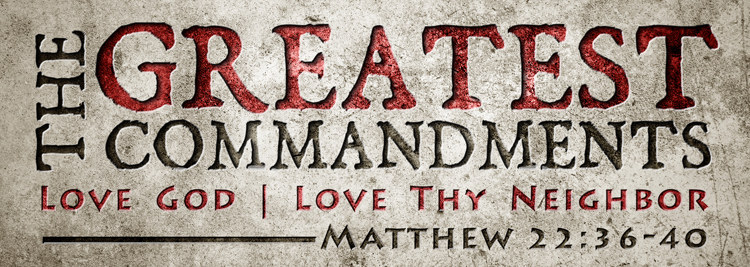
The Great Commandment Pt 1 – Matthew 22:33-40

I.  INTRO

A.   We are going to take the next couple of weeks and look at what the Bible refers to as the Great Commandment.  An important preliminary vision passage because it synthesizes so much of the Bible into two pretty straightforward commands.

B.    Matthew 22:33-40 (NAS): “Teacher, which is the great commandment in the Law?” And He said to him, “ ‘YOU SHALL LOVE THE LORD YOUR GOD WITH ALL YOUR HEART, AND WITH ALL YOUR SOUL, AND WITH ALL YOUR MIND.’ This is the great and foremost commandment. The second is like it, ‘YOU SHALL LOVE YOUR NEIGHBOR AS YOURSELF.’ On these two commandments depend the whole Law and the Prophets.” (Notice the order.  Loving people id the outflow of loving God.)

C.    We will divide this passage up into two messages…

  1. This week: “You shall love the Lord your God with all your heart, and with all your soul, and with all your mind – this is the great and foremost commandment.”
  2. Next week: “You shall love your neighbor as yourself.”

D.   Here are two important questions…

  1. What is God’s heart for Southside Bible Fellowship?  And for you?
  2. What is God’s VISION for us during this transition season?  Vision will focus us.  Vision will restrain us – Pro 29:18 (NAS): “Where there is no vision, the people are unrestrained…” 

II.   BODY

A.   “You shall love the Lord your God with all your heart, and with all your soul, and with all your mind – this is the great and foremost commandment” is a quote from Deut 6:5 and is:

1.     Part of the Shema Yisrael (Heb word for hear), vs. 4-9. The Shema is the central prayer in the Jewish prayer book and is usually the first section of Scripture that a Jewish child learns – as well as the prayer that is most often said each morning and evening by the Jewish people.

4 “Hear, O Israel! The LORD is our God, the LORD is one! 5 You shall love the LORD your God with all your heart and with all your soul and with all your might. 6 These words, which I am commanding you today, shall be on your heart. 7 You shall teach them diligently to your sons and shall talk of them when you sit in your house and when you walk by the way and when you lie down and when you rise up. 8 You shall bind them as a sign on your hand and they shall be as frontals on your forehead. 9 You shall write them on the doorposts of your house and on your gates.”

2.     Rabbi Julian Sinclair: Oneness, [or] unity, is the aspiration of love, and love emerges from a perception of unity. This insight is also expressed in the Shema: its first line declares God’s unity, and ends with the word “one.” Then follows the mitzvah [commandment] to love God. Love comes out of a sense of God’s unity pervading all things.

3.     In the Torah (the first 5 books of the Bible) there are 613 commandments (explicit and implicit).

4.     The 10 Commandments (Ex 20 & Deut 5) are understood to be the root commands — revealing God’s standard of holiness.  They also reveal our need for a Savior.

  • Gal 3:24Therefore the Law has become our tutor to lead us to Christ, so that we may be justified by faith.”
  • The Law is like a dentists mirror – it can point out decay, but can’t do anything about it.

5.     In Deut 5 – the previous chapter, we find the second listing of the 10 Commandments (also in Ex 20).

  • The first two commandments speak to the issue of idolatry:  #1 is Deut 5:7 – “You shall have no other God’s before me.”
  • The 2nd Commandment states – Deut 5:8-10: “You shall not make for yourself an idol, or any likeness of what is in heaven above or on the earth beneath or in the water under the earth. 9 You shall not worship them or serve them; for I, the LORD your God, am a jealous God, visiting the iniquity of the fathers on the children, and on the third and the fourth generations of those who hate Me, 10 but showing lovingkindness to thousands, to those who love Me and keep My commandments.”

6.     Theologians think that if someone were to be able to keep the first commandment the others would not be a problem – because they all have to do with idolatry.

7.     Martin Luther:  All those who do not at all times trust God and do not in all their works or sufferings, life and death, trust in His favor, grace, and good-will, but seek His favor in other things or in themselves, do not keep this [First] Commandment, and practice real idolatry.

8.     Tim Keller:  Sin isn’t only doing bad things, it is more fundamentally making good things into ultimate things. Sin is building your life and meaning on anything, even a very good thing, more than on God. Whatever we build our life on will drive us and enslave us. Sin is primarily idolatry.

9.     So, what are we saying? All 613 unchangeable commandments of the Torah can be summed-up in these two verses (or 6 words): Love God and love your neighbor. Every person on the planet has this built-in longing to deeply connect with God and people.  We were designed, created to be worshippers.  This, then, becomes the grand objective and passion of every human heart.  Augustine said it well:  “Our heart’s are restless until they find their rest in God.”

B.    Years ago Rick Warren said something that, I think, begins to put this into perspective: “A great commitment to the Great Commandment and the Great Commission will grow a great [Christian and a great] church.”

  1. A key and critical question is, how will this commitment be expressed?
  2. The Church (at least in N America) has placed an emphasis on the Great Commission without a sufficient understanding and practice of the Great Commandment.
  3. John Piper:  Passion for God in worship precedes the offer of God in evangelism because we cannot commend what we do not cherish.
  4. I believe this is THE most critical issue facing Southside Bible Fellowship during this season – duty or delight.

C.    So, if we are to “LOVE THE LORD YOUR GOD WITH ALL YOUR HEART, AND WITH ALL YOUR SOUL, AND WITH ALL YOUR MIND” our question is – How do we get there from here?

1.     Come alive to God.  Ephesians 2:1-10 An explanation of the Gospel…

 1 And you were dead in your trespasses and sins, 2 in which you formerly walked according to the course of this world, according to the prince of the power of the air, of the spirit that is now working in the sons of disobedience. 3 Among them we too all formerly lived in the lusts of our flesh, indulging the desires of the flesh and of the mind, and were by nature children of wrath, even as the rest. 4 But God, being rich in mercy, because of His great love with which He loved us, 5 even when we were dead in our transgressions, made us alive together with Christ (by grace you have been saved), 6 and raised us up with Him, and seated us with Him in the heavenly places in Christ Jesus, 7 so that in the ages to come He might show the surpassing riches of His grace in kindness toward us in Christ Jesus. 8 For by grace you have been saved through faith; and that not of yourselves, it is the gift of God; 9 not as a result of works, so that no one may boast. 10 For we are His workmanship, created in Christ Jesus for good works, which God prepared beforehand so that we would walk in them. 

2.     Find your true joy and delight in the message of the Gospel – and the Person of Jesus Christ.

  • My prayer for us as a community of believers: “That we would experience Jesus Christ, the sovereign, risen, living, Lord of the universe; and that He would continue to become THE source and content of our real hope and joy.”
  • One of the most important discoveries we will ever make is:  God is most glorified in you when you am most satisfied in Him (John Piper). This is to be the motor that drives our lives.  This concept, I believe, will be key to this transition season here at SBF.
  • Tragically most of us have been taught that duty, not delight, is the way to glorify God. But here is what the Great Commandment is instructing us to do: To delight in God is your duty!
  • John 15:11-12 (AMP) – “I have told you these things, that My joy and delight may be in you, and that your joy and gladness may be of full measure and complete and overflowing. This is My commandment: [or, out of that joy and delight] that you love one another [just] as I have loved you.”

3.     Come to grips with the idolatry that grips ALL of our lives.

a.     Tim Keller:[1] One of the main ways to read the Bible is as the ages-long struggle between true faith and idolatry. In the beginning, human beings were made [created] to worship and serve God, and to rule over all created things in God’s name (Gen 1:26­–28).

Rom 1:21–25 — Paul understands that original sin as an act of idolatry:

21 For even though they knew God, they did not honor Him as God or give thanks, but they became futile in their speculations, and their foolish heart was darkened. 22 Professing to be wise, they became fools, 23 and exchanged the glory of the incorruptible God for an image in the form of corruptible man and of birds and four-footed animals and crawling creatures.

 24 Therefore God gave them over in the lusts of their hearts to impurity, so that their bodies would be dishonored among them. 25 For they exchanged the truth of God for a lie, and worshiped and served the creature rather than the Creator, who is blessed forever. Amen.

b.     Instead of living for God, we began to live for ourselves, or our work, or for material goods. We reversed the original intended order. And when we began to worship and serve created things, paradoxically, the created things came to rule over us.

1 John 5:20-21“And we know that the Son of God has come, and has given us understanding so that we may know Him who is true; and we are in Him who is true, in His Son Jesus Christ. This is the true God and eternal life. 21 Little children, [speaking to believers] guard yourselves from idols.”

c.     What is idolatry?

  • It exchanging the truth for a lie.
  • Putting our trust in other saviors – “momentary functional saviors,”
  •  “Exchanging God for pitiful substitutes.” (John Piper),
  • Whoever or whatever we give central value to,
  • Whatever controls us is our Lord.

d.     David Powlison writes in Seeing with New Eyes[2]: The most basic question which God poses to each human heart: “Has something or someone besides Jesus the Christ taken title to your heart’s functional trust, preoccupation, loyalty, service, fear, or delight?

e.     Here are some questions that will bring some of our idol systems to the surface:

  • What do I worry about the most?
  • What, do you really want, or expect out of life?
  • What do I use to comfort myself on a bad day?  Cope?  Release valves?
  • What preoccupies me?
  • A Puritan writer from the 17th century said: Our religion is what we do with our solitude (What do you daydream about?).
  • For what do you want to be known?
  • What prayer, unanswered, what make you seriously question God?

f.      Root idols vs. branch (surface) idols:  Lust, like rape, is hardly ever about sex – it’s about self-image, it’s about anxiety, it’s about fear.  These are some of the root idols that seek to control our lives – they are the sin behind the sin…

III.         CONCLUSION

A.   How do we replace our idols?[3]

B.    Idolatry is not just a failure to obey God; it is setting our heart and affections on something, or someone other than God. This cannot be remedied by repenting that you have an idol – or by engaging willpower to try and live differently.

C.    Here’s the final passage for today…

Colossians 3:1-3 (Put On the New Self)

1Therefore if you have been raised up with Christ, keep seeking the things above, where Christ is, seated at the right hand of God. 2 Set your mind on the things above [i.e., YOU SHALL LOVE THE LORD YOUR GOD WITH ALL YOUR HEART, SOUL, AND MIND], not on the things that are on earth. 3 For you have died [to sin, to idolatry] and your life is hidden with Christ in God.

D.   We are invited to rest in, appreciate, rejoice in what Jesus has done through his hideous death – and resurrection.

E.    Jesus must become more beautiful to your imagination, more attractive to your heart, than your idols.

F.    If we uproot our idols (through repentance) but fail to plant the love of God (or, delight in God) in its place, the idol will grow back – like mowing a weed.

G.   Repentance and rejoicing must go together.


[1] “Talking About Idolatry in a Postmodern Age.”

[2] Pgs. 132-40.

[3] Adapted from Counterfeit Gods by Tim Keller, pgs. 170-172.

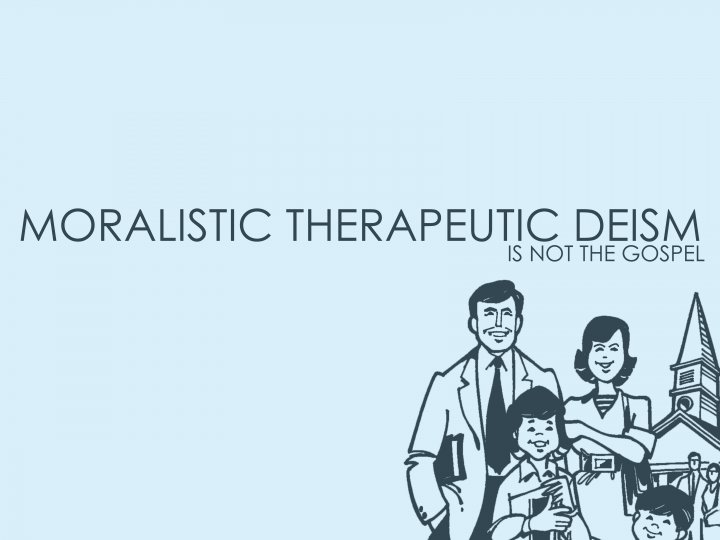
Moralistic Therapeutic Deism – Pt 2 (Teens Are Listening To Us)

It is easy to get caught in the trap of moralism.  You might be asking, “What is moralism?”  Moralism seeks to achieve growth or “Christian maturity” through behavior modificationConsider the following descriptions:

  1. One of the most seductive false gospels is moralism, which can take many forms and can emerge from any number of political and cultural impulses. Nevertheless, the basic structure of moralism comes down to this — the belief that the Gospel can be reduced to improvements in behavior.
  2. Moralism is a religious attitude that tends to look down on unbelievers from a self-righteous position by comparing our supposed moral superiority to theirs. It is as if we believe our entrance into Christianity is by grace but that our growth in Christ is due to maintaining a (NT) moral code.
  3. Those who believe this fall into the trap (perhaps subconsciously) of believing that grace alone (Sola gratia) is insufficient for sanctification. The New Testament authors invite us to bear in mind that God’s commands for us to be holy and love our neighbor etc. are not there to show our ability, but to reveal our inability (e.g., Rom 3:19-20) and to remind us of our continual dependence on the grace of God to do in us and through us what we cannot do (accomplish) on our own.

The pursuit of all things Christian must be anchored in the grace of God or it will be doomed to failure.  Grace is at the heart of the gospel, and without a clear understanding of the gospel and grace we can easily slip into moralism, which bears little resemblance to what the gospel offers us.

Dr. R. Albert Mohler, Jr., president of The Southern Baptist Theological Seminary in Louisville, Kentucky, writes the following about a disturbing and discouraging trend in American Christianity, which adds to the false gospel of moralism

The “Moralistic Therapeutic Deism”[1] that these researchers [sadly] identify as the most fundamental faith posture and belief system of American teenagers appears, in a larger sense, to reflect the culture as a whole. Clearly, this generalized conception of a belief system is what appears to characterize the beliefs of vast millions of Americans, both young and old.

This is an important missiological observation–a point of analysis that goes far beyond sociology. As Christian Smith and Melinda Lundquist Denton explained, Moralistic Therapeutic Deism “is about inculcating a moralistic approach to life. It teaches that central to living a good and happy life is being a good, moral person. That means being nice, kind, pleasant, respectful, responsible, at work on self-improvement, taking care of one’s health, and doing one’s best to be successful.” In a very real sense, that appears to be true of the faith commitment, insofar as this can be described as a faith commitment, held by a large percentage of Americans. These individuals, whatever their age, believe that religion should be centered in being “nice”– a posture that many believe is directly violated by assertions of strong theological conviction.

Moralistic Therapeutic Deism is also “about providing therapeutic benefits to its adherents.” As the researchers explained, “This is not a religion of repentance from sin, of keeping the Sabbath, of living as a servant of sovereign divinity, of steadfastly saying one’s prayers, of faithfully observing high holy days, of building character through suffering, of basking in God’s love and grace, of spending oneself in gratitude and love for the cause of social justice, et cetera. Rather, what appears to be the actual dominant religion among U.S. teenagers [according to the study] is centrally about feeling good, happy, secure, at peace. [Good insight!] It is about attaining subjective well-being, being able to resolve problems, and getting along amiably with other people.”

In addition, Moralistic Therapeutic Deism presents a unique understanding of God. As Smith explains, this amorphous faith “is about belief in a particular kind of God: one who exists, created the world, and defines our general moral order, but not one who is particularly personally involved in one’s affairs–especially affairs in which one would prefer not to have God involved. Most of the time, the God of this faith keeps a safe distance.”

Smith and his colleagues recognize that the deity behind Moralistic Therapeutic Deism is very much like the deistic God of the 18th-century philosophers. This is not the God who thunders from the mountain, nor a God who will serve as judge. This undemanding deity is more interested in solving our problems and in making people happy. “In short, God is something like a combination Divine Butler and Cosmic Therapist: he is always on call, takes care of any problems that arise, professionally helps his people to feel better about themselves, and does not become too personally involved in the process.”

Obviously, Moralistic Therapeutic Deism is not an organized faith. This belief system has no denominational headquarters and no mailing address. Nevertheless, it has millions and millions of devotees across the United States and other advanced cultures, where subtle cultural shifts have produced a context in which belief in such an undemanding deity makes sense. Furthermore, this deity does not challenge the most basic self-centered assumptions of our postmodern age. Particularly when it comes to so-called “lifestyle” issues, this God is exceedingly tolerant and this religion is radically undemanding.

As sociologists, Smith and his team suggest that this Moralistic Therapeutic Deism may now constitute something like a dominant civil religion that constitutes the belief system for the culture at large. Thus, this basic conception may be analogous to what other researchers have identified as “lived religion” as experienced by the mainstream culture.

Moving to even deeper issues, these researches claim that Moralistic Therapeutic Deism is “colonizing” Christianity itself, as this new civil religion seduces converts who never have to leave their congregations and Christian identification as they embrace this new faith and all of its undemanding dimensions.

Consider this remarkable assessment: “Other more accomplished scholars in these areas will have to examine and evaluate these possibilities in greater depth. But we can say here that we have come with some confidence to believe that a significant part of Christianity in the United States is actually [only] tenuously Christian in any sense that is seriously connected to the actual historical Christian tradition, but is rather substantially morphed into Christianity’s misbegotten step-cousin, Christian Moralistic Therapeutic Deism.”

They argue that this distortion of Christianity has taken root not only in the minds of individuals, but also “within the structures of at least some Christian organizations and institutions.”

How can you tell? “The language, and therefore experience, of Trinity, holiness, sin, grace, justification, sanctification, church, . . . and heaven and hell appear, among most Christian teenagers in the United States at the very least, to be supplanted by the language of happiness, niceness, and an earned heavenly reward.”

This radical transformation of Christian theology and Christian belief replaces the sovereignty of God with the sovereignty of the self. In this therapeutic age, human problems are reduced to pathologies in need of a treatment plan. Sin is simply excluded from the picture, and doctrines as central as the wrath and justice of God are discarded as out of step with the times and unhelpful to the project of self-actualization.

All this means is that teenagers have been listening carefully. They have been observing their parents in the larger culture with diligence and insight. They understand just how little their parents really believe and just how much many of their churches and Christian institutions have accommodated themselves to the dominant culture. They sense the degree to which theological conviction has been sacrificed on the altar of individualism and a relativistic understanding of truth. They have learned from their elders that self-improvement is the one great moral imperative to which all are accountable, and they have observed the fact that the highest aspiration of those who shape this culture is to find happiness, security, and meaning in life. 

This research project demands the attention of every thinking Christian. Those who are prone to dismiss sociological analysis as irrelevant will miss the point. We must now look at the United States of America as missiologists once viewed nations that had never heard the gospel. Indeed, our missiological challenge may be even greater than the confrontation with paganism, for we face a succession of generations who have transformed Christianity into something that bears no resemblance to the faith revealed in the Bible. The faith “once delivered to the saints” is no longer even known, not only by American teenagers, but by most of their parents. Millions of Americans believe they are Christians, simply because they have some historic tie to a Christian denomination or identity.

We now face the challenge of evangelizing a nation that largely considers itself Christian, overwhelmingly believes in some deity, considers itself fervently religious, but has virtually no connection to historic Christianity. Christian Smith and his colleagues have performed an enormous service for the church of the Lord Jesus Christ in identifying Moralistic Therapeutic Deism as the dominant religion of this American age. Our responsibility is to prepare the church to respond to this new religion, understanding that it represents the greatest competitor to biblical Christianity.


[1] This quote is from the book: Souls in Transition: The Religious and Spiritual Lives of Emerging Adults by Christian Smith, with Patricia Snell, Oxford University Press, Sept 2009.

Gospel-Shaped Power

By David Herring (June 26, 2011 @ Southside)

Acts 4:1-12 And as they were speaking to the people, the priests and the captain of the temple and the Sadducees came upon them, 2 greatly annoyed because they were teaching the people and proclaiming in Jesus the resurrection from the dead. 3 And they arrested them and put them in custody until the next day, for it was already evening. 4 But many of those who had heard the word believed, and the number of the men came to about five thousand. 5 On the next day their rulers and elders and scribes gathered together in Jerusalem, 6 with Annas the high priest and Caiaphas and John and Alexander, and all who were of the high-priestly family. 7 And when they had set them in the midst, they inquired, “By what power or by what name did you do this?” 8 Then Peter, filled with the Holy Spirit, said to them, “Rulers of the people and elders, 9 if we are being examined today concerning a good deed done to a crippled man, by what means this man has been healed, 10 let it be known to all of you and to all the people of Israel that by the name of Jesus Christ of Nazareth, whom you crucified, whom God raised from the dead—by him this man is standing before you well. 11 This Jesus is the stone that was rejected by you, the builders, which has become the cornerstone. 12 And there is salvation in no one else, for there is no other name under heaven given among men by which we must be saved.”

Acts 4:13-37 Now when they saw the boldness of Peter and John, and perceived that they were uneducated, common men, they were astonished. And they recognized that they had been with Jesus. 14 But seeing the man who was healed standing beside them, they had nothing to say in opposition. 15 But when they had commanded them to leave the council, they conferred with one another, 16 saying, “What shall we do with these men? For that a notable sign has been performed through them is evident to all the inhabitants of Jerusalem, and we cannot deny it. 17 But in order that it may spread no further among the people, let us warn them to speak no more to anyone in this name.” 18 So they called them and charged them not to speak or teach at all in the name of Jesus. 19 But Peter and John answered them, “Whether it is right in the sight of God to listen to you rather than to God, you must judge, 20 for we cannot but speak of what we have seen and heard.” 21 And when they had further threatened them, they let them go, finding no way to punish them, because of the people, for all were praising God for what had happened. 22 For the man on whom this sign of healing was performed was more than forty years old. 23 When they were released, they went to their friends and reported what the chief priests and the elders had said to them. 24 And when they heard it, they lifted their voices together to God and said, “Sovereign Lord, who made the heaven and the earth and the sea and everything in them, 25 who through the mouth of our father David, your servant, said by the Holy Spirit, “‘Why did the Gentiles rage, and the peoples plot in vain? 26 The kings of the earth set themselves, and the rulers were gathered together, against the Lord and against his Anointed’ — 27 for truly in this city there were gathered together against your holy servant Jesus, whom you anointed, both Herod and Pontius Pilate, along with the Gentiles and the peoples of Israel, 28 to do whatever your hand and your plan had predestined to take place. 29 And now, Lord, look upon their threats and grant to your servants to continue to speak your word with all boldness, 30 while you stretch out your hand to heal, and signs and wonders are performed through the name of your holy servant Jesus.” 31 And when they had prayed, the place in which they were gathered together was shaken, and they were all filled with the Holy Spirit and continued to speak the word of God with boldness. 32 Now the full number of those who believed were of one heart and soul, and no one said that any of the things that belonged to him was his own, but they had everything in common. 33 And with great power the apostles were giving their testimony to the resurrection of the Lord Jesus, and great grace was upon them all. 34 There was not a needy person among them, for as many as were owners of lands or houses sold them and brought the proceeds of what was sold 35 and laid it at the apostles’ feet, and it was distributed to each as any had need. 36 Thus Joseph, who was also called by the apostles Barnabas (which means son of encouragement), a Levite, a native of Cyprus, 37 sold a field that belonged to him and brought the money and laid it at the apostles’ feet.

Acts – How does the Gospel get from Jerusalem to the rest of the world?

Our passage – the Gospel impacts Jerusalem on the day after Pentecost (5000 believe)

  1. Gospel silence is demanded
  2. Gospel boldness is requested
  3. Gospel power is displayed

Big Idea: The Gospel produces unnatural boldness and humility in believers.

1. Gospel silence is demanded – the Jewish authorities demand silence about the Gospel

4:13-22 Now when they saw the boldness of Peter and John, and perceived that they were uneducated, common men, they were astonished. And they recognized that they had been with Jesus. 14 But seeing the man who was healed standing beside them, they had nothing to say in opposition. 15 But when they had commanded them to leave the council, they conferred with one another, 16 saying, “What shall we do with these men? For that a notable sign has been performed through them is evident to all the inhabitants of Jerusalem, and we cannot deny it. 17 But in order that it may spread no further among the people, let us warn them to speak no more to anyone in this name.” 18 So they called them and charged them not to speak or teach at all in the name of Jesus. 19 But Peter and John answered them, “Whether it is right in the sight of God to listen to you rather than to God, you must judge, 20 for we cannot but speak of what we have seen and heard.” 21 And when they had further threatened them, they let them go, finding no way to punish them, because of the people, for all were praising God for what had happened. 22 For the man on whom this sign of healing was performed was more than forty years old.

– The boldness of the disciples astonishes the authorities

4:13 “Now when they saw the boldness of Peter and John, and perceived that they were uneducated, common men, they were astonished. And they recognized that they had been with Jesus.”

They had made the connection between their boldness and the relationship with Jesus.

– The product of the miracle silences the authorities

4:14 “But seeing the man who was healed standing beside them, they had nothing to say in opposition.”

– Their astonishment and their silence evaporates when they have a council

– What evaporates their bewilderment? They consider the influence these men and this miracle will have on the rest of the people – perhaps these men have more power and will use their power to displace us.

4:16-17 “What shall we do with these men? For that a notable sign has been performed through them is evident to all the inhabitants of Jerusalem, and we cannot deny it. 17 But in order that it may spread no further among the people, let us warn them to speak no more to anyone in this name.”

Their greed for power blinded them to the meaning the miracle and the Gospel behind it.

– Peter identifies the authority issue.

4:19-20 But Peter and John answered them, “Whether it is right in the sight of God to listen to you rather than to God, you must judge, 20 for we cannot but speak of what we have seen and heard.”

-Why would they fear the spread of such a message? If people came to believe in this Jesus, then they would probably overthrow those who crucified Him

– Therefore, they use all the authority they have to forbid the spreading of the Gospel

4:18 “So they called them and charged them not to speak or teach at all in the name of Jesus.”

2. Gospel boldness is requested The disciples pray for boldness to speak about the Gospel

4:23-31 When they were released, they went to their friends and reported what the chief priests and the elders had said to them. 24 And when they heard it, they lifted their voices together to God and said, “Sovereign Lord, who made the heaven and the earth and the sea and everything in them, 25 who through the mouth of our father David, your servant, said by the Holy Spirit, “‘Why did the Gentiles rage, and the peoples plot in vain? 26 The kings of the earth set themselves, and the rulers were gathered together, against the Lord and against his Anointed’ — 27 for truly in this city there were gathered together against your holy servant Jesus, whom you anointed, both Herod and Pontius Pilate, along with the Gentiles and the peoples of Israel, 28 to do whatever your hand and your plan had predestined to take place. 29 And now, Lord, look upon their threats and grant to your servants to continue to speak your word with all boldness, 30 while you stretch out your hand to heal, and signs and wonders are performed through the name of your holy servant Jesus.” 31 And when they had prayed, the place in which they were gathered together was shaken, and they were all filled with the Holy Spirit and continued to speak the word of God with boldness. 

– The disciples are released, so they go and report everything to their friends

-What is their response to this power move?  a bigger power move – prayer; although they have been threatened by the “temple” authorities, they appeal to the King who reigns in the true temple

– Notice the language of authority and power:

4:24-26 “Sovereign Lord, who made the heaven and the earth and the sea and everything in them, 25 who through the mouth of our father David, your servant, said by the Holy Spirit, “‘Why did the Gentiles rage, and the peoples plot in vain? 26 The kings of the earth set themselves, and the rulers were gathered together, against the Lord and against his Anointed’

– They interpret this “power struggle” through Gospel lenses with this quote of Scripture

4:27-28 for truly in this city there were gathered together against your holy servant Jesus, whom you anointed, both Herod and Pontius Pilate, along with the Gentiles and the peoples of Israel, 28 to do whatever your hand and your plan had predestined to take place.

– Notice their theology of predestination and God’s sovereignty doesn’t stifle their praying or evangelizing, it emboldens them to request what He promises

4:29-30 And now, Lord, look upon their threats and grant to your servants to continue to speak your word with all boldness, 30 while you stretch out your hand to heal, and signs and wonders are performed through the name of your holy servant Jesus.”

They don’t pray for vengeance against the temple authorities, they pray for boldness in Gospel witness because they expect God to continue to be merciful (“while you stretch out your hand to heal”).

– God grants their request:

4:31 And when they had prayed, the place in which they were gathered together was shaken, and they were all filled with the Holy Spirit and continued to speak the word of God with boldness.

3. Gospel power is displayed – The power of the Gospel is displayed in the radical generosity of believers.

4:32-37 Now the full number of those who believed were of one heart and soul, and no one said that any of the things that belonged to him was his own, but they had everything in common. 33 And with great power the apostles were giving their testimony to the resurrection of the Lord Jesus, and great grace was upon them all. 34 There was not a needy person among them, for as many as were owners of lands or houses sold them and brought the proceeds of what was sold 35 and laid it at the apostles’ feet, and it was distributed to each as any had need. 36 Thus Joseph, who was also called by the apostles Barnabas (which means son of encouragement), a Levite, a native of Cyprus, 37 sold a field that belonged to him and brought the money and laid it at the apostles’ feet.

– Luke is doing 2 things in these 6 verses: summarizing and preparing us for the next development

– Now what would you expect after a moment like verse 4:31?  it seems like you would expect this next section to be exploding with more miracles, healings, and exorcisms

– What do you find instead? the miracle of generosity in believers

-Remember what they prayed for:

4:29-30 And now, Lord, look upon their threats and grant to your servants to continue to speak your word with all boldness, 30 while you stretch out your hand to heal, and signs and wonders are performed through the name of your holy servant Jesus.

4:33 And with great power the apostles were giving their testimony to the resurrection of the Lord Jesus, and great grace was upon them all.

– Their theology transforms their practice – we have something in common with everyone (our need of the Gospel)

– They met the urgent needs of their friends:

4:34 There was not a needy person among them

Religious authorities:

– Cowards (weasels)

– Selfish (prideful)

Believers:

– Courageous (lions)

– Generous (humble)

May God grant us the same courage and generosity because the Gospel produces unnatural boldness and humility in believers.