
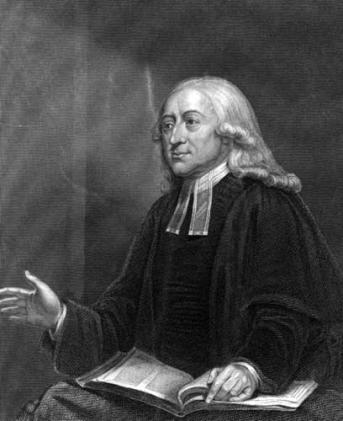
The Conversion of John Wesley – at 34

One of my historical, or literary, mentors is John Wesley the great revivalist of the eighteenth century and the founder of Methodism.

Wesley grew up in a Christian home, the fifteenth child of Samuel Wesley and his wife Susanna Annesley.  (Samuel and Susanna had nineteen children, of which nine died as infants and four were twins.)  Wesley’s father was a poet and pastor and his mother was particularly devoted, daily committing quality time with each of her children. Wesley attended seminary at Oxford and served as deacon in his father’s church.  Eventually, at the age of thirty-two Wesley decided to serve as a missionary to the Americas.  James Hutton, an acquaintance saw him off when he sailed to Georgia and corresponded with him after he reached America.  Wesley related how a group of Moravians sailing on the same ship sang hymns of praise in the midst of a great storm and how they answered those who asked whether they were afraid,  “We are neither afraid for ourselves nor for our children.”  Hutton in his book relates scenes of the Moravians, after they arrived in Savannah Georgia, felling timber, constructing houses, preaching to the Indians, and holding a song meeting all to the amazement and delight of John Wesley.

Hutton also describes the influence of these Moravians continued to have on John Wesley, “He talked much with the learned August Gottlieb Spangenberg, after he arrived in Georgia.

“My brother,” said Spangenberg to Wesley, “Do you know Jesus Christ?”

“I know,” replied Wesley,  “that Jesus Christ died for my sins.”

“That’s not what I asked you,” pursued Spangenberg, pressing the question further home,

“Do you know Jesus Christ?”  “I hope He has died to save me,” stammered Wesley.

“Do you know yourself?” persisted Spangenberg, who was not content with skin-deep work.

“No,” replied Wesley, and added, “I long to know Jesus Christ.” And Wesley stumbled on as dazed as ever.

“I went to America to convert the Indians,” he wrote, bitterly, in his Journal, on his way home to England; “but oh, who shall convert me?  I have a fair summer religion. I can talk well; nay, and I believe myself, when no danger is near. But let death look me in the face, and my spirit is troubled. Nor can I say, ‘to die is gain.’ I have a sort of fear that when I have spun my last thread I shall perish on the shore. I have learned that I who went to America to convert others was not converted myself.”[1]

The Moravian Peter Bohler was leading a bible study in London’s Fetter Lane. A historian writes, ‘Charles [Wesley, John’s brother] and John were in almost daily contact with Bohler.’

Peter Boehler said one day to John Wesley, “My brother, my brother, that philosophy of yours must be purged away.”

When John Wesley complained, “Ah, how can I preach the faith which I have not got?”

Peter Boehler answered, “Preach faith till you have it, and then, because you have it, you will preach it.”

“’In the evening,’ says Wesley, ‘I went very unwillingly to a society in Aldersgate Street, where one was reading Luther’s preface to [his commentary on] Romans.  About a quarter before nine while he was describing the change God works in the heart through faith in Christ, I felt my heart strangely warmed.  I felt I did trust in Christ alone, for salvation; and an assurance was given me that He had taken away my sins, even mine, and saved me from the law of sin and death.’”[2]

Finally, John Wesley got his breakthrough.  He had already discussed justification by faith with Peter Bohler, but this was different.

At 34 years of age he was finally born again.

After this Wesley followed Whitefield’s example and began preaching both justification by faith and the new birth in the churches. And one by one, the Anglican church leaders resisted him.

It wasn’t long before these newly converted ‘Methodists’, George Whitefield and John and Charles Wesley, began to gather others together to seek God for greater blessings.

Although the Wesleys and Whitefield parted ways (Whitefield was a Calvinist and the Wesleys Arminian), over the next 40 years these men would literally change the world.  It’s never too late…


[1] J.E. Hutton, A Short History of the Moravian Church (London: Moravian Publication Office, 1895), p. 189.

[2]. John Wesley Journal, May 24th 1738, Vol. 1. p.103.

Stages of Renewal

I listened to a lecture the other day that concluded with Mark Driscoll quoting Rick Warren on seven stages of renewal.  I can certainly see the pattern to be accurate in my experience and I thought it was very succinctly stated.

I have incorporated some of my thoughts and experience to each of the seven stages and conclude with two quotes that, from my viewpoint, help us to to engage the stages.

1. Personal renewal is about loving God and begins with acknowledging Jesus Christ as our greatest treasure and the object of worship. Personal renewal occurs as we recognize our spiritual poverty and surrender afresh to loving care and instruction of a God who is alive and available. The outflow of this active and intentional surrender is prayer, the reading and study of Scripture, and a growing worship of Jesus and connectedness with him – which renews us from the inside out.

2. Relational renewal is about authentically loving others.  As we embrace personal renewal with Jesus an initial effect is that we have new hope for people and pursue them in love. If married, relational renewal begins with our spouse. And, if we are parents our children ensue. Relational renewal allows us to be authentic around others, stop pretending and performing, and simply be in loving community where we are known and know others, with deep gratitude for the work of the gospel.

3. Missional renewal awakens in us a hope and love for the Great Co-mission. Once we have personal and relational renewal, the result is that God’s people want to be on mission together doing what God calls the church to accomplish. Without personal renewal, a church cannot have relational renewal. And, without both a church has no life or unity that allows them to press forward on mission with God together.

4. Internal cultural renewal happens as the fruit of personal, relational, and missional renewal forms a new culture of grace internally and new passion for lost people externally. In a church this results in people trusting their leaders and one another more, wanting to spend more time together, worshiping with greater intensity, and hanging out longer after services – as they begin to realize they are becoming a unified community.  This also increases innovation, a willingness to risk, and a burgeoning missiology.

5. Structural renewal is necessary once the personal, relational, missional, and internal renewals have been initiated and creates the need to change how a church operates. What structures have hindered growth?  What structures can be implemented so the church won’t have a bottleneck as the church grows? There is no perfect structure in Scripture because every situation is different. Rick Warren speaks of changing structures just about every year at Saddleback. We can’t put new wine in old wineskins. As a church begins to get healthier and healthier, the structure needs to change.

6. Institutional renewal happens when Christianity’s institutions change. Institutions – like seminaries and denominations are usually the last ones to change; they have difficulty with the change process. Unfortunately, institutions generally exist to preserve the change of the previous generation. It’s like a tree – the growth of a tree is not on the trunk but on the new branches. Institutions are like trunks. They provide stability not innovation.  Innovation happens at the local church level.

7. External cultural renewal is the fruit of personal, relational, missional, internal, structural, and institutional renewal. It might be best described as the outworking of Acts 2:43-47: A renewed sense of awe, wonders and signs taking place, refreshed and authentic community, mutual identification amongst classes and cultures, equality, unity, enthusiastic joy, heartfelt praise, favor with all the people, and salvations.

Here are two quotes that seem to reflect the attitude that initiates the process:

Charles Spurgeon was converted on January 6, 1850, and on February 1 he wrote the following prayer of consecration:

“O great and unsearchable God, who knows my heart, and tries all my ways; with a humble dependence upon the support of Your Holy Spirit, I yield up myself to You; as Your own reasonable sacrifice, I return to You your own. I would be forever, unreservedly, perpetually Yours; while I am on earth, I would serve You; and may I enjoy you and praise You for ever! Amen.”

James Burns, in Revival, Their Laws and Leaders writes:

“To the church, a revival means humiliation, a bitter knowledge of unworthiness and an open humiliating confession of sin on the part of her [pastors] and people.  It is not the easy and glorious thing many think it to be, who imagine it filled the pews and reinstated the church in power and authority.  It comes to scorch before it heals; it comes to [convict] people for their unfaithful witness, for their selfish living, for their neglect of the cross, and to call them to daily renunciation and to a deep and daily consecration.  That is why a revival has ever been unpopular with large numbers within the church.  Because it says nothing to them of power, or of ease, or of success; it accuses them of sin; it tells them they are dead; it calls them to awake, to renounce the world [system] and to follow Christ.”