
1 John 1:5-2:2

I. INTRO

A.  Last Sunday we saw from verses 3 and 4 that John makes the message of Christ (call it theology, or doctrine) the basis of all significant Christian fellowship.

B.  Ecc 4:12, “A cord of three strands is not quickly broken.”

C.  1:3: “What we have seen and heard we proclaim to you so that you may have fellowship with us.” In order to create and nurture deep (honest) Christian fellowship we have to acknowledge that Jesus Christ is at the center – and who He is and what He taught is both the standard and the ultimate goal of our lives.

D.  This week:

1.  God Is Light – 1 John 1:5-10

This is the message we have heard from Him and announce to you, that God is Light, and in Him there is no [notice John’s use of absolute terms] darkness at all. 6 If we say that we have fellowship with Him and yet walk in the darkness, we lie and do not practice the truth; 7 but if we walk in the Light as He Himself is in the Light, we have fellowship with one another, and the blood of Jesus His Son cleanses us from all sin. 8 If we say that we have no sin, we are deceiving ourselves and the truth is not in us. 9 If we confess our sins, He is faithful and righteous to forgive us our sins and to cleanse us from all unrighteousness. 10 If we say that we have not sinned, we make Him a liar and His word is not in us. [From this we get an idea of what some of the false teachers have been preaching…]

2:18 – Antichrists, 
2) 2:22 – Liars/Antichrists, 3) 2:26 – Deceivers
, 4) 3:7 – Deceivers
, 5) 4:1 – False Prophets, 6) 4:3 – Antichrists

2.  Jesus Christ Is Our Advocate (and Propitiation) — 1 John 2:1-2

[Grandpa Pastor John] 1My little children, I am writing these things to you so that you may not sin. And if anyone sins, we have an Advocate with the Father, Jesus Christ the righteous; 2 and He Himself [He became] is the propitiation for our sins; and not for ours only, but also for those of the whole world.

II.    BODY

A.  There are 2 parts to this message.

1.  God is Light

a.  Here is the overall structure of verses 5-10:

1)  Verse 5 is the foundation: God is light.

2)  Verses 6-7 are the application: Walk in the Light.

3)  Verses 8-10 are the clarification: No one can claim to be without sin.

b.  Walking in darkness destroys fellowship with God – and authentic fellowship with one another.  We are as sick as our secrets.

2.  Jesus Christ is our Advocate (2:1) – and our Propitiation (2:2).

B.  God is light

1.  We could talk about the fact that everything in the universe cycles, or circles, around the sun.

2.  We could talk about photosynthesis – the chemical process that converts carbon dioxide into organic compounds using the energy from sunlight.

3.  Does the Bible ever talk about what it means to “walk in the light”?  Yes, Jesus, in the Sermon on the Mount is quite clear about what it means to walk in the light.  View them as stepping stones – as we continuously cycle through the Beatitudes we will continue to grow deeper in God

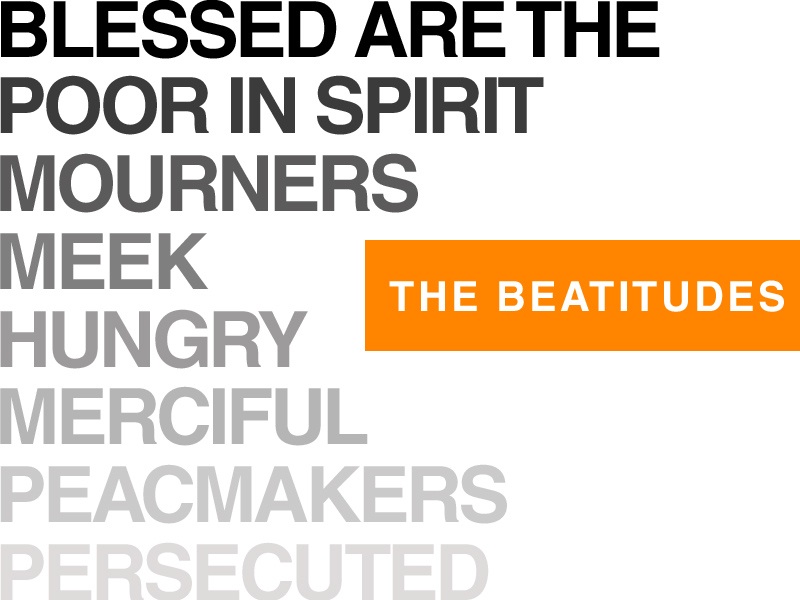
4.  The Beatitudes (Matthew 5:3-10) A lifeline to spiritual formation

a.  The Beatitudes (Mat. 5:3-12) describe eight qualities that characterize the life of Jesus Christ, and therefore our life in Jesus Christ.  Following is an overview of how one unfolds into the next… (This, BTW, will be the pathway for our transition season here at SBF…)

1) Blessed are the poor in spirit… [Blessed are those who know their need for God]. To enter into God’s kingdom, we are invited to admit that we have come to the end of ourselves and are in need of God’s help and care.  It’s the realization that, “I can’t get there from here;”  “I killed Christ;” “I am more depraved…”

2) Blessed are those who mourn… As we are honest about our own sinful tendencies there will be a transforming grief, or repentance, that surfaces – not only for our own lives, but also for the injustice, greed, and suffering that grips our world.

3) Blessed are the meek…Grieving over sin and suffering places us in a humble posture that helps us become life-long learners (disciple means learner). Meekness is not weakness, but the power of your potential under Christ’s control – like a broken horse. (Take you, break you, and give you.)  As meek people we become learners (disciples).

4) Blessed are those who hunger and thirst for righteousness…To be hungry and thirsty is the desire to be empty of those things that don’t reflect God, and initiates a deep longing for wholeness in our lives.

5) Blessed are the merciful…As we receive God’s mercy we begin to give mercy – to ourselves and to others.

6) Blessed are the pure in heart… Mercy cleanses our heart and restores purity to our lives. 2 Cor 11:2  – For I am jealous for you with a godly jealousy; for I betrothed you to one husband, so that to Christ I might present you as a pure virgin.

7) Blessed are the peacemakers… Purity gives way to a personal serenity and peacefulness. Peace is not the absence of conflict, but the absence of anxiety in the midst of inevitable conflict – and when others encounter it, they want it too.  Peacemakers vs. peacekeepers.  False peace at any price.

8) Blessed are the persecuted… Living life from a kingdom of God perspective will place us in conflict with those that oppose it (susually it’s “religious” people!).

C.  Let’s go back to 1 John and look at chapter 2:1-2.  1My little children, I am writing these things to you so that you may not sin. And if anyone sins, we have an Advocate with the Father, Jesus Christ the righteous; 2 and He Himself is the propitiation for our sins; and not for ours only, but also for those of the whole world.

1.  Jesus Christ is our Advocate and our Propitiation.

a.  Advocate

1) Greek: paraklētos

2) Lit., “called to one’s side,” i.e., to one’s aid. It was used in a court of justice to denote a legal assistant, counsel for the defense, or, one who pleads another’s cause, an intercessor.

3) Or Comforter when speaking of the Holy Spirit, in Jhn 14:16; 15:26; and 16:7.

b.  Propitiation

1) Greek: hilasmos

2) Propitiation is a term that we don’t use regularly. It is possible to go through high school and college and never to learn the meaning of this word.

3)  If we have to learn a big word, then let’s do it by giving to it a short definition: Propitiation refers to satisfaction.  Remember Mick Jagger and the Rolling Stones?  “I can’t get no satisfaction…” Well Mick, yes you can. Another word is appeasement.

4)  The personal means by whom God shows mercy to the sinner who believes on Christ as the One provided. In the former passage He is described as “the propitiation for our sins; and not for ours only, but also for the whole world.” God is holy… God’s wrath = anger (at sin) and longing (for His children to find their comfort and joy in Him).

III.  CONCLUSION

A.  The final word of the text is that we must not keep this consolation for ourselves alone. “And he is not the propitiation for our sins only, but for the sins of the whole world.”

B.  CS Lewis:  The Christian doesn’t think God will love us because we’re good, but that God will make us good because He loves us.

C.  Without the knowledge of our extreme sin, the payment of the Cross seems trivial and does not electrify or transform.

D.  But without the knowledge of Christ’s completely satisfying life and death, the knowledge of sin would crush us – or move us to deny and repress it.

E.  By walking in the light we hold our depravity and the Cross in a healthy and dynamic tension that will lead to transformation and renewal.

The Great Commandment Pt 2 – Matthew 22:39

Love Your Neighbor as Yourself

I.   INTRO/REVIEW

A.   We have been looking at what the Bible refers to as the Great Commandment, which is for us, important preliminary vision passage because it synthesizes so much of the Scripture into two VERY straightforward commands.

B.    (It is quite important for us to understand that when the NT authors declare God’s commands for us to be holy and to love our neighbor, etc. These commands are not there to show our ability, but to reveal our inability – and to remind us of our continual dependence on the grace of God to do in us and through us what we cannot do on our own.)

C.    Matthew 22:33-40 (NAS): “Teacher, which is the great commandment in the Law?” And He said to him, “ ‘YOU SHALL LOVE THE LORD YOUR GOD WITH ALL YOUR HEART, AND WITH ALL YOUR SOUL, AND WITH ALL YOUR MIND.’ This is the great and foremost commandment. The second is like it, ‘YOU SHALL LOVE YOUR NEIGHBOR AS YOURSELF.’ On these two commandments depend the whole Law and the Prophets.” (Notice the order – and notice that Jesus was asked to answer with one commandment, but He gave them two…)

D.   We have multiplied this passage into two messages…

  1. Last week: “You shall love the Lord your God with all your heart, and with all your soul, and with all your mind – this is the great and foremost commandment.” (Click here to read that post.)
  2. Review of last week: How do we love God?
  • Come alive to God.
  • Find your true joy and delight in the message of the Gospel – and the Person of Jesus Christ.
  •  Come to grips with the idolatry that grips ALL of our lives.

(i)    Idolatry is not just a failure to obey God; it is setting our heart and affections on something, or someone other than God.

(ii)  This cannot be remedied by repenting that you have an idol – or by engaging willpower to try and live differently.

(iii) If we uproot our idols (through repentance) but fail to plant the love of God (or, delight in God) in its place, the idol will grow back – like mowing a weed.  Repentance and rejoicing must go together.

E.  This week: (v. 39)“You shall love your neighbor as yourself.”  And here’s the questions we’re asking as we unpack these verses…

  • What is God’s heart/vision for Southside Bible Fellowship?
  • And for you?

II.  BODY

A.   The life-changing context of this commandment:

 ‘YOU SHALL LOVE YOUR NEIGHBOR AS YOURSELF.’ 40 On these two commandments depend the whole Law and the Prophets.”

  1. The overwhelming commandment to “neighbor love.”  Who is my neighbor?  This passage retold in Luke 10 – and is followed by Jesus unpacking the Good Samaritan and Mary and Martha.
  2. John Piper: This is a staggering commandment. If this is what it means, then something unbelievably powerful and reconstructing will have to happen in our souls.  It seems to demand that I tear the skin off my body and wrap it around another person so that I feel that I am that other person; and all the longings that I have for my own safety, health, success, and happiness I now feel for that other person as though s/he were me.

B.    Loving God is invisible. It is an internal passion of the soul. But it comes to expression when we love others.  (Similar to James 2:18: “I will show you my faith by my works.”)

  1. Idolatry and pride are at the root of our sinfulness.  Pride is the desire for our own happiness apart from God and apart from the happiness of others in God.
  2. Pride is the pursuit of happiness anywhere but in the glory of God and the good of other people.

C.   So, Jesus says, “Love your neighbor as yourself.”  How do we get there from here? Four points (adapted from John Piper):

1.     Understand that our self-love is a creation of God.

  • Jesus says in effect: I start with your inborn, deep, defining human trait—your love for yourself.  It’s a given.  Jesus is saying, I don’t command it — I assume it.
  • We all have a powerful instinct of self-preservation and self-fulfillment. We all want to be happy, to live and love with satisfaction, we want enough food, we want enough clothes, we want a place to live, we want protection from violence, we want meaningful or important work, we want sincere and meaningful friendships, and we want our lives to count!  All this is self-love.
  • Self-love is the deep longing to diminish pain and to increase joy. That’s what Jesus starts with when he says, “as yourself.”
  • This is common to all people. We don’t have to learn it, it comes with our humanity. Our Father created it. These longings are natural…

2.     Make your self-seeking the measure of your self-giving.

  • When Jesus says, “Love your neighbor as yourself,” the word “as” is very radical: That’s a BIG word: It means: If you are energetic in pursing your own happiness, be AS energetic in pursuing the happiness of your neighbor. If you are creative in pursuing your own happiness, be AS creative in pursuing the happiness of your neighbor. If you are persevering in pursuing your own happiness, be AS persevering in pursuing the happiness of your neighbor.
  • In other words, Jesus is not just saying: seek for your neighbor the same things you seek for yourself, but also seek them in the same way—with the same zeal, energy, creativity, and perseverance. The same life and death commitment when you are in danger.  Make your own self-seeking the measure of your self-giving.
  • Here’s where this gets difficult: We feel that if we take Jesus seriously, we will not just have to love others “as we love ourselves,” but we will have to love others “instead of loving ourselves.”
  • See the handout: “Developing Practical Skills to Love Well”… (This handout should be in the foyer at SBF.)

3.     It’s the first commandment that makes the second doable.

  • This is why the first commandment is the first commandment.
  • If we try to accomplish the 2nd Commandment without FULLY engaging the 1st it will become the suicide of our own happiness.
  • The 1st commandment is the basis of the 2nd commandment. The 2nd  commandment is a visible expression of the 1st commandment.

4.     Make God the focus of your self-seeking.

  • Take all your self-love—all your longing for joy, hope, love, security, fulfillment, and significance—take all that, and take it to God, until He satisfies your heart, soul, and mind.
  • What you will find is that this is not a canceling out of self-love. This is a fulfillment and transformation of self-love. Self-love is the desire for life and satisfaction rather than frustration and death.
  • God says, “Come to me, and I will give you fullness of joy. I will satisfy your heart, soul, and mind with My glory. This is the first and great commandment…
  • And with that great discovery—that God is the never-ending fountain of our joy—the way we love others will be forever changed.
  • Our quest for joy and happiness becomes a life-long quest for God. And He can be be found [only] in the Person Jesus Christ.  (I wish “all paths” led to God, but they do not…)

III. CONCLUSION

A.   As we bring this to a close, we can say that our ultimate GOAL is to love God with all of our heart, soul, and strength – and the FRUIT is that we will splash His love onto people.

B.    God’s word for us this morning is that we embrace these commandments with tremendous focus and authenticity during this season of learning to express the redemptive love of God in and through SBF.

C.    Let these verses deeply touch and challenge your soul – and remake your priorities.

D.   Get alone with God and deal with Him about these things. Let’s not assume that we fully know what love is – or that love has the proper centrality in our lives.

E.    God is saying:  All of Scripture, all God’s plans for history, hang on these two great purposes: that 1) he be loved with all our heart, and 2) that we love each other as we love ourselves.

F.    A closing verse:  Gal 6:10 – “So then, while we have opportunity, let us do good to all people, and especially to those who are of the household of the faith.”

The Great Commandment Pt 1 – Matthew 22:33-40

I.  INTRO

A.   We are going to take the next couple of weeks and look at what the Bible refers to as the Great Commandment.  An important preliminary vision passage because it synthesizes so much of the Bible into two pretty straightforward commands.

B.    Matthew 22:33-40 (NAS): “Teacher, which is the great commandment in the Law?” And He said to him, “ ‘YOU SHALL LOVE THE LORD YOUR GOD WITH ALL YOUR HEART, AND WITH ALL YOUR SOUL, AND WITH ALL YOUR MIND.’ This is the great and foremost commandment. The second is like it, ‘YOU SHALL LOVE YOUR NEIGHBOR AS YOURSELF.’ On these two commandments depend the whole Law and the Prophets.” (Notice the order.  Loving people id the outflow of loving God.)

C.    We will divide this passage up into two messages…

  1. This week: “You shall love the Lord your God with all your heart, and with all your soul, and with all your mind – this is the great and foremost commandment.”
  2. Next week: “You shall love your neighbor as yourself.”

D.   Here are two important questions…

  1. What is God’s heart for Southside Bible Fellowship?  And for you?
  2. What is God’s VISION for us during this transition season?  Vision will focus us.  Vision will restrain us – Pro 29:18 (NAS): “Where there is no vision, the people are unrestrained…” 

II.   BODY

A.   “You shall love the Lord your God with all your heart, and with all your soul, and with all your mind – this is the great and foremost commandment” is a quote from Deut 6:5 and is:

1.     Part of the Shema Yisrael (Heb word for hear), vs. 4-9. The Shema is the central prayer in the Jewish prayer book and is usually the first section of Scripture that a Jewish child learns – as well as the prayer that is most often said each morning and evening by the Jewish people.

4 “Hear, O Israel! The LORD is our God, the LORD is one! 5 You shall love the LORD your God with all your heart and with all your soul and with all your might. 6 These words, which I am commanding you today, shall be on your heart. 7 You shall teach them diligently to your sons and shall talk of them when you sit in your house and when you walk by the way and when you lie down and when you rise up. 8 You shall bind them as a sign on your hand and they shall be as frontals on your forehead. 9 You shall write them on the doorposts of your house and on your gates.”

2.     Rabbi Julian Sinclair: Oneness, [or] unity, is the aspiration of love, and love emerges from a perception of unity. This insight is also expressed in the Shema: its first line declares God’s unity, and ends with the word “one.” Then follows the mitzvah [commandment] to love God. Love comes out of a sense of God’s unity pervading all things.

3.     In the Torah (the first 5 books of the Bible) there are 613 commandments (explicit and implicit).

4.     The 10 Commandments (Ex 20 & Deut 5) are understood to be the root commands — revealing God’s standard of holiness.  They also reveal our need for a Savior.

  • Gal 3:24Therefore the Law has become our tutor to lead us to Christ, so that we may be justified by faith.”
  • The Law is like a dentists mirror – it can point out decay, but can’t do anything about it.

5.     In Deut 5 – the previous chapter, we find the second listing of the 10 Commandments (also in Ex 20).

  • The first two commandments speak to the issue of idolatry:  #1 is Deut 5:7 – “You shall have no other God’s before me.”
  • The 2nd Commandment states – Deut 5:8-10: “You shall not make for yourself an idol, or any likeness of what is in heaven above or on the earth beneath or in the water under the earth. 9 You shall not worship them or serve them; for I, the LORD your God, am a jealous God, visiting the iniquity of the fathers on the children, and on the third and the fourth generations of those who hate Me, 10 but showing lovingkindness to thousands, to those who love Me and keep My commandments.”

6.     Theologians think that if someone were to be able to keep the first commandment the others would not be a problem – because they all have to do with idolatry.

7.     Martin Luther:  All those who do not at all times trust God and do not in all their works or sufferings, life and death, trust in His favor, grace, and good-will, but seek His favor in other things or in themselves, do not keep this [First] Commandment, and practice real idolatry.

8.     Tim Keller:  Sin isn’t only doing bad things, it is more fundamentally making good things into ultimate things. Sin is building your life and meaning on anything, even a very good thing, more than on God. Whatever we build our life on will drive us and enslave us. Sin is primarily idolatry.

9.     So, what are we saying? All 613 unchangeable commandments of the Torah can be summed-up in these two verses (or 6 words): Love God and love your neighbor. Every person on the planet has this built-in longing to deeply connect with God and people.  We were designed, created to be worshippers.  This, then, becomes the grand objective and passion of every human heart.  Augustine said it well:  “Our heart’s are restless until they find their rest in God.”

B.    Years ago Rick Warren said something that, I think, begins to put this into perspective: “A great commitment to the Great Commandment and the Great Commission will grow a great [Christian and a great] church.”

  1. A key and critical question is, how will this commitment be expressed?
  2. The Church (at least in N America) has placed an emphasis on the Great Commission without a sufficient understanding and practice of the Great Commandment.
  3. John Piper:  Passion for God in worship precedes the offer of God in evangelism because we cannot commend what we do not cherish.
  4. I believe this is THE most critical issue facing Southside Bible Fellowship during this season – duty or delight.

C.    So, if we are to “LOVE THE LORD YOUR GOD WITH ALL YOUR HEART, AND WITH ALL YOUR SOUL, AND WITH ALL YOUR MIND” our question is – How do we get there from here?

1.     Come alive to God.  Ephesians 2:1-10 An explanation of the Gospel…

 1 And you were dead in your trespasses and sins, 2 in which you formerly walked according to the course of this world, according to the prince of the power of the air, of the spirit that is now working in the sons of disobedience. 3 Among them we too all formerly lived in the lusts of our flesh, indulging the desires of the flesh and of the mind, and were by nature children of wrath, even as the rest. 4 But God, being rich in mercy, because of His great love with which He loved us, 5 even when we were dead in our transgressions, made us alive together with Christ (by grace you have been saved), 6 and raised us up with Him, and seated us with Him in the heavenly places in Christ Jesus, 7 so that in the ages to come He might show the surpassing riches of His grace in kindness toward us in Christ Jesus. 8 For by grace you have been saved through faith; and that not of yourselves, it is the gift of God; 9 not as a result of works, so that no one may boast. 10 For we are His workmanship, created in Christ Jesus for good works, which God prepared beforehand so that we would walk in them. 

2.     Find your true joy and delight in the message of the Gospel – and the Person of Jesus Christ.

  • My prayer for us as a community of believers: “That we would experience Jesus Christ, the sovereign, risen, living, Lord of the universe; and that He would continue to become THE source and content of our real hope and joy.”
  • One of the most important discoveries we will ever make is:  God is most glorified in you when you am most satisfied in Him (John Piper). This is to be the motor that drives our lives.  This concept, I believe, will be key to this transition season here at SBF.
  • Tragically most of us have been taught that duty, not delight, is the way to glorify God. But here is what the Great Commandment is instructing us to do: To delight in God is your duty!
  • John 15:11-12 (AMP) – “I have told you these things, that My joy and delight may be in you, and that your joy and gladness may be of full measure and complete and overflowing. This is My commandment: [or, out of that joy and delight] that you love one another [just] as I have loved you.”

3.     Come to grips with the idolatry that grips ALL of our lives.

a.     Tim Keller:[1] One of the main ways to read the Bible is as the ages-long struggle between true faith and idolatry. In the beginning, human beings were made [created] to worship and serve God, and to rule over all created things in God’s name (Gen 1:26­–28).

Rom 1:21–25 — Paul understands that original sin as an act of idolatry:

21 For even though they knew God, they did not honor Him as God or give thanks, but they became futile in their speculations, and their foolish heart was darkened. 22 Professing to be wise, they became fools, 23 and exchanged the glory of the incorruptible God for an image in the form of corruptible man and of birds and four-footed animals and crawling creatures.

 24 Therefore God gave them over in the lusts of their hearts to impurity, so that their bodies would be dishonored among them. 25 For they exchanged the truth of God for a lie, and worshiped and served the creature rather than the Creator, who is blessed forever. Amen.

b.     Instead of living for God, we began to live for ourselves, or our work, or for material goods. We reversed the original intended order. And when we began to worship and serve created things, paradoxically, the created things came to rule over us.

1 John 5:20-21“And we know that the Son of God has come, and has given us understanding so that we may know Him who is true; and we are in Him who is true, in His Son Jesus Christ. This is the true God and eternal life. 21 Little children, [speaking to believers] guard yourselves from idols.”

c.     What is idolatry?

  • It exchanging the truth for a lie.
  • Putting our trust in other saviors – “momentary functional saviors,”
  •  “Exchanging God for pitiful substitutes.” (John Piper),
  • Whoever or whatever we give central value to,
  • Whatever controls us is our Lord.

d.     David Powlison writes in Seeing with New Eyes[2]: The most basic question which God poses to each human heart: “Has something or someone besides Jesus the Christ taken title to your heart’s functional trust, preoccupation, loyalty, service, fear, or delight?

e.     Here are some questions that will bring some of our idol systems to the surface:

  • What do I worry about the most?
  • What, do you really want, or expect out of life?
  • What do I use to comfort myself on a bad day?  Cope?  Release valves?
  • What preoccupies me?
  • A Puritan writer from the 17th century said: Our religion is what we do with our solitude (What do you daydream about?).
  • For what do you want to be known?
  • What prayer, unanswered, what make you seriously question God?

f.      Root idols vs. branch (surface) idols:  Lust, like rape, is hardly ever about sex – it’s about self-image, it’s about anxiety, it’s about fear.  These are some of the root idols that seek to control our lives – they are the sin behind the sin…

III.         CONCLUSION

A.   How do we replace our idols?[3]

B.    Idolatry is not just a failure to obey God; it is setting our heart and affections on something, or someone other than God. This cannot be remedied by repenting that you have an idol – or by engaging willpower to try and live differently.

C.    Here’s the final passage for today…

Colossians 3:1-3 (Put On the New Self)

1Therefore if you have been raised up with Christ, keep seeking the things above, where Christ is, seated at the right hand of God. 2 Set your mind on the things above [i.e., YOU SHALL LOVE THE LORD YOUR GOD WITH ALL YOUR HEART, SOUL, AND MIND], not on the things that are on earth. 3 For you have died [to sin, to idolatry] and your life is hidden with Christ in God.

D.   We are invited to rest in, appreciate, rejoice in what Jesus has done through his hideous death – and resurrection.

E.    Jesus must become more beautiful to your imagination, more attractive to your heart, than your idols.

F.    If we uproot our idols (through repentance) but fail to plant the love of God (or, delight in God) in its place, the idol will grow back – like mowing a weed.

G.   Repentance and rejoicing must go together.


[1] “Talking About Idolatry in a Postmodern Age.”

[2] Pgs. 132-40.

[3] Adapted from Counterfeit Gods by Tim Keller, pgs. 170-172.

The Gospel and the Beatitudes (Matthew 5:3-10)

This is a sermon I spoke at three services at Shiloh Community Church in Orleans MI last weekend (Palm Sunday).  I focused primarily on poor in spirit, mourning, and peacemaking

It’s Palm Sunday and we are remembering and celebrating the triumphal entry of The Servant King Jesus – arriving into Jerusalem to the praise and adulation of the multitude — and less than a week later, he is to be brutally and shamefully murdered…

  1. Next week is the high point of the Christian calendar as we celebrate the resurrection of Jesus Christ from the dead.
  2. Jesus triumphed over death and hell and bridged the gap between our utter depravity and God’s standard of holiness. (To miss the mark by even a little is still to have missed the mark.)
  3. We call this sacrifice the Gospel – or Good News.

I believe it is Tim Keller who reminds us that the Gospel is not advice, it is news.  It is the ultimate Good News.  He suggests that weekend services are not primarily the place to give advice… Gospel-centered (or Christ-centered) change is rooted in remembrance. We are to remind one another of what Christ Jesus has done, not what we must do.

We cannot commend what we do not cherish.  -John Piper

The essence of Christian maturity is when the Gospel – or, what Christ has done — gets worked in – and then through our lives, which is what I’d like to spend our remaining time considering.

Turn to Matthew 5 where we will take a look at the Beatitudes.  While you’re turning, allow me to offer a few introductory thoughts.

What is Christian conversion? Christian conversion, or salvation, occurs when genuine repentance and sincere faith in Jesus intersect.

  1. These are not two separate actions – but one motion with two parts:
    • As we turn to Christ for salvation we turn away from the sin that we are asking Jesus Christ to forgive us from. (Rom 3:23 – All have sinned and fallen short of God’s standard.)
    • Neither repentance nor faith come first – they must come at the same time.
  2. They are two sides of the same coin.[1]

Contained in the Beatitudes are eight qualities that characterize the life of Jesus Christ, and therefore, through conversion, they begin to characterize our life in Jesus Christ.  Jesus calls us to follow him through life and to depend upon his strength and power.

The word beatitude comes from the Latin word meaning “blessed.”

  1. More specifically the word means exalted joy, or true happiness. (Joy is calm delight in even the most adverse circumstances.  Joy fueled Paul’s contentment.)
  2. With the beatitudes, Jesus dives into our innermost being probing the heart and raising the question of motive.
  3. What made Jesus a threat to everyone and the reason He was eventually killed was that in His encounters with people (particularly the religious leaders), He exposes what they were on the inside.  Some people find it liberating – others hate it.

The Beatitudes, I have come to see, are our surrendered response to the Gospel.  I view the Beatitudes as a step-by-step spiritual formation process that moves us toward spiritual depth and maturity.  This becomes cyclical as we grow deeper and deeper in our faith.  The Beatitudes become the outworking of the Gospel in and through our lives.

Matthew 5:3-10…

3“Blessed are the poor in spirit, for theirs is the kingdom of heaven.

 4“Blessed are those who mourn, for they shall be comforted.

 5“Blessed are the meek (gentle), for they shall inherit the earth.

 6“Blessed are those who hunger and thirst for righteousness, for they shall be satisfied.

 7“Blessed are the merciful, for they shall receive mercy.

 8“Blessed are the pure in heart, for they shall see God.

 9“Blessed are the peacemakers, for they shall be called sons of God.

 10“Blessed are those who have been persecuted for the sake of righteousness, for theirs is the kingdom of heaven.

Following is an overview and how one unfolds into the next…The first two are foundational to the Gospel blossoming in and through our lives…

1.  Blessed are the poor in spirit…

a.  “You’re blessed when you’re at the end of your rope.  With less of you there is more of God and his rule.” (MSG)
b.  Another translation renders this verse, “Happy are those who know their need for God.” (JBP)
c.  What does it mean to be “poor in spirit”?  A desperateness of soul that is weary of living in it’s own strength and longs for God’s mercy and grace to come and refresh the soul.  In a word, it is DESPERATION.
d.  Consider the Prodigal Sons (Lk 15)…

2.  Blessed are those who mourn…

a.  I have a river of sin in my life – with 3 primary tributaries…

#1 – Original sin (Adam & Eve traded the presence of God for the knowledge of God – and that’s been our core tendency ever since…

#2 – Family of origin issues

#3 – My own dumb choices.

b.  As we are honest about the sin that has infected us there will be a transforming grief and accompanying repentance, that surfaces – not only for our own lives, but also for the injustice, greed, lust, and suffering that grips our world.

c.  I want to own my sin everyday.[2]

d.  This is counter intuitive (paradox – seeming contradiction).  We go down to go up; death precedes resurrection; we get to joy by traveling through grief.  Our soul wants to find a way around grief, but God says, “No, you must travel through grief – and the good news is, He says, “I’ll go with you and we will do it in My strength and power.”

e.  The way of the Gospel is a death and resurrection cycle…

f.  The gospel has the greatest potential to captivate us when we understand that we are more depraved than we ever realized and simultaneously more loved that we ever dared to imagine.

g.  I don’t mind inviting you to question your own salvation today.  If our default mode is, “I’m basically a good person…” then we simply have not understood the gospel.

3.  Blessed are the meek…

a.  Rick Warren would say, “Meekness is not weakness, but the power of your potential under Christ’s control.”

b.  The concept of meekness describes a horse that has been broken.  We can either surrender to Christ and invite the breaking, or remain the undisciplined and wild stallion.

c.  Grieving over sin and suffering grows meekness in us and delivers us into a humble learning posture (disciple means learner).

4.  Blessed are those who hunger and thirst for righteousness…Spiritual hunger and thirst is the growing desire to be empty of those things that don’t reflect God, and initiates a deep longing for wholeness in our lives.

5.  Blessed are the merciful…

a.  Mercy is entering into another persons feelings – attempting to see things from another person’s perspective – all with understanding AND acceptance…just like Jesus has done for us.

b.  As we receive God’s mercy we begin to give mercy – to ourselves and to others.

6.  Blessed are the pure in heart…

a.  Mercy cleanses our heart and restores purity to our lives.

b.  Did you know that your (spiritual and emotional) virginity CAN be restored?

2 Cor 11:2For I am jealous for you with a godly jealousy; for I betrothed you to one husband, so that to Christ I might present you as a pure virgin.

7.  Blessed are the peacemakers…

a.  Purity gives way to a personal serenity and peacefulness.  Peace is not the absence of conflict, but the absence of anxiety in the midst of inevitable conflict – and when others encounter it, they want it too.

b.  Our Western concept of peace needs to be considered in the light of the ancient Hebrew concept of peace, which is SHALOM — and means more than our limited understanding of peace (i.e., the lack of conflict).

Biblical SHALOM speaks of a universal flourishing, wholeness and delight; a rich state of affairs in which natural needs are satisfied, natural gifts a fruitfully employed — all under the arc of God’s love. Shalom is the way things ought to be.

Neal Plantinga – “the webbing together of God, humans, and all creation in equity, fulfillment, and delight.”

c.  There is a difference between a peacemaker and a peacekeeper.

To be a peacemaker does not mean peace at any cost.

Peacekeeping creates a false peace.

Many of us live out our lives with this false peace and say nothing or do nothing to change it—in churches, homes, work places, and our marriages.

Examples:

(i)  A family member makes a scene at a family gathering.  It embarrasses you, the rest of the family, but you say nothing.  You keep the peace because to go there would unearth a lot of stuff that you just aren’t willing to deal with.

(ii) Your spouse makes insulting remarks to you or humiliates you publicly through critical tone of voice.  It grates on you.  But you keep silent because you want to keep the peace.

d.  We struggle with this false peace because the conventional wisdom of the day is that its better to keep the peace than to make the peace and there is a very real difference.

e.  Keeping this false peace insures that real issues, real concerns, and real problems are never dealt with.

f.  A façade, or veneer, of peace in that there is calm but the reality is the tension is still there.

g.  True peacemakers will challenge and disrupt the false peace.

h.  Jesus didn’t have a problem disrupting the false peace of his day.

i.  The whole history of redemption, climaxing in the death and resurrection of Jesus is God’s strategy to bring about a just and lasting peace between rebel man and himself and between man and man (Eph 2:14-22)

j.  Colossians 1:19-20 puts it like this,

“For God was pleased to have all his fullness dwell in him, and through him to reconcile to himself all things, whether things on earth or things in heaven, by making peace through his blood, shed on the cross.”

k.  True peacemakers will give people the benefit of the doubt while graciously bringing up concerns

l.  But true peacemakers will deal with what is real.  FIRST IN THEIR OWN LIVES…

m.  True peacemakers will steward the conflict they find themselves in because God will often use conflict to develop things in our lives that are developed in no other way.

8.  Blessed are the persecuted… Living life from a kingdom of God perspective will place us in conflict with those that oppose it (often times it’s “religious” people!).

Without the knowledge of our extreme sin, the payment of the Cross seems trivial and does not electrify or transform.

But without the knowledge of Christ’s completely satisfying life and death, the knowledge of sin would crush us – or move us to deny and repress it. By walking the way of the Beatitudes we hold our depravity and the Cross in a healthy and dynamic tension that will lead to transformation and renewal.


[1] Wayne Gudem, Systematic Theology, p. 713.

[2] “None is righteous, no, not one.” Romans 3:10 (ESV)
And you were dead in the trespasses and sins in which you once walked, following the course of this world, following the prince of the power of the air, the spirit that is now at work in the sons of disobedience.” Eph 2:1-2 (ESV)