Oikos Evangelism

Mark 5:18-20

This is an article about personal evangelism. Now, before the cold sweat comes or you begin to sink into the quicksand of guilt (Catholic or otherwise), I will say that my aim is to take a little different approach than many, if not most, contemporary churches.

I’d like to ask the question, “What does the New Testament say about how God’s church impacts culture?” For some this may be a review but for many, this could be a whole new paradigm.

The big picture overview that can be seen in the NT is that it’s not about launching a program, it’s about (re-) initiating a lifestyle perspective regarding the people that God has already placed in our lives.

Consider Mark 5:18-20 “As Jesus was getting into the boat, the man who had been demon possessed begged to go with him. 19 But Jesus said, “No, go home [oikos] to your family, and tell them everything the Lord has done for you and how merciful he has been.” 20 So the man started off to visit the Ten Towns [Decapolis[1]] of that region and began to proclaim the great things Jesus had done for him; and everyone was amazed at what he told them.”  

Three thoughts about evangelism related to this passage…

  1. To take a quick look at the Greek word “oikos” (which is at the heart of this passage.)
  2. To help us consider who “our people” are.
  3. To provide some biblical perspective on how to identify begin to pray for, and to practically love and serve the people that (I would say) God has sovereignly placed in our lives.

Consider them one at a time…

1. The (Greek) word “oikos

You might know oikos as a popular brand of yogurt, but I would like to introduce what many theologians and church historians refer to as the oikos principle. The word oikos is used 120 times throughout the NT and is most often translated house or household—not the structure but the inhabitants. Here’s my best and most concise description (or definition) of oikos: Oikos is a social system composed of those connected to each other through shared ties and/or tasks. (Your sphere of consistent connections.)

I would point out here that anthropologists have identified three universal units of every society and every culture throughout recorded history, which are social systems based on 1) common kinship, 2) common community, and 3) common interests.

So, why are we talking about our oikos’? Because, in the NT the oikos principle became oikos evangelism, which became the chief strategy that God used to expand the KOG and populate the church. Michael Green, in his classic book, Evangelism in the Early Church, (1970) observes that the NT Church vigorously adhered to the oikos principle as its primary strategy for the advance of God’s kingdom. The early Christians knew when the message of faith was heard and demonstrated by friends and family who were known, and trusted; barriers to the gospel were removed and receptivity to the message increased dramatically.

Epistle to Diognetus—a letter to a friend explaining why Christianity was growing so quickly. It has been dated between 130-200 AD… “Christians busy themselves on earth, but their citizenship is in heaven. They live in their own native lands, but they live as aliens. For every foreign country is to them as their native land, and every native land is as their foreign country. They marry and have children, but they do not kill unwanted babies. They share their table with everyone, but they don’t share their bed with everyone. They love everyone but are persecuted by all. They are poor and make many rich. They are short of everything and yet have plenty of everything. They are treated outrageously but behave respectfully. They are mocked and blessed in return.  When they do good, they are attacked. When they are attacked, they rejoice as if being given new life.”[2]

What we see is that life change—or life transformation—catches the attention of people. One of these days you might have someone at work say to you, “You’re kind of a jerk, so why are you being so kind to me?”

2. Who are “our people”?

This shouldn’t be too hard to figure out…Our oikos consists of all the people we come into contact with on a regular consistent basis. It encompasses our family, friends, neighbors, coworkers, the other parents of your kid’s sport team, your hairstylist, your golf buddies, your business associates, your mechanic, your carpool buddies, your dentist, etc.

In other words, we would say that every person likely has a distinct and measurable oikos. Husbands and wives certainly have overlapping oikoi but each one also has a distinct and separate oikos—and your children also have an overlapping oikos with you but they also have a growing distinct and separate oikos. Statistically, the vast majority of us have between 8-15 people in our oikos who are unchurched unbelievers, or “de-churched” people.

3. How to pray for and practically love and serve the people that God has sovereignly placed in our lives.

Write down the names of the 8-15 people that you encounter regularly that are unchurched or de-churched. Again, they could be relatives, neighbors, co-workers, fellow club or gym members, golfing buddies, barista at your favorite coffee shop, etc. After you’ve written down the names, place the card somewhere where you’ll see it consistently – your Bible, on the refrigerator, the dashboard of your car, or your bathroom mirror. Then pray for them. When you have the opportunity to interact with people on your list be fully present with them. Listen well. Don’t try to fix them or give advice that isn’t asked for. Empathy is a better relational connector than sympathy. The universal longing for full acceptance and belonging is the core issue that must be addressed (and hopefully experienced) in our evangelistic efforts. Remember what Augustine said, “You have made us for yourself, O Lord, and our heart is restless until it rests in you.” It is always helpful to keep in mind that when we were at our worst, on the most depraved day (or season) of our lives, Jesus was loving us at that very moment.

The oikos principle or oikos evangelism is not a program that needs to be introduced to try and grow a church. Church growth is the fruit, not the goal. What I’m talking about here is our desire to get back to the basics of the Christian life, which is to love God, love people, participate in the expansion of God’s Kingdom, and serve faithfully in a local church.


[1] A federation of 10 Greco-Roman cities on the eastern frontier of the Roman Empire where Greek settler-soldiers and their families lived and had their own court system, currency, temples, theaters, and armies. There was no love lost between the Jewish people and the inhabitants of the Decapolis.

[2] Epistle to Diognetus. Dated between 130-200 A.D. The anonymous author of this Epistle gives himself the title Mathetes, which means “a learner, pupil, or a disciple.”

EQUIPPING FOR EFFECTIVE SERVICE

“And He (Jesus) gave some as apostles, and some as prophets, and some as evangelists, and some as pastors and teachers, for the equipping of the saints for the work of service, to the building up of the body of Christ.”    Ephesians 4:11-12 (NAS)

THE EQUIPPING MINISTRY

The Greek word translated “equipping” (NAS, NLT, and ESV), or “train” (MSG), or “to prepare” (NIV), or “perfecting” (ASV) is KATARTISMOS which means to com­pletely furnish or to fully prepare. This equipping is an internal work manifesting its fruit in external mini­stry service. As we trace the usage and application through the New Testament, we will find that the most effective equipping includes both “repairing” and “preparing” the people of God. What we will discover is that the equipping process is far more than dispensing information or teaching someone how to perform a given task. It involves the effective and pastoral preparation of one’s inner person.

FOUR ASPECTS OF THE EQUIPPING PROCESS

While KATARTISMOS only appears once in the New Testament, its related verb form, katartizo, appears 13 times. The following are four instances to help us better understand the equipping process.

1.   The restoring of that which is separa­ted, alienated, or at odds. “Brethren, even if [anthrōpos] is caught in any trespass, you who are spiritual, restore such a one in a spirit of gentleness; looking to your­selves, lest you too be tempted” (Gal 6:1). The words for “equip” (Eph 4:12) and “restore” (Gal 6:1) are the same Greek word! This aspect of the equipping process involves the honest, loving confrontation of sin and/or sinful patterns with the overall objective always being restoration. Sin cau­ses a breach in relation­ship; both in our relatio­nship with God and in our relati­onships with one another. Because sin and relational conflicts are inevitable, churches need to have a clear and written church restoration policy, which articulates their current thinking regarding church discipline. (Additionally, a church staff needs a clearly defined grievance procedure stated in an up-to-date staff handbook.) The Bible encourages us to see church discipline in the context of three important factors: the seriousness of sin, sacrificial love, and endless forgiveness. Therefore, teach regularly on the many “one another” passages in the New Testament as well as the peacemaking skills described in Gal 6; Mat 5:18; 1 Tim 5; and Titus 3:10.

2.   The right ordering and arrange­ment of that which is without form and void. “By faith we un­derstand that the worlds were prepared by the word of God, so that what is seen was not made out of the things which are visi­ble” (Heb 11:3, emphasis added). The inference here has to do with the positive impact of God’s creative acts and the healthy systems that perpetuate what is created. In Gen 1:2 we read that the earth was “formless and void.” The result of God’s creative act was that order and form were brought to that which was former­ly chaotic. A second aspect of the equipping process involves the establishment of redemptive systems and structures—both individually and corporately—which sustain and nurture the body.

3.   The supplying of that which is necessary or lacking. “Night and day we pray most earnestly that we may see you again and supply what is lacking in your faith” (1 Thess 3:10, emphasis added). Fai­th, in the above passage, has to do with one’s walk with Jesus Christ. Equipping, in this third aspect, has to do with a commitment to consistently and intentionally teach the sound doc­trines of Scripture and encourage prac­tical application. We want to get people into the Bible and get the Bible into them.

4.   The mending of that which is broken, torn, or incomplete. “And going on from there He saw James the son of Zebedee, and John his brother in the boat with Zebedee their fa­ther, mending their nets; and He called them” (Matt 4:21, emphasis added). A fourth aspect of equipping is to mend that which is torn. From a spiritual and emotional perspective, we will want to be prepared to provide the resources necessary for people to recover from emotional and spiritual wounding (see Mal 3:2-3). For all of us, this is a cyclical and developmental process. We do not want to encourage “naval-gazing,” yet we want to provide ongoing pathways to healing and growth.

Summary – Our Commission to Equip (Eph. 4:1-16) – Leaders are called by God to develop pathways to repair and prepare the people of God, individually and corporately, for delegated roles in order to fulfill their divine destinies as well as carry out God-given vision.

Equipping Metrics:

1.  Quantitative — Recording quantitative metrics including Yearly and Quarterly (S.M.A.R.T.?[1]) goals, recruiting and coaching appointments, leaders developed and released into ministry, teams built, overall people involved in teams and ministries related to your role description, consistency and excellence of training events, a growing “New Community” of motivated, coachable, and maturing leaders.

2.  Qualitative — Keeping track of: Unity, enthusiasm, genuine joy and excitement in the gospel and the church’s vision, your team members own sense of growth and calling, responsive obedience to God’s Word, the fruit of the Spirit, a humble willingness to follow (followership), eagerness to serve, conflict resolution skills, emotional health, openness and active receptivity to unchurched, de-churched, etc.


[1] specific, measurable, achievable, relevant, and time-defined

Relational Reconciliation

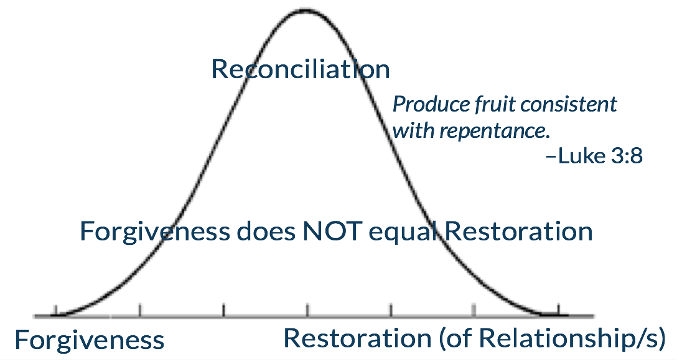
Consider the chart below. Forgiveness, reconciliation, and the restoration of relationships is always the goal. Reconciliation is at the heart of the gospel and is not an option. As believers we have been assigned the ministry of reconciliation:  

“All this is from God, who through Christ reconciled us to himself and gave us the ministry of reconciliation.” –2 Cor 5:18

While seeking to be reconciled, move towards forgiving those who have wounded and hurt you. (This is not an option either.) Now, it’s important to understand that forgiveness and restoration are not the same. You may choose to forgive, but the end result of reconciliation that leads to restoration may take more time. Notice the pathway on the chart below…

Reconciliation can be a long journey, but it is one that believers are admonished to take. In Mark 11:25, Jesus tells us, “When you stand praying, if you hold anything against anyone, forgive him, so that your Father in heaven may forgive you your sins.” Paul tells us to “Bear with each other and forgive whatever grievances you may have against one another. Forgive as the Lord forgave you” (Col 3:13). To forgive as God forgives us, we must:

a. See others as image bearers of God who are also given to sinful frailty

b. Be willing to bear their debt.

The word “forbearance” is a word that is used mostly in the KJV and can be defined as, “to abstain or hold back; forbearance is akin to patience and self-control.”

    Desire the other person’s good (sometimes at personal cost to you). People are not the hurt that they do to us. We are all broken yet God uses broken people to serve His purpose in a broken world.

    Managing Church Change

    The Bible has a lot to say about resistance to change, highlighting both human nature and spiritual perspectives on transformation:

    Emotional Resistance


    The Bible recognizes that people naturally tend to resist change due to fear and comfort with the familiar. In Luke 5:36-39, Jesus uses a parable about wine and wineskins to illustrate this resistance, noting that people often prefer the old ways, saying “the old is better.”

    Several biblical passages explore spiritual barriers to change, including:

    • Jeremiah 17:9 describes the human heart as “deceitful above all things, and desperately wicked”
    • Romans 8:7 explains that the carnal mind is “enmity against God” and is not subject to divine transformation
    • Mark 10:17-22 provides an example of resistance through the story of the rich young ruler who was unwilling to give up his possessions to follow Jesus

    Theological Perspective

    The Bible suggests that true change requires divine intervention. Without the Holy Spirit changing a person’s heart, behavioral modifications are not sustainable. The transformation process is often compared to refining fire (Mal 3:2), pruning (Jn 15:2), or what Paul termed a “thorn in the flesh” (2 Cor 12:7), which can be uncomfortable but ultimately leads to growth. After all of Job’s troubles his testimony is, “I have heard of You by the hearing of the ear; but now my eye sees You” (Job 42:5).

    Ultimately, Scripture emphasizes that change is a sacred process, and resistance often stems from pride, fear of the unknown, and attachment to familiar patterns that may have even become idols. (An idol is frequently a good thing that becomes an ultimate thing.)

    Paul addressed resistance to change in his ministry through various strategies, demonstrating both patience and decisiveness:

    Strategies for Addressing Resistance

    Reasoning and Patience: Paul often engaged in reasoning and pleading with those resistant to his message. He spent time dialoguing and debating with religious leaders. We see in his interactions in Corinth where he initially engaged in vigorous dialogue before deciding to move on when his opposition became abusive (Acts 18).

    Walking Away from Toxic Situations: When faced with stubborn resistance or abusive behavior, Paul chose to walk away rather than persist in unfruitful situations. This approach is evident in places like Pisidian Antioch, where he decided to focus on more receptive audiences after encountering rejection (see Acts 13).

    Adaptive Methodology: Paul was flexible in his approach, adapting his methods to reach different groups. He expressed this adaptability in 1 Cor 9:22, stating he became “all things to all people” to save some, reflecting a willingness to adjust his tactics for effective ministry.

    Defending His Calling: In 2 Cor, Paul defended his ministry against opposition by emphasizing spiritual authority and relying on divine power rather than human strength. He addressed resistance by highlighting the spiritual nature of his mission and encouraging humble self-examination among his detractors.

    Guidance for Future Leaders: Paul advised younger leaders like Titus to avoid engaging repeatedly with divisive individuals (3:10; see also Rom 16:17 and 1 Cor 1:10). He recommended giving such people a chance but warned against wasting too much time on persistent opposition.

    Through these methods, Paul managed resistance by balancing patience with strategic withdrawal, adapting his approach to suit different listeners, and maintaining a focus on productive ministry efforts.

    Strategies for Managing Resistance

    1. Communicate Clearly

    • Explain the Purpose: Clearly and repeatedly communicate how the change aligns with the church’s mission and how it will benefit the congregation and the broader community.
    • Address Concerns: Listen to members’ concerns and provide honest answers, emphasizing how the change supports God’s will and strengthens the church’s relationship with God.

    2. Introduce Gradually

    • Prepare the Congregation: Introduce changes gradually, allowing time for members to adjust and understand the value of the change.
    • Use Scripture: Remind members of scriptural teachings related to change to ease fears and build acceptance. A sermon series studying Nehemiah’s change taxonomy is often helpful.

    3. Build Support

    • Engage Key Leaders: Have visionary conversations with key lay leaders and staff to ensure they are supportive and can even act as advocates for change.
    • Unify Leadership: Take the time to ensure all church leaders are on the same page and can present a united front.

    4. Emotional Considerations

    • Allow for Grieving: Recognize that all change brings a sense of loss. Allow members to express their emotions and provide support as they adjust.
    • Respect Traditions: Understand which traditions reflect the unique callings of the congregation. A book has been written titled, “Sacred Cows Make Gourmet Burgers.”

    5. Strategic Planning

    • Develop a Comprehensive Plan: Carefully plan how changes will be implemented, considering resources, potential impacts, and unintended consequences.
    • Monitor Progress: Keep track of how changes are being received and make adjustments as necessary to address any ongoing resistance or issues. Practice creative redundancy in communication plans.

    By following these strategies, church leaders can effectively manage resistance to change, fostering an environment where transformation is seen as a positive step forward rather than a threat.