
Gregg A. Caruso

Refractions on Life and Leadership

Gregg A. Caruso

Plan B: Further Thoughts on Faith by Ann Lamott Quotes

While I read this book a while ago, I just went through my notes and some of the quotes. I found this book to be quite refreshing and I have her latest book, Grace (Eventually): Thoughts on Faith, on my wish list.

From the first chapter, Ham of God, Lamott’s pastor, Veronica, is quoted as defining peace as joy at rest and joy as peace on its feet (p. 7)

While describing her perspective of Rahab’s world (Joshua 2) and the impulse Rahab felt to align herself with God’s people – even at great risk to her own life – Lamott describes the upside of desperation and even likens it to an acronym for G.O.D.: gifts of desperation. The main gift, she writes, is a willingness to give up the conviction that [we] are right. The fruit is a greater sensitivity to God’s voice; which she describes as “the secret place that, as Robert Frost wrote, ‘sits in the middle and knows'” (pgs. 19-22).

When we pray, we are not starting a conversation from scratch, we are just remembering to plug back into a conversation that’s always been in progress (pg. 25).

When God is going to do something wonderful, He or She always starts with hardship (p. 33).

Lamott writes, “Some people think that God is in the details, but I have come to believe that God is in the bathroom. Prayer usually means praise, or surrender, acknowledging that you have run out of bullets” (p. 37).

Lamott writes poignantly about her mother’s death and the myriad of feelings that tormented and challenged her. She even left her mom’s ashes in the closet while she worked out her feelings and her grief! She writes, “So I left her in the closet for two years to stew in her own ashes, and I refused to be nice to her, and didn’t forgive her…I assumed Jesus wanted me to forgive her, but I also know he loves honesty and transparency…I know forgiveness is a component of freedom, yet I couldn’t…grant her amnesty. Forgiveness means it finally becomes unimportant that you hit back.”

We are responsible not for the outcome of things, but only for their ingredients (p.61).

Lamott sees Jesus’ mother Mary as the feminine face of divine love. And in unpacking the Catholic prayer, Hail Mary (sometimes called the “Angelical Salutation”, from the first words in its Latin form, the “Ave Maria”) she focuses on the phrase “full of grace” and quotes Archbishop Carlo Maria Martini of Milan who writes that the phrase is passive and past tense, so it really means something like, “You have been loved for a very long time” (p. 63).

Laughter is carbonated holiness (p. 66).

Love and patience are like Holiness Helper in each other’s lives (p. 69).

Lamott shares a Hasidic story of a rabbi who always told his people that if they studied the Torah, it would put Scripture on their hearts. One of them asked, “Why on our hearts instead of in our hearts?” The rabbi answered, “Only God can put Scripture inside. But reading sacred text can put it on your hearts, and then when your hearts break, the holy words will fall inside” (p. 73).

Lamott, at one point, prays, “Please let me feel you You while I adjust to not getting what I was hoping for” (pgs. 74-75).

Maybe this is what grace is, the unseen sounds that make you look up (p. 162).

Time-tested friends help us to step into the shape that is waiting for us (p. 172).

Faith is not about how we feel, it is about how we live (p. 213).

Quoting Gerald May, “Grace threatens all my normalities” (p. 233).

Faith includes noticing the mess, the emptiness and discomfort, and letting it be there until some light returns. Faith also means reaching deeply within, for the sense one is born with… (p. 257).
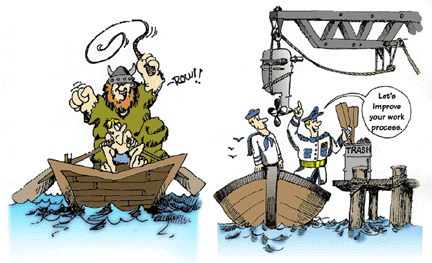

What Effective Leaders Do

Carmine Gallo wrote in Business Week about, “The Seven Secrets of Inspiring Leaders” reflecting on research by Maritz Research which found that only 10% of employees look forward to going to work. The main reason? A lack of leadership. While Gallo was conducting research for the book, Fire Them Up the following seven practices were shown to result in inspirational communication:

1. Demonstrate enthusiasm — consistently. “Inspiring leaders have an abundance of passion for what they do. You cannot inspire unless you’re inspired yourself. Period. Passion is something I can’t teach. You either have passion for your message or you don’t. Once you discover your passion, make sure it’s apparent to everyone within your professional circle.”

2. Articulate a compelling course of action. “Inspiring leaders craft and deliver a specific, consistent, and memorable vision. A goal such as “we intend to double our sales by this time next year,” is not inspiring. Neither is a long, convoluted mission statement destined to be tucked away and forgotten in a desk somewhere. A vision is a short (usually 10 words or less), vivid description of what the world will look like if your product or service succeeds.”

3. Sell the benefit. “Always remember, it’s not about you, it’s about them. In a Journalism class, I was taught to answer the question, “Why should my readers care?” That’s the same thing you need to ask yourself constantly throughout a presentation, meeting, pitch, or any situation where persuasion takes place. Your listeners are asking themselves, what’s in this for me? Answer it. Don’t make them guess.”

4. Tell more stories. “Inspiring leaders tell memorable stories. Few leaders appreciate the power of stories to connect with their audiences… No amount of data can replace that story… Stories connect with people on an emotional level. Tell more of them.”

5. Invite participation. “Inspiring leaders bring employees, customers, and colleagues into the process of building the organization. This is especially important when trying to motivate young people. The command and control way of managing is over. Instead, today’s managers solicit input, listen for feedback, and actively incorporate what they hear. Employees want more than a paycheck. They want to know that their work is adding up to something meaningful.”

6. Reinforce an optimistic outlook. “Inspiring leaders speak of a better future… Extraordinary leaders throughout history have been more optimistic than the average person. Winston Churchill exuded hope and confidence in the darkest days of World War II. Colin Powell said that optimism was the secret behind Ronald Reagan’s charisma. Powell also said that optimism is a force multiplier, meaning it has a ripple effect throughout an organization. Speak in positive, optimistic language. Be a beacon of hope.”

7. Encourage potential. “Inspiring leaders praise people and invest in them emotionally. Richard Branson has said that when you praise people they flourish; criticize them and they shrivel up. Praise is the easiest way to connect with people. When people receive genuine praise, their doubt diminishes and their spirits soar. Encourage people and they’ll walk through walls for you.”

No leader accomplishes a vision alone. Inspiration is critical to rally people to make the journey and to commit the time and energy required to bring a vision to pass. These seven techniques present some great ways to inspire and motivate people to greatness.

Study: Poor Planning Impedes Church Progress

The Christian Post reports that most pastors have no problem identifying needs and problems in their communities, but 67 percent say they don’t understand why progress toward solutions is so slow. A new study by LifeWay research found that only 29 percent of pastors strongly agreed that they had a clear plan to transform their churches into what God wanted them to be. “The effectiveness of local church ministry often is jeopardized by poor organization,” diagnosed Scott McConnell, associate director of LifeWay Research. “Understanding God’s calling and the context of the church is important, but leadership requires knowing where you are, knowing where you need to go, and knowing how to get there. Most pastors actively pursue the first two, but many struggle with the third.”

Obama’s Leadership Potential – As a Visionary Minimalist

I thought this was an excellent article on Obama’s leadership style – and potential. If you’d like to go directly to the Washington Independent website click here.

Obama the Visionary Minimalist

He Seeks Consensus on ‘What’ to Do — Not ‘Why’ to Do It

addthis_pub = ‘washingtonindependent’; By Cass R. Sunstein
President-elect Barack Obama (WDCpix)

And to those Americans whose support I have yet to earn, I may not have won your vote, but I hear your voices, I need your help and I will be your president too.”

So said President-elect Barack Obama, in one of the most revealing sentences in his victory speech Tuesday. In his rejection of standard political divisions, his emphasis on “e pluribus unum,” and his gracious inclusion of those whose support he has “yet to earn,” we can find a clue to what makes our new president-elect so remarkable — perhaps even unique in the nation’s long history.

Some public officials are minimalists. They do not like to reject the fundamental commitments of their fellow citizens. On environmental questions, sex equality, national security and economic policy, they try to bracket our deepest disagreements. They seek to obtain a consensus on what to do — not on why to do it.


Minimalists favor their approach because they think, as a pragmatic matter, it is most likely to work. They also insist that their approach, putting fundamental differences to one side, shows respect to their fellow citizens.

Political minimalism has a distinguished tradition in U.S. politics. In recent history, President George H.W. Bush stands as the leading minimalist. To the extent that Bush succeeded, especially in foreign affairs, it was because he enlisted diverse people, and diverse views, on behalf of the policies he chose.

Other public officials are visionaries. They have a large-scale vision about the direction in which the nation should go. They believe in big steps, not small ones.

Above all, these visionaries seek to alter the nation’s self-conception. In changing policy on the economy, or on national defense, they are entirely comfortable with asserting that their vision is the superior one and that alternative visions should be rejected. When they succeed, they transform how the nation understands itself.

Our greatest presidents — including Washington, Lincoln, and Franklin Delano Roosevelt — have been visionaries. In recent American history, President Ronald Reagan stands as the leading visionary.

Obama is something new in American politics — and not just for the obvious reasons. He is a visionary minimalist. This is a key both to his extraordinary campaign and to his unique promise. It even helps explain his conception of public service.

Obama’s minimalism lies in his consistent rejection of the standard social divisions — between red states and blue states, liberal and conservatives, Democrats and Republicans. As he said in his 2004 Democratic Convention speech, “We worship an awesome God in the blue states, and we don’t like federal agents poking around our libraries in the red states.”

Obama shows unfailing respect for those with competing views. In designing policies — on climate change, tax reform, energy conservation, foreign policy — he attempts to produce solutions that will accommodate, rather than repudiate, the defining commitments of his fellow citizens. Even on the most divisive issues of separation of church and state, Obama favors approaches that will attract support from all sides.

But Obama is a visionary too. Unlike most minimalists, he is willing to think big.

When he speaks of change, he means to include ambitious plans for energy independence, universal health care and educational reform. No less than Reagan, he wants to transform the nation’s self-understanding. He seeks not only to go beyond the divisions of the 1960s, but also to synthesize deeper strands in our history.

Thus Obama recognizes and celebrates the individualist strain in American culture. But he draws attention to a counterpoint — one that emphasizes mutual obligations.
As he said in 2004 and has often repeated since, “If there’s a senior citizen somewhere who can’t pay for her prescription and has to choose between medicine and the rent, that makes my life poorer, even if it’s not my grandmother. . . . It’s that fundamental belief — I am my brother’s keeper, I am my sister’s keeper – that makes this country work.”

With the election of a new president, I expect that we will soon enter a novel period of American life, in which a commitment to public service, sacrifice and a sense of mutual obligations will play a far larger role. That commitment will be anything but partisan. It will be felt in red states and blue states alike.

And it will be made possible, and fueled, by the visionary minimalism of America’s president-elect.

Cass R. Sunstein is Felix Frankfurter professor of law at Harvard Law School. He will be the Harry Kalven Visiting Professor at University of Chicago Law School in January 2009. His most recent book, which he co-wrote with Richard Thaler, is “Nudge: Improving Decisions about Health, Wealth, and Happiness.” His books include “Are Judges Political? An Empirical Analysis of the Federal Judiciary” and “The Second Bill of Rights: FDR’s Unfinished Revolution and Why We Need It More Than Ever.