 This was the fourth in a “U2 Lists” series, where @U2 staffers pick a topic and share their personal rankings on something U2-related. @U2 writer Maddy Fry put the following list together. I find her to be quite well spoken – she has offered some profound insight into the genius that is U2 – as well as her own spiritual journey. I added a link to the lyrics of each song. Read, listen, reflect, enjoy…
10) “Tomorrow“
Appearing on what is probably U2’s most overtly religious album, October, ‘Tomorrow’ is arguably the standout track: painful, disturbing, and brutally honest in its description of the singer’s ascent from the agony arising in the wake of his mother’s death to the healing and elation he receives from a sudden spiritual awakening. The song’s slow beginning reflects Bono’s grief and confusion as he veers between trying to form a dialogue with his mother to openly pleading for her return: “Going out/going outside mother/I’m going out there/Won’t you be back tomorrow?/won’t you be back tomorrow?/ will you be back tomorrow?” Yet as it speeds up and builds to a crescendo, it becomes unclear whether Bono’s cry of “I want you/I want you” is addressed to his mother or to some higher being, as he startlingly admonishes the listener to “Open up, open up, to the love of God/to the love of he who made the blind to see/he’s coming back, he’s coming back/Oh believe.”
This tight connection between the loss of his mother and his move towards faith is a theme Bono revisits time and again, particularly on the Pop album via the song “Mofo,” where he directly asks her “Am I still your son?” in between his attempts to locate “the baby Jesus under the trash.” As on “Tomorrow,” no answer comes back from the silence. However, in his mother’s absence, on both songs the singer’s God maintains a constant, if at times aloof, watch.
9) “Drowning Man“
Despite containing no references whatsoever to “drowning,” this low-key track on the War album arguably has a soporific effect on the listener, with the slow-paced drumbeat and repetitive guitar, interspersed with rapid bursts of melody from the violin, creating an aura of being submerged in sound. Bono was apparently on a particularly high plane of spiritual consciousness when writing the lyrics, in a state of mind akin to that of one speaking in tongues, the effect being of stepping outside of the self and surrendering to a higher sense of love. The lines toward the end — “Rise up, rise up/with wings like eagles/you’ll run/you’ll run/you’ll run and not grow weary” — are lifted from Isaiah 40:31, with the line seemingly blurred at times between dialogue and self-reflection. Is the song aimed at anyone in particular (such as the claim by Niall Stokes in U2 Into the Heart that the song is addressed to the then-irreligious Adam Clayton), or is it merely Bono channelling through himself the sentiments expressed by the higher power he’s communing with?
8) “The Wanderer“
Here Bono makes Johnny Cash take on the role of the central character of the Book of Ecclesiastes, the wise old preacher whom he calls “the Wanderer.” The post-Bill Gibson cityscapes of the rest of the Zooropa album are replaced by a still electronica-based, but more rural and folksy setting, where the protagonist, despite his insightful musings — “I went out there in search of experience/to taste and to touch/and to feel as much/as a man can, before he repents” — is mired with uncertainty, travelling through a land where corruption and temptation are never far away — “I went out walking/through streets paved with gold/lifted some stones/saw the skin and bones/of a city without a soul” — and where he is unsure if he’ll ever make it back home, spiritually or physically: “Jesus, don’t you wait up/Jesus I’ll be home soon.” In a brilliant and other-worldly fusion of industrial electronic beats and Johnny Cash’s rustic vocals, the lost character in the album’s title track here seems to have found his voice; although he may have a religion, he has no compass, and certainly no map.
7) “Love Rescue Me“
On this mournful track from Rattle and Hum, the strident certainty of the spiritual songs on U2’s previous albums is replaced here with fear, guilt, despair and a sense of isolation from God. Described by Bono as being about “a man whom the whole world is looking to for salvation, but who needs a shot of salvation himself,” the lyrics draw on imagery from the Psalms, where the King David-esque figure appears to be no longer deriving any comfort from the Lord’s rod and staff (Ps. 23:4). Moving between self-hatred — “I’m here without a name/in the palace of my shame” — and anger at the outside world — “Many strangers have I met/on the road to my regret/many lost who seek to find themselves in me/they ask me to reveal/the very thoughts they would conceal” — the song is particularly moving live, perhaps most memorably during the band’s 1989 New Year’s Eve show at the Point Depot in Dublin, where Bono dedicated it to “those who work for Amnesty International and to those who depend on Amnesty International.”
This was not the first time U2 had drawn on the love-hate howls of the Psalmist for inspiration, but in terms of their spiritual direction it marked a significant shift away from the unquestioning, wide-eyed devotion of many of their previous religiously-minded songs.
6) “The Playboy Mansion“
Spiritual discontent abounds on the Pop album, particularly so on “The Playboy Mansion,” where the voice in the song wonders if in a world of rampant materialism, where “the banks they’re like cathedrals” and “chance is a kind of religion,” he has lost the ability to gain entrance to heaven, the ultimate “Playboy Mansion.” Yet despite its cynicism, there remains a note of hope, with the speaker confident that the world around him does not need a sharp re-awakening, but will “come around.” There are also echoes of Revelation 21:4 at the end when he asks “Then will there be no time for sorrow/then will there be no time for shame?” However, the speaker has to be content with solitary contemplation, as not for the first time, whoever resides within the mansion gives no reply.
5) “Wake Up Dead Man“
Bitter, enraged and at times desperate, the final song on the Pop album is a fierce antidote to any rose-tinted view of the spiritual life. Bono states his predicament bluntly and uncompromisingly in the first few lines, painting a grim picture of what is perhaps his boldest depiction of a life lived in isolation from both God and the wider world: “Jesus, Jesus help me/I’m alone in this world/and a fucked-up world it is too/tell me, tell me the story/the one about eternity/and the way it’s all gonna be/wake up/ wake up dead man.”
Crying out to a deity who may or may not have abandoned him, in “Wake Up Dead Man” (the lyrics of which were partly written by the Edge), Bono describes a bleak situation, one of being so consumed by naked anger with God that it makes hard listening for any believer. However, I’ve often found it the perfect sound track to those blackest of black moments, as the song almost perfectly articulates what it feels to have what Bono has called that “very valid” sense of outrage at a God who at times seems indifferent to the awfulness of the human condition. Like the best U2 songs, it makes uncomfortable, but undeniably necessary listening.
4) “Mercy“
Only recently have I begun to realise what an absolute gem this song is. Upon first hearing it, I was admittedly unimpressed. But gradually, repeated listening meant that it worked its way under my skin, at times talking to me quietly like a voice whispering in the ear, at others almost shouting to me at the top of its lungs. More than any other U2 song, “Mercy” seems to express pure humility, awe and devotion at the divine, one who is always referred to directly via relatable sentiments yet only described in specific religious terms in the first two lines: “I was drinking some wine/and it turned to blood/what’s the use of religion/if you’re any good?” The listener is instantly plunged into a familiar U2 theme: that of questioning organised religious structures whilst simultaneously cutting through determinedly to an instant dialogue with God. It has echoes of both “Please” (“You know I’ve found it hard to receive”) and “Acrobat” (“Yeah, I’d break bread and wine/if there was a church I could receive in”), but instead of frustration, the sentiment expressed here is pure joy. Conveying both an overwhelming desire to give (“You’re gravity searching for the ground”) and receive (“Your heart is my home”), “Mercy” is arguably one of the few U2 songs where a true, unquestioning union with the deity, whoever or whatever he, she or it may be, is achieved. I can only begin to guess at why it was left off How to Dismantle an Atomic Bomb.
3) “Yahweh“
Luckily, this is one song that the band chose to include on the aforementioned album. Despite certainly being a good choice as a closing track, “Yahweh” (which takes its title from the Hebrew word for God) is a song that in my view works best live. Stripped down to just an acoustic guitar, keyboard and vocals, this is heartfelt, content and intimate dialogue with the Lord, where Bono lays clear his perceived flaws — “Take this mouth/so quick to criticise/take this mouth/give it a kiss” — whilst never ceasing to subject the object of devotion to rigorous questioning via the refrain of “Yahweh/Yahweh/still I’m waiting for the dawn.” A greater spiritual wisdom seems more apparent here than on the likes of “Wake Up Dead Man” as, despite his demand at the end to know “why the dark before the dawn?”, Bono shockingly surrenders himself completely to the deity: “take this heart/take this heart/take this heart/and let it break.” One of my most treasured moments as a U2 fan was watching “Yahweh” performed in Cardiff three-and-a-half years ago, with the final lines being sung against a background video of an egg hatching and a bird flying freely upwards, seeming to depict spiritual growth and freedom. To quote Bono, God was truly walking through the room at that point.
2) “I Still Haven’t Found What I’m Looking For“
Along with “Running to Stand Still,” this song has often competed to be my favourite on The Joshua Tree. Drawing on the rich language of the Psalms — “I have spoke with the tongue of angels/I have held the hand of the Devil” — “I Still Haven’t Found…” is first and foremost, to quote Bono, “a song of doubt far more than it is of faith.” The inevitable sense of restlessness and torment that defines the life of almost any believer at one time or another comes through particularly strongly here, as despite Bono’s assertion to the Almighty that “You broke the bonds/loosed the chains/carried the cross/and my shame/all my shame/you know I believe it,” he still remains unsatisfied: “But I still haven’t found what I’m looking for.”
Although Paul Gambacinni’s description of the aforementioned lines as being like “a human being on a plate” is perhaps a little over-zealous, the spiritual condition inherent in the song certainly seems to match Bono’s statement in Bono In Conversation with Michka Assayas that “the life of a true believer is one of a more uphill struggle, with things illuminated along the way.” Judging by the way the line “I still haven’t found what I’m looking for” is repeated throughout until the end, that struggle seems destined to be a never-ending one.
1) “40“
To this day, I still feel that all U2 songs that deal with matters of a spiritual, philosophical or religious nature ultimately have “40” as their benchmark. More than any other, this is a U2 song that for which the word ‘transcendent’ absolutely applies.
Yet it is another that I feel is only truly brought to life when performed live, as the version on War in many ways feels far too restrained. Most live versions of the song, from the 1989 concert at the Point Depot, to the one on the Chicago DVD, to the 1987 version in Paris that came with last year’s super deluxe re-mastered edition of The Joshua Tree, have spanned at least five minutes in length, with Edge’s soaring guitars, Larry’s pounding drums and Bono’s vocals drawn from Psalm 40 — “I waited patiently on the Lord/He inclined and heard my cry/He lifted me up out of the pits/and out of the miry clay” — ensuring that when “40” is performed live, what BP Fallon described as “the U2 magic” truly happens.
What I could honestly call my first true experience of God happened when I was listening for the first time to the version of the song performed live at the Point Depot that came with The Complete U2. Maybe it was the way the guitar just seemed to create the feeling of spiraling upwards, outside of oneself; maybe it was the continuous singing of “How long to sing this song?” by the crowd as every instrument bar the drums faded away into nothingness; or maybe it was just the sheer joy that the song seemed to express, free from doubt, pain or disillusionment. Things weren’t quite the same for me after those seven minutes and 25 seconds came to an end; and every time I listen to it, they somehow still aren’t.

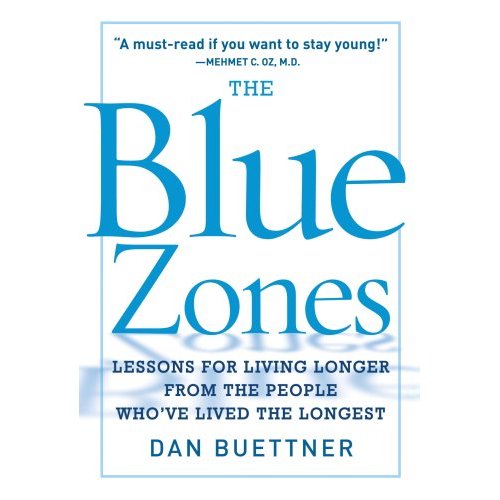 The Blue Zones are five pockets around the world where people live the longest, healthiest lives. There is a website and a book extolling the virtues of seeking to match the lifestyles of those who live in the Blue Zones. In the book, it takes 38 pages to explain the nine common denominators of the world’s longest-lived people (the Power 9). An average reader could read the whole book in two hours. Most people just want the 10 things they could do to live longer and stay younger.

 Gregg A. Caruso