Nurturing Creativity

Elizabeth Gilbert, author of Eat, Pray, Love on nurturing creativity. She makes a good case for the idea that greatness comes from without and not from within – and the idea of just showing up. While I haven’t read the book and don’t know the details of her belief system (click here to go to an elegantly stated critique of her book), I do think we can learn from her passion and authenticity. (FYI, it’s an 18 minute video.) I would like us to be to be able learn from others about the important issues of our day and always be willing to ask the questions:  What is redemptive?  And, How will this help me to contextualize God’s good news in my current cultural context?

Finally, I’m a HUGE fan of the TED talks. It began in 1984 as a conference bringing people together from three worlds: technology, entertainment, and design. Since then its scope has become ever broader, bringing together some of the world’s most fascinating thinkers and doers who are challenged to give the talk of their lives in 18 minutes. Check it out here.

The Strength Is In The Struggle

I received this this morning from an old friend named Marilyn…

I love the illustration of the caterpillar and the butterfly. The lonely butterfly egg hatches. The caterpillar just begins to instinctively eat the leaf it was hatched on. When it finishes that leaf it finds another. Yet one day, by God’s design, it climbs a small branch and spins a cocoon. In that cocoon, the caterpillar melts. From that liquid, God forms the butterfly. That is why the butterfly is all wet when it comes out of the cocoon. It then has to laboriously stretch out its wings to cause the liquids to move into its veins. Then it rests. Then it stretches out again and rests. Finally when it is dry and strong, the tiny thread that secured it to the cocoon breaks and it is free to fly and drink nectar.

Have you ever asked God to remove your trial? Paul did, and the Lord told him, “My grace is sufficient for you, for My strength is made perfect in weakness” (2 Corinthians 12:9). I like to think about grace as a box. Each side top and bottom is labeled, “My grace is sufficient.” In my struggle, I often say, “Here I am Lord, standing in my grace box.” It helps me to focus on Him and realize afresh that I am surrounded by His grace strength.

Every trial contains another essential step in God’s purpose for our life. Hebrews 10:36 says, “For you have need of endurance, so that after you have done the will of God, you may receive the promise.” Did Abraham struggle as he waited twenty some years before God’s promise was fulfilled in his life? Romans 4:18 says, “Who, contrary to hope, in hope believed.” This needful endurance means that we can bear up under our difficult trial through hope, continually drawing our strength from the Lord.

1 Peter 5:10 says, “But may the God of all grace, who called us to His eternal glory by Christ Jesus, after you have suffered a while, perfect, establish, strengthen, and settle you.” Did you notice that the establishing comes after the suffering? So many things in nature bear out this truth. The crocus that emerges through the snow, the baby bird that pecks its way through an egg, the seedling that pushes through the earth, all represent how the strength is in the struggle.

1 Peter 1:7 tells how the fiery trials are necessary to purify our faith. Faith is essential. Hebrews 11:6 says that without faith it is impossible to please God. There is another aspect to struggling. People watch our faith. It could be that the trial you are enduring right now is a testimony to God’s grace strength in your life. I like to read true life stories of missionaries to see how God was faithful in their impossible circumstances. Their endurance fortifies and encourages me, as I read how God orchestrated their lives, interweaving people and circumstances to fulfill His divine purpose for them.

Galatians 6:9 says, “And let us not grow weary while doing good, for in due season we shall reap if we do not lose heart.” Be encouraged today to stand in your grace box and endure because the strength is in the struggle.


The Eastern Roots of Our Christian Faith

On a couple of occasions in a church service during our Deeper Still series (a contemplative look at the Lord’s Prayer) I have made the point that we, in the western world, often forget that Christianity was birthed and is rooted in the East. 
Here is my best attempt at a short history:
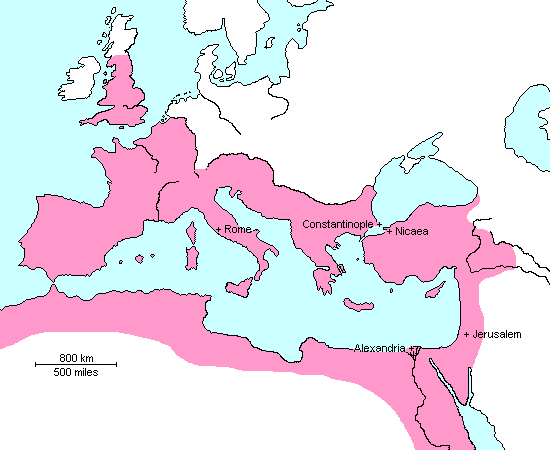
The westernization of Christianity began with Paul planting and writing to churches throughout the Mediterranean region.  The book of Acts ends with Paul imprisoned in Rome (about 64AD). Paul, by the way, was part of the early persecution of the Church (see Acts 8).  After Paul’s conversion he experienced severe persecution throughout the remainder of his life – which is said to have ended with his beheading.  The first large-scale persecution of the Jerusalem Church occurred in 70AD with the destruction of Jerusalem by the Romans.  This drove Christians (and Jews) out of the region and onto the vast system of roadways built by Rome and linking what is today western Europe, Turkey, and northern Africa resulting in an era of missionality. In his book, The Forgotten Ways: Reactivating the Missional Church, Alan Hirsch calculates that the early church grew from 25,000 in 100AD to about 20,000,000 by 310AD!  This, no doubt, influenced Emperor Constantine, who, in 313AD, made Christianity the formal religion of the Empire (see map above).  (There is still debate over whether or not Constantine was an active follower of Christ.  Some maintain that in making Christianity the religion of the empire his goals were more political than theological.) Nevertheless, Constantine was uniquely a product of both the east and the west and this set the stage for Christianity to strengthen its flow into what is today Europe (and into N Africa).
Beginning around the third century Christian hermits, ascetics and monks fled to the desert of Egypt.  They were seeking to escape the chaos and the Diocletian (predecessor of Constantine) persecution, abandoning the cities of the secular world to live in solitude.  In Egypt, refugee communities formed at the edges of population centers, far enough away to assure safety.  In 313, when Christianity was made legal, many continued to live in these marginal areas.  The solitude of these places attracted them because the privations of the desert were a means of learning the ways of Jesus — fasting and seeking God.  They believed that desert life would teach them to follow God’s call in a more focused and deliberate way.  During the 4th century, these communities continued to attract others and as the lifestyle progressed, these men and women developed a reputation for holiness and wisdom.  Today they are referred to as the Desert Fathers.  Many individuals who spent part of their lives in the Egyptian desert went on to become important figures in the Church and society of the 4th and 5th centuries, among them Athanasius, Anthony, John Chrysostom, and John Cassian.  The spirituality of the Desert Fathers deeply affected the Western Church (including Protestantism) and the Eastern Church – their role creates the opportunity for Catholic, Eastern Orthodox, and Protestant believers to enjoy some common ground.  For instance Augustine, who was converted through the writings of  Anthony of the Desert, continues to be revered and respected by the Catholics, Eastern Orthodox, and Protestants alike.  Additionally, the monastic institutions Cassian and Augustine helped spread into Europe are said to have kept learning and culture alive during the Early Middle Ages, and were often the only institutions that cared for the sick and poor.  (It should be noted that while all this was going on in N Africa and S Europe, Saint Patrick was preaching the gospel and building communities of faith in Ireland – which spread south into Europe even as Cassian-Augustinian inspired communities spread north.)  For this reason, the writings and spirituality of the Desert Fathers are still of interest to many people today.
When we hear the phrase “contemplative spirituality,” it is often a reference to the learning and teaching of these Desert Fathers. 
“Contemplative spirituality” means the understanding that God wants to have a real relationship with us – this is not just religion – God longs to walk alongside us in our lives and speak into and guide our live.  Our part in allowing this to happen is to learn the blessings of solitude, silence, and listening – this is especially helpful in our 21st century ADD culture.  It’s a way of practicing our faith that can be foreign to many Christians, especially us Evangelicals who are trained to read Scripture more for information than formation.  We can engage the Text with the intention to be formed by it, to deepen our relationship with God.  In this process we are making ourselves available to God, positioning ourselves before him that he might have access to our lives.  Studying and learning both the western and eastern constructs of our Christian faith will strengthen us to live as balanced and faithful Christ-followers.
Here are some practices of Scripture that have a more contemplative aspect to them:
  • Meditation (Psalm 1:2; 4:4; 27:4; 39:3; 48:9; 63:6; 77:6, 12; 119:15, 23, 27, 48, 52, 78, 97, 99, 117, 148; 143:5; 145:5)
  • Silence as a form of contemplation and listening (Psalm 46:10a; Isaiah 30:15; Matthew 6:6; Matthew 11:29; 1 Peter 3:4; 1 John 3:19)
  • Fasting as a form of humble focus (Ps 35:13b, et al.)
J.I. Packer in his classic work, Knowing God says, meditation is a lost art today, and Christian people suffer grievously from their ignorance of the practice.  Meditation is the activity of calling to mind, and thinking over, and dwelling on, and applying to oneself, the various things that one knows about the works and ways and purposes and promises of God.  It is the activity of holy thought, consciously performed in the presence of God, under the eye of God, by the help of God, as a means of communion with God. (pgs 18-19).