Change is the New Normal

As we study the book of Acts it occurs to me that when the church started everything radically changed for the disciples, as well as for every person who decided to become an active intentional follower of Christ. 

The disciples were convinced that they were to become the cabinet members for the new theocracy that Jesus was going to set up on the earth.  They were hoping for condos on the Mediterranean and what they got was a call to become the servants of all.  Almost all of them would die martyrs deaths. 

Here are some quotes on CHANGE.  Think about it…

  • “If you want to make enemies, try to change something.” —Woodrow Wilson,
  • “It is not merely that changes in our world demand new responses from us. The very foundations of society have changed.” —Craig Van Gelder
  • “A church which pitches its tents without constantly looking out for new horizons, which does not continually strike camp, is being untrue to its calling… (we must) play down our longing for certainty, accept what is risky, and live by improvisation and experiment.” —Hans Kung
  • “The illiterate of the 21st century will not be those who cannot read and write, but those who cannot learn, unlearn, and relearn.” —Alvin Toffler

  • “Uncertainty is the only thing to be sure of.”—Anthony Muh
  • “If you don’t like change, you’re going to like irrelevance even less.” —General Eric Shinseki
  • “If things seem under control, you’re just not going fast enough.” —Mario Andretti
  • “It is generally much easier to kill an organization than change it substantially.” —Kevin Kelly
 Have said the above there are (at least) three things that will never change:
  1. God’s love never changes (see Malachi 3:6, Jeremiah 31:3, Psalm 119:159, Romans 8:38)
  2. God’s Word will never change (see Isaiah 40:8, Psalm 119:152, Matthew 5:24)
  3. God’s purpose for my life will never change (1 Samuel 15:29, Psalm 33:11, Proverbs 19:21, Romans 8:28, Psalm 56:11, Psalm 46:1-2)


Thoughts on the Trinity

This Sunday we will be taking a look at Acts 2:1-41, were the Holy Spirit rushes (“like a mighty wind”) into the lives of some bewildered disciples of the ascended Christ. This moment would forever change the course of human history. The God of the universe has become available to humankind through Jesus Christ – and now the Holy Spirit. It will be helpful for us to consider the mystery, or paradox, of the Trinity…

Neither of the words “Trinity” nor “Tri-unity” appears in the Old or New Testaments, yet the concept has its basis in an understanding of scriptural teaching. Our English word “Trinity” is derived from Latin, “Trinitas,” meaning “the number three, a triad.”  This abstract noun is formed from the adjective trinus (three each, threefold, or triple),  — just as the word unitas is the abstract noun formed from unus (one). The corresponding word in Greek means “a set of three” or “the number three.”

Tertullian, a Latin theologian of North African decent, who wrote in the early third century, is credited with first using the words “Trinity,”  “person,” and “substance”  to explain that the Father, Son, and Holy Spirit are “one in essence – not one in Person.”

About a century later, in 325, the First Council of Nicaea established the doctrine of the Trinity as orthodoxy and adopted the Nicene Creed that described Christ as, “God of God, Light of Light, very God of very God, begotten, not made, being of one substance with the Father.”

The concept of the Trinity was introduced by Jesus Christ himself,  in Matthew 28:19-20:

“Therefore go and make disciples of all nations, baptizing them in the name of the Father and of the Son and of the Holy Spirit, and teaching them to obey everything I have commanded you.”

Jesus not only defines the Trinity, but appears to indicate that there is one name that encompasses the Father, the Son, and the Holy Spirit.

Timothy Keller in his remarkable book, The Reason for God: Belief in an Age of Skepticism describes the inner workings of the Trinity as a dance into which we are invited. Imagine that – the God and Creator of the universe invites us into this dance of perfect unity and love. How could anyone resist such love? Keller says, “Christianity, alone among the world’s faiths, teaches that God is triune and the trinity means that God is, in essence, relational. That is why we were created, to be in a relationship and a community with God and that the ultimate end of creation is union in love between God and his loving creatures.” Keller goes on to say, “we were made to center our lives upon him, to make the purpose and passion of our lives knowing, serving, delighting and resembling him. This is the dance of God, and we lost the dance when we became stationary, self-centered, self-absorbed and consumed with the “endless, unsmiling concentration on our needs, wants, treatment, ego, and record.” But Christ died for us and in his dying, invited us back into the dance. And if we accept the invitation, we can put our lives on a whole new foundation, making him the center and stop trying to be our own Savior and Lord.”

Finally, in his resent book, Irresistible Revolution, Shane Claiborne states that, “community is what we are created for. We are made in the image of God who is community, a plurality of oneness. When the first human was made, things were not good until there were two, helping one another. The biblical story is the story of community” (pg 134).

For a more scholarly yet conversant treatment of the Trinity, read Jonathan Edwards’ unpublished essay on the Trinity. You can find it here.

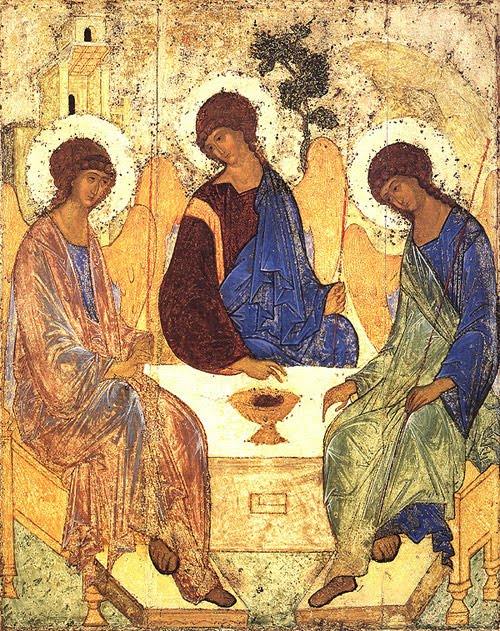
The pic above is entitled, The Holy Trinity (The Hospitality of Abraham) and is a famous icon by the Russian artist, Andrei Rublev c. 1360-1430.  Icon is a Greek word that means “image.” Throughout Christian history, especially during the time when literacy was not an opportunity for all, icons were used to teach or inspire common people telling the stories of the faith. To watch a clip of how and why icons are made click here.

Celebrating SHAVUOT (or Pentecost)

This Sunday we will be studying Acts 2:1-40. Here’s a bit of back ground…

There are three major festivals of Israel on the sacred calendar of to be observed as “a statute for ever throughout your generations in all your dwellings.” (Leviticus 23:14, 21, 41; Deuteronomy 16:16,17)
They are:
  1. Passover, the Feast of Unleavened Bread
  2. The Feast of Weeks – also called “Pentecost,” a Greek translation of the Hebrew words meaning, the “fiftieth day” when the Festival was celebrated (Lev. 23:15,16).
  3. Feast of Tabernacles

Passover marked the first spring harvest. The first fruits of a sheaf or “omer” of barley was required by the Torah to be presented before the LORD in the House of God, as a thanksgiving “wave offering.” (Lev. 23:10,11)
From the next day, seven weeks or forty-nine days were counted to wheat harvest. (Lev. 23:10:11)
On the “fiftieth day” – “Pentecost” or “Shavuot” – another harvest thanksgiving service was observed in the House of God. This time, from the firstfruits of wheat harvest, “two loaves of bread baked with leaven were waved before the LORD,” in the act of thanksgiving.” (Lev. 23:16-20). These three festivals marked Israel’s history in the process of their redemption. These festivals were also prophetic and typological of the greater redemption which would come through Jesus Christ the Messiah.

  Below is a dramatic scripture reading of the Pentecost story from Acts 2 from The Message. It’s almost 3 minutes…

The Ascension of Jesus

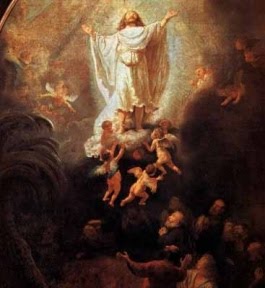
The pic is The Ascension by Rembrandt (1636).

The ascension of Jesus is the final component of the 5-fold Christ Event, which also includes the virgin birth, miraculous ministry, death, and resurrection of Jesus. The Christ Event established the kingdom of God on the earth – and the kingdom will be consummated at Christ’s second coming. You and I live in the in-between time. This is a very important theological perspective and a Vineyard core value. More Sunday…

We won’t be spending too much time on this Sunday, so I thought I’d offer this article from Theopedia

Also known as the exaltation of Jesus, the ascension of Jesus is well attested in the New Testament. It describes Jesus’ ascent upward into heaven after spending 40 days on the earth. The ascension takes place after his resurrection (John 20:17; Acts 1:3). Luke gives the best account, stating that “he left them and was taken up into heaven” (Luke 24:51). In Acts Luke adds that, “…he was taken up to heaven” (Acts 1:2) and that, “This same Jesus, who has been taken from you into heaven, will come back in the same way you have seen him go into heaven” (Acts 1:11). When Jesus actually ascended, “he was taken up before their very eyes, and a cloud hid him from their sight” (Acts 1:9).

Most references in Scripture speak of Jesus’ ascended status and do not actually mention how he came to be in heaven. These passages speak more of Jesus’ “exalted state”, that is, his present status in heaven after the experience of his ascension. Most notably is the quotation of Psalm 110:1, “sitting at the right hand of God.” This is the most quoted OT text in the NT. Mark places the use of this Psalm in the very teachings of Jesus (Mark 12:35-37; 14:62). Furthermore, Paul gives reference to Jesus’ exalted state in Philippians 2:8-11, stating in verses 9-11 that “…God exalted him to the highest place and gave him the name that is above every name, that at the name of Jesus every knee should bow, in heaven and on earth and under the earth, and every tongue confess that Jesus Christ is Lord, to the glory of God the Father.” Elsewhere, Paul makes reference to Christ being “taken up in glory” (1 Timothy 3:16). Other passages attest the very same about Jesus and give suggestion to his ascension into heaven (cf. John 6:62, 13:1-3, 16:5 & 28, 20:17; Acts 2:32-33; Hebrews 4:14, 9:24; 1 Peter 3:22; Revelation 1:12-18, 3:21).