
7 Tips If You’re Chronically Late.

Feeling as though you’re always running twenty minutes behind schedule is an unhappy feeling. Having to rush, forgetting things in your haste, dealing with annoyed people when you arrive…it’s no fun.

If you find yourself chronically late, what steps can you take to be more prompt? That depends on why you’re late. The first step is to identify the problem – then you can see more easily what you need to change.

There are many reasons you might be late, but some are particularly common. Are you late because…

1. You sleep too late? If you’re so exhausted in the morning that you sleep until the last possible moment, it’s time to think about going to sleep earlier. Many people don’t get enough sleep, and sleep deprivation is a real drag on your happiness and health. Try to turn off the light sooner each night.

2. You try to get one last thing done? Apparently, this is a common cause of tardiness. If you always try to answer one more email or put away one more load of laundry before you leave, here’s a way to outwit yourself: take a task that you can do when you reach your destination, and leave early. Tell yourself that you need that ten minutes on the other end to read those brochures or check those figures.

3. You underestimate the commute time? You may tell yourself it takes twenty minutes to get to work, but if it actually takes forty minutes, you’re going to be chronically late. Have you exactly identified the time by which you need to leave? That’s what worked for me for getting my kids to school on time. We have a precise time that we’re supposed to leave, so I know if we’re running late, and by how much. Before I identified that exact time, I had only a vague sense of how the morning was running, and I usually thought we had more time than we actually did. My daughter goes into near-hysterics if we’re late, so that motivated me to get very clear on this issue.

4. You can’t find your keys/wallet/phone/sunglasses? Nothing is more annoying than searching for lost objects when you’re running late. Designate a place in your house for your key items, and put those things in that spot, every time. I keep everything important in my (extremely unfashionable) backpack, and fortunately a backpack is big enough that it’s always easy to find. My husband keeps his key items in the chest of drawers opposite our front door.

5. Other people in your house are disorganized? Your wife can’t find her phone, your son can’t find his Spanish book, so you’re late. As hard as it is to get yourself organized, it’s even harder to help other people get organized. Try setting up the “key things” place in your house. Prod your children to get their school stuff organized the night before—and coax the outfit-changing types to pick their outfits the night before, too. Get lunches ready. Etc.

6. You hate your destination so much you want to postpone showing up for as long as possible? If you dread going to work that much, or you hate school so deeply, or wherever your destination might be, you’re giving yourself a clear signal that you need think about making a change in your life.

7.  Your co-workers won’t end meetings on time? This is an exasperating problem. You’re supposed to be someplace else, but you’re trapped in a meeting that’s going long. Sometimes, this is inevitable, but if you find it happening over and over, identify the problem. Is too little time allotted to meetings that deserve more time? Is the weekly staff meeting twenty minutes of work crammed into sixty minutes? Does one person hold things up? If you face this issue repeatedly, there’s probably an identifiable problem – and once you identify it, you can develop strategies to solve it — e.g., sticking to an agenda; circulating information by email; not permitting discussions about contentious philosophical questions not relevant to the tasks at hand, etc. (This last problem is surprisingly widespread.)

Late or not, if you find yourself rushing around every morning, consider waking up earlier (see #1 above). Yes, it’s tough to give up those last precious moments of sleep, and it’s even tougher to go to bed earlier and cut into what, for many people, is their leisure time. But it helps.

I’ve started getting up at 6:00 a.m. so I have an hour to myself before I have to rassle everyone out of bed. This has made a huge improvement in our mornings. Because I’m organized and ready by 7:00 a.m., I can be focused on getting all of us out the door. (On a related note, here are more tips for keeping school mornings calm and cheery.)

What are some other strategies that work if you suffer from chronic lateness?

* A great blog, Get Rich Slowly, is about “personal finance that makes cents.” It covers a very broad range of topics related to finance, so there’s much there of interest to just about anyone.

Gretchen Rubin is a best-selling writer whose new book, The Happiness Project, is an account of the year she spent test-driving studies and theories about how to be happier. On this blog, she shares her insights to help you create your own happiness project.  Thanks Earl.
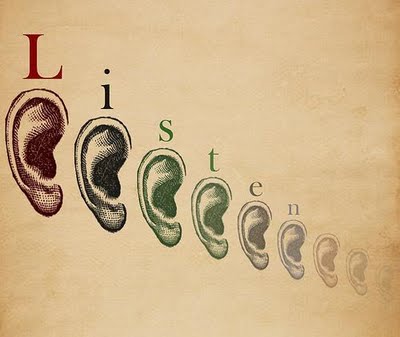
The Art of Listening

Proverbs 2:2 – “Let your ears listen to wisdom. Apply your heart to understanding.”
Proverbs 8:1 – “Listen as Wisdom calls out! Hear as understanding raises her voice!”
Proverbs 12:15 – “Fools think their own way is right, but the wise listen to others.”
Proverbs 15:31 – “If you listen to constructive criticism, you will be at home among the wise.”

No wonder listening is an undervalued art. Research shows that we speak at a rate of about 125 words per minute, yet we have the capacity to listen to approximately 400 words per minute. So what are we doing with that extra space in our minds when someone else is talking? Are we really listening?

Listening is essential to emotional health fulfilling relationships. If you are experiencing challenging interactions or want your connections to deepen – study and reflect on how to improve listening your skills. The benefits? Consider the following:

  • People will feel be more drawn to us; we will feel “safe” to others.
  • We will learn something new.
  • We will solve problems more effectively.
  • We will experience less loneliness and frustration.
  • We will feel more joyful and relaxed.

Learn to listen well, and watch you relationships begin to thrive. Here’s some thoughts.

1. Pay attention
Since our brains have the capacity to process 275 more words per minute than are actually spoken, we tend to fill up the void with extraneous thoughts. Notice how when someone is speaking, you are partially listening, while simultaneously planning the rest of your day, replaying a meeting that just occurred, or deciding what you will say next. Paying attention is the foremost guideleine for good listening. Hear the words, and let their meaning in. If your mind begins to wander, simply re-focus your attention on the conversation.

2. Be receptive
If you show up with an agenda, you are not going to be available to fully hear what the other person is saying. There is no problem with having goals for an interaction, but let them go while the other person is speaking so you can hear what is being expressed. Balance your need for a given outcome with your desire to sustain a harmonious relationship.

3. Check your understanding
Make sure you can repeat what you just heard, and if you can’t, ask for clarification. You might be surprised at how much you are missing. Most people are. When you think you’ve gotten it, you might say, “So what you are saying is….” to verify your understanding.

4. Be an explorer
Explorers are open and curious. They are inquisitive, without knowing what they will find. So what do you do with all of that excess brainpower? Focus on the speaker. Notice body language, tone of voice, and rate of speaking. Then look beneath the words to see what feelings and needs are being communicated. You never know what you might find.

5. Show interest
If you find yourself bored and distracted, reconnect with the interaction. Maintain eye contact, uncross your arms, and ask questions that take the conversation deeper. Find out what really matters to the person you are speaking with.

7. Be patient
As much as you may be tempted, don’t speak over someone who is talking. When you feel the urge to step in, take a breath, let your agenda go, and continue to listen. If you need to move the conversation along, do so politely, as in, “Excuse me, I’m so sorry for interrupting, but…” Likewise, be careful not to jump to conclusions or assume you know what hasn’t yet been said. These are all signs that your inner explorer has fallen asleep. Revitalize your experience by paying attention to what is happening in the moment.

8. Get out of a rut
Have you ever had the same problematic conversation with someone over and over? Bring a fresh perspective to the relationship by redoubling your efforts to listen. Let go of your need to be right or your ideas about what the other person should be saying or doing, and hear them as if for the first time. This moves you from contraction and limit to possibility and potential simply by listening.

In the end, being in right relationships is more important than being right. Effective listening develops empathy, which is the capacity for a deep understanding of another’s experience. And isn’t that what it takes for a relationship to thrive? It’s as simple as paying attention.

The above was adapted from an article by Gail Brenner, Ph.D.

A Church Without Walls

Let’s not refer to the church building as “the church.” The building is not the church. In a humorous way we’ve identified it as a “sheep shed.” It is important that we understand that no physical walls can define the church (1 Peter 2:4-5; 9-12).

A church without walls is the church at all times and in all places: Imagine a community of faith that can’t be pinned down to a single piece of property or to a set of buildings, but our relationship with Christ spills out into everything we do-into our homes, our communities, and into our workplaces-24/7. If God is in control, where we live, work, and play is no accident. God has placed us strategically to demonstrate his love and be his messengers. Whether it is in small groups, the workplace, over lunch or across the backyard fence, we can creatively engage and embrace our “world”, individually and corporately, so that they might see a little bit of Jesus in us.

A seeker’s first experience of Christ may not come in our weekly celebration of worship. Rather, that first experience comes because a committed Christ-follower has reached out and has been Christ to them. Our growth reflects God’s blessing and has more to do with new people starting the journey with Christ than it does with people transferring from other churches. No geographic or social walls limit  involvement. (Acts 1:8)

A church without walls is a missional church: A missional church builds bridges to people that don’t know Christ or see his relevance to their lives, whether it is in Burma, Brazil, or our own backyard. A missional church is committed as much to the needs of people outside our walls as those inside. We want to be a church that is known-and valued-by our neighbors. Therefore, we look for ways for our faith to be relevant to our communities without compromising our commitment to Christ. We seek to promote social justice and creation care. We will lovingly, but courageously, stand up for our faith and be willing to engage society and to take a stand for justice and compassion. No walls should exist between us as Christians (Ephesians 2:14-22).

A church without walls extends ministry into the community: God has called us into one body, one family. We believe effectiveness in engaging our world is directly related to the degree we are able to live in authentic biblical community with one another. Compassion and accountability characterize this kind of community. We recognize that we are a broken, yet redeemed people. We are a church that is learning how to love. When we get together to worship, we reflect the diversity of the communities God has placed around us. What brings us together is Christ; we don’t get hung up with how much money a person makes, the color of their skin, the sin they struggle with, their age or their background. In fact, we do everything we can to tear down the walls these things have created. We believe people matter to God – and we seek to be a church where the broken have found a true home. No walls stand between God and us (John 15:5-8).

A church without walls is an empowered church: Jesus Christ has torn down the wall of sin that divided us from God, and now we belong to him. We are dependent solely on God for effectiveness. Prayer is always our first course of action. Moving people toward Christ, and serving them as they become his devoted followers, is at the center of all that we seek to do. We believe that lives are changed through the power of the Holy Spirit and the Word of God. Effective ministry is borne out of an ever deepening relationship with God and other people. We encourage each other to grow in Christ, and to seek after God with our whole hearts, so that God may reveal his will for us, individually and corporately — and empower us to do it! No walls stand in the way of our personal development and service (Ephesians 4:11-13).

A church without walls is an equipping church: We seek servant-leaders who are learning how to raise-up other servant-leaders. Living on the front lines of ministry demands skill and support. We endeavor to equip people toward developing life skills (not just “church” skills), and seek to support them as they serve. We will encourage others to discover their spiritual passions, make good use of God’s gifts, and discern God’s call on their lives. We seek to pursue excellence in service. We seek to serve in teams. The seek an atmosphere here that will be charged with the excitement and zeal of the changed lives of people committed to Christ and his service.

WHAT IS BIBLICAL COMMUNITY?

The God we worship is a God Who has eternally existed in community. Father, Son, and Holy Spirit have dwelt in perfect unity, love and joy before and throughout time. This triune God created humanity as the focus of His creations for the display of this relationship.
In the beginning it was written, “it is not good for [humankind] to be alone” (Genesis 2:18). Man was walking in the garden with God and without sin and yet such a relationship was not ideal. It was not in accordance with the purpose of the Creator for the creature.

We read in the Gospels that among Jesus’ final words before the cross was a prayer for the unity of His people, a unity expressive of the unity found within the godhead (John 17:21-22). We know from the testimony of the early – and this is at the heart of what Tom Hovsepian spoke about last Sunday at church — that community was the natural result of the Spirit’s influence upon the Church (Acts 2:42-47).

It is apparent that community is not some peripheral Christian teaching but is central to the outworking of God’s purpose in the world. God is glorified when God is properly reflected; by dwelling in unity, we rightly image our communal Maker.
In being responsive to this calling, each person is invited to be deeply involved in the lives of others, to “do life together.” Unfortunately, we have not always done a great job of explaining exactly what this phrase means. This article will serve as a short introduction to the topic of biblical community and what it is that we mean when we commend “doing life.”
Our hope for us is not that we would simply hang out with each other, but rather, that we would engage in a battle for deep and abiding relationships within the body. We find the following characteristics to be particularly indicative of biblical community:
1. Love
Love can be a rather ambiguous term. We love our lives, our children, our dogs, Mexican food and the 49ers. Surely we do not mean the same thing in each use of the term.
Five times in letter of 1st John, the apostle writes that believers are to love one another. However, he does not leave the command ambiguous. Rather, he qualifies the command by showing that love is best represented by the sending of the Son to die for our sins and thus is inherently sacrificial (1 John 3:16-18). Let us love in truth and deed and not merely in word. Love that is not sacrificial is not really love.
2. Consistency
The early church pictured in the book of Acts met daily to encourage each other and worship together. Hebrews 10 tells us to not neglect meeting together as some are in the habit of doing, while chapter 4 tells us to exhort one another daily. A clear Scriptural admonition exists toward long lasting relationships and deeply consistent presence in the lives of others. Occasional or infrequent gatherings do not capture the spirit of the text.
3. Worship
The early church spent its time engaging in the celebration of the Lord and the remembrance of the gospel through the means of grace which were provided. We therefore find it essential for biblical community to be about the pursuit of the Lord through the Lord ’s Supper, prayer, singing and the reading and teaching of the Scriptures.
4. Authenticity
People who gather together and yet do not truly know each other cannot rightly be called a community. The Bible strongly encourages the confession of sin, struggles and praises, which is evidence of a life of transparency. This characteristic also bears with it a commitment to engage in the proper means of fighting back sin for the good of the sinner, the health of the body and the glory of the Lord. Oftentimes such a dedication to put sin to death includes the proper and godly use of the steps of discipline as outlined in Matthew 18 and elsewhere.
Given the characteristics of community, what are the practical implications? While the list could be quite extensive, a large number of the guidelines could easily be seen by doing a thorough search of the dozens of “one another” passages especially within the New Testament. Such passages tell believers to:
Love one another (John 13:34, 15:12), Outdo one another in showing honor (Romans 12:10), Live in harmony with one another (Romans 12:16) , Comfort and agree with one another (2 Corinthians 13:11), Serve one another (John 13:1-20; Galatians 5:13), Bear one another’s burdens (Galatians 6:2), Forgive one another (Ephesians 4:32), Submit to one another (Ephesians 5:21), Be honest with one another (Colossians 3:9), Encourage one another (1 Thessalonians 5:11), Confess to one another (James 5:16), Pray for one another (James 5:16)
The church wants its active participants to think theologically and live Christianly. We want to be distinct in the way in we work, speak, think, relate, rest, and play. We want to do those things, which glorify God. To properly reflect the communal nature of the Trinity and to follow God’s communal commands, we must as a people engage in fellowship which is sacrificially loving, consistent, worshipful, and authentically transparent – going below the waterline. In this way, we seek to “do life together.”