The Question of Orthodoxy

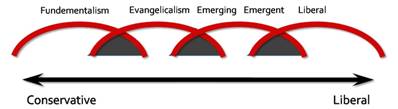
I found this to be an interesting depiction of the various components of Christian orthodoxy in the 21st century (of course everyone THINKS they’re orthodox!). I came across this recently in  a post by C. Michael Patton.

Why the labels? I find it very worthwhile to categorize (even if we don’t get it exactly right). Theology – and defining (and re-defining) orthodoxy –  are important. Having said that, no one is going to arrive at the pearly gates having gotten it right. Therefore it’s important to take theology and orthodoxy seriously, but not ourselves…

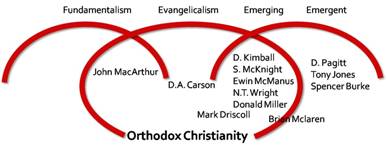
So, what is orthodoxy?

Patton says this: Historic Christian orthodoxy refers to the sine qua non (the “without which not”) of Christian belief. This belief is held, to paraphrase Augustine, “by all Christians, of all time, everywhere.” In other words, it is not limited to time or geographical region. Therefore, it would be found very early in some sort of articulated fashion, though not necessarily in formal document, in the early church.

Historic orthodoxy did take a few centuries to articulate in thought and word. It is unthinkable that in the first few centuries Christians would have developed in their understanding beyond a seed form of the basics below. They were too busy trying to stay alive, legitimize themselves to hostile Jews and Romans,  and encourage the local congregations. These basics were handed down in tradition (the regula fide) and Scripture.

Doctrines developed in understanding, people began to part ways in their interpretation of these doctrines. Traditional orthodoxy takes time to develop since it comes primarily as a result of controversy and challenge. There is a Catholic orthodoxy, Protestant/Evangelical orthodoxy, and Eastern Orthodoxy traditional orthodoxy.

Historic Protestant/Evangelical Orthodoxy

  • Deity of Christ
  • Doctrine of the Trinity
  • The Sovereignty of God
  • The historicity of physical death, burial, and resurrection of Christ
  • Hypostatic Union (Christ is fully God and fully man)
  • The sinfulness of man in corrupt nature, imputed guilt, and personal sinfulness
  • The necessity of the vicarious substitutionary atonement on the cross
  • Salvation through grace alone by faith alone on the basis of Christ alone
  • The reality of the body of Christ (the catholic [universal] Church)
  • The authority of the visible local bod[ies] of Christ
  • The infallible, inerrant inspiration of Scripture alone with final authority on all matters of faith.
  • The canon of Scripture made up of the Old (39 books) and New (27 books) Testaments
  • The future second coming

My own studies have led me to believe that we need to critique both modernity (wherein much of current protestant and evangelical orthodoxy was forged) and postmodernity (where much of emergent theology is being forged). (Check out a good article on the differences here.) My thoughts are that we are to be conservative in our theology (that is to conserve the essential elements of orthodox Christianity) and (be) liberal in our practice of that theology. For me that means we are to contextualize the gospel appropriately and actually live out the good news (instead of just talking about it).

I’ve just started reading GK Chesterton‘s Orthodoxy at the gym (it’s free on Kindle). It’s about 100 years old and it speaks fairly specifically to the modern/postmodern dilemma. Chesterton speaks to the “twin insanities of hyper-rationalism and hyper-emotivism.” Matthew Lee Anderson in a blog at First Thoughts says, “Chesterton’s poetic-prose articulates a vision of Christianity that is as artistic as it is analytic, and as such is a more effective antidote to the prevailing post-modern sensibilities than any other book I have found.”

Anderson goes on to say, Chesterson “artistically defends the existence of the truth and grounds Christianity in the pre-rational experience of story without jeopardizing truth’s existence or fallaciously opposing reason and emotion…In sum, [Orthodoxy] remains the single most effective articulation of a Christianity that is intellectually robust, artistically engaged, spiritually sensitive…”


Random Thoughts From My Stickies

I use the application “stickies” on my Mac to make notes to myself and to collect random thoughts, quotes, or pithy sayings to contemplate or study. Following are some random thoughts from the last few weeks. Sorry I didn’t always record the source…

*God’s perfection doesn’t merely reject or punish evil: it overwhelms it with good.

*Grace – God’s love for tomorrow coming into our life today

*Love – Shared hope (Kim McManus)

*There is a difference between obligation obedience and covenantal obedience

*Shalom results from living in the tension of…

  1. Contentment (Phil 4:6-7)
  2. Justice – making things right (Lk 18:7b-18a) “Shalom-makers”
  3. Righteousness – right relationship, navigate the relationship (Rom 8:31-39)
  4. Loyalty
  5. Community (Col 3:12-17)
  6. Wholeness
  7. Integrity
  8. Salvation

*Paradigm shift  — Gap between stimulus and response (Covey)

*Rules keep us immature

*Virtue comes as a result of moral effort – It’s like learning a new language, it becomes second nature

*We don’t need to learn our love language as much as we need to learn the language of love

*Learn to think Christianly

*The nature of virtue ethics

*The Spirit works to re-humanize us

*Love is not our duty, it is our destiny

*Take a nurturing response toward your emtional self, listen to the emotional self in the presence of God (Ps 139:1-3), draw your emotional self toward God, stay and wait/receive in God’s presence (Ps 46:10; Lk 10:42) — It is scary to be deeply revealing in God’ presence.

*Soul ache

*God comes to you disguised as your life. –Paula D’Arcy

*Every person we meet is Jesus in a distressing disguise.  –Mother Theresa

*Worship is the primary means to transformation

*Gideon and God test one another. God is available for interaction. Invitation to be bold (vs foolish). We are free to be bold.

*God “tests” us to reveal our hearts to ourselves (he already knows).

*OT is brutal and filled with war. The NT concept is that our battle is NOT against flesh and blood (Eph 6).

*Glory of God is among the poor.  –Joel Green

*Take calcium to sleep better

*Spiritual Formation – Intentionally partnering with the work of the Holy Spirit to help people learn to love the Lord their God with all of their heart, mind, soul, and strength.

*Joy does not mean the absence of sorrow, but the capacity to rejoice in the midst of it.  –Gordon Fee

*Bidden or not bidden, God is present. Erasmus/Jung

*God is the goal of God – John Piper

The embrace of faith, like any embrace, is visible.  –Scot McKnight, Dancing Grace (Chap 13)

*Marriage is a duel to the death which no man of honour should decline.
I refuse to die while I am still alive.
–GK Chesterton – Man Alive

Surrender as a Tipping Point

Malcolm Gladwell published his best selling book The Tipping Point in 2000. Tipping points are “the levels at which the momentum for change becomes unstoppable.”[1] Gladwell defines a tipping point as a sociological term: “the moment of critical mass, the threshold, the boiling point.”[2] The book endeavors to explain and describe the “mysterious” sociological changes that mark everyday life. Gladwell says, “Ideas and products and messages and behaviors spread like viruses do.”[3]

I’ve been considering the tipping point relative to the concept of surrender. From a big-picture perspective it seems we all surrender to something. It may be ambition, it may be a vice, it may be a philosophy. It reminds me of the Bob Dylan song, Gotta Serve Somebody[4]:

You may be an ambassador to England or France,
You may like to gamble, you might like to dance,
You may be the heavyweight champion of the world,
You may be a socialite with a long string of pearls

But you’re gonna have to serve somebody, yes indeed
You’re gonna have to serve somebody,
Well, it may be the devil or it may be the Lord
But you’re gonna have to serve somebody

Surrender is inevitable. It’s not a question of if, it’s a question of to what – or to who?

In 1 Kings 20:1-3 Ben-Hadad, king of Aram (Damasus), sent Ahab, king of Israel, a very audacious demand:

“Now Ben-Hadad king of Aram mustered his entire army. Accompanied by thirty-two kings with their horses and chariots, he went up and besieged Samaria and attacked it. He sent messengers into the city to Ahab king of Israel, saying, “This is what Ben-Hadad says: ‘Your silver and gold are mine, and the best of your wives and children are mine.'”

Verse four gives us an excellent initial definition of surrender:

4The king of Israel answered, ‘Just as you say, my lord the king. I and all I have are yours’” (emphasis added).

While surrender might be a life-long process – where’s the tipping point?

For the last several years I have been particularly drawn to the Sermon on the Mount in Matthew’s gospel chapters 5-7. In particular, I see the Beatitudes in Matthew 5:3-11 as a very specific spiritual formation pathway – each one a stepping-stone, or even a prerequisite, for the next. The word beatitude comes from the Latin word meaning “blessed” and, more specifically, the word refers to the potential for us to know exalted joy, or true happiness.

The first beatitude gives us some insight into surrender – “Blessed are the poor in spirit, for theirs is the kingdom of heaven.” Being poor in spirit acknowledges a desperateness of soul that is weary of living in it’s own strength and longs for the refreshment of God’s mercy and grace.  I see becoming poor in spirit as a main ingredient of a life surrendered.

What I believe Jesus and the first beatitude is teaching is that surrender can be defined, or described, as admitting that by myself, left to my own devices, I am completely powerless and that I need something beyond myself to set me free.”[5] The Message translation says it so well, “You’re blessed when you’re at the end of your rope. With less of you there is more of God and his rule.”

Recovery folks seem to get this, but church folks seem to have a hard time with it.

I find that aiming to live in the brokenness and vulnerability that the Beatitudes invite us into is the counter-intuitive route to a deep and abiding joy. (There is a difference between happiness and joy, but that’s for another blog.)

Following is an overview of how I see one unfolding into the next…

Blessed are the poor in spirit… To enter into God’s kingdom, we are invited to admit that we have come to the end of ourselves and are in need of God’s help and care. (The first steps of surrender.)

Blessed are those who mourn… As we are honest about our own sinful predilections there will be a transforming grief, or repentance, that surfaces – not only for our own lives, but also for the injustice, greed, and suffering that grips our world.

Blessed are the meek…Grieving over sin and suffering places us in a humble posture that helps us become life-long learners (disciple means learner).

Blessed are those who hunger and thirst for righteousness…To be hungry and thirsty is the desire to be empty of those things that don’t reflect God, and initiates a deep longing for wholeness in our lives.

Blessed are the merciful…As we receive God’s mercy we begin to give mercy – to ourselves and to others.

Blessed are the pure in heart… Mercy cleanses our heart and restores purity to our lives.

Blessed are the peacemakers… Purity gives way to a personal serenity and peacefulness. Peace is not the absence of conflict, but the absence of anxiety in the midst of inevitable conflict – and when others encounter it, they want it too.

Blessed are the persecuted… Living life from a kingdom of God perspective will place us in conflict with those that oppose it (sometimes it’s “religious” people!).

Finally, Andrew Murray, a 19th century South African author, revivalist, and pastor, emphasizes that it is God who actually accomplishes our surrender:

“God does not ask you to give the perfect surrender in your strength, or by the power of your will; God is willing to work it in you. Do we not read: “for it is God who is at work in you, both to will and to work for his good pleasure” [Phil 2:13]? And that is what we should seek for — to go on our faces before God, until our hearts learn to believe that the everlasting God…will come in to turn out what is wrong, to conquer what is evil, and to work what is well-pleasing in [God’s] blessed sight. God…will work it in you.”[6]

Here we have a refined description for surrender: Go on our faces before God, until our hearts learn…

So, where’s the tipping point? While surrender is a lifetime journey there is usually a dark night of the soul that captures our attention – and if we’re honest we catch a glimpse of our poverty and we find ourselves on our faces beginning to learn. In our surrender the dark nights become the fuel that leads to that deep and abiding joy.

Augustine of Hippo, the 4th century church father described what may have been his tipping point: “All my empty dreams suddenly lost their charm and my heart began to throb with a bewildering passion for the wisdom of eternal truth…My God, how I burned with longing to have wings to carry me back to you, away from all earthly things, although I had no idea what you would do with me!”[7]

God is good.


[1] Walsh, Bryan. “A green tipping point.” Time Magazine. 2007-10-12.

[2] Gladwell, p. 12

[3] Gladwell, p. 7

[4] Slow Train Coming (1979)

[5] Margaret Bullitt-Jonas, Holy Hunger: A Memoir of Desire, Knopf (1999)

[6] Absolute Surrender, Moody-Press: Chicago (1895), p 8.  This text is in public domain and can be downloaded here: http://www.jesus.org.uk/vault/library/murray_absolute_surrender.pdf

[7] Confessions III, 4.

The Conversion of John Wesley – at 34

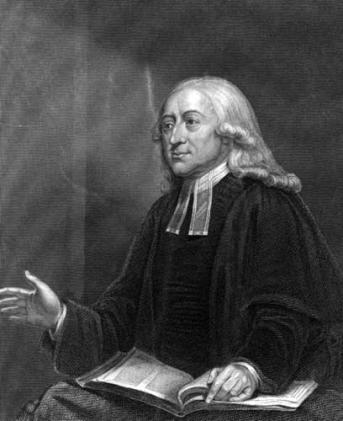
One of my historical, or literary, mentors is John Wesley the great revivalist of the eighteenth century and the founder of Methodism.

Wesley grew up in a Christian home, the fifteenth child of Samuel Wesley and his wife Susanna Annesley.  (Samuel and Susanna had nineteen children, of which nine died as infants and four were twins.)  Wesley’s father was a poet and pastor and his mother was particularly devoted, daily committing quality time with each of her children. Wesley attended seminary at Oxford and served as deacon in his father’s church.  Eventually, at the age of thirty-two Wesley decided to serve as a missionary to the Americas.  James Hutton, an acquaintance saw him off when he sailed to Georgia and corresponded with him after he reached America.  Wesley related how a group of Moravians sailing on the same ship sang hymns of praise in the midst of a great storm and how they answered those who asked whether they were afraid,  “We are neither afraid for ourselves nor for our children.”  Hutton in his book relates scenes of the Moravians, after they arrived in Savannah Georgia, felling timber, constructing houses, preaching to the Indians, and holding a song meeting all to the amazement and delight of John Wesley.

Hutton also describes the influence of these Moravians continued to have on John Wesley, “He talked much with the learned August Gottlieb Spangenberg, after he arrived in Georgia.

“My brother,” said Spangenberg to Wesley, “Do you know Jesus Christ?”

“I know,” replied Wesley,  “that Jesus Christ died for my sins.”

“That’s not what I asked you,” pursued Spangenberg, pressing the question further home,

“Do you know Jesus Christ?”  “I hope He has died to save me,” stammered Wesley.

“Do you know yourself?” persisted Spangenberg, who was not content with skin-deep work.

“No,” replied Wesley, and added, “I long to know Jesus Christ.” And Wesley stumbled on as dazed as ever.

“I went to America to convert the Indians,” he wrote, bitterly, in his Journal, on his way home to England; “but oh, who shall convert me?  I have a fair summer religion. I can talk well; nay, and I believe myself, when no danger is near. But let death look me in the face, and my spirit is troubled. Nor can I say, ‘to die is gain.’ I have a sort of fear that when I have spun my last thread I shall perish on the shore. I have learned that I who went to America to convert others was not converted myself.”[1]

The Moravian Peter Bohler was leading a bible study in London’s Fetter Lane. A historian writes, ‘Charles [Wesley, John’s brother] and John were in almost daily contact with Bohler.’

Peter Boehler said one day to John Wesley, “My brother, my brother, that philosophy of yours must be purged away.”

When John Wesley complained, “Ah, how can I preach the faith which I have not got?”

Peter Boehler answered, “Preach faith till you have it, and then, because you have it, you will preach it.”

“’In the evening,’ says Wesley, ‘I went very unwillingly to a society in Aldersgate Street, where one was reading Luther’s preface to [his commentary on] Romans.  About a quarter before nine while he was describing the change God works in the heart through faith in Christ, I felt my heart strangely warmed.  I felt I did trust in Christ alone, for salvation; and an assurance was given me that He had taken away my sins, even mine, and saved me from the law of sin and death.’”[2]

Finally, John Wesley got his breakthrough.  He had already discussed justification by faith with Peter Bohler, but this was different.

At 34 years of age he was finally born again.

After this Wesley followed Whitefield’s example and began preaching both justification by faith and the new birth in the churches. And one by one, the Anglican church leaders resisted him.

It wasn’t long before these newly converted ‘Methodists’, George Whitefield and John and Charles Wesley, began to gather others together to seek God for greater blessings.

Although the Wesleys and Whitefield parted ways (Whitefield was a Calvinist and the Wesleys Arminian), over the next 40 years these men would literally change the world.  It’s never too late…


[1] J.E. Hutton, A Short History of the Moravian Church (London: Moravian Publication Office, 1895), p. 189.

[2]. John Wesley Journal, May 24th 1738, Vol. 1. p.103.