Church Revitalization
1

 Change is hard work. Looking at the book of Nehemiah (an example of a masterful change-agent) we see he did three initial things
10 Signs you’re not ready for change:
 God’s Lovingkindness – I will betroth you to Me in…lovingkindness… (Hosea 2:19c)
“How precious is Your lovingkindness, O God! And the sons of men take refuge under the shadow of Your wing.” –Psalm 37:6
When all the forces of hell seem to be raging about you — in your body, heart, or mind— when you can’t trust in your own ability to keep yourself securely tucked away under his wings, remember: no one and nothing is able to pry his hand open or keep his betrothed from his love. We persevere because of God’s invincible love.[1]
“Because thy lovingkindness is better than life, my lips shall praise thee.” —Psalm 63:3
Hosea saw the relationship between God and Israel as that of a husband[2] with the attendant attributes of commitment, righteousness, justice, lovingkindness, compassion, and faithfulness. Through this enacted prophecy Hosea learned that at the core of the covenant is God’s profound love for his people. God seeks a response of surrender that will lead to a deep and abiding intimacy with God.
Lovingkindness — HESED (Hebrew)
That God acts in hesed (or sometimes spelled checed) has been described as the “classic message of Hosea.”[3]
Hesed occurs 176 times in the Old Testament from Gen 19:19 – Jonah 4:2, 121 times in the Psalms (or 70%). The most significant feature of this term is that God gives hesed to us in absolute freedom. Whether it’s God or people acting in lovingkindness, hesed is given of the “helper’s” own free will. Additionally, hesed always argues for loyalty of love.[4]
Hesed can be difficult to translate into English because embedded in it’s meaning is the unbreakable covenant bond that God initiates with his people.
A good, working definition of hesed is: the covenant, consistent, relentless, pursuing, lavish, extravagant, unrestrained, loyal, and one-way love of God.
The promises God makes are not conditional. God is NOT saying, “If you do this, then I will do that.” There are no “if’s” in these promises of God. There are no time limits, no cancellation clauses.
And so, while hesed has the feelings of love, kindness, mercy, and affection it is defined primarily by the unconditional steadfast, loyal, and trustworthiness of God’s covenant with his people.
In the Old Testament, God’s anger and wrath is expressed within the constraint of the unbreakable covenant bond, and is for the purpose of restoring the mutuality of that bond. While God’s covenant bond is unbreakable and unconditional, it is not an “anything goes” relationship. It is a bond that has a purpose: so that we will be a blessing. And the nature of this blessing is justice: right relationships with all – as well as harmony and well-being for all (SHALOM).
Pastor and author Rob Bell has an interesting take on God’s wrath.[5] He says the problem we face is not that God is angry with us, but that we think God is angry with us. Thus, Jesus’ purpose wasn’t to change God’s mind about us, but to change our mind about God: to notify us of God’s lack of anger[6] and to free us from the prison of our misconceptions so that we can truly live well. The place of church and religious ritual is to remind us of our standing with God and freedom to live lives of sacrifice and service. What do YOU think?
[1] Elyse Fitzpatrick, A Steadfast Heart, P&R 2006: 77.
[2] Norman D. Snaith, Mercy and Sacrifice. A Study of the Book of Hosea, SCM Press, 1953: 40, 52.
[3] Van Gemeren, Willem, A. Interpreting the Prophetic Word, Acadamie 1990: 114.
[4] Harris, Archer, & Waltke, 1980.
[5] Rob Bell, “the god’s aren’t angry” Tour, 2007.
[6] Bell would say that God’s wrath is more about passion than anger.
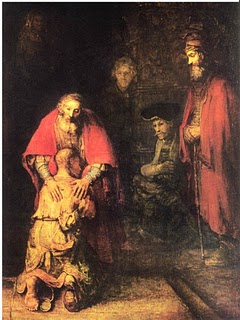
Produce fruit in keeping with repentance. –Matthew 3:8
…They should repent and turn to God, performing deeds in keeping with their repentance. –Acts 26:20
Repentance is a decisive reorientation of one’s life away from self and toward God. Commenting on Matthew 3:8 John Calvin writes, “Repentance is an inward matter, which has its seat in the heart and soul, but afterwards yields its fruits in a change of life.”[1]
When John the Baptist told the Jewish people that they must bring forth fruit in keeping with repentance, what did he mean?
There are three additional questions that will help to understand what the Bible means by fruit:
1. What is repentance?
a) The Greek verb that is translated repent in the New Testament is metanoia. The word literally means to think after. It suggests the idea of thoughtful reflection regarding a deed after the commission of it. In the case of a sinful action, the idea would be a retrospection of the act and the subsequent feeling of godly sorrow that leads to repentance (see 2 Cor 7:9-10).
b) Thomas Watson, an English Puritan (ca. 1620-1686) said, “Repentance is a grace of God’s Spirit whereby a sinner is inwardly humbled and visibly reformed.”[2]
c) Repentance involves a God-initiated resolve to acknowledge the wrongful conduct and surrender ourselves to the empowering grace of God, which alone will accomplish in us and through us what we have never been able to accomplish on our own.
d) Dan Allender, a contemporary Christian educator and author, writes that repentance is “an about face movement from denial and rebellion to truth and surrender…[that] involves the response of humble hunger, bold movement, and wild celebration when faced with the reality of our fallen state and the grace of God…It is a shift in perspective as to where life is found…It is melting into the warm arms of God, received when it would be so understandable to be spurned.”[3]
e) Paul writes that, godly sorrow leads to repentance (2 Corinthians 7:10). The repentance of this text is life reformation, not mere grief over the act.
2. What is the significance of the expression, in keeping with repentance? (NKJ: worthy of; AMP: consistent with.)
a) The expression in keeping with is the Greek word axios and originally had to do with objects that were of equal weight, i.e., one item corresponds to another in weight. The metaphorical use in the NT may be employed regarding actions — either good or bad.
b) The change of life that is characteristic of repentance must correspond to the gravity and nature of the offence. Otherwise, it is not biblical repentance.
3. What is implied by the phrase, produce fruit?
a) The Greek word for fruit is karpos and means “the visible expression of [God’s] power working inwardly and invisibly, [and] the character of the fruit being evidence of the character of the power producing it (see Mat 7:16). Just as the visible expressions of hidden lusts are the works of the flesh, so the invisible power of the Holy Spirit in those who are brought into [a] living union with Christ (see Jn 15:2-8, 16) produces ‘the fruit of the Spirit’ (Gal 5:22).”[4]
b) In addition to the fruit of the Spirit what does it mean to produce the fruit of repentance? Here are a some signs of fruit that will typically be found in a truly repentant person[5]:
i) Repentant people are willing to confess all their sins, not just the sins that got them in trouble. A house isn’t truly clean until we open every closet and sweep every corner. People who truly desire to be clean are completely honest about their lives. No more secrets. Christian psychologist and author Larry Crabb defines integrity as pretending about nothing.[6]
ii) Repentant people face the pain that their sin caused others. They invite the victims of their sin (anyone hurt by their actions) to express the intensity of emotions that they feel — anger, hurt, sorrow, and disappointment. Repentant people do not give excuses or shift blame. They made the choice to hurt others, and they take full responsibility for their behavior.
iii) Repentant people ask forgiveness from those they hurt. They realize that they can never completely “pay off” the debt they owe their victims. Repentant people don’t pressure others to say, “I forgive you.” Forgiveness is a journey, and people need time to deal with the hurt before they can forgive. All that penitent people can do is admit their indebtedness and humbly request the undeserved gift of forgiveness.
iv) Repentant people remain accountable to a small group of mature Christians. They gather a group of friends around themselves who hold them accountable to a plan for honest living. They invite the group to question them about their behaviors.
v) Repentant people accept their limitations. They realize that the consequences of their sin (including the distrust) will last a long time, perhaps the rest of their lives. They understand that they may never enjoy the same freedom that other people enjoy. Adulterers, for example, would be wise to place strict limitations on their time with members of the opposite sex. That’s the reality of their situation, and they willingly accept their boundaries.
vi) Repentant people are faithful to the daily tasks God has given them. We serve a merciful God who delights in giving second chances. God offers repentant people a restored relationship with him and a new plan for life. Consider Hosea’s promise to rebellious Israel:
Come, let us return to the Lord. He has torn us to pieces but he will heal us; he has injured us but he will bind up our wounds. After two days he will revive us; on the third day he will restore us, that we may live in his presence. (Hosea 6:1-2)
The conscientious student of the Bible is led to conclude that any repentance, without the full compliment of the elements that define that term, is simply not a biblical repentance.
[1] John Calvin, Commentary on Matthew, Mark, & Luke, Vol 1.
[2] Thomas Watson, The Doctrine of Repentance, Banner of Truth, 1999: 18.
[3] Dan Allender, The Wounded Heart, Navpress, 1990: 217.
[4] W. E. Vine, Vine’s Expository Dictionary of New Testament Words, Vol 2, Revell 1940: 143.
[5] Adapted from the article Six Signs of Genuine Repentance by Bryce Klabunde.
[6] Larry Crabb, Finding God, Zondervan 1993: 16.
 Gregg A. Caruso