What About My Brokenness?

Owning What I Can Own Plus a Look at Nehemiah 1

(This post is adapted from a sermon given on June 7, 2020.)

In the church I am currently serving as an intentional interim pastor we have been walking through the Sermon on the Mount (Matthew 5-7). What we are discovering is that the sermon is NOT about moral conformity to a new set of New Testament rules (i.e., moralism), neither is it “picking and choosing” Bible passages that we think are relevant for today (i.e., secularism).

The SOTM is identifying a third way to live as a follower of Jesus… through the removal of our sin by God’s grace through faith, through the restructuring of our heart from the inside out, and through a whole reversal of values.

In this article, I’d like for us to take what we’re seeing in the SOTM and consider the events of the last few months by asking the question, “What is God trying to say to His Church in this season?

Here’s an overview:

  • Over the years, I have found Nehemiah’s response to crisis to demonstrate an appropriate and godly pattern of engagement – and I’d like for us to look at the highlights of that today.
  • I also want to begin to provide some specific action steps for us to take in the coming days, weeks, months, and years. I have also begun a list of resources on our church’s website blog
  • I also want to share two defining moments in my life – as a man, as a follower of Jesus, and as a pastor. Both of these defining moments happened when I was the permanent pastor of a church – one in the late 1980s and the other one in the early 1990s. I will share the first upfront and I’ll share the second one at the conclusion.

In the early 90s, I became involved in a 2-year racial reconciliation group for pastors from across our city that was facilitated by Spencer Perkins (the son of John Perkins) and an Anglo man named Chris Rice (Spencer’s family and Chris’ family lived in community under the same roof). In our pastor’s group, there were Anglo, Latino, African American, and a Japanese American…

That 2-year time period became, in itself, a defining moment for me but two specific occasions were particularly impacting…

One of the African American pastors grew-up on the East Coast (S.C. I believe) and the other one grew up on the West Coast (L.A. area). Both of these pastors grew-up in Christian homes. Here’s what both of them believed growing up: They did not believe that white people could be Christians because of the way they treated black people. That moment took my breath away and opened the door for me to begin to see the effects of institutionalized and systemic racism and the cocoon of white privilege.

The other profound moment came on Oct 3, 1995, the day O.J. Simpson was acquitted for the deaths of his ex-wife, Nicole Brown Simpson, and her friend Ron Goldman. Do you know what my first thought was when I heard the verdict? This is the tiniest glimpse of the repeated injustice that African Americans have been subjected to in this country – for centuries!

These two related experiences were moments of profound clarity for me that grew in me a heart for reconciliation that has only become more and more impassioned over time.

The horrific video of George Floyd being murdered on a street in Minneapolis MN is, I believe, symbolic of the United States of America having our collective knee on the necks of not only African Americans, but Native Americans, Latino Americans, and Asian American people in this country.

Institutional, Systemic Racism is a gruesome and undeniable stain on our national conscience – and I believe we need to own it as Americans.

White Privilege doesn’t mean that the average white person hasn’t needed to work hard for what we have attained; White Privilege means that us white folks have, generally speaking, have (present tense) greater access to power and resources than people of color [in our same situation] do.

Let me speak in the “I.” The question for me is not, “Am I a racist?” I am a racist. I have it in me and on me by virtue of Institutional Racism, White Privilege, and my own insensitivities. And I have come to hate it. Here’s the question I must continue to ask myself: “Where am I still a racist?”

What I have just shared may be deeply uncomfortable for you. I get it. Let me take it a step further – I would like you to engage in some personal reflection, some reading, and some praying to locate yourself in this opportune moment in history. We have a grace disguised opportunity in our country as well as in the Church. None of us would have chosen to be here, but we are.

With that said, let’s look at what Nehemiah did in one of the most severe crisis moments in his lifetime…

I would like to look at Nehemiah 1 and list for you the specifics and priority of Nehemiah’s response…

V. 2 – Nehemiah inquired. We need to ask questions and we need to listen.

I have spoken with some non-white friends to inquire about how they are doing and to get their perspective and advice. In regard to asking questions and listening, one of my friends told me the greatest investment we can make is spending time. He said time is our most valuable resource and it takes time to really get to know someone. Taking time is not quick encounters to ease our guilty conscience but a commitment to building ongoing relationships with people who are different from us.

V. 4 – “I sat down and wept and mourned for days.” We see this same calling as the SOTM begins – to acknowledge our spiritual poverty and to mourn over our own sinful/selfish condition. We need to mourn (or grieve) over the current condition of our country. And this includes not only the racism but also the 117,000+ (as of 6/15) COVID deaths in the US and almost 428,000+ deaths around the world.

I want to introduce a biblical term that most of us have heard but perhaps have not understood. Lament. One-third of the Psalms (50) are categorized as “Songs of Lament.” Jeremiah wrote the book of Lamentations (it comes just after Jeremiah).

What does it mean to lament? Lament is a prayer (or prayers) that believers offer to a sovereign God when life doesn’t fit with what they know to be true about Him, or the coming of God’s promises seem to be woefully delayed.

Psalm 13: “How long, O Lord, will you forget me? Forever? How long must I take comfort in my soul having sorrow in my heart all the day?”

So, a prayer of lament is a prayer from a place of pain and complete honesty that leads to trust.  One author said, without prayers of lament we tend to fall into one of two ditches — either the ditch of denial, everything’s fine, or the ditch of despair, I can’t do this.[1]

In prayers of lament we take our sorrows to God and we talk to Him about them.

V. 6 – “Me and my father’s house have sinned.” I hope you see what’s happening here. Nehemiah is taking on and owning the sins of his forefathers. I believe we must do the same.

The Church as a whole has failed miserably in the areas of justice that include race, sexism, conflict resolution and reconciliation, and immigrant care.

One of the core beliefs and practices of VitalChurch Ministry is the perspective that corporate (or, all church) renewal begins with personal renewal, and personal renewal begins with each one of us owning our own issues. (If we’re honest, we’re much better at owning other people’s issues.)

Here is a succinct review of what we see, not only in the first chapter of Nehemiah but in the whole book…

  • Nehemiah listened
  • Nehemiah learned (he took four months to pray, fast, and to plan)
  • Nehemiah lamented
  • Nehemiah loved (Not only did Nehemiah lead in the rebuilding of the walls of desolate Jerusalem but he also helped to lead a spiritual renewal, along with Ezra, after the wall was completed – all because of a deep love for God and the Jewish people returning from exile.

I want to invite you into that space. God has been up to something since the pandemic began. As I said earlier, the SOTM is about the removal of our sin through admitting our spiritual poverty and receiving God’s grace through faith, it’s about a restructuring of our heart (individually and collectively) from the inside out, and a whole reversal of values.

There’s been a lot of fluff in the Christian Church in America. The easy believeism, the me-centered choruses, the lack of doctrinal sermons, and the lack of integrity, which the culture has noticed (is noticing?) and we have been pushed back out to the margins of society. The good news, of course, is that the Bible was written to people who resided out on the margins.

My second defining moment that shaped me as a man, a Jesus follower, and as a pastor will, I hope, will sum-up much of what I’ve been trying to say. (I hope this is the beginning of a church-wide dialogue.)

It was the late 1980’s and I was pastoring the same church I spoke of earlier and the AIDS Epidemic was in full-swing and I decided to take a class from the Gay and Lesbian Task Force on caring for AIDS patients. My mother was a Hospice Nurse, so I grew up in an environment of care and compassion.

As one might imagine, when the two guys who were teaching the class found out I was a pastor it caused a bit of a stir and I ended up staying late after a few sessions to talk about God, Gays, and the care of AIDS patients.

Here’s something I learned from them… It involves the difference between sympathy and empathy – and for the sake of time, I’ll condense several conversations into learnings…sympathy says, “I am SO sorry!” Sympathy says, “I will certainly pray for you.” Or, sympathy will write a check. Those are good, awesome, and appropriate responses.

Empathy, on the other hand, says “WE have a problem and what are WE going to do about it?” Empathy is shoulder to shoulder.

My defining moment happened when I clearly made a distinction between sympathy and empathy – and how both are necessary in their own time and in their own way, yet they are distinctive. And then these two guys told me something that broke my heart…They told me that, while they had both received sympathy from the Church, they had never received empathy.

Friends, it’s shoulder-to-shoulder time. We have work to do. Let’s start a conversation that leads to action. And I hope you see that I’m not just talking about sexual identity issues regarding sympathy and empathy. I’m also talking about racism, sexism, and immigrant issues – reconciliation of all kinds that is rooted in the gospel.

To be rooted in the gospel means that Jesus Christ, the Great Reconciler, is our greatest hope and boast, our deepest longing and delight, and our most passionate song and message. To be rooted in the gospel means that the good news of God’s empowering grace is what defines us as Christians, unites us as brothers and sisters, changes us as both sinners and saints, and sends us as God’s people on mission. When we are rooted in the gospel, the gospel is exalted above every other good thing in our lives and triumphs over every bad thing set against it.


Discussion/Reflection Questions

Read through the Bible verses addressing ethnicity as well as the definitions of racism and white privilege on the blog.

  1. After reading through the verses is there one or two that stand out to you? Why?
  2. After reading the definitions of racism and white privilege, what stands out to you that you either may have not thought about for a while or that you are seeing for the first time?
  3. Just like there are sins of both commission and omission, do you think there could be both explicit as well as implicit racism ingrained in American culture? How about ingrained in the Evangelical Church?
  4. What does it mean to be “rooted in the gospel”?
  5. In considering Nehemiah’s response to crisis (1:2-6), he listened, he learned, he lamented (and repented), and he loved. Which of these responses do you feel are strengths in your life and which ones would you identify as weak?
  6. In considering the difference between sympathy and empathy, where do we need to grow as a church? Where do you need to grow?
  7. Do you have specific thoughts of what God is seeking to say to the Church during this COVID and Racial Injustice Protest moment?


[1] Mark Vroegop. Dark Clouds, Deep Mercy: Discovering the Grace of Lament, Crossway 2019.

What About My Anger?


Matthew 5:21-26.

Anger is an old foe of mine. I have struggled with anger for most of my life (mostly focused on myself with a few exceptions). The way I have come to describe my anger over the years is that sometimes I feel like a pinball machine with a ball of anger bouncing around my soul. When I was younger, I got into a fight and went into a blind rage and put another young man into the hospital. It terrified me. The upside is that it probably moved me toward Christ because I felt so out of control. The downside is that when Linda and I were first married and would get into a disagreement I feared that I could lose control. I tended to earn inward in those moments instead of engaging in a healthy and biblical way. So, I’m speaking to you as a fellow traveler today – not someone who has it all together…

Here’s what I’ve learned about anger:

  1. Anger is a good thing. God gets angry and so should we. (This seems contradictory to what the text actually says but we will also consider the larger context.)
  2. Our passage for today is one of the premier relational passages in the whole Bible.

We will be looking at Matthew 5:21-26 and before we read it, we need to grasp the context of the verses we will be looking at (context is king!).

Last week I pointed out that the keyword for the whole sermon is righteousness. Jesus says that if we want to go to heaven our righteousness must exceed the righteousness of the scribes and Pharisees (v. 20) – a shocking statement to anyone within earshot.

To try and put it succinctly there are two overlapping ways to understand this call (not invitation) to righteousness…The most common way is to see righteousness as the effect of our conversion. At conversion, we receive the complete and total righteousness of Jesus. (The theological term is justification.) Isaiah likens justification to a “robe of righteousness” (61:10). If you have more of an accountant’s mindset you could think of it as a full and total reconciling of the books – all your bills are paid, the mortgage is paid off, and you have enough in reserves to last the rest of your life.

The other overlapping way to understand righteousness is our response to God’s gift of justification, there’s a longing or desire or hunger and thirst for God that wants to honor God, please God, worship God, and pursue God. What Jesus is saying to us in the SOTM is that our spiritual vitality, and what will get us to heaven, will come from spiritual hunger for God. [Are you hungry for God?]

This is the primary focus of Jesus’ statement about our righteousness needing to be greater than the scribes and Pharisees, who focused more on external righteousness, but Jesus is looking for heart longing. And if you were with us last week you might remember that I said if you don’t have this hunger and thirst for God (5:6), you’re probably not a Christian.

Beginning with our passage today Jesus reinterprets six commands from the OT Law and addresses the need for heart change and not just external obedience. So, with all that said, let’s look at Mat 5:21-26…

“You have heard that our ancestors were told, ‘You must not murder. If you commit murder, you are subject to judgment.’ 22 But I say, if you are even angry with someone, you are subject to judgment! If you call someone an idiot, you are in danger of being brought before the court. And if you curse someone, you are in danger of the fires of hell.

23 “So if you are presenting a sacrifice at the altar in the Temple and you suddenly remember that someone has something against you, 24 leave your sacrifice there at the altar. Go and be reconciled to that person. Then come and offer your sacrifice to God.

25 “When you are on the way to court with your adversary, settle your differences quickly. Otherwise, your accuser may hand you over to the judge, who will hand you over to an officer, and you will be thrown into prison. 26 And if that happens, you surely won’t be free again until you have paid the last penny.  –Matthew 5:20-26

There are four things we must know about anger in order to redeem it:

  1. The POWER of Anger
  2. The POTENTIAL of Anger
  3. The PROBLEM of Anger
  4. The PRESCRIPTION for Healing Inappropriate Anger

I will attempt to address what this passage is saying about inappropriate anger as well as looking at the larger context – why anger is a good thing.

Let’s look at them one at a time…

The POWER of Anger — Anger has been referred to as the dynamite of the soul.  It can have devastating consequences…

It can wreak havoc on our bodies — A sound mind makes for a robust body, but runaway emotions corrode the bones.  –Pro. 14:30 (Medical studies affirm this)

It can wreak havoc on our relationships — See to it that no one comes short of the grace of God; that no root of bitterness springing up causes trouble, and by it many be defiled.  –Hebrews 12:15

It can wreak havoc on our capacity to make wise and intelligent decisions — He who is quick-tempered exalts folly.  –Proverbs 14:29b (Anger can actually become addictive – it’s usually masking deeper woundedness.)

The POTENTIAL of Anger — The Bible repeatedly speaks of God’s anger. Another phrase we see in Scripture is, “The Wrath of God.” A lot of people struggle here because there’s a fairly common perspective, especially among cultural critics of the Christian faith, that really wants to assume that, if God is love, God would never get angry. Here’s the problem with that perspective: If you have a God that never gets angry, you can’t have a God of love because if God never gets angry, He can’t really love anything.

If there is someone we love, and that person is threatened you will – and should become angry. Martyn Lloyd-Jones is SO succinct when he says, “our anger must only be against sin.”[1] Sin of all kinds should make us angry. First and foremost, your own sin—and then the sin in the world around us.

This is what the 2nd Beatitude up in 5:4, blessed are those who mourn is addressing. We’d say things like, “I hate slothfulness, I hate abuse, I hate oppression and greed.” We hate expressions of sinfulness. Just a reminder here that Paul reminds us in Eph 4:26, “be angry but do not sin.”

In our passage today in v. 22 it says, if you are even angry with someone, you are subject to judgment! If you call someone an idiot, you are in danger of being brought before the court. And if you curse someone, you are in danger of the fires of hell.”  (How convicting is THAT!) What Jesus is saying here is that we MUST separate the sin from the sinner.

And finally, anger and wrath also contain longing. Say your spouse or your kid does something really stupid and you get angry…isn’t part of that anger a longing for the person to make good decisions? The same is true for God’s anger and God’s wrath.

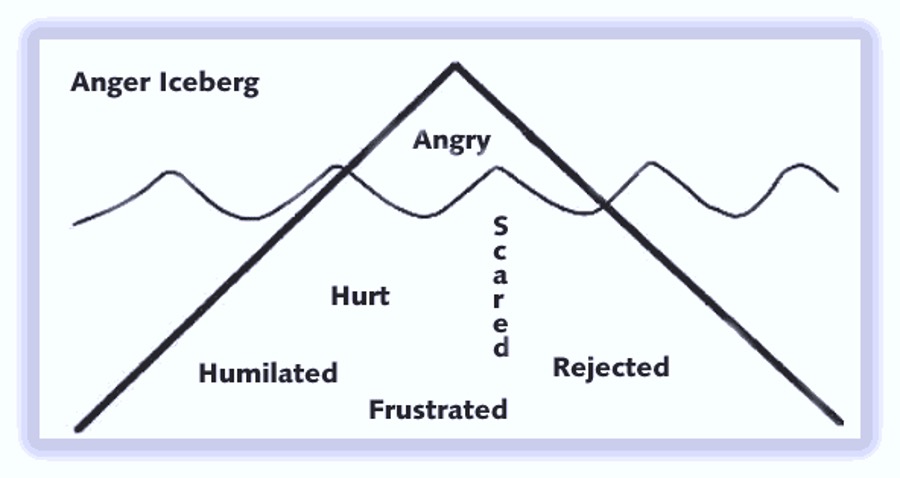
The PROBLEM of Anger — Anger is often a secondary emotion, not a primary emotion.  So, our anger can mask, or disguise primary emotions such as frustration, grief, fear, or offense. Here’s a crude graphic that illustrates this…

Anger becomes a problem when it gets out of control and when it hurts people emotionally or even physically. An important key to understanding the PROBLEM of anger is for us to see anger as an opportunity to look deeper into the heart of God.  Our anger can become a window through which we can discover – and deal with the woundedness we bring into our Christian experience.[2]

Another way to illustrate this is to liken anger to the engine light on a car. If the light starts flashing it tells that something is wrong.

When you feel anger let’s view it as an opportunity to explore what may be below the surface – what the anger may be masking. The purpose of examining our emotions is not merely to better ourselves, but to reveal what separates us from God and others.

The PRESCRIPTION for Healing Our Unrighteous Anger — Three quick thoughts for you to consider:

  1. If we were to condense vs. 23-26 into a single thought it would be, when reactive or contemptuous anger surfaces deal with it quickly. Again, Paul says in Eph 4:26 we are not to let the sun go down on your anger. (The longer we’re married the less we take that verse literally.)
  2. And then vs. 25-26 indicates that the proudful failure (or unwillingness) to reconcile could result in a prison sentence. This is true spiritually as wellit may be the prison of resentment, or bitterness (which Heb 12:15 says will eventually defile many people). It may be the prison or fear, or sadness, or guilt, or shame, or envy, or depression. These are all very real prisons that we can end up confined to if we’re not dealing with the emotions that result in anger.
  3. Finally, go to the blog and take the anger eval questionnaire.

The gospel tells us that Jesus absorbed our vitriol and our anger. He also absorbed the wrath and anger of God toward a proud and stiff-necked people. Because Jesus did it for us – let’s continue to be patient and kind with one another by His strength and by His power.

[1] Lloyd-Jones: 226.

[2] Adapted from Allender, Dan & Tremper Longman. The Cry of the Soul, NavPress new ed. 1999: 10.

Anger Self Evaluation Questionnaire

This week I’ve been restudying Matthew 5:21-26 in preparation for a sermon this weekend. It appears that anger has taken root in our culture and even in the Church. What can we do about that?

My thinking is that this crisis is the result of an inadequate discipleship process in the Evangelical Church over the last few decades, which has been principle-driven to a fault. Certainly, Scripture is full of principles to be learned and practiced. Where we’ve fallen short, in my opinion, is not helping people to integrate those principles into practices.

“Now may the God of peace Himself sanctify you entirely; and may your spirit and soul and body be preserved complete, without blame at the coming of our Lord Jesus Christ.”  –1 Thessalonians 5:23

This passage is not meant to be a singular proof text, it is one of many biblical texts that indicate God wants access to, not only WHAT we do but WHY we do what we do. Our spirit, soul, and body represent the overlapping distinctives of our human nature. Embedded in these distinctives are our intellect, will, and emotions. One of the late R.C. Sproul‘s descriptions of the sanctification process is the ongoing “mending of all human imperfection,” which will be completed at the Second Coming of Jesus. In the meantime, we are constantly learning principles and (hopefully) putting them into practice to strengthen our spirit, soul, and body through the teaching, convicting, and empowering presence of the Holy Spirit in our lives.

The idea of integrating emotional health into the sanctification and discipleship process is learning how to manage our feelings and emotions in appropriate ways. One example of a failure of effective discipleship would be the guy (who might even be a pastor or a church leader) who knows the Bible really really well, yet is prone to outbursts of anger. This becomes confusing to people both inside and outside the church and waters down both our witness and effectiveness.

What is Emotional Health?

Emotional health is what occurs when my feelings are being placed under the power of the cross in an ongoing way so that they are acknowledged as present (as opposed to denying them), listened to for what they communicate about me, expressed adequately and appropriately to others, and acted upon in ways that are appropriate and (begin to) reflect the character of Christ. They exist, but they no longer dominate my behavior. I begin to respond more than I react and when I blow it, I own it and apologize. My emotions are recognized and given their rightful place in the course of godly conduct.

With the above in mind, please take some time to consider if anger has taken-up too much residential space in your soul…

Anger Self Evaluation Questionnaire

The following inventory can help you in the recognition process as you seek to determine whether your anger is reaching a destructive level in your life.

  • I become impatient easily when things do not go according to my plan.
  • I tend to have critical thoughts toward others who don’t agree with my opinions.
  • When I am displeased with someone, I may shut down any communication with them or withdraw entirely.
  • I get annoyed easily when friends and family do not appear sensitive to my needs.
  • I feel frustrated when I see someone else having an easier time than me.
  • Whenever I am responsible for planning an important event, I am preoccupied with how I must manage it.
  • When talking about a controversial topic, the tone of my voice is likely to become louder and more assertive.
  • I can accept a person who admits his or her mistakes, but I get irritated easily at those who refuse to admit their weaknesses.
  • I do not easily forget when someone does me wrong.
  • When someone confronts me with a misinformed opinion, I am thinking of my comeback even while they are speaking.
  • I find myself becoming aggressive even while playing a game for fun.
  • I struggle emotionally with the things in life that aren’t fair.
  • Although I realize that it may not be right, I sometimes blame others for my problems.
  • More often than not, I use sarcasm as a way of expressing humor.
  • I may act kindly toward others on the outside yet feel bitter and frustrated on the inside.

Scoring: If you recognize 4-8 of the above, your anger is probably more present than you would prefer. If you identified with 9 or more boxes, there is a strong possibility that you have an ongoing struggle with anger or rage, whether you are aware of it or not.

(Adapted from “The Anger Workbook,” written by Dr. Les Carter and Dr. Frank Minirth)

What About My Righteousness?

The print above could be purchased here.

A sermon for Community Covenant Church in Rehoboth MA on April 26, 2020. Last Fall we went through the Beatitudes one at a time in a series entitled Read the Red and in these weeks following Easter we’re back in the Sermon on the Mount with a series entitled “What About __________?

Today we will be looking at Matthew 5:17-20 and if you’re joining us for the first time, we are in a series considering what is likely the first extended sermons of Jesus called the SOTM.

I like to remind people that Jesus was the most radical person who ever lived and that He came out of heaven and into our brokenness to launch a revolution. The SOTM has been called His manifesto-like our Declaration of Independence or Martin Luther King’s, I Have a Dream speech.

The SOTM is only 109 verses and takes about 10-15 minutes to read so it’s widely thought that Matthew is giving us the “Cliff Notes” version. If I were to provide you with a simplified overview of the SOTM it would be that, with this inaugural sermon, Jesus dives into our innermost being probing the heart and raising the question of motive.

Today, we will look at what scholars have described as the “thesis statement” of the sermon. Most of us remember learning about a thesis statement in high school or college. By way of review, a thesis statement is (usually) a one-sentence overview of the main idea of the essay, or manifesto, or book. Most often it appears at the conclusion of the introduction or preface, but sometimes it can appear in the first or second paragraph of the first chapter. A good thesis statement will describe the intention of the author and will prepare the reader to begin to see and understand the main ideas that will be presented.

So, with that said, I would like to read Matthew 5:17-20 and then pray. See if you can identify the thesis statement for the SOTM.

“Do not think that I came to abolish the Law or the Prophets [what we know today as the OT]; I did not come to abolish but to fulfill. For truly I say to you, until heaven and earth pass away, not the smallest letter or stroke [KJV “jot and tittle”] shall pass from the Law until all is accomplished. Whoever then annuls one of the least of these commandments, and teaches others to do the same, shall be called least in the kingdom of heaven; but whoever keeps and teaches them, he shall be called great in the kingdom of heaven. For I say to you that unless your righteousness surpasses that of the scribes [Gk word is the root of our English word grammar] and Pharisees [religious police], you will not enter the kingdom of heaven.”

Those four verses are packed with meaning and implications, but scholars agree that v. 20 is the thesis statement for the whole sermon. It would have equaled a gut-punch to the soul of anyone who heard what Jesus said.

The legalistic scribes and Pharisees had shaped the Jewish legal system to focus more on external obedience and Jesus shows up with a deeper version of reality that was always pretty clear throughout the OT, which says motive matters. An OT verse that many of us are familiar with is 1 Samuel 16:7: “…for God sees not as man sees, for man looks at the outward appearance, but the LORD looks at the heart.”

Today we only have time to consider two questions this important passage addresses. I’ll give them to you and then we will go back and look at them one at a time…

  1. What does it mean that Jesus fulfills the Law? There’s a lot of confusion about this both inside and outside the church.
  2. What does it mean for our righteousness to progress beyond the Scribes and Pharisees?

Again, we’ll look at them one at a time…

  1. What does it mean that Jesus fulfills the Law?

The purpose of the OT Law was to point God’s chosen people forward to the promised Messiah (Jesus). The short version is that once Jesus came, the Law’s purpose was fulfilled, and much of the Law became obsolete. It was not deleted, but fulfilled by a more penetrating Law, the Law of the Gospel contained in God’s radical and revolutionary kingdom.

It’s pretty common these days for the cultural critics of Christianity to dismiss Christians as inconsistent because, from their perspective, we follow some of the laws in the OT and ignore others. The challenge usually sounds something like this: “When the Bible talks about certain sexual behaviors as sin, you quote that; but when it says not to eat shellfish or not to get a tattoo, you just ignore it. Aren’t you just picking and choosing what suits you best?” That’s a legit question, right?

As far back as the mid-16th century, John Calvin saw that the Mosaic Laws could be distinguished into three categories—and then the scholars who wrote The Westminster Confession of Faith (1646) followed Calvin’s lead identifying three categories of Mosaic Law: Civil Laws, Ceremonial Laws, and Moral Laws.

Let’s take a brief look at each.

  • Civil (or Judicial) Law were given for the nation of Israel in its particular circumstances at that time, which described how the people were to order their behavior in relationship to others, including what they were to do and not do. The Civil Law was fulfilled when Jesus came and established the KOG on the earth – it was/is a new spiritual Israel, that we now identify as the Church—and as such, we’re no longer bound by the Mosaic civil codes—they are now obsolete.
  • Ceremonial Law concerning burnt offerings and sacrifices and all the ritual and ceremonial worship practices. These laws are no longer in effect if we accept Jesus as the perfect sacrifice. In fact, it would actually be offensive to go back to them, because that would communicate that Jesus’ sacrifice wasn’t sufficient.
  • Moral Law consisted of the Ten commandments and the great moral principles that have been laid down once and forever. The Moral Law is permanent and perpetual[1] and still applies to us. While we are called to still adhere to the Moral Laws of God, they too were fulfilled by the coming of Jesus, in that He kept all of them perfectly, every day, for His entire life. In fact, whenever Jesus, in His teaching, mentioned the moral laws, He either reaffirmed them or intensified them—as we’ll see in the coming weeks., God has graciously given to the believer the Holy Spirit to supply us with a growing love for God’s Moral Law AND the power to live by it.[2]

If this is new information or a new perspective for you, I hope you can begin to see how important it is to comprehend how Jesus fulfills the OT Law—and renders the Civil and Ceremonial Laws obsolete. It is also important that we are able to respond to the cultural critics of the Christian faith.

Does this mean we can, or should, abandon the OT as unnecessary? The NT cannot be truly understood except in the light provided by the OT.[3] Paul told Timothy in 2 Tim 3:16 that, “All scripture is given by inspiration of God, and is profitable for doctrine, for reproof, for correction, for instruction in righteousness.”  So, the OT was not written TO us, but it was written FOR us.

I came across this quote in some notes: “So, eat your shrimp and get that tattoo without guilt, but don’t throw away your 10 Commandments just yet.”

  1. What does it mean for our righteousness to progress beyond the Scribes and Pharisees?

Righteousness is that which satisfies the demands of the Law. It is doing what is right. To be called righteous means that one is in right standing with God. What Jesus is saying in v. 20 is that the purpose of God’s law was to show us that we needed more righteousness than we could come up with on our own.

Galatians 3:24-26 addresses how the Law works on our behalf: Therefore the Law has become our tutor to lead us to Christ, so that we may be justified by faith. But now that faith has come, we are no longer under a tutor. For you are all sons of God through faith in Christ Jesus.

The purpose of the Law was to show us that we couldn’t do it on our own. It’s like a dentist’s mirror, which can point out decay, but it can’t do anything about it.

So, this perspective of righteousness becomes the thesis statement of the SOTM[4]. The goal is to show us what true righteousness is – and to show us that we can’t get there on our own. Last Fall when Pastor Chris taught us about hungering and thirsting for righteousness he said that an appetite for righteousness is a desire to align our lives with who God is and all that He is doing, seeing Jesus as our representative and example, while guided by the movement and power of the Holy Spirit. That’s very good…

So, how do we gain this righteousness? Let’s go back to the Beatitudes…

The first three Beatitudes inform us of how we can enter into the KOG. Another way to say this is they tell us how we can be converted.

To be poor in spirit means that we recognize our spiritual poverty and that we need the resources of something, or Someone, to become the people that we long to be.

Another word for mourn is repent. We repent over the selfish tendencies and sinful condition of our soul – and the woeful condition of the world around us.

To become meek means that we become humble learners. As we’ve heard, meekness is not weakness but strength (or giftedness) that increasingly comes under God’s control and direction. Remember, disciple means learner.

As we recognize our spiritual poverty, repent over our selfish and sinful condition, we become humble learners, a hunger and thirst for God and God’s ways begins to grip our soul. The psalmist provides us with an excellent metaphor in Psalm 42:1-2a, As the deer pants for the water brooks, so my soul pants for You, O God. My soul thirsts for God, for the living God…” This is how we know conversion has taken place.

If you don’t have a growing hunger to honor and please God that results from acknowledging your spiritual poverty, mourning over it, and becoming a humble learner, you’re probably not a Christian. Certainly, like the moon, our hunger for God can wax and wane, but if it’s just not there, I think you should be concerned for your soul.

The final four Beatitudes address our sanctification and are a lifelong process.

We experience God’s mercy and as we receive it we begin to give mercy to others. God’s mercy begins to purify our hearts and cleanse us from the brokenness of sin – both the sins that have been committed against us as well as the sins we have committed. This, in turn, leads to a peace that passes understanding – and then, access to a wisdom that helps others make peace with God and one another. And finally, we need to expect persecution. Living life from a kingdom of God perspective will place us in conflict with those that oppose it—and usually it’s “religious” people.

Overall, the big idea of these four verses that we’ve looked at today informs us that Jesus is inviting us to surrender afresh to an internal moral law and that through the empowering presence of the Holy Spirit, we can re-orient our values, vision, and habits from the ways of external righteousness to a growing whole-heartedness toward God.


Study Questions

  1. What are your thoughts regarding Jesus being the most radical person who ever lived and that He came to launch the Kingdom of God as a revolution? (Being part of a revolution requires that we be “all in.” Where do you feel lax and where do you feel focused?)
  2. Jesus fulfilled the Civil, Ceremonial, and Moral Law. Is the idea that most of the OT Law has been rendered obsolete, or fulfilled by the perfect sacrifice of Jesus new to you? (Over the last several months we’ve been talking about the whole Bible as one story, with Jesus declaring the whole OT is really about Him—see Luke 24:27. Has this changed the way you are reading your Bible?)
  3. Do you feel like you could adequately respond to a cultural critic of the Christian faith who asks why it appears that we keep some of God’s laws but not all of them?
  4. Does it make sense to you that, while we are called to still adhere to the Moral Laws of God, that we now have the empowering presence of the Holy Spirit to grow in us a love for God’s Word and sanctifying power to increase our responsive obedience?
  5. There are (at least) two ways to talk about our righteousness. One is how we are fully justified by grace through faith at conversion and the other is (growing in) our longing to love and honor God and be more like Jesus. Do you feel clear about the distinctions? If not, what seems confusing to you?
  6. The fourth Beatitude is hungering and thirsting for righteousness. Talk about your current hunger and thirst. Has this shelter at home season enhanced or hindered your hunger and thirst for God?

Bonus Questions for Pondering: Could we assume that most of the scribes and Pharisees were sincere in their intention to keep the Law even if they were primarily concerned with outward appearances? For millennia women have been considered second class citizens (even in the Church), even when we see clearly how both Jesus and Paul elevated their role. And if we assume that many slaveholders in the 17th – 19th centuries were sincere in their belief that the Bible justified slavery, where and how did these groups misinterpret Scripture? Do you think there might be any theological perspectives that our grand- and great grand-kids might look back on and wonder why we believed the Bible was saying such a thing?

[1] Lloyd-Jones: 195.

[2] Lloyd-Jones: 194.

[3] Lloyd-Jones: 191.

[4] Pennington: 177.