
God Is Closer Than You Think #11 – What Are Sanctification & Perseverance?

I. INTRO

We are nearing the conclusion of series God Is Closer Than You Think

My overriding goal (for the series) has been for us to have a greater understanding and confidence in Who God is – and What God has accomplished on our behalf.

Studying theology and doctrine is often referred to as Systematic Theology, which means our study of Scripture is organized around fairly standard categories – or systems.  Knowing and understanding basic Bible beliefs is important for everyone of us:

People who don’t know what the Bible teaches will not be able to distinguish truth from error, staying what Paul calls in Eph 4:14 “children tossed around by waves and carried about by every wind of doctrine.”

But Christians who have a solid foundation will become more mature and will not be led astray – and will have better discernment: Hebs 5:14 says, “But solid food is for the mature, who because of practice have their senses trained to discern good and evil.”

As we begin this morning, let’s take a few moments and review what is called the Order of Salvation (or, the blessings that come to us when we become believers):

  • Election, or God’s choice of us.  Eph 1:4 — “He chose us in Him before the foundation of the world, that we would be holy and blameless before Him.”
  • The Gospel Call, where we hear the gospel message and God calls us to Himself in such a way that we respond in saving faith.  Acts 15:17 – “we are called by name…”
  • Regeneration, where God imparts new life to us so we have the spiritual ability to respond.  Titus 3:5 – “He saved us, not on the basis of deeds which we have done in righteousness, but according to His mercy, by the washing of regeneration and renewing by the Holy Spirit.”
  • Conversion = Repentance + Faith.  Repent of sin and trust in Christ for salvation.  This is our response to the gospel call.  We see Paul’s dramatic conversion detailed in Acts 9.
  • Justification – Immediately after conversion comes justification, which forever changes our legal standing before God.  God declares us not guilty but righteous because of the finished and complete work of Christ.
  • Adoption – Not only has our legal status changed but our family status is also changed as God makes us members of His family – with all the privileges of adoption.

All of the above occur at the beginning of our Christian lives – we’ve believed, we’ve been forgiven of our sins, we’ve become members of God’s family – our status and relationship are forever changed.

But what happens to us internally?

Which brings us to what we want to look at this morning:  Sanctification, which is a progressive work of God and us that makes us more and more free from sin and more like Christ in our actions.

II. BODY

Let’s begin by considering some of the major differences between Justification and Sanctification.

  • This is important because Catholics and Protestants have two very different perspectives on the difference.
    • Roman Catholic doctrine doesn’t distinguish between justification and sanctification – it mingles them together and views them as one single process.
    • In Catholic theology people are not entirely justified until they are perfect internally.
    • So, in this life Catholic theology says we can never be fully justified.  Catholics would say that the vast majority of people who physically die go to Purgatory to receive further purging or cleansing from sin until they finally we become “perfect” and are released into heaven.
    • Catholics combine justification and sanctification – we separate them.  How do we separate them?
  • As we said last week, Justification has to do with our legal standing – it’s as if God is a judge pronouncing us, “Not guilty!”  Sanctification has to do with our internal condition – What is the state of our heart?  What is the state of our internal moral status?
  • The difference between Justification and Sanctification is like the difference between a judge and a surgeon.
    • The judge declares us righteous, which is something on the outside of us and is in relationship to God’s Law.
    • But the surgeon goes inside and changes something in us, s/he fixes something.  Sanctification is God working inside to grow us up, to fix us, to make us more like Christ.
  • Justification is once for all time.  Roms 5:1 – Therefore, having been justified by faith, we have peace with God through our Lord Jesus Christ.”  But sanctification continues throughout the rest of our lives.
  • Justification is entirely God’s work, He pronounces us “Not guilty!” or, forgiven and righteous because of faith.  Sanctification is something we cooperate with.
  • Justification is perfect and complete in this life – it’s once for all time.  God declares us not guilty.  Sanctification is not perfect in this life…Sanctification is greater in some than in others.  We are to make progress in our sanctification (1 Tim 4:15).

There are three stages of sanctification:

  1. Positional Sanctification –Our sanctification has a definite beginning.  Our position of perfect acceptance with God at the moment we place our faith in Christ is where we begin.  When a person becomes a believer there is immediately a change of heart  and a growing desire to do what God wants (1 John 3:9).
  2. Progressive Sanctification — Our growth in Christ-like character and conduct during our life on this earth.  After conversion there is a new ability to change – we are no longer helpless or trapped by sin.  We have access to new power.
  3. Final Sanctification — Our ultimate perfection when we stand in Christ’s presence spotless and blameless – forever free from sin.  (Like having had a cold or allergies… and then being able to breath again.

Now, let’s take what we now know about Sanctification and look at Hebs 12:1-3…

V.1 — “Therefore, since we have so great a cloud of witnesses surrounding us, let us also lay aside every encumbrance and the sin which so easily entangles us, and let us run with endurance the race that is set before us.

  • There are two parts of the sanctification process.  Remember we said that Sanctification is a progressive work of God and us.
  • We have both an active and a passive role in our own sanctification.
  • Some churches/denominations only see one or the other…
  • Hebs 12:1 is speaking more to our active role.
  • The word “witnesses” is the same word we get our English word ‘martyr’ from.
  • The “cloud of witnesses” speaks of BOTH those who have gone before us AND those who are currently standing beside us.
  • With the testimony of those who have gone before us (including Christ) and the community of those who are standing with us, we begin to ‘lay aside’ those idols (or functional saviors) that we used to turn to in order to seek comfort and joy.
  • Now we turn to what Christ has done – and seek to find our comfort and joy in Him.
  • Remembering what He has done – and taking comfort in the witness of the saints – past and present.
  • An ‘encumbrance’ is something that we have been forgiven for but we still hold on to it.  Or, it could refer to a pattern, or tendency, that continues to pop-up in our lives.  Like a besetting sin, or family of origin issue…
  • Let us run with endurance the race that is set before us.”
  • Life is a race – regimen of difficulties. The word race (agōn) is the Greek word we get our English word ‘agony’ from.  Life is an agonizing struggle.
  • Exercise is necessary – the whole point is opposition.  When I’m doing chest presses at the gym it ‘feels’ like I’m getting weaker, but I’m actually getting stronger – in the long run.  We also wear gym clothes at the gym – and when we catch a glimpse of ourselves in the mirror we are reminded of why we are there.
  • Suffering is necessary.
  • Our faith will never grow unless it’s challenged.
  • One theologian and writer Eugene Peterson, author of the paraphrased Message, also wrote a book titled, A Long Obedience In the Same Direction.

Vs.2-3 — Fixing our eyes on Jesus, the author and perfecter of faith, who for the joy set before Him endured the cross, despising the shame, and has sat down at the right hand of the throne of God. For consider Him who has endured such hostility by sinners against Himself, so that you will not grow weary and lose heart.”

  • Hebs 12:2-3 are speaking more to our passive participation in the sanctification process…
  • We are to ‘fix our eyes on Jesus’ (v.2) and we are to ‘consider Him’ (v.3).
  • To put it simply: Jesus endured short-term pain because of the certainty of long-term gain.  Our years on earth amount to less than a breath of eternity.

III. CONCLUSION

I’d like to close with three quotes to help us gain perspective…

  • The twentieth-century British pastor D. Martyn Lloyd-Jones said, “If we only spent more of our time in looking at Christ we should soon forget ourselves.” Fixing our eyes on Christ is the first step and the entire path of the Christian life. We don’t look to Christ in faith to be saved and then look to ourselves to persevere. We trust Christ alone as our Savior and look to Christ alone and follow Him as our Lord. In order to look to Christ as our Savior and Lord, we need new eyes and a new heart.
  • The late beloved pastor James Montgomery Boice wrote that…The only thing that will ever get us moving along this path of self-denial and discipleship is fixing our eyes on Jesus and what He has done for us, coming to love Him as a result, and thus wanting also to be with Him both now and always. Jesus is our only possible model for self-denial. He is the very image of cross-bearing. And it is for love of Him and a desire to be like Him that we take up our cross and willingly follow Him (Mk 8:34, 35, 36).[1]
  • Piper — The greatest act of love that has ever been performed was sustained by the joy of hope. For the joy set before Him He died for us. How do you keep on loving people, and sacrificing to do them good, the way Jesus did? For the joy set before you, that streams back into the present and becomes your strength (Nehemiah 8:10)[2]

As we prepare our hearts for communion, let us remember that fixing our eyes means to look away from other things and steadfastly or intently toward Jesus – and what He has accomplished on our behalf.

We are sustained in the marathon of life by the joy that we find through surrendering our idols to God, wherein we begin to find our true joy and delight in Him.

And it’s only the beginning…

[1] Boice, J M and Philip G. Ryken. The Heart of the Cross, Crossway: 1999.

[2] Sermon: Be Constant in Prayer for the Joy of Hope.

God Is Closer Than You Think #10 – What Are Justification and Adoption?

I. INTRO

Today’s big idea:

  • Justification is our legal standing because of what Christ has done.
  • Adoption reveals how God feels about us.

The sermon map (Thanks to JT):

  • Over the last 19-months here at SBF, we have taught more on the doctrine of justification than we have on the doctrine of adoption.  I don’t think we should ever teach less on the doctrine of justification.  I do think, however, that we should teach more on the doctrine of adoption.
  • We cannot understand adoption apart from justification.
  • Another way to say it is: A growing understanding of justification positions us to more fully appreciate and participate in adoption.
  • So, this morning we will review justification – and then we will use Galatians 4:1-7 to help us unpack the doctrine of adoption.
  • And with the conclusion I want the Scriptures to help you understand how God feels about you.

A review of justification (Roms 3):

There is a longing in every human heart to “justify our existence.”

  • Paul speaks directly to this longing in Roms 3:21-23…(the words righteousness and justified used in this passage come from the same Greek root word[1])…

21 But now apart [distinct or separate] from the law the righteousness of God has been made known… 22 This righteousness is given through faith in Jesus Christ to all who believe[2][not just head, but head & heart[3]]. There is no difference between Jew and Gentile, 23 for all have sinned and fall short of the glory of God, 24 and all [who believe] are justified freely by His grace through the redemption that came by Christ Jesus.

  • Two weeks ago Jeff Arthurs taught on “What It Means to Be A Christian” and he clearly stated that our responsibility is to “believe.”
    • We do not work FOR our salvation, we work FROM our salvation.
    • God is not opposed to EFFORT, He is opposed to EARNING.
    • We do good deeds, not in order to EARN salvation, but because we ARE saved.
  • And then last week JT Holderman set the table for us very well as he unpacked the doctrine of the Atonement [to make amends], which is the means by which God redeems His people from sin.  JT said there are two major themes that saturate this doctrine:
    • Atonement is about God’s character: Our God will not simply let us remain in sin, but instead He is a God whose love so overflows that He must redeem His people.
    • Atonement is also about our relationship with God.  Because of the doctrine of the atonement we can be reunited in relationship with God, which is the very reason we were created.
  • Jesus condescended to leave heaven and the perfect tri-unity of the Godhead, to provide humanity with an absolutely unheard-of spirituality and an unimaginable approach to God.
  • Where God provides us with an unblemished record—absolutely free of charge.
  • Not just a good record, or even a great record – but a divine righteousness – a perfect record that comes to us, alights upon us — as a gift!
  • When we have justification it is the end of any personal struggle for validation, for worth, or worthiness, and acceptability.
  • Apart from the Christian gospel there is no other religion or belief system that offers anything like this.
  • Here is the gospel: God develops a perfect righteousness and provides it to us – and by THAT righteousness alone we are completely and eternally justified.
  • Here is how J.I. Packer says it (simply and elegantly) in his classic book Knowing God:  [Justification is] God’s forgiveness of the past, together with his acceptance for the future.[4]

II. BODY

Now, we will turn our attention toward the doctrine of adoption – turn to Galatians …The beginning of Gal 4 is a little-bit like walking up to two people who are already deep into a conversation – it will help us to have some perspective…

  • Paul is angry as he writes this letter.  It is different from his other letters to churches (or his Pastoral Epistles written to Timothy and Titus).
  • The lack of thanksgiving in his greeting reveals his unhappiness.
  • Paul follows what one commentator describes as a “standard rebuke-request format.”[5]
  • The intro/greeting is a rather terse 5 verses.
  • The rebuke section begins in 1:6 – 4:11.
  • The request section begins in 4:12-6:18.

All of chapter 3 (preceding our passage for today) is about the Law…

  • The curse of the Law
  • The temporary purpose of the Law (vs.19-20, “mediator, or v.24 “tutor” — temporary intervention).  Paul in 4:2 also uses the words, “guardians and managers…”
  • Paul is making a strong appeal to the Galatians to not return to bondage – which carries over into our Chap 4 passage.

Here is the main idea of Gal 4:1-7: God has sent His Son to offer justification to His people and God has sent His Holy Spirit into our hearts to initiate, from the center of our being, a holy and repetitive prayer (v.6): “crying[6] ‘Abba Father’” (It’s actually Trinitarian…)

1.  Vs. 1 – 3:The Law enslaves.

“Now I say, as long as the heir is a child, he does not differ at all from a slave although he is owner of everything, but he is under guardians and managers until the date set by the father. So also we, while we were children, were held in bondage under the elemental things of the world.

The Galatians were primarily Gentiles, not Jews – Paul is referring to their pre-Christian idolatry (4:8[7]).  The Judaizers were convincing them to abandon the gospel and come under the Mosaic Law.

2.  Vs. 4 – 5: The Son of God atones (or redeems) and justifies. God has graciously intervened…

But when the fullness of the time came, God sent forth His Son, born of a woman, born under the Law, so that He might redeem those who were under the Law, that we might receive the adoption as sons.

We see in this verse that Jesus Christ was uniquely qualified to be our Savior – “born of a woman, born under the Law.”

  • In order to be our Savior Jesus must be LIKE us.  This draws attention to His humanity.
  • And in order to be our Savior He must also be UNLIKE us in that He perfectly fulfilled the LAW.  2 Cor 5:21 – God made him who had no sin to be sin for us, so that in him we might become the righteousness of God.”

Jesus was truly God and fully man who defeated the power of sin.

3.  Vs. 6 – 7:The Spirit of God authenticates.

Because you are sons, God has sent forth the Spirit of His Son into our hearts, crying, ‘Abba! Father!’ Therefore you are no longer a slave, but a son; and if a son, then an heir through God.”

**Here’s what we REALLY need to see about this passage:  God’s purpose was to both redeem and to adopt“to redeem [and justify] those who were under the law, so that we might receive His adoption as sons” (v. 5).

J.I. Packer[8]:  “What is a Christian?  The question can be answered in many ways but the richest answer I know is that a Christian is one who has God as Father.  Our understanding of Christianity cannot be better than our grasp of adoption.  The truth of adoption gives us the deepest insights that the NT affords into the greatness of God’s love.

God has personal, particular, and passionate love – for you.

Churches are full of people who are not certain of God’s love for them…I hope you have been, or will be, amazed and overwhelmed by God’s love.

And if you are not an active intentional follower of Jesus Christ, I hope you are convicted of your sin and convinced of God’s love for you as revealed through the death of His Son — and that we would all experience God’s adopting grace.

III.  CONCLUSION

As we close and begin to prepare our hearts for communion I’d like for us to take a look at the phrase “Abba Father,” found here in the Galatians 4:6.  It will help us to better understand how God feels about us.

The phrase “Abba Father” is used three times in the NT:

  • “’Abba, Father,’ he said, ‘everything is possible for you. Take this cup from me. Yet not what I will, but what you will.’” Mark 14:36
  • “The Spirit you received does not make you slaves, so that you live in fear again; rather, the Spirit you received brought about your adoption to sonship. And by him we cry, ‘Abba, Father.’” Romans 8:15
  • “Because you are his sons, God sent the Spirit of his Son into our hearts, the Spirit who calls out, ‘Abba, Father.’” Galatians 4:6

According to Jewish rabbinical teachings, slaves were forbidden to address the head of the family by the affectionate title, “Abba.”

  • “Abba” approximates “papa” or “daddy” and implies unwavering trust.
  • “Father” expresses intelligent comprehension of the relationship.
  • Together the two reveal the trusting love and intelligent confidence of a secure son or daughter.

Redemption and justification are accomplished by the Son and applied to our hearts by the Holy Spirit.

J.I. Packer is again helpful: “Adoption is a family idea conceived in terms of love and viewing God as Father.  In adoption God takes us into his family and fellowship, establishes us as his children and heirs.  Closeness, affection, and generosity are at the heart of the relationship. To be right with God the judge is a good thing, but to be loved and cared for by God the Father is greater.”[9]

Jesus was sent that we might have the status of sonship, and the [Holy] Spirit was sent that we might experience it.  The inheritance is for sons; it is not for slaves!  It doesn’t come by keeping the law, but by living in the Spirit.[10]

Charles Spurgeon, “once knew a good woman who was the subject of many doubts, and when I got to the bottom of her doubt, it was this: she knew she loved Christ, but she was afraid he did not love her.  ‘Oh!’ I said, ‘that is a doubt that will never trouble me; never, by any possibility, because I am sure of this, that the heart is so corrupt, naturally, that love to God never did get there without God’s putting it there.’  You may rest quite certain, that if you love God, it is a fruit, and not a root.  It is the fruit of God’s love to you, and did not get there by the force of any goodness in you.  You may conclude, with absolute certainty, that God loves you if you love God.”[11]

That Holy Spirit’s cry, “Abba, Father” assures us of God’s love for us – and did not originate from you or within you, it is a gift from God and He gave you that gift through His Holy Spirit.  It is His means of assuring you that HE LOVES YOU!

Do not doubt and do not fear…but ask yourself this question: “Do I know the reality of the internal witness of the Spirit of God in my soul?”

In 4:15 Paul essentially asks the Galatians, “Where has your joy gone?”

  • Does your joy tend to collapse?
  • Our joy collapses, or recedes, because we forget our sonship, we forget we are fully adopted sons embraced by a Father who sent his Son to change our status into sons – and who sent His Holy Spirit to give us the experience of sonship and to offer us His strength to change and grow (next week).
  • The more we are aware of (and engaged) of God’s initiative, the more we will be overwhelmed by God’s love.
  • IF we have placed our belief and trust in what Christ has done WE ARE FULLY ADOPTED.

DO NOT allow yourselves, or this church, to move back into legalism/moralism…

Do the words closeness, affection, and generosity describe your perception and experience of God?  If not, perhaps you are more aware of your sin than you are of the adopting grace of God.

Let’s take a few moments to quietly contemplate this as we prepare our heart’s for communion…


[1] Righteousness = dikaiosynē; Justified = dikaioō.

[2] It is God who awakens belief in our hearts. Col 2:13: When you were dead in your sins and in the uncircumcision of your sinful nature, God made you alive with Christ. He forgave us all our sins.

[3] A saving faith has within it an element of yielding, a repentance of trying to be lord of one’s own life and a submission to the Lordship of Jesus. (W. E. Vine, Reflections on Words of the New Testament:132.)

[4] J.I. Packer. Knowing God, pp. 206-207.

[5] G. Walter Hansen, Galatians, IVP 1994: 14.

[6] This word in the Greek (krazō) actually refers to the constant and incessant appeal of a raven (we might be more familiar with a crow).

[7] Formerly, when you did not know God, you were slaves to those who by nature are not gods.

[8] Knowing God, InterVarsity Press 1973:181-182f.

[9] Ibid:187-188.

[10] Philip Ryken, Galatians, Reformed Expository Commentary, P&R, 2005:166.

[11] The Relationship of Marriage.

SBF eNEWS – Oct 31, 2012

In Celebration of Martin Luther’s Conviction and Courage

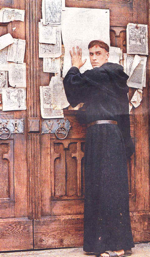
This Sunday we will continue in our series God Is Closer Than You Think with a message that will respond to the question, “What are justification and adoption?”  This is good timing.  495 years ago on October 31, 1517 in the little town of Wittenberg, Germany a Catholic priest nailed an invitation to debate on the church door. People immediately began to take notice and within the week, copies of his theses would be talked about throughout the surrounding regions; and within a decade, Europe itself was shaken by his act of conviction and courage.  Later generations would mark Martin Luther‘s nailing of the 95 theses on the church door as the beginning of the Protestant Reformation, but what did Luther think he was doing at the time? To answer this question, we need to understand a little about Luther’s own spiritual journey.

As a young man in Germany at the beginning of the 16th century, Luther was studying law at the university. One day he was caught in a storm and was almost killed by lightening.  He cried out to St. Anne and promised God he would become a monk if he survived.  In 1505, Luther entered the Augustinian monastery, and in 1507 became a priest.  His monastic leaders sent him to Rome in 1510, but Luther was disenchanted with the ritualism and dead faith he found in the papal city. There was nothing in Rome to mend his despairing spirit or settle his restless soul.  He felt cut off from God, and he could not find a cure for his discontent.

Martin Luther was bright, and his superiors soon had him teaching theology in the university.  In 1515, he began teaching Paul’s epistle to the Romans.  Slowly, Paul’s words in Romans began to break through the gloom of Luther’s soul.  Luther wrote,

“My situation was that, although an impeccable monk, I stood before God as a sinner troubled in conscience, and I had no confidence that my merit would assuage him.  Night and day I pondered until I saw the connection between the justice of God and the statement ‘the just shall live by faith.’ Then I grasped that the justice of God is that righteousness by which through grace and sheer mercy God justifies us through faith.  Thereupon I felt myself to be reborn and to have gone through open doors into paradise. The whole of Scripture took on a new meaning…This passage of Paul became to me a gate to heaven.”

The more Luther’s eyes were opened by his study of Romans, the more he saw the corruption of the church in his day.  The glorious truth of justification by faith alone had become buried under a mound of greed, corruption, and false teaching.  The more Luther studied the Scriptures, the more he saw the need of showing the church how it had strayed from the truth.

In Martin Luther’s day, nailing of the theses to the church door was the means of inviting scholars to debate important issues.  No one took up Luther’s challenge to debate at that time, but once news of his proposals became known, many began to dialogue about the issues Luther raised – and particularly that salvation was by faith in Christ’s work alone. Luther apparently at first expected the Pope to agree with his position, since it was based on Scripture; but in 1520, the Pope issued a decree condemning Luther’s views.  Luther publicly burned the papal decree.  With that act, he also burned his bridges behind him.

Who can you invite to church this Sunday to hear about this great distinction between Catholicism and Protestantism?  Invite someone today – or forward this email to a friend…

Justification and Adoption are foundational to our faith – and feed our assurance of God’s relentless and scandalous love.  Who do you know that could benefit from this life altering truth?

Search Team Update

To date we have nine completed packets.  Our Search Team will be meeting this Sunday afternoon from 4-6pm to review the candidates.  Please be in prayer for this VERY important process.  As a church we have we have engaged the “hard good” of getting healthier spiritually and emotionally.  We are looking for and praying for a pastor and his wife who have done the same.  We need God’s uncommon wisdom during the search process.

See you Sunday (I can’t wait!)

Pastor Gregg

God Is Closer Than You Think #9 What Is the Atonement?

by Guest Speaker J.T. Holderman

Sermon’s Purpose is Praise: The single goal of this sermon is to paint a picture of God’s loving and merciful character so that we praise and glorify Him. I want to draw our hearts to praise God this morning.

Definition of Atonement: The atonement is the means by which God redeems His people from sin. There are two major themes than saturate this doctrine:

  • Atonement is about God’s character: Our God will not simply to let us remain in sin, but instead he is a God whose love so overflows that He must redeem His people.
  • Atonement is also about our relationship with God. Because of the doctrine of the atonement we can be reunited in relationship with God, the very reason we were created.

The Sermon Map: But first let me draw you a map of where we are going. This is a complicated doctrine and I don’t want us to be confused, I want us to get it with such clarity that our heart sings praise to God! The entire Bible is a story about the atonement, how God redeems His people from Sin and grants them relationship with Him.

  • Here is the basic flow of the Bible: Good à Bad à Fix (flawed and perfect) à Good.
  • Here is the basic flow of the Bible:

Our Relationship w/ God à Sin à Atonement (flawed and perfect) à Redeemed Relationship w/ God.

I want us to think in every step this morning: “how does this call us to glorify God? Does this make me want to praise God?” The glorification, praise, worship of God is our goal this morning.

1) The Good (Relationship with God): We were created with a purpose: for relationship with God. There is a reason you breathe this morning. We were created for relationship. Adam and Eve were privileged to know God in the garden. This is The Good, the relationship with God is the good! The story of the Bible begins with the good! We see God’s character here as loving. These are our two themes and they start right at the beginning of Genesis. But the good turns from good to bad quickly:

Serious: The reason we were created is a serious matter: relationship w/ God.

a.       One rule: Told them not to eat of the tree of good and evil, serious matter, boundaries on the relationship.

b.      Rule Broken: They ate it L. They did the one thing that God commanded them not to. The one thing that would break the relationship with God, the reason they were created, they did it!

c.       Relationship with God is serious because it’s the reason for every person’s heartbeat and breath. Your heart beats because it was meant to beat for a relationship with God. Every thump thump is a cry from your being that your life is meant to be spent in relationship with God.

2) The Bad (Sin): And we see that Adam and Eve sinned by disobeying God, by making themselves Lord, obeying their own commands, namely to eat from the tree. And by doing so they thrust the whole human race into a sinful reality. The good, the perfect relationship with God, because of sin, is corrupted.

A) Serious: We said our relationship with God was serious, but sin is also serious: it brings death. It has been that way since God told Adam and Eve they would die: But of the tree of the knowledge of good and evil you shall not eat, for in the day that you eat of it you shall surely die (Gen. 2:17). Sin brings death because it is a serious offense to God (i.e. Rom. 5:12; 6:23). God is holy and righteous and can have no relationship with sin. Since humanity through Adam and Eve sinned everyone is therefore doomed to die, both physically and spiritually. Adam and Eve are thrust from the garden; they are thrown out of God’s presence.

B) Messy: Sin messes up the way things are supposed to be. For example Adam and Eve freak out after eating the fruit because they realize they are naked! They were fine with being naked in front of one another prior to the sin. It messed things up. God had to make clothes for them. Sin also messes up our relationship with God because He can have nothing to do with sin! And since he can have nothing to do with sin he can have nothing to do with us. His character as a holy God demands that he can’t be in relationship with Him.

Recap of Sin:

Because of sin 1) we deserve to die, 2) we deserve God’s wrath against sin, 3) we are separated from God by our sins, and 4) we are in bondage to sin.

Transition: A fix is therefore needed. God’s character demands that He do something because of His love for us. God provides a fix for our sin, a remedy. We should praise God that He is a gracious loving God! God’s character is gracious, we should be astounded and we should be driven to our knees in thanks and praise! We deserve death, but God sees us and says “I will help them.” This is the essence of God’s character, love.

3) The Fix (Atonement): Because of God’s character he provides a fix for sin, a way that sin can be removed, so that we can be in relationship with God. We call this atonement. Atonement is the means by which God redeems His people from sin. This is our topic this morning. So God gives Moses on Mt. Sinai the means by which our sins can be covered, by which they can be atoned so that we can be in relationship with Him. This means is sacrifice. Sacrifice becomes the remedy that brings us back into relationship with God. Without it we are separated from God.

A) Serious: There is an image in the Old Testament of how sin has separated us from God: The curtain. In the tent of meeting, where God resided, the curtain stood between the regular place of worship and the holy of holies where only the high priest could go once a year to make sacrificial atonement for our sins. The curtain acts as the symbol of what our sin has earned, separation from relationship with God.

…The LORD said to Moses, “Tell Aaron your brother not to come at any time into the Holy Place inside the veil, before the mercy seat that is on the ark, so that he may not die. For I will appear in the cloud over the mercy seat. But in this way Aaron shall come into the Holy Place: with a bull from the herd for a sin offering and a ram for a burnt offering. He shall put on the holy linen coat and shall have the linen undergarment on his body, and he shall tie the linen sash around his waist, and wear the linen turban; these are the holy garments. He shall bathe his body in water and then put them on. (Leviticus 16:1-4)

B) Messy: Sacrificial offerings were a messy affair. It is downright disgusting. If you have ever cleaned a fish, you know your first couple of tries at gutting it are gross. The sacrifice to atone for our sins happened once a year, on the day of atonement.

And he shall take from the congregation of the people of Israel two male goats for a sin offering, and one ram for a burnt offering. “Aaron shall offer the bull as a sin offering for himself and shall make atonement for himself and for his house… He shall kill the bull as a sin offering for himself. And he shall take a censer full of coals of fire from the altar before the LORD, and two handfuls of sweet incense beaten small, and he shall bring it inside the veil and put the incense on the fire before the LORD, that the cloud of the incense may cover the mercy seat that is over the testimony, so that he does not die. And he shall take some of the blood of the bull and sprinkle it with his finger on the front of the mercy seat on the east side, and in front of the mercy seat he shall sprinkle some of the blood with his finger seven times. (Leviticus 16:5-14)

At this point we should be asking ourselves: “Why is blood required?” Why does God choose this way to atone for the sins we have committed, to bring us back into relationship with Him? I think to put it simply, the seriousness of sin calls for blood. Blood in ancient times represented life, much the same as it does today, but there was a greater sacredness to blood that we do not share today.

For the life of the flesh is in the blood, and I have given it for you on the altar to make atonement for your souls, for it is the blood that makes atonement by the life. (Leviticus 17:11)

C) Necessary: In order to be in relationship with God, our sins must be covered, they must be blotted out, God does this in atonement. Our sin prevents us from knowing God. It’s devastating. But God’s character shows us that His love is greater than our sin and He has planned a way for our sins to be covered, to be atoned for. The animal that is sacrificed dies in our place, it is a substitute! In order to be in relationship with God and have our sins covered the sacrifice of atonement is necessary.

For on this day shall atonement be made for you to cleanse you. You shall be clean before the LORD from all your sins… And this shall be a statute forever for you, that atonement may be made for the people of Israel once in the year because of all their sins.” (Leviticus 16:29-34)

Transition: So we see the good goes to the bad and God gives us a fix. But guess what, animal sacrifice is flawed! Why??? It doesn’t cover all the sins that we have yet to commit, it only covers those that have been committed. So under this sacrifice of atonement we have to keep resacrificing. So we need a perfect fix. We need some sacrifice that will cover all sin, past, present and future so that we can have confidence that a relationship with God will always be possible.

4) The Fix (Perfect): The fix of animal sacrifices just isn’t perfect. Instead the hope that you and I bear as Christians rests again in God’s character. God’s character is ultimately manifested in His son Jesus Christ. There is no good news without Jesus. The doctrine of the atonement is the means by which God redeems His people from sin. Jesus is the means of our perfect fix, the perfect atonement. Because of God’s love for you, He sent His son to act as the perfect sacrifice that would cover all our sin, once and for all. Jesus ultimately fulfills perfectly. Jesus is our perfect fix!!! Praise God!

A) Serious: And we see again that this sacrifice is serious. God Himself in the form of His son Jesus Christ endured death for you and for me. In the same way that an animal was used as a substitute for our sins, Jesus is our substitute. And this is serious; God died for you and for me.

B) Messy: And we see that our atonement through Jesus is messy. God sheds His own son’s blood on a Roman torture device. It is messy. If you have seen “The Passion of the Christ” you know something of the grotesque mess I am speaking about. This is the price that God goes through for you and me so that we can be redeemed, that we can be back in relationship with Him.

…not by means of the blood of goats and calves but by means of his own blood, thus securing an eternal redemption. (Hebrews 9:12)

C) Necessary: We see that our relationship with God can only happen through the atonement of our sin.And that our sin can never fully be atoned for under the covenant of the Old Testament sacrificial system. God’s character demands a perfect fix. Jesus is that perfect fix. His perfect blood, his spotless life free of sin is a necessary sacrifice of substitution to give you and me a relationship with God.

For if the blood of goats and bulls, and the sprinkling of defiled persons with the ashes of a heifer, sanctify for the purification of the flesh, how much more will the blood of Christ, who through the eternal Spirit offered himself without blemish to God, purify our conscience from dead works to serve the living God. Therefore he is the mediator of a new covenant, so that those who are called may receive the promised eternal inheritance, since a death has occurred that redeems them from the transgressions committed under the first covenant. (Hebrews 9:13-15)

In Christ, we are perfectly redeemed. Every sin you have ever committed, are committing, and will ever commit are put to death and substituted for Christ’s righteousness on the cross. This is God magnifying, God glorifying, God praising news! The old covenant required that we do something to atone for our sins, the priest would offer sacrifice. But the new covenant, Jesus Himself, is someone else atoning for our sins, once and for all! Jesus abolishes the old covenant. Again this is God’s character being revealed to us. We see more and more that He longs to show us his love for us by being a merciful God that longs to bring us back into relationship with Him. This is our takeaway. The greatness of God is magnified in the doctrine of the atonement!

D) Beautiful: This is beautiful right? This is the Gospel. This is good news for you and me! We have been ransomed by God, we have been purchased by the blood of His son all for the purpose of being in relationship with Him. The primary work is not what we have done but what God has done for us!!! This is grace. This is the Gospel.

5) The Good (Redeemed Relationship): And so we are back. We have traveled the story of God’s love for us in the Bible from the good, to the bad, to the flawed fix, to the perfect fix. We are now back at the good because of Jesus. We are back in relationship with God through the blood of His son. Our sins have been atoned for. This  news calls us to glorify and praise the one who loves us as much as God.

Therefore, brothers, since we have confidence to enter the holy places by the blood of Jesus, by the new and living way that he opened for us through the curtain, that is, through his flesh… (Hebrews 10:19-20)

We are back at the image of the curtain. The dividing wall between us and God. It was a physical thing in the tabernacle and temple that divided the presence of God from His people. But because of Jesus the curtain has been torn in two!!!

And the curtain of the temple was torn in two, from top to bottom. (Mark 15:38)

We are no longer separated from God! This is the atonement. This is what God has done for you and I. This is how it is possible to have a relationship with God! Because of Jesus’ blood. It is glorious news. This is the Gospel! And this changes our lives.

Atonement Ramifications: Therefore the atonement brings five realities for you and me this morning, here at Southside:

1)      Because of the atonement, Salvation and Justification with God are possible (Gregg will speak on Justification next week). But because our sins are taken away on the cross, by faith in Jesus, we can have an eternal relationship with God. This is good news! This calls us to praise God! All your sins are taken away so you can be saved.

2)      Because of the atonement you have a redeemed relationship with God (EXPENSIVE RELATIONSHIP). You are no longer separated, he hears your prayers, he hears your needs and he longs for you to know Him. It’s beautiful. It’s like the telephone when all you knew was the postal service.

3)      Because of the atonement you are given a new identity (SELF WORTH!). You are no longer a sinner, someone who should be ashamed of everything you do. You are seen through faith in Jesus as perfect, spotless like Jesus was. God really looks down on you and sees a perfect person. He looks on you and has value for who you are because of what Christ went through for you. You have had your sinful identity substituted with Christ!

4)      Because of the atonement you are loved. We see more in the doctrine of atonement about God’s love for humanity than many other doctrines. Love is the center point of this doctrine. A love for you!

5)      Because of the atonement we can live sanctified. We are no longer in bondage to sin. We have been freed and can live for God, as He desires.

The doctrine of the atonement is deep theology, but it’s practical, it makes you a new person and reveals to you the character of a loving and merciful God.

Glorify God: So what is our take away this morning, what does this doctrine call you and I to do with our lives? To glorify God, to praise God, to worship Him! This is the point of the sermon. The story of the Bible is a story of a God for you. It’s a story that can’t simply reside in the mind, it must burst forth from us in acts of praise. Sing to God! Praise Him in your prayers! Lift His name high when you talk to friends! Your call this morning is to glorify God because of who He is and what He has done for you. He will remember your sin no more!!! This is good news. God has redeemed you. Worship Him this morning.