Leadership Is an Art

In the mid-80’s I had the chance to meet and spend time with Max De Pree while I was a student at Fuller Seminary. His book, Leadership Is an Art, had been assigned in a class and he was also a board member at Fuller. I became a huge fan and have spent my ministry career seeking to develop the art of leadership in the churches I have served. There are a multitude of books detailing the science of leadership but very few extolling the art of leadership.

Leadership Is an Art

Max De Pree was the Chairman of Herman Miller, Inc., during an especially creative period for the furniture design company. He was also a Fuller Theological Seminary board member and the inspiration and namesake for Fuller’s Max De Pree Center for Leadership. De Pree authored several highly regarded leadership books including Leadership Is an Art, Leadership Jazz: The Essential Elements of a Great Leader, Leading Without Power, and Called to Serve: Creating and Nurturing the Effective Volunteer Board.

Leadership Is an Art presents a unique perspective on leadership that emphasizes two key concepts:

1. Leadership as stewardship: De Pree views leadership not as a position of power, but as a responsibility to serve others and nurture the organization’s values and culture.

2. Defining reality and expressing gratitude: “The first responsibility of a leader is to define reality. The last is to say thank you. In between the two, the leader must become a servant and a debtor. That sums up the progress of an artful leader” (pg. 11).

 The book outlines De Pree’s view of a leader’s core duties. Enabling others to reach their potential: According to De Pree, empowering followers to achieve their personal and institutional potential is a key aspect of leadership.

Focus on relationships and values: De Pree stresses the importance of building relationships, initiating ideas, and creating a lasting value system within an organization.

Participative management: The book advocates for inclusive decision-making processes and recognizing the diverse gifts and talents of team members.

Measuring leadership through followers: De Pree suggests that the true measure of leadership is seen in the growth, learning, and achievements of the followers.

Leadership as an ongoing learning process: De Pree views leadership as an art to be learned over time through practice and experience, rather than simply by reading books.

Overall, Leadership is An Art expresses a values-based approach to leadership that emphasizes serving others, fostering developmental growth, and building a strong organizational culture based on shared values and effective relationships wherein team members enjoy the status of being co-creators.

Criticism

Over the years I have received my share of criticism. Much of it has been deserved. When it happens, deserved or not, I will recall a quote I read about 45 years ago from J. Oswald Sanders’ classic leadership primer, Spiritual Leadership. Here’s what he wrote…

“No leader is exempt from criticism, and one’s humility will nowhere be seen more clearly than in the manner in which one accepts and reacts to it. Samuel Brengle, who was noted for his sense of genuine holiness, had been subjected to caustic criticism. Instead of replying in kind or resorting to self-justification, he replied: ‘From my heart, I thank you for your rebuke. I think I deserved it. Will you, my comrade, remember me in prayer?’ On another occasion, a biting, censorious attack was made on his spiritual life. His answer was: ‘I thank you for your criticism of my life. It set me to self-examination and heart-searching and prayer, which always leads me into a deeper sense of my utter dependence on Jesus for holiness of heart, and into sweeter fellowship with Him’” (p. 120).

While I have not often been known for my “genuine holiness” (maybe Linda has), I have nevertheless come back to these words time and time again and sought to reflect and respond with a heart to learn and to grow.

What About My Anger?

Matthew 5:21-26

Anger is an old foe of mine. I have struggled with anger for most of my life. It’s been mostly self-directed – with a few exceptions along the way. As I think I’ve mentioned in a previous sermon. I am a reactor on a life-long journey to become a responder. While I am much more aware of my triggers these days, I can still be reactive at times.

One way I have come to describe my anger over the years is that it can feel like a pinball of anger ricocheting around my soul. I’d like to think that at least sometimes it’s righteous anger but mostly it’s me wanting what I want when I want it.

When I was much younger, I got into a fight and went into a blind rage, and put another young man into the hospital. It terrified me because I had no idea where the rage came from. The end result is it likely moved me toward trusting Jesus because I realized I couldn’t trust myself. And it even affected my early days of marriage. When Linda and I disagreed I shut down because I was afraid of what might happen.

All that to say, I’m a fellow traveler—not someone who has it all together.

So, let’s see what Jesus has to say about our anger. Matthew 5:21-26 is one of the premier relational passages in the whole Bible.

It is the first of six commands in Matthew 5 that theologians call The Six Antitheses (Matthew 5:21-48). Sometimes these are called the Six Intensifiers, because that’s what Jesus is doing. All six of these commands begin with the words, “You have heard it said, but I say to you…”

This phrase was actually quite common for Rabbis to use. What they were usually trying to say is, “You thought it meant only this, but actually it means this…”[1] What Jesus is doing with these six commands is pointing to a way of life that is much much deeper and more expansive than just the words of the command itself. Jesus is not changing the meaning; He’s intensifying the meaning.

Jesus wants His hearers to search out the wisdom underneath the command. It’s actually a lot like reading the book of Proverbs (Wisdom Literature). We can read a proverb and think to ourselves, “There’s a lot more here than there appears to be at first glance.”

What Jesus is saying with these six commands, is that God’s wisdom can be found in every Law of the OT and Jesus is showing us how to dig for and find that wisdom. Jesus agrees with these six commands from the OT and goes on to apply them in very practical ways and reveal the deeper intentions of the OT Law.

In these six commands, Jesus is not so much reinterpreting the OT Law, but He is correcting the long-term misunderstandings of the OT Law.[2] Last week it was pointed out that the followers of Jesus are to be a city set on a hill (5:14) and in these verses that follow Jesus is teaching about the kind of human community and relationships that we ought to be intent on developing. The basic problem of the Pharisees and other religious teachers—and I would say, the basic problem of the human condition, lies in the contradiction between our outward professions, our acts of piety, and the condition of our hearts. Jesus addresses this contradiction later on in Mathew 23:23 where He says, “Woe to you, scribes and Pharisees, hypocrites! For you tithe mint and dill and cumin and have neglected the weightier provisions of the law: justice and mercy and faithfulness.” The scribes and Pharisees had become experts in the minutia of the OT Law instead of delving into the matters of the heart.[3] It would be incorrect to say that Jesus is replacing the OT Law rather, He is showing His disciples that, the Law, rightly understood, goes much further than what the scribes and the Pharisees had taught them.[4]

So, with all that said, let’s consider Matthew 5:21-26…

“You have heard that the ancients were told, ‘YOU SHALL NOT MURDER,’ and ‘Whoever commits murder shall be answerable to the court.’ 22 But I say to you that everyone who is angry with his brother shall be answerable to the court; and whoever says to his brother, ‘You good-for-nothing,’ shall be answerable to the supreme court; and whoever says, ‘You fool,’ shall be guilty enough to go into the fiery hell. 23 Therefore, if you are presenting your offering at the altar, and there you remember that your brother has something against you 24 leave your offering there before the altar and go; first be reconciled to your brother, and then come and present your offering. 25 Come to good terms with your accuser quickly, while you are with him on the way to court, so that your accuser will not hand you over to the judge, and the judge to the officer, and you will not be thrown into prison. 26 Truly I say to you, you will not come out of there until you have paid up the last [cent].” 

And here’s the big idea: To maintain right[eous] relationships, we receive God’s grace to battle our anger and contempt at the heart level.

With the notion that Jesus came to actually turn the world right side up, I think this passage addresses three ways this happens as we learn how to process our anger (and contempt) biblically.

  1. Right-Side-Up Reckoning (Vs. 21-22)
  2. Right-Side-Up Reconciliation (Vs. 23-24)
  3. Right-Side-Up Recompense (Vs. 25-26)
  4. Application: Remember the Way of Righteousness

Let’s consider them one at a time…

  1. Right-Side-Up Reckoning (Vs 21-22)

“You have heard that the ancients were told, ‘YOU SHALL NOT MURDER,’ and ‘Whoever commits murder shall be answerable to the court.’ 22 But I say to you that everyone who is angry with his brother shall be answerable to the court; and whoever says to his brother, ‘You good-for-nothing,’ shall be answerable to the supreme court; and whoever says, ‘You fool,’ shall be guilty enough to go into the fiery hell.” 

So, the first thing we see here is that Jesus is equating anger with murder (righteous vs. unrighteous anger – Jesus in the Temple / Eph 4:26). Martyn Lloyd-Jones said in his commentary on the Sermon on the Mount that we are only to be angry at sin. We also see here that both murder and anger are answerable to the local court.

What we have here is unrighteous anger followed by two insults. The Greek word for “you good-for-nothing” is raca, which literally means ‘empty-headed.’ Dallas Willard points out that raca may have “originated from the sound one makes to collect spittle from the throat in order to spit.” And the Greek word for the phrase, “you fool” is the same word (mōros) we get our English word moron.

What’s most interesting here is that while the descriptions of the behaviors decrease in intensity – from murder to anger to empty-headed, to moron, YET notice the consequences increase from being accountable to what amounts to the local court, then to the Supreme Court, and then if we call someone a moron, we could end up in the fiery hell!

Can you imagine what the congregation listening to Jesus must have been thinking? (And I hope you’re a little bit freaked out as well.) Remember, Jesus just said, in v. 20, that the righteousness of His followers MUST EXCEED the righteousness of the scribes and Pharisees.

Tim Mackey from the BibleProject said of this verse, that Jesus “is scrambling our sense of values” to make the point that He is just as concerned with the thoughts and intents of the heart (Heb 4:12) as He is with any outward action or activity. That’s heavy.

And there’s even a deeper meaning to grab a hold of here… Insults, anger, and murder are all declarations of contempt that devalue a person who was made in the image of God. The late Dallas Willard, writes that “contempt is to think or speak of someone in such a degrading way that they are dehumanized. It spits on the deep need to belong and is inherently poisonous. It stabs the soul to its core and deflates its powers of life. Contempt can hurt so badly and destroy so deeply that murder would almost be a mercy.”

In these verses, Jesus is teaching us to see in ourselves all the ways our anger and insults devalue and express contempt for people as we, or when we, sit in judgment of another’s worth. The scribes and Pharisees simply did not understand the deeper purpose of the Law.

  1. Right-Side-Up Reconciliation (Vs. 23-24)

“Therefore, if you are presenting your offering at the altar, and there you remember that your brother has something against you 24 leave your offering there before the altar and go; first be reconciled to your brother, and then come and present your offering.”

Biblical scholars would say the context here is that you have just insulted your brother and are now presenting your offering to the Lord. The one who initiates the reconciliation here is the one who has wronged the other person.[5] What Jesus is saying is that God only welcomes offerings from those who are acting justly (Gen 4:4–7; Pr 15:8; Isa 1:11–17; Jer 6:20; Am 5:21–24).[6] This is a distinct reference to Cain and Able.

  1. Right-Side-Up Recompense (Vs. 25-26)

“Come to good terms with your accuser quickly, while you are with him on the way to court, so that your accuser will not hand you over to the judge, and the judge to the officer, and you will not be thrown into prison. 26 Truly I say to you, you will not come out of there until you have paid up the last [cent].”

Jesus is saying that we need to seek reconciliation quickly. And that failure to reconcile will have disastrous consequences on a human level, but even more so if we are not reconciled to God.[7] Jesus is also addressing the problem of conflict in the larger society—in this case legal conflict, which (as we know) has only proliferated in our current cultural context. Followers of Jesus are to consistently pursue, and seek to assist with, heart level reconciliation in all areas of life.[8]

Application: Remember the Way of Righteousness

To make our way to practical application we must first go back to Matthew 5:20: “For I say to you that unless your righteousness surpasses that of the scribes and Pharisees, you will not enter the kingdom of heaven.”

I hope that today’s passage helps you to see that righteousness, from the perspective of Jesus, has much more to do with the intent of the heart than any outward compliance or activity. Matthew 5:20 is the thesis statement of the whole sermon. The main point of the SOTM is that Jesus is explaining that our righteousness comes most unexpectedly—it’s the right-side-up way.

To partake of the righteousness that Jesus is challenging us to live by, we must go back and put into practice the first three Beatitudes, remembering there is an emptying and then a filling in our spiritual formation (or sanctification) process.
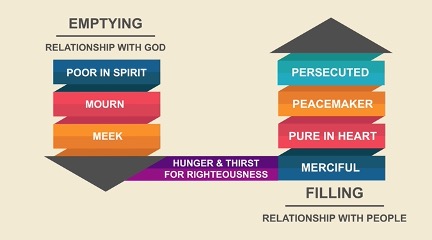
beatitudes-1

Martyn Lloyd-Jones in his commentary states, “Keep showing up at Mat 5:3.”

Blessed are the poor in spirit… To enter into God’s kingdom, we are invited to admit that we have come to the end of ourselves and need God’s help and care.

Blessed are those who mourn… As we are honest about our own sinful tendencies there will be a transforming grief, or repentance, that surfaces – not only for our own lives, but also for the injustice, greed, and suffering that grips our world.

Blessed are the meek…Grieving over sin and suffering places us in a humble learning posture (remember, disciple means learner).

Blessed are those who hunger and thirst for righteousness…Spiritual hunger and thirst is the desire to be empty of those things that don’t reflect God and initiate a deep deep longing for wholeness in our lives. And it’s out of that longing that God supplies His empowering grace to do IN us and THROUGH what we have not been able to do on our own.

Exceeding the righteousness of the scribes and the Pharisees, then, is a matter of seeking to worship, honor, serve, and responsively obey God from a fundamentally changed heart. This is a heart that reaches beyond the legalistic boundaries of the law to allow the Holy Spirit to have complete and total access to our hearts that will fill us afresh with mercy, purity, and peace.

[1] NIV Cultural Backgrounds Study Bible Notes.

[2] ESV Global Study Bible Notes.

[3] Gospel Transformation Study Bible Notes.

[4] Pillar New Testament Commentary.

[5] ESV Global Study Bible Notes.

[6] NIV Cultural Backgrounds Study Bible Notes.

[7] ESV Global Study Bible Notes.

[8] Reformation Study Bible Notes.

Advent Love

From a sermon preached at Calvary Church Pacific Palisades on December 24, 2023.

Merry Christmas! Thank you for joining us this Christmas Eve afternoon. You may not have noticed that we have a short Advent Season this year. Advent is a four-Sunday anticipatory journey leading up to the traditional Christmas Eve (or Day) Service. But this year the fourth Sunday of Advent IS today (Christmas Eve), so we are combining the fourth Sunday of Advent with Christmas Eve and this afternoon we will be considering Advent Love.

There is a very popular and free Bible app called YouVersion that has been downloaded more than 700 million times in the U.S. and around the world. In 2023 the longing for hope is reflected in a list of the top 10 verses that users searched for. The No. 1 verse for the third year running was, “So do not fear, for I am with you; do not be dismayed, for I am your God,” — Isaiah 41:10. Other popular searches included more familiar verses like, “For God so loved the world, that He gave His only begotten Son, that whoever believes in Him shall not perish, but have eternal life.” –John 3:16. And “For I know the plans that I have for you,’ declares the LORD, ‘plans for welfare and not for calamity to give you a future and a hope.’”  –Jeremiah 29:11

This is a verse that had a strong effect on me when I was 20 years old. I had an encounter with God a few months after reading this verse. A friend who became a Jesus follower gave me a used Bible. I took it home and sat it on the dining room table wondering where I should start, so I just opened the book and looked down and Jer 29:11 was highlighted, so I read it and thought, “Well, there’s two things I don’t have yet – a future and a hope. I should probably keep looking into this Christian thing…”

Hope, as most of you know, is a traditional Advent theme and one that we addressed three weeks ago in our Advent series, Good News, Great Joy. We have looked at the Advent themes of HOPE, PEACE, and JOY. By way of reminder, here’s a (very) succinct overview…

Advent HOPE is a life-shaping certainty that our ultimate future is found in the eternal love and glory of God. A holy and practiced HOPE can overwhelm whatever grief we may be experiencing.

Advent PEACE is not merely the absence of conflict or fear but an unshakeable confidence and trust in God’s wise and good control over our lives.

Advent JOY is delight and gladness in God and His salvation for the sheer beauty and worth of who God is. The counterfeit of JOY is mere happiness.

And for the next few minutes, we will be considering Advent Love.

Why these themes?

Because of the incarnation of Jesus, the Christ we now have an awakened HOPE that gives way to an abiding PEACE, which blossoms into a fragrant JOY that causes God’s sacrificial LOVE to flourish.

I have a non-traditional advent verse for us to consider today… “See what great love the Father has lavished on us, that we should be called children of God! And that is what we are!”  –1 John 3:1a (NIV) [notice the exclamation points…] Just a bit of context…John was the sole remaining survivor of the original 12 apostles who had intimate and eyewitness friendships with Jesus — and John is likely between 85-90 years old as he’s writing this letter.

John wrote the Gospel of John, and he also wrote first, second, and third John. The Gospel of John was written that we might believe. The Letters of John were written that we might know – as in having assurance. Assurance that the Christian faith is true. Assurance of our own salvation. Assurance of God’s love for us, which I’d like to focus on today.

I’d like to draw out two aspects of this verse as we consider God’s Advent LOVE…

  1. The FOCUS of God’s great love.
  2. John’s EXPERIENCE of God’s great love.

The FOCUS will be fairly familiar to many of us, but considering John’s EXPERIENCE may offer a fresh perspective for some of us. With that said, here’s the big idea for us to reflect on this Christmas Eve:

There is a difference between knowing ABOUT God and truly KNOWING God.

Let’s look at these two aspects one at a time…

  1. The FOCUS of God’s great love.

The first thing we need to notice in 1 John 3:1a is that “The Father has lavished great love upon us.” [I love that word lavish…]

The Greek word for great in this verse literally means “from what country?” If we were to contemporize the phrase it would mean that this love is “unworldly,” or, out of this world. (used 7x’s throughout the NT). This same word is used in Lk 1:29 when the angel Gabriel appeared to Mary and told her she was “favored, and the Lord was with her.” She was “pondering this ‘unworldly’ salutation.” This word is also used in Mat 8:27 when Jesus spoke and calmed the ragging sea and the disciples looked at each other in the boat and basically said, “Who is this guy?!?”

The Greek word for love in 1 Jn 3:1 is agape. Simply stated, AGAPE LOVE is a sacrificial serving that reaches out to people who don’t deserve it. (“For God so loved the world…”) C. S. Lewis wrote a book entitled The Four Loves in which he unpacks four different Greek words for love. Lewis uses the word charity to describe agape love. Lewis writes that charitable love allows us “to love what is not naturally loveable; lepers, criminals, enemies, morons, the sulky, the superior, and the sneering.”[1]

What does it mean that we are “called children of God”? It’s not just an expression, there is a theological order of salvation. First, there is an outward call that people hear with the ears of faith, which leads to regeneration where God sovereignly imparts spiritual life into the hearers, which leads to conversion where we confess our sin and selfishness and then willingly surrender to the call of God, which then leads to justification where we are instantaneously and legally forgiven of all of our sins, which then leads to our adoption wherein God makes us members of His family. And this adoption includes becoming “partakers of the divine nature” (1 Pet 1:3-4.) And with this gift of divine nature, we then begin the lifelong journey of sanctification (or transformation).

Think of God as Judge and Jury. He declares us “not guilty.” Then He gets up and comes around the bench, takes off His robe, and adopts you into His family. One theologian says that “God gives [us] His own life and love in adoption.”[2]

This is the kind of love you and I are invited into…Advent and celebrating Christmas gives us space to step back and reorient our lives to both receive God’s love as well as to share God’s love.

2. John’s EXPERIENCE of God’s great love.

The old KJV translates this verse as, “Behold, what manner of love the Father hath bestowed upon us, that we should be called the sons [lit children] of God.” Most English translations do not do justice to the Greek rendition. In the NIV translation, at least have the exclamation points at the end of the first two sentences. A literal translation might be: “Look at the sort of love the Father has given us!” [3]

So, what’s happening here? As John is writing about assurance and thinking about what he’s about to write, he gets caught up in worship and adoration. And we, the readers, experience John experiencing God. Grammatically, these verses can be described as parenthetical, meaning they could have been or should have been placed in parenthesis.

This sort of outburst of spontaneous worship and exaltation happens (at least) two other times in the NT. Paul, in writing to the Ephesians in chapter 1:3-14 there is one run-on sentence of 202 words where we readers experience Paul experiencing God. And the same thing happens in Peter’s doxology in 1 Pet 1:3-9. In each instance, we experience each author experiencing God.

Here’s what’s happening…In 1 John 3:1-3, John goes from knowing to beholding. John goes from understanding to standing under – and he’s not just writing about it – he’s demonstrating it to us. It’s like the truth of Scripture becoming radioactive and gushing out of our head and traveling the 18 inches from our head to our heart and then flooding through our soul. Still, another way to think about this is like lightning striking a lightning rod and all of that energy coursing through the rod. Has that happened to you? Have you had an encounter with God where you experienced His love and delight?

This is what I want for every person in this room (or who watches this online). That, by God’s grace and mercy our knowledge ABOUT God would be converted to a personal and experiential knowledge OF God.

Think of a father dropping his son off to college and as the son walks his father to the car, the father stops and grabs his son kisses him, looks him in the eyes, and says: “I love you son and there is NOTHING I wouldn’t do for you to help you become the man that God has called you to be – including die for you.” And the son weeps. Why? It’s not new information. The son already knew his father loved him. But the information becomes new, and he experiences his father’s love in a new and profound way.[4]

When the truth about God, or the truth about our identity as a child of God becomes real to us – it flows out into every other part of our lives.

My longing to understand God’s love and grace exploded into a whole new reality when I realized that Hosea REALLY, REALLY, REALLY loved Gomer.

D.L. Moody a 19th-century American evangelist and pastor was walking up Wall Street in New York City…and amid the bustle and hurry of that city…the power of God fell upon him as he walked…and he had to hurry off to the house of a friend and ask that he might have a room by himself. In that room, he stayed alone for hours [as] the Holy Spirit moved upon him filling his soul with such joy that he had to ask God to withhold His hand, lest he die on the spot from…joy. [5] I want this for you and for me.

As we close and prepare to go on our merry way, I’d like to repeat a verse that I shared earlier. It’s one of the most searched verses from the YouVersion app… “For I know the plans that I have for you,’ declares the LORD, ‘plans for welfare and not for calamity to give you a future and a hope.’”  –Jeremiah 29:11

That’s a pretty encouraging verse, right? And then let’s look at Jeremiah 29:12-13… “Then you will call upon Me and come and pray to Me, and I will listen to you. 13 You will seek Me and find Me when you search for Me with all your heart.”

God has plans for you and me. And He is inviting us to come to Him and pray. Notice that He says that we will find Him (or experience Him) when we search for Him with ALL of our hearts.

It’s not that we need to be all heart all the time. But there is a wholeheartedness that God is looking and waiting for. Have you made your whole heart available to God?

What if your relationship to God is not based on your spiritual resume, but based on the spiritual resume of Jesus, who lived a life of perfect obedience because you and I couldn’t? What if you and I are radically loved because of what Jesus has done? The astonishing and life-changing message of Christmas is that God didn’t just declare his love; he demonstrated it. God didn’t just tell us what love is; He showed it to us, and God is willing and wanting to show up in our lives to reveal Himself and His love to us.

Our cultural symbol for love is a heart because the emphasis is on how we feel. But the Bible’s symbol for love is a cross—a demonstrated and sacrificial agape love that reaches out to people who don’t deserve it. My prayer for you, for me, and for Calvary Church this Christmas is that there would be a refreshed wholeheartedness that would position us for a fresh encounter with the living and loving God.


[1] The CS Lewis Signature Classics, Harper One 2017: 828.

[2] Kyle Strobel. Formed for the Glory of God, IVP 2013: 43.

[3] Colin Kruse. The Letters of John (Pillar New Testament Commentary Series). 1 John 3:1-3.

[4] Adapted from Tim Keller, which is adapted from Thomas Goodwin (1600-1680), an English Puritan theologian and preacher.

[5] R.A. Torrey. Why God Used D.L. Moody, 1923: 51-55.