
Unknown's avatar

About Gregg A Caruso

I have enjoyed the privilege of serving the Church as a co-church planter, pastor of multi-staffed churches, coach, mentor, mission’s executive, trainer, interventionist, diagnostician, and intentional interim pastor. I have served in such varied places as Carson City (NV), Santa Barbara (CA), Oceanside (CA), Boone (IA), London, Amsterdam, Barcelona, the North Shore of O’ahu, the SF Bay Area (CA), Manchester (NH), Temecula (CA), Torrance (CA), Taunton (MA), and Rehoboth (MA). My all-time favorite book on leadership is “Leadership is an Art” by Max DePree. What a great and humbling topic. "Leading Without Power" is also an excellent read. Specialties: Intentional Interim Pastor (IIP) Gospel-centered theological 'reboot' Change management Organizational development Analytics (3 tiers of diagnostics available) Policy-based governance Conflict management and reconciliation

Addressing the Underlying Causes of Conflict – Part 6

Two businessmen having a tug of war

A Biblical Response To Each Dimension (2 of 3)

  1. How To Establish Scriptural Guidelines for Healthy Interaction?
  • Your contract needs to stipulate that you will have enough authority to do your job. Having said that, go in listening and build as much relational authority as you can. Exercising positional authority should be the last resort.
  • Teach, train, and model biblical conflict resolution
  • Lovingly but directly confront gossip and triangulation
  • Move congregants to be willing to own their own issues instead of focusing on the issues of those they are in conflict with (see Matthew 7:5). Conducting a Sacred Assembly is often helpful in turning a corner into a new season of fruitful ministry.

The Role of the Sermon In Conflicted Congregations

In an interim context using old sermons is often not helpful because they may fail to address the root or core issues in a conflicted church. The aim of preaching is to be faithful to the text and prophetic to the context.

  • “And so the resident minor poet of a congregation has to be disciplined to take the time necessary not only to dig for the mystery of a God with us, but also to write the poetic sermon in such a way as to invite the congregation to slow down. There is a reason why churches don’t have drive-through windows. No one grabs the Incarnation on the run.”[1]
  • Expository sermon series’ for churches in conflict:
    • Beatitudes/Sermon on the Mount (helps people begin to own their own issues and refocuses on the KOG)
    • Nehemiah (good and clear change-agent taxonomy that begins with humility, confession, prayer, and planning)
    • 1 John (back to basics Christianity after a church split)
    • Philemon (reconciliation)
    • A series on the “one anothers” can also be quite helpful.

[1] Barnes: 134.

Addressing the Underlying Causes of Conflict – Part 5

Conflict-4

A Biblical Response To Each Dimension (1 of 3)

  1. How To Identify and Address the Root Issue?

When Jesus (through John) addresses the seven churches in Revelation 2-3 the overall pattern is to identify the strengths of the churches and then to identify the sinful patterns:

  • Ephesus: “but this I have against you” (Rev 2:4)
  • Smyrna: “He who has an ear, let him hear what the Spirit says to the churches” (Rev 2:11)
  • Pergamum: “But I have a few things against you” (Rev 2:14)
  • Thyatira: “But I have this against you” (Rev 2:20)
  • Sardis: “Wake up, and strengthen the things that remain” (Rev 3:2)
  • Philadelphia: “He who has an ear, let him hear what the Spirit says to the churches” (Rev 3:13)
  • Laodicea: “Those whom I love, I reprove and discipline; therefore be zealous and repent.” (Rev 3:19)

Catalogue the strengths of a church and then address sins (i.e., conduct a strategic S.W.O.T.). We must identify the core congregational “sins of the fathers” (see Exodus 20:5, 34:7; Numbers 14:18; Nehemiah 1:6). This is particularly true of congregations born out of a split or involved in a prolonged or catastrophic conflict. Churches often face a multi-generational [sin] transmission process that will not be changed by the introduction of “new blood” – either lay or ordained.[1]

The VitalChurch Process

VC-Process

Therefore, it is quite helpful to employ some kind of diagnostic process. Engaging a third party, or as VitalChurch does — bring in a discernment team,  will provide an objective viewpoint as well as help the interim interventionist remain the “good cop.”

  • Our Responsibility: Nehemiah 1:6b – “I and my father’s house have sinned.”
  • Our Objective: 2 Corinthians 5:18 – “Now all these things are from God, who reconciled us to Himself through Christ and gave us the ministry of reconciliation.”
  • Our Standard: Romans 12:18 – “If possible, so far as it depends on you, be at peace with all [people].”

A list of corporate sins one church confessed to in a church-wide Sacred Assembly:

  1. Conflict avoidance
  2. Poor processes and communication
  3. Subtle pressure/perceived pressure and unhealthy loyalty by leaders
  4. Lack of clear grievance procedures
  5. Poor discernment
  6. Lack of training for ministry leaders and participants
  7. Gossip and relational triangulation
  8. Moralism


[1] Friedman: 196.

Addressing the Underlying Causes of Conflict – Part 4

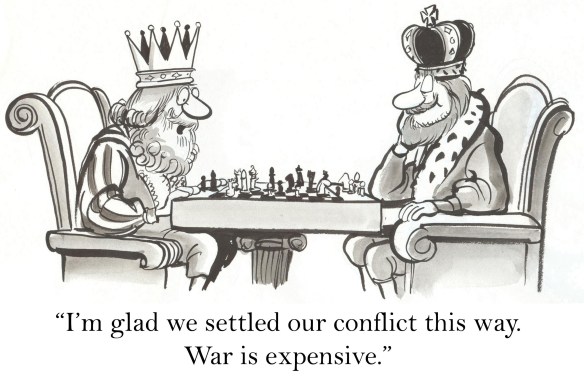
I'm glad we settled our conflict

The Upside of Conflict

The study by Psychometrics Canada, based in Edmonton, Alberta, concludes that conflict can actually benefit an organization when managed properly. The study finds that conflict can be a catalyst for better solutions, major innovations, increased motivation, and other workplace benefits. Specifically, the more than 350 HR professionals across Canada surveyed said conflict can lead to:

  • Better understanding of others (77%)
  • Better solutions to problems and challenges (57%)
  • Higher work-team performance (40%)
  • Increased motivation (31%)
  • Major innovations (21%)

Addressing the Underlying Causes of Conflict – Part 3

Parting-of-Lot-and-Abraham-cropped

THE THREE DIMENSIONS OF CONFLICT

  1. The Perceived Issue

Most of us have heard it said: “The presenting issue is [hardly ever] the real issue.” If that is true what does it mean? As an intentional interim pastor I am called to intervene[1] in the life of a congregation, continually searching for the deeper, truer understandings of what we experience — both in the biblical text and in the sub-text of our congregants’ lives.[2]

Defining conflict…

  • Conflict is when there is a difference, plus tension.
  • Conflict is a dispute between two or more persons over values, goals, processes, and/or facts.
  • Conflict involves uncooperative attitudes and unaccommodating interactions and exchanges.

In a conflicted congregation the goodwill is gone. People can no longer agree to humble, prayerful, and civil dialogue. Poor conflict resolution skills within a congregation are a strong indicator of superficial relationships and struggling marriages. (Keep in mind that like attracts like.)

The Bible indicates that both wisdom and discernment are gifts and ours for the asking. For each there is a caveat that invites our participation (an imperative to the grace indicative). For wisdom the biblical caveat is that it is often found in the context of community – there is wisdom in a multitude of counselors (Pro. 15:22). For discernment the caveat is that it is tied to a growing understanding of biblical truth, which divides between the soulish and the spiritual (Heb. 4:12). With whatever wisdom and discernment are available we must ask God to reveal the “sin beneath the sin,” asking: What is at the root of this current conflict?

  1. Unhealthy Ways People Interact With One Another

We must see, understand, and deal with the unhealthy emotional processes that are at the root of almost every congregational conflict. What we find in the vast majority of N. American and U.K. churches is that emotional health has not been integrated into the discipleship process. As a result there are several unhealthy emotional processes, including: gossip, triangulation[3], resistance to change, compliant behaviors (“yes-man/woman syndrome”), the “sudden” eruption of conflict, the proliferation of “non-issue” issues in conflict (“vitriolic pettiness” defines one congregant I recently had to deal with), unjust projection of blame (usually aimed at the pastor), unwillingness/inability to “own up” to one’s actions, highly reactive and unstable relationships, clergy sexual misconduct, short-term focused, and the inability to build spiritual momentum.

There are (at least) three interlocking emotional systems that fuel congregational conflict:

  • Family of origin issues
  • Nuclear family issues
  • Congregation issues

Unresolved issues in any of these can produce symptoms in the others. This is true for all combatants.[4] Churches, like families, often sweep their issues under the rug. When conflict conflagulates within a congregation it is time to shake the rug.

  1. The Capacity of People To Talk In Non-Distorted and Non-Anxious Ways To Resolve the Root Issue/s

This capacity is called “emotional health” (or EQ/EI). Emotional health is what occurs when our feelings are put under the power of the cross so that they are acknowledged as present (as opposed to denying them), listened to for what they communicate about us, expressed adequately and appropriately to others, and acted upon in ways that are appropriate. They exist, but they don’t dominate our behavior. They are recog­nized and given their rightful place in the course of godly conduct.[5] In too many churches sanctification is only focused on the mind and the will – not the emotions. It’s as if church leaders acknowledge grace for salvation but sanctification is more about gaining knowledge and strengthening the will.

[1] A term coined for the Church by Lyle Schaller. The Interventionist, Abingdon Press 1997.

[2] Adapted from Barnes.

[3] The proliferation of in-direct communication between two principle parties by involving an additional third party to carry the messages between the two principle parties.

[4] Adapted from Friedman: 195.

[5] Miles: 15.5.