
Consider the chart below. Forgiveness, reconciliation, and the restoration of relationships is always the goal. Reconciliation is at the heart of the gospel and is not an option. As believers we have been assigned the ministry of reconciliation:
“All this is from God, who through Christ reconciled us to himself and gave us the ministry of reconciliation.” –2 Cor 5:18
While seeking to be reconciled, move towards forgiving those who have wounded and hurt you. (This is not an option either.) Now, it’s important to understand that forgiveness and restoration are not the same. You may choose to forgive, but the end result of reconciliation that leads to restoration may take more time. Notice the pathway on the chart below…
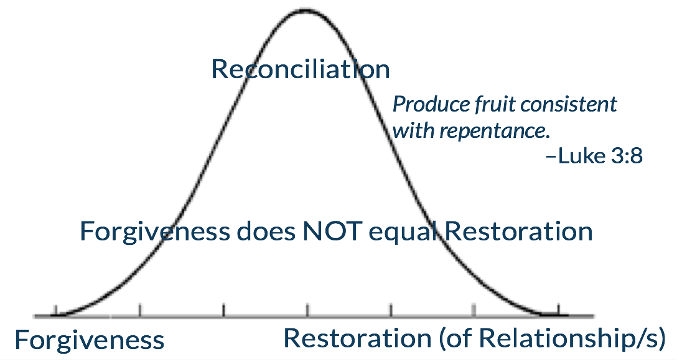
Reconciliation can be a long journey, but it is one that believers are admonished to take. In Mark 11:25, Jesus tells us, “When you stand praying, if you hold anything against anyone, forgive him, so that your Father in heaven may forgive you your sins.” Paul tells us to “Bear with each other and forgive whatever grievances you may have against one another. Forgive as the Lord forgave you” (Col 3:13). To forgive as God forgives us, we must:
a. See others as image bearers of God who are also given to sinful frailty
b. Be willing to bear their debt.
The word “forbearance” is a word that is used mostly in the KJV and can be defined as, “to abstain or hold back; forbearance is akin to patience and self-control.”
Desire the other person’s good (sometimes at personal cost to you). People are not the hurt that they do to us. We are all broken yet God uses broken people to serve His purpose in a broken world.
 Gregg A. Caruso