

A Biblical Response To Each Dimension (1 of 3)
- How To Identify and Address the Root Issue?
When Jesus (through John) addresses the seven churches in Revelation 2-3 the overall pattern is to identify the strengths of the churches and then to identify the sinful patterns:
- Ephesus: “but this I have against you” (Rev 2:4)
- Smyrna: “He who has an ear, let him hear what the Spirit says to the churches” (Rev 2:11)
- Pergamum: “But I have a few things against you” (Rev 2:14)
- Thyatira: “But I have this against you” (Rev 2:20)
- Sardis: “Wake up, and strengthen the things that remain” (Rev 3:2)
- Philadelphia: “He who has an ear, let him hear what the Spirit says to the churches” (Rev 3:13)
- Laodicea: “Those whom I love, I reprove and discipline; therefore be zealous and repent.” (Rev 3:19)
Catalogue the strengths of a church and then address sins (i.e., conduct a strategic S.W.O.T.). We must identify the core congregational “sins of the fathers” (see Exodus 20:5, 34:7; Numbers 14:18; Nehemiah 1:6). This is particularly true of congregations born out of a split or involved in a prolonged or catastrophic conflict. Churches often face a multi-generational [sin] transmission process that will not be changed by the introduction of “new blood” – either lay or ordained.[1]
The VitalChurch Process
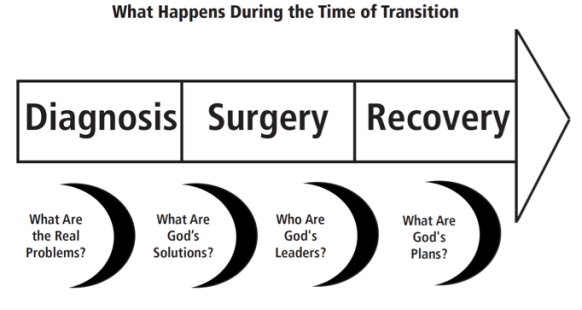
Therefore, it is quite helpful to employ some kind of diagnostic process. Engaging a third party, or as VitalChurch does — bring in a discernment team, will provide an objective viewpoint as well as help the interim interventionist remain the “good cop.”
- Our Responsibility: Nehemiah 1:6b – “I and my father’s house have sinned.”
- Our Objective: 2 Corinthians 5:18 – “Now all these things are from God, who reconciled us to Himself through Christ and gave us the ministry of reconciliation.”
- Our Standard: Romans 12:18 – “If possible, so far as it depends on you, be at peace with all [people].”
A list of corporate sins one church confessed to in a church-wide Sacred Assembly:
- Conflict avoidance
- Poor processes and communication
- Subtle pressure/perceived pressure and unhealthy loyalty by leaders
- Lack of clear grievance procedures
- Poor discernment
- Lack of training for ministry leaders and participants
- Gossip and relational triangulation
- Moralism
[1] Friedman: 196.
 Gregg A. Caruso